Key takeaways
- Peec AI, Promptwatch, Conductor, and BrightEdge all offer AI search visibility tracking, but they differ dramatically in what they do after showing you the data.
- Promptwatch is the only platform in this comparison that closes the full loop: find gaps, generate content, track results -- with crawler logs, Reddit/YouTube insights, and ChatGPT Shopping tracking included.
- Conductor and BrightEdge are strong enterprise SEO platforms that have added AI monitoring, but their roots (and strengths) are still in traditional search.
- Peec AI is a capable monitoring tool, but multiple independent reviews flag it as limited in scope -- no content generation, no crawler logs, no traffic attribution.
- If you're choosing purely for AI visibility optimization (not just tracking), Promptwatch is the clearest choice. If you need a full enterprise SEO suite that also covers AI, Conductor or BrightEdge may fit better.
AI search is no longer a trend worth watching from a distance. BrightEdge's own research data shows AI search visits growing at double-digit rates month over month in 2025, while organic search traffic is under pressure. ChatGPT, Perplexity, Claude, and Google AI Overviews are now meaningful discovery channels for many brands -- and most marketing teams have no idea whether they're visible in them.
That's pushed a wave of new platforms into the market, each promising to solve the "AI visibility" problem. The four platforms in this comparison represent different philosophies about what that actually means: Peec AI (purpose-built AI monitoring), Promptwatch (end-to-end GEO optimization), Conductor (enterprise SEO with AI tracking added), and BrightEdge (legacy enterprise SEO evolving toward AI).
Let's break down what each one actually does, where they fall short, and which makes sense for which team.
What we're comparing
Before diving in, it's worth being precise about what "AI search visibility" means in practice. There are at least three distinct problems:
- Monitoring: knowing when and how your brand appears in AI-generated answers
- Diagnosing: understanding why competitors appear more often than you
- Fixing: creating content and optimizing pages so AI models start citing you
Most platforms solve problem one. Fewer solve problem two. Almost none solve all three. That distinction matters a lot when you're evaluating tools.
Peec AI
Peec AI built early momentum in 2025 as one of the first platforms to track brand presence across multiple LLMs. It covers Google AI Overviews, ChatGPT, Perplexity, and Claude, and offers prompt-level analytics that show how your brand appears in AI-generated summaries.

The platform is genuinely useful for monitoring. Teams that need a simple dashboard showing "are we mentioned in AI answers for these prompts?" will find it functional. It also does competitive benchmarking -- you can see which competitors appear more often than you for a given set of queries.
The limitations are real, though. SE Ranking's independent review of Peec AI alternatives describes it as effective for AI Overviews visibility tracking and content gap identification, but notes that enterprise teams were running into three recurring problems: costs scaling badly for large keyword sets, accuracy inconsistencies across industries, and a lack of features beyond monitoring. Nightwatch's 2026 comparison is blunter, calling Peec AI "basic LLM visibility tracking with limited features and no search engine or prompt research capabilities."
There's no built-in content generation, no crawler log analysis, no traffic attribution, and no Reddit or YouTube tracking. For a team that just wants to monitor, it works. For a team that wants to improve their AI visibility, it leaves you with data but no clear path forward.
Best for: Teams that need basic LLM monitoring and are comfortable doing their own content strategy and optimization work separately.
Promptwatch
Promptwatch takes a different approach. It's built around what the team calls an "action loop": find the gaps, create content that ranks in AI, then track whether it worked.

The gap analysis is genuinely differentiated. The Answer Gap Analysis feature shows you exactly which prompts your competitors appear for that you don't -- not as a vague suggestion, but as specific content topics and questions that AI models are answering from competitor pages. That's useful in a way that raw visibility data isn't.
The built-in AI writing agent then generates articles, listicles, and comparisons grounded in citation data from over 880 million citations analyzed. This isn't generic content -- it's engineered based on what AI models actually cite, which prompts have volume, and what competitors are doing. For teams that want to close the loop between "we're invisible here" and "we published something to fix it," this is the most direct path.
A few other capabilities worth noting:
- AI crawler logs show you which AI bots (ChatGPT, Claude, Perplexity, etc.) are crawling your site, which pages they're reading, and any errors they encounter. Most competitors don't offer this at all.
- Prompt Intelligence includes volume estimates and difficulty scores, so you can prioritize high-value, winnable prompts instead of spreading effort thin.
- Reddit and YouTube tracking surfaces discussions that directly influence AI recommendations -- a channel most platforms ignore.
- ChatGPT Shopping tracking monitors when your brand appears in product recommendation carousels.
- Traffic attribution connects AI visibility to actual revenue via a code snippet, Google Search Console integration, or server log analysis.
Promptwatch monitors 10 AI models: ChatGPT, Perplexity, Google AI Overviews, Google AI Mode, Claude, Gemini, Meta/Llama, DeepSeek, Grok, Mistral, and Copilot. Pricing starts at $99/month for the Essential plan (1 site, 50 prompts, 5 articles), $249/month for Professional (2 sites, 150 prompts, 15 articles, crawler logs), and $579/month for Business (5 sites, 350 prompts, 30 articles). A free trial is available.
In a 2026 comparison of 12 GEO platforms, Promptwatch was the only platform rated as a "Leader" across all categories -- the core reason being that it moves beyond monitoring into actual optimization.
Best for: Marketing and SEO teams that want to improve AI visibility, not just measure it. Agencies managing multiple brands. Any team that wants to connect AI search performance to revenue.
Conductor
Conductor is a mature enterprise SEO platform that has added AI visibility tracking as a significant feature layer. Its evaluation guide for AI visibility platforms (published January 2026) actually ranked itself first overall -- which you should take with appropriate skepticism, but it does reflect that Conductor has invested seriously in this space.
What Conductor does well is integration. If your team is already running traditional SEO workflows in Conductor -- keyword tracking, content optimization, technical audits, reporting -- the AI visibility layer slots in without requiring a separate tool. For enterprise teams that value consolidation and don't want to manage five different platforms, that's a real advantage.
Conductor's AI tracking covers the major models and includes brand mention monitoring, citation tracking, and competitive benchmarking. The platform is built for large organizations with complex approval workflows, multi-team collaboration, and enterprise security requirements.
The honest limitation is that Conductor's AI visibility features are newer and less deep than a purpose-built platform. It doesn't have crawler logs for AI bots, Reddit/YouTube tracking, or the kind of prompt-level intelligence that Promptwatch or even Peec AI offer. Content generation exists but isn't grounded in citation data the way Promptwatch's is. For a team whose primary challenge is AI visibility, Conductor may feel like it's doing everything adequately rather than anything exceptionally.
Pricing is enterprise-tier and not publicly listed -- expect a sales conversation and a contract.
Best for: Large enterprises already invested in Conductor for traditional SEO that want to add AI monitoring without switching platforms. Teams where consolidation and workflow integration matter more than depth of AI-specific features.
BrightEdge
BrightEdge is one of the oldest enterprise SEO platforms in the market, and it's been adapting to the AI search shift with genuine urgency. Its research reports on AI search traffic trends are among the more credible data sources in the industry -- the company has the scale to see meaningful signals.
The platform now includes AI search monitoring alongside its traditional rank tracking, content recommendations, and competitive intelligence. For enterprise teams, BrightEdge's strength is data breadth: it processes enormous volumes of search data and can show you how AI search trends correlate with your traditional SEO performance.
Where BrightEdge falls short in this comparison is the same place Conductor does: the AI visibility features are additions to a traditional SEO platform, not the core product. There's no content generation engine built around AI citation data, no crawler logs for AI bots, and no Reddit/YouTube tracking. The platform also uses fixed prompt sets in some features, which limits flexibility for teams that want to track custom, industry-specific queries.
Like Conductor, pricing is enterprise-only and requires a sales process. BrightEdge is typically one of the more expensive options in the market.
Best for: Enterprise teams with existing BrightEdge contracts that want to add AI search data to their existing reporting. Organizations where traditional SEO and AI search need to be tracked in a single platform for executive reporting.
Side-by-side comparison
| Feature | Peec AI | Promptwatch | Conductor | BrightEdge |
|---|---|---|---|---|
| AI model coverage | ChatGPT, Perplexity, Claude, Google AIO | 10 models incl. DeepSeek, Grok, Mistral | Major models | Major models |
| Prompt-level analytics | Yes | Yes (with volume + difficulty) | Limited | Limited |
| Answer gap analysis | Basic | Yes (competitor-level) | No | No |
| AI content generation | No | Yes (citation-grounded) | Limited | No |
| AI crawler logs | No | Yes | No | No |
| Reddit/YouTube tracking | No | Yes | No | No |
| ChatGPT Shopping tracking | No | Yes | No | No |
| Traffic attribution | No | Yes (GSC, snippet, logs) | Partial | Partial |
| Traditional SEO features | No | No | Yes (full suite) | Yes (full suite) |
| Pricing transparency | Limited | Yes ($99–$579/mo) | Enterprise only | Enterprise only |
| Free trial | Yes | Yes | No | No |
| Best for | Basic monitoring | Full AI visibility optimization | Enterprise SEO + AI monitoring | Enterprise SEO + AI monitoring |
How to choose
The right answer depends on what problem you're actually trying to solve.
If your team's primary goal is to improve how often AI models cite your brand -- and you want tools that help you create the content to make that happen -- Promptwatch is the clearest choice. It's the only platform here that takes you from "we're invisible for this prompt" to "here's the content to fix it" to "here's proof it worked." The pricing is also transparent and accessible without a sales call.
If you're already deep in Conductor or BrightEdge for traditional SEO and you need AI visibility data that integrates with your existing workflows and executive reporting, those platforms make sense. You'll get adequate AI monitoring without adding another vendor. Just don't expect the depth of a purpose-built AI visibility tool.
If you're evaluating Peec AI, the honest question is: what do you plan to do with the data? If the answer is "we'll figure out the content strategy separately," it can work. If you want the platform to help you act on what you find, you'll hit its ceiling quickly.
One thing worth noting: the AI search visibility market is moving fast. Platforms that were monitoring-only in early 2025 are adding features, and the gap between leaders and laggards is narrowing. Whatever you choose, make sure you're evaluating current capabilities, not what a platform's roadmap promises.
Other tools worth knowing
A few other platforms come up regularly in enterprise AI visibility conversations:
Profound is a strong monitoring platform with good entity extraction and attribution mapping, starting at $99/month. It's more focused than Peec AI but still primarily a monitoring tool.
Profound

AthenaHQ covers multi-engine AI visibility well and is popular with competitive intelligence teams, though it lacks content generation and optimization capabilities.

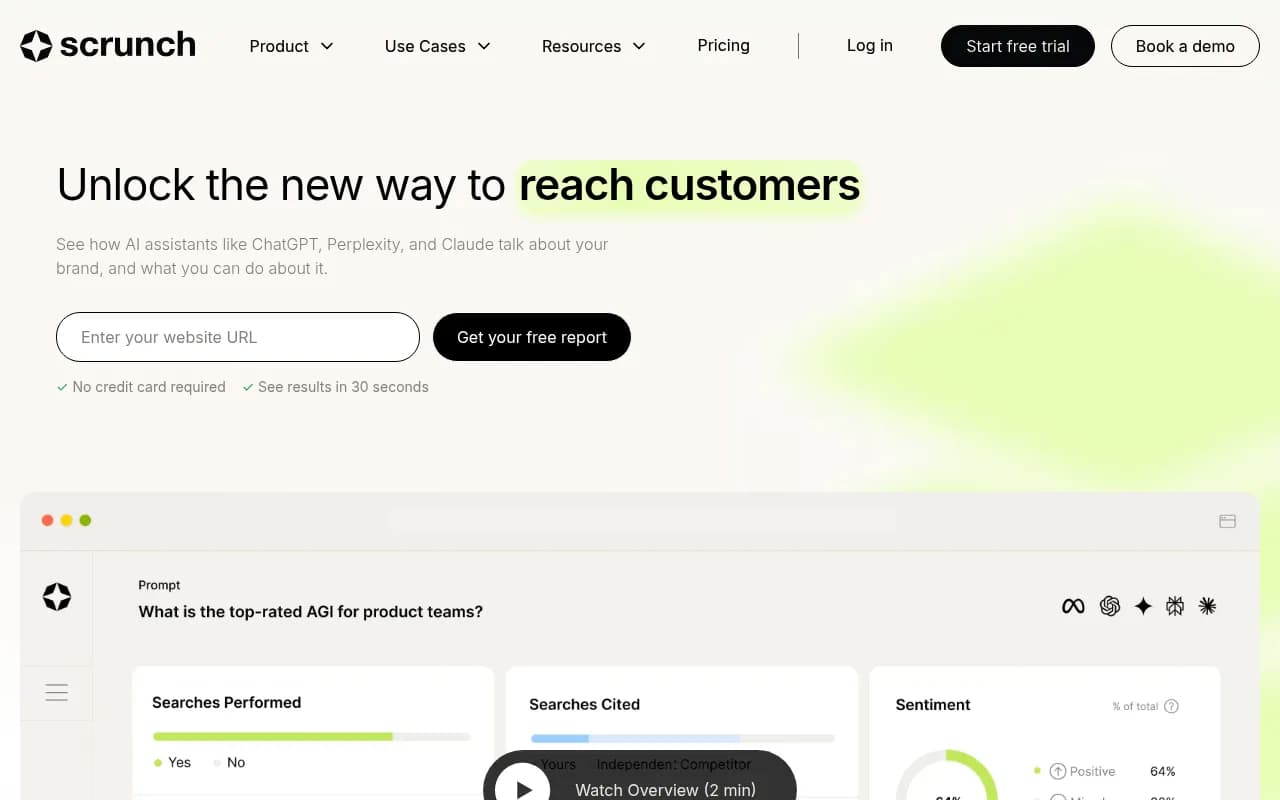
Scrunch AI specializes in brand narrative analysis -- useful if your concern is how AI models describe your brand, not just whether they mention it.
Semrush has added AI visibility features to its broader platform, similar to Conductor and BrightEdge in the "traditional SEO tool adding AI monitoring" category.
The bottom line
The core question in this comparison isn't which platform has the most features -- it's which one matches how your team actually works and what outcome you're trying to drive.
Monitoring your AI visibility without acting on it is just a more expensive way to feel anxious. The platforms that help you close the loop between data and content are the ones worth paying for in 2026.