Key takeaways
- All four platforms track brand visibility across AI search engines like ChatGPT, Perplexity, and Google AI Overviews -- but they differ sharply in what they do with that data.
- Peec AI and Profound are strong monitoring tools; Promptwatch and Searchable go further with built-in content generation.
- Promptwatch is the only platform in this comparison rated as a "Leader" across all GEO categories, with crawler logs, Reddit/YouTube tracking, and a full content optimization loop.
- Profound targets enterprise teams with deep analytics but comes at a significantly higher price point.
- If your goal is to close the gap between "knowing you have a visibility problem" and "actually fixing it," Promptwatch is the clearest choice.
There's a version of this problem that every marketing team is running into right now. You buy an AI visibility tool, you get a dashboard, you see that your brand shows up in 22% of relevant ChatGPT responses while your competitor shows up in 61%. And then... you stare at the screen.
The data is real. The gap is real. But the tool has done its job and left you to figure out the rest.
That's the core tension in the AI visibility space in 2026: monitoring is table stakes, but most platforms stop there. This comparison looks at four tools that represent different philosophies on what an AI visibility platform should actually do -- Peec AI, Promptwatch, Profound, and Searchable -- and tries to answer a simple question: which one helps you close the gap?
What we're actually comparing
Before getting into specifics, it's worth being clear about what "closing the gap" means. There are really two gaps:
The first is the visibility gap -- the difference between how often your brand appears in AI responses versus how often it should. Every tool here measures this.
The second is the action gap -- the distance between knowing you have a problem and knowing what to do about it. This is where platforms diverge dramatically.
A tool that only measures the first gap is useful. A tool that addresses both is transformative.
The four platforms
Peec AI
Peec AI is a Berlin-based AI search analytics platform built around monitoring. It tracks brand mentions across ChatGPT, Perplexity, Google AI, and a handful of other models using UI scraping -- meaning it interacts with AI models the way a real user would, capturing authentic response data rather than API outputs.
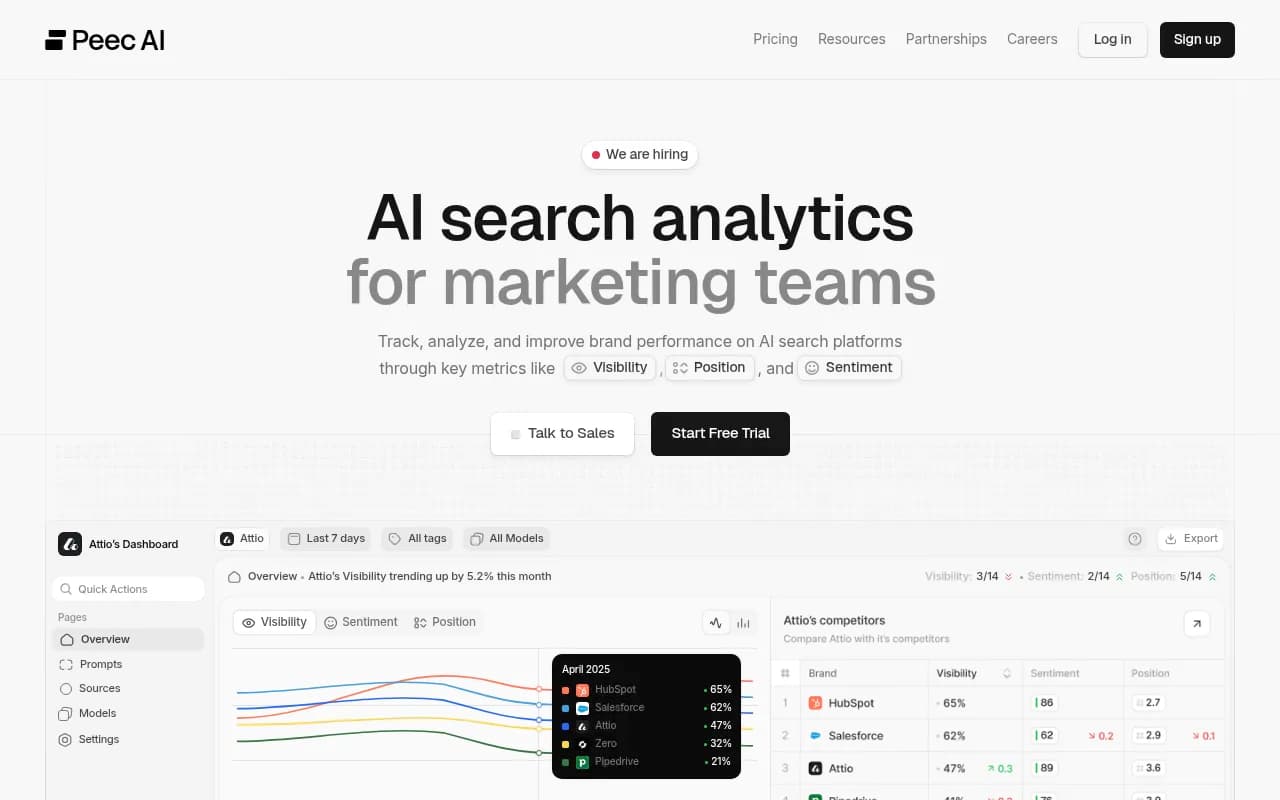
The platform's standout feature is its "Actions" tab, which turns visibility data into a prioritized to-do list. This is genuinely useful -- it bridges the gap between seeing a problem and knowing what to address first. Peec AI also does well on multi-language accuracy and regional benchmarking, which matters if you're tracking visibility across markets.
Where it falls short: the Actions feature tells you what to work on, but not how. There's no built-in content generation, no crawler logs, no Reddit or YouTube source analysis. It's a monitoring tool with a smart prioritization layer on top. For teams that already have strong content operations and just need direction, that's enough. For teams that need the whole workflow, it's not.
Pricing starts at $95/month. G2 rating sits at 5.0/5, though the review count is relatively small.
Promptwatch
Promptwatch is an Amsterdam-based platform built around what it calls the "action loop": find gaps, create content, track results. It monitors 10+ AI models including ChatGPT, Claude, Gemini, Perplexity, Grok, DeepSeek, Copilot, Mistral, Meta AI, and Google AI Overviews.

The key differentiator is that Promptwatch doesn't stop at showing you where you're invisible. Its Answer Gap Analysis identifies the specific prompts where competitors appear but you don't -- and then the built-in AI writing agent generates content designed to get cited by those models. That content is grounded in 880M+ real citations, not generic SEO templates.
Other features that matter: real-time AI crawler logs (which pages ChatGPT, Claude, and Perplexity are actually reading, and what errors they hit), Reddit and YouTube source tracking (since AI models frequently cite these), ChatGPT Shopping monitoring, prompt volume and difficulty scoring, and query fan-outs that show how a single prompt branches into sub-queries.
In a 2026 comparison of 12 GEO platforms, Promptwatch was the only one rated as a "Leader" across all categories. Most competitors were rated as monitoring-only dashboards.
Pricing: Essential at $99/month (1 site, 50 prompts, 5 articles), Professional at $249/month (2 sites, 150 prompts, 15 articles, crawler logs), Business at $579/month. Free trial available.
Profound
Profound is the enterprise play in this comparison. It tracks brand mentions across 9+ AI engines and goes deep on analytics -- sentiment analysis, source attribution, competitive benchmarking, share-of-voice tracking across models. For large brands with complex monitoring needs and dedicated analyst teams, it's genuinely impressive.
Profound
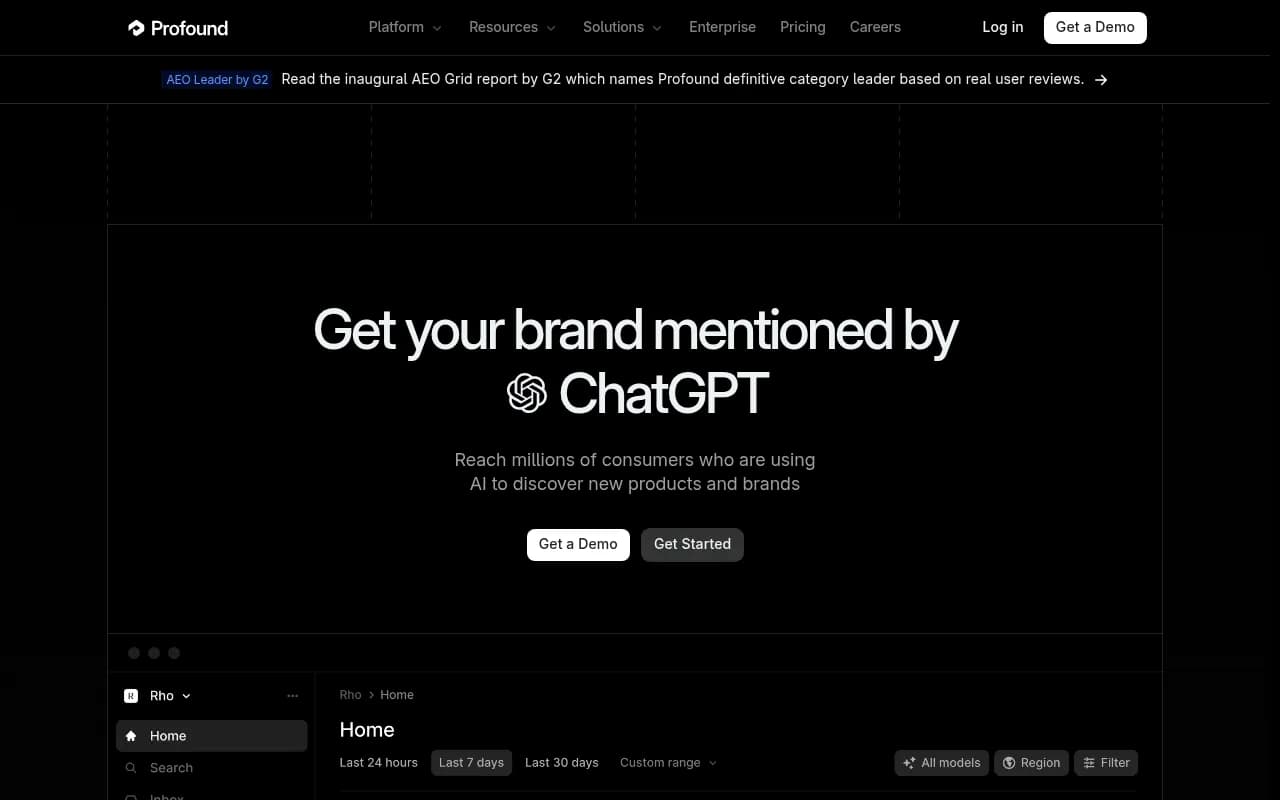
The tradeoff is price and scope. Profound is positioned for enterprise budgets, which puts it out of reach for most mid-market teams. And while its analytics are thorough, it's primarily a monitoring and reporting platform. There's no built-in content generation, no crawler logs, and no Reddit/YouTube tracking. You get excellent data; you still need to figure out what to do with it.
For pure monitoring breadth, Profound is close to Promptwatch's coverage -- but at a higher price point and without the optimization layer. Teams that need to report AI visibility to executives will find Profound's dashboards compelling. Teams that need to actually improve their visibility will find themselves needing additional tools.
Searchable
Searchable is the fourth platform in this comparison and the least well-documented of the group. It offers AI search visibility tracking with built-in content generation, which puts it in the same category as Promptwatch rather than the monitoring-only camp.
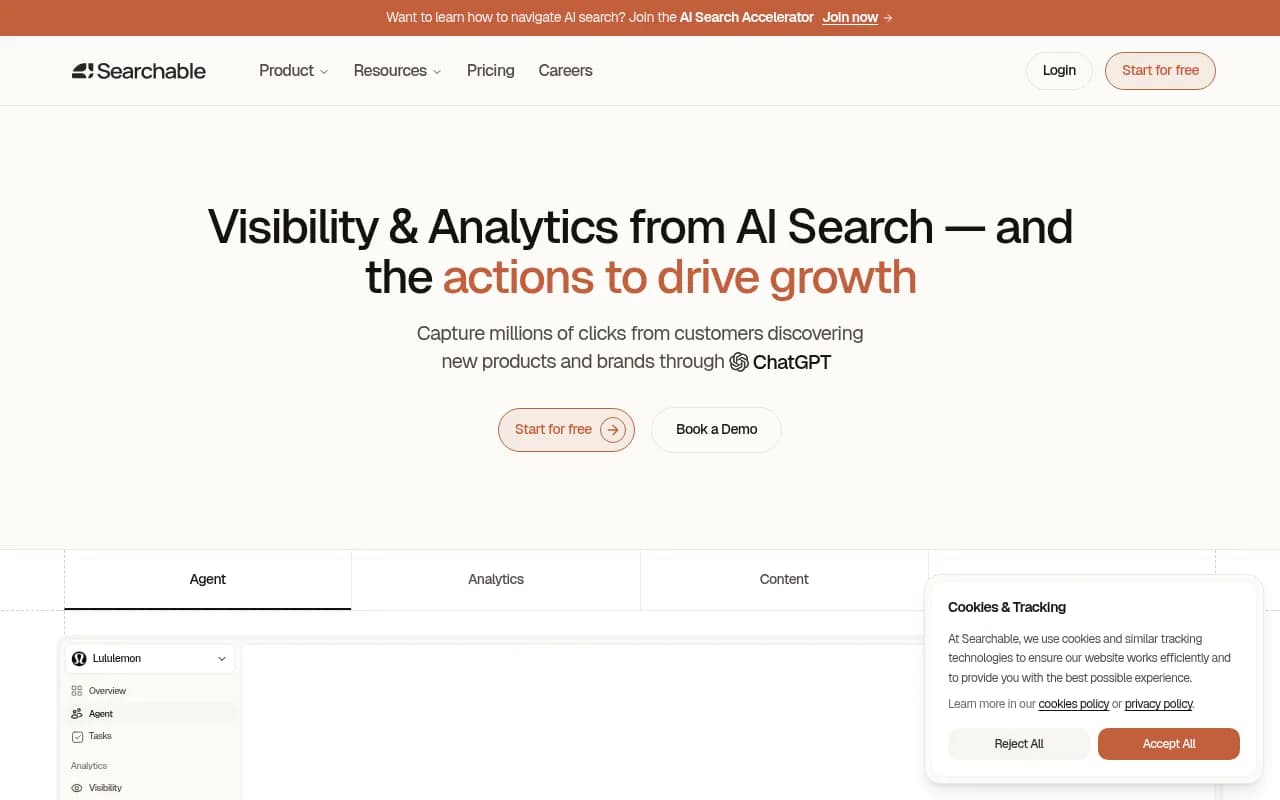
Based on available information, Searchable covers the major AI engines and provides content creation capabilities alongside its tracking. However, it lacks several features that matter for serious GEO work: no crawler logs, no Reddit/YouTube source analysis, no ChatGPT Shopping tracking, and less depth on prompt intelligence (volume estimates, difficulty scoring, query fan-outs).
It's worth evaluating if you're looking for a simpler, potentially lower-cost entry point into the monitoring-plus-content space. But for teams that need the full picture -- including understanding why AI models are or aren't citing you -- the feature gaps are real.
Feature comparison
| Feature | Peec AI | Promptwatch | Profound | Searchable |
|---|---|---|---|---|
| AI models tracked | ChatGPT, Perplexity, Google AI | 10+ (ChatGPT, Claude, Gemini, Perplexity, Grok, DeepSeek, Copilot, Mistral, Meta AI, AI Overviews) | 9+ | Major engines |
| Starting price | $95/mo | $99/mo | Enterprise pricing | Not publicly listed |
| Free trial | Yes (7 days) | Yes (7 days) | Limited | Varies |
| Content generation | No | Yes (AI writing agent) | No | Yes |
| Answer gap analysis | Partial (Actions tab) | Yes (full gap analysis) | No | Limited |
| AI crawler logs | No | Yes (real-time) | No | No |
| Reddit/YouTube tracking | No | Yes | No | No |
| ChatGPT Shopping tracking | No | Yes | No | No |
| Prompt volume/difficulty | No | Yes | No | No |
| Multi-language/region | Yes (strong) | Yes | Yes | Limited |
| Best for | Mid-market monitoring | Full optimization | Enterprise reporting | Entry-level optimization |
The action gap in practice
Here's a concrete example of how these platforms diverge. Say you're a SaaS company and you discover that when someone asks ChatGPT "what's the best project management tool for remote teams," your brand doesn't appear but three competitors do.
With Peec AI, you'd see this gap and get a prioritized action item. But you'd need to go figure out what content to create, where to publish it, and how to structure it to get cited.
With Profound, you'd get detailed analytics on which sources those competitors are being cited from, how sentiment compares, and how your share-of-voice has trended. Still no guidance on what to actually write.
With Promptwatch, you'd see the gap, get a breakdown of what content is missing from your site (the specific topics and angles AI models want to answer that prompt), and then use the built-in writing agent to generate an article engineered to get cited -- grounded in the actual citation patterns from 880M+ data points. Then you'd track whether that article starts getting cited, and see the crawler logs to confirm AI models are actually reading it.
With Searchable, you'd get some version of the content generation workflow, but without the crawler logs or Reddit/YouTube analysis to understand the full picture of why you're not being cited.
The difference isn't subtle. It's the difference between a diagnostic tool and a treatment plan.
Who should use what
Choose Peec AI if: You have a strong in-house content team that just needs direction on what to prioritize. The Actions feature is genuinely useful for teams that can execute independently. Also worth considering if multi-language accuracy is a primary concern.
Choose Promptwatch if: You want to actually improve your AI visibility, not just measure it. The full action loop -- gap analysis, content generation, crawler logs, traffic attribution -- makes it the most complete platform in this comparison. Particularly strong for marketing teams and agencies that need to show results, not just reports.
Choose Profound if: You're an enterprise brand with a dedicated analytics team and executive reporting requirements. The depth of monitoring and competitive benchmarking is excellent. Budget for it accordingly.
Choose Searchable if: You're earlier in your GEO journey and want a simpler entry point into the monitoring-plus-content space. Understand the feature gaps before committing.
The monitoring-only trap
One thing worth naming directly: there's a real risk in buying a monitoring tool and thinking you've solved your AI visibility problem. You haven't. You've bought a thermometer, not a treatment.
The platforms that only show you data -- even excellent, well-organized data -- leave you with the hardest part of the job still to do. And in a space where AI search is moving as fast as it is in 2026, the time between "knowing you have a gap" and "closing that gap" matters enormously.
The tools that have built the full workflow (find gaps, create content, track results) are the ones that will actually move your visibility scores. That's the category Promptwatch is in, and it's the category that will matter most for teams measured on outcomes rather than reports.
A note on what to track
Regardless of which platform you choose, the metrics worth tracking are:
- Visibility percentage by prompt category (not a single overall score -- segment by funnel stage)
- Position within AI responses (first mention vs. tenth is not equivalent)
- Sentiment in AI descriptions of your brand (especially for evaluation-stage prompts)
- Source attribution -- which pages, Reddit threads, or YouTube videos are being cited when AI talks about your category
- Traffic from LLMs -- actual clicks and conversions, not just mentions
Most platforms in this comparison handle the first two reasonably well. Fewer handle the last three. That's where the real differentiation lives.
Bottom line
The AI visibility space has matured enough in 2026 that "we track your brand across ChatGPT and Perplexity" is no longer a differentiator. Every serious platform does that now.
The question is what happens after the tracking. Peec AI gives you a prioritized list. Profound gives you deep analytics. Searchable gives you some content generation. Promptwatch gives you the whole loop -- from identifying the exact prompts where you're losing to competitors, to generating the content that fills those gaps, to confirming that AI crawlers are reading it and your visibility scores are improving.
For teams that need to close the gap between data and results, that's the meaningful distinction.