Key takeaways
- Peec AI is a solid entry-level tracker but lacks content generation and crawler log access, making it a poor fit for enterprise teams.
- Evertune has impressive consumer panel data (25M users) and is well-suited for Fortune 500 brand perception work, but comes at a premium price.
- Relixir positions itself as an end-to-end GEO engine with content automation, though it's newer and less battle-tested at scale.
- Promptwatch is the only platform in this comparison rated as a "Leader" across all GEO categories, combining monitoring, content gap analysis, AI writing, crawler logs, and traffic attribution in one loop.
The GEO platform market has gotten crowded fast. In 2024, most brands had never heard of "AI visibility." Now there are dozens of tools claiming to solve it, and the differences between them actually matter.
This comparison focuses on four platforms that come up most often in enterprise shortlists: Peec AI, Promptwatch, Relixir, and Evertune. They're not the same product. They have meaningfully different philosophies, feature sets, and price points. Here's how they actually stack up.
What we're comparing and why it matters
Before getting into the platforms, it's worth being clear about what "GEO platform" even means in 2026.
At the basic end, a GEO tool monitors AI responses and tells you whether your brand got mentioned. That's table stakes. The harder and more valuable problem is figuring out why you're not being mentioned, and then doing something about it.
Most platforms stop at step one. The ones worth paying for go further.
The four criteria that matter most for enterprise buyers:
- AI engine coverage (how many models, how fresh)
- Depth of insight (prompt volumes, citation sources, competitor gaps)
- Content optimization (can the tool help you fix what's broken)
- Enterprise readiness (security, integrations, multi-site, traffic attribution)
The platforms at a glance
| Platform | Best for | Monitoring | Content generation | Crawler logs | Starting price |
|---|---|---|---|---|---|
| Peec AI | Small/mid-market teams | Good | No | No | ~$99/mo |
| Promptwatch | Marketing teams & agencies wanting full GEO loop | Excellent (10 models) | Yes (built-in AI writer) | Yes | $99/mo |
| Relixir | Enterprise brands wanting end-to-end GEO automation | Good | Yes | Limited | Custom |
| Evertune | Fortune 500 brand perception & consumer research | Excellent | No | No | Custom (high) |
Peec AI
Peec AI tracks brand visibility across ChatGPT, Perplexity, Claude, and Google AI Overviews. It's one of the more accessible entry points into GEO monitoring, and for smaller marketing teams without big budgets, it does a reasonable job.

What Peec does well: prompt-level analytics, visibility tracking, and surfacing which content is missing or underrepresented. The interface is clean and the learning curve is low. If you're a solo marketer or a small team just getting started with GEO, it's a workable starting point.
Where it falls short: there's no content generation, no crawler log access, and the enterprise analytics are limited. A review from Vizii's GEO tool roundup specifically called out that Peec is "less deep for enterprise analytics." SE Ranking's analysis of Peec alternatives noted that while it tracked Google AI Overview visibility and prompt-level data reasonably well, teams quickly outgrow it when they need to actually act on what they find.
The core limitation is that Peec is a monitoring dashboard. It shows you the problem but doesn't help you fix it. For a team that just wants to check a box on AI visibility reporting, that might be enough. For a team that wants to actually improve their AI search presence, it's not.
Evertune
Evertune takes a different approach to the market. Rather than focusing purely on prompt-level tracking, it combines direct API access to base LLMs with EverPanel, a demographically weighted panel of 25 million users. This lets it measure both what AI models "know" about your brand at a training level and how real consumers experience AI-generated answers.

The AI Brand Index, which scores brands on a 0-100 scale weighted by mention frequency and position, is genuinely useful for executive reporting. The Consumer Preferences module, which tests brands against dozens of buyer preference topics, is the kind of insight that traditional GEO trackers don't offer.
Evertune has raised $19M in funding and was founded by early Trade Desk team members. It's clearly built for enterprise. The platform analyzes over 1 million AI responses monthly per brand, which is a meaningful data volume.
The catch: Evertune is a measurement and insights platform, not an optimization platform. It tells you a lot about where you stand and why, but it doesn't generate content to close the gap. For a Fortune 500 brand with a large content team that just needs better intelligence, that's fine. For a mid-market brand that needs both the insight and the fix, you'll need to pair it with something else.
Pricing is custom and, based on the enterprise positioning, likely starts well above the other platforms in this comparison.
Relixir
Relixir positions itself as an end-to-end GEO engine built specifically for enterprise brands. It combines AI search monitoring with content automation, aiming to close the loop between "you're invisible" and "here's content that will fix it."
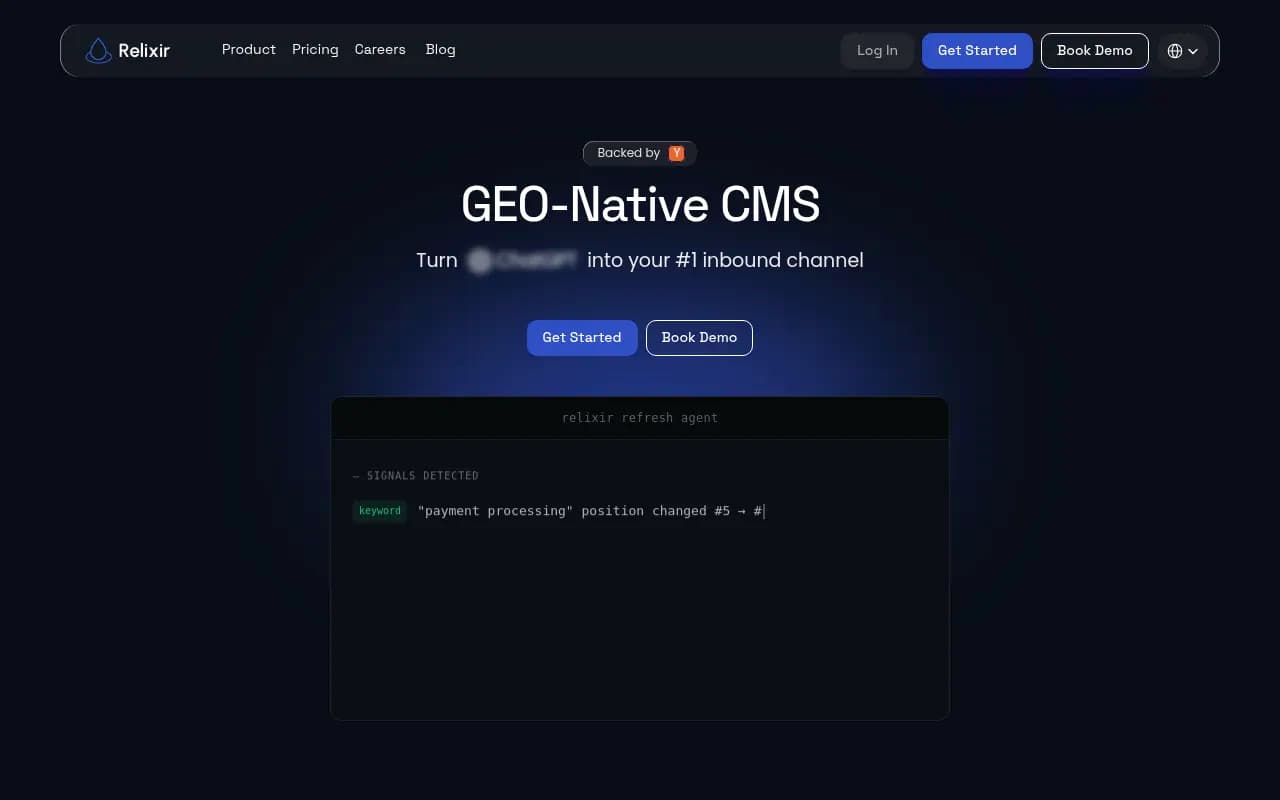
The pitch is compelling. GEO isn't just a tracking problem; it's a content problem. Relixir seems to understand that. The platform targets enterprise brands that want the full workflow handled in one place.
The honest caveat: Relixir is newer to the market than the other platforms in this comparison. There's less independent data on how well the content automation actually performs at scale, and the enterprise track record is still being established. Pricing is custom, which makes it harder to evaluate ROI without a sales conversation.
If you're an enterprise brand evaluating Relixir, the right questions to ask are: how many AI models does it monitor, what does the content generation workflow actually look like, and can it attribute AI visibility to real traffic and revenue?
Promptwatch
Promptwatch is the platform that most directly addresses the full GEO problem: find the gaps, create content to fill them, and track whether it worked.

The monitoring layer covers 10 AI models (ChatGPT, Perplexity, Claude, Gemini, Grok, DeepSeek, Copilot, Meta AI, Google AI Overviews, and Google AI Mode) with over 1.1 billion citations, clicks, and prompts processed. That's not a marketing number; it's the data foundation that makes the rest of the platform work.
What separates Promptwatch from the other three platforms in this comparison is the action loop:
Answer Gap Analysis shows you the specific prompts where competitors are being cited but you're not. Not just "you're invisible for X topic" but the exact questions, the exact content gaps, and the exact competitors winning those positions.
AI content generation uses that citation data to produce articles, listicles, and comparisons engineered to get cited by AI models. This isn't generic content; it's built around what the models actually cite, at what prompt volumes, and for which personas.
Traffic attribution closes the loop. A code snippet, Google Search Console integration, or server log analysis connects AI visibility improvements to actual traffic and revenue. Most GEO platforms have no answer when you ask "did this work?"
The crawler log feature is worth calling out specifically because it's rare. Promptwatch logs real-time visits from AI crawlers (ChatGPT, Claude, Perplexity, etc.), showing which pages they read, which errors they hit, and how often they return. This is the kind of technical visibility that enterprise SEO teams are used to having for Google but have been flying blind on for AI engines.
Pricing starts at $99/month for the Essential plan (1 site, 50 prompts, 5 articles), $249/month for Professional (2 sites, 150 prompts, 15 articles, crawler logs), and $579/month for Business (5 sites, 350 prompts, 30 articles). Agency and enterprise pricing is custom. A free trial is available.
In a 2026 comparison of 12 GEO platforms, Promptwatch was the only one rated as a "Leader" across all categories. That's a meaningful distinction in a market where most tools do one thing reasonably well.
Head-to-head: the features that actually matter
| Feature | Peec AI | Promptwatch | Relixir | Evertune |
|---|---|---|---|---|
| AI models monitored | 4-5 | 10 | Varies | Multiple (API-direct) |
| Prompt volume data | Basic | Yes (with difficulty scores) | Limited | No |
| Answer gap analysis | Partial | Yes | Yes | No |
| Content generation | No | Yes (AI writer) | Yes | No |
| AI crawler logs | No | Yes | Limited | No |
| Traffic attribution | No | Yes (3 methods) | Unknown | No |
| Reddit/YouTube tracking | No | Yes | No | No |
| ChatGPT Shopping tracking | No | Yes | No | No |
| Consumer panel data | No | No | No | Yes (25M users) |
| Multi-language/region | Limited | Yes | Limited | Yes |
| Enterprise security | Basic | Yes | Yes | Yes |
| Free trial | Yes | Yes | No | No |
| Starting price | ~$99/mo | $99/mo | Custom | Custom (high) |
Who should use what
Choose Peec AI if you're a small team with a limited budget that just needs basic AI visibility reporting. It's a reasonable starting point, but plan to outgrow it.
Choose Evertune if you're a large brand (think Fortune 500) that needs deep consumer perception data and brand-level AI intelligence, and you have a separate content team to act on the insights. The 25M-user panel is genuinely differentiated.
Choose Relixir if you're an enterprise brand specifically looking for an end-to-end GEO automation platform and are willing to evaluate it carefully given its relative newness in the market.
Choose Promptwatch if you want to actually improve your AI search visibility, not just measure it. The combination of gap analysis, content generation, crawler logs, and traffic attribution makes it the most complete platform in this comparison. It's also the only one with transparent, accessible pricing that doesn't require a sales call to get started.
The question most buyers don't ask
Most GEO platform evaluations focus on the monitoring features: how many models, how fresh the data, how good the dashboards. Those things matter, but they're not the right primary question.
The right question is: after I see the data, what happens next?
If the answer is "you export a report and figure it out yourself," that's a monitoring tool. If the answer is "the platform shows you what to create, helps you create it, and then tracks whether it worked," that's an optimization platform.
Only two platforms in this comparison have a real answer to that question: Promptwatch and Relixir. Of those two, Promptwatch has the longer track record, the more transparent pricing, and the broader feature set (crawler logs, Reddit/YouTube tracking, ChatGPT Shopping, traffic attribution) that enterprise teams actually need.
The GEO market will keep maturing. More platforms will add content generation. More will add attribution. But right now, in 2026, the gap between monitoring-only tools and full optimization platforms is still wide enough to matter a lot for your results.