Key takeaways
- Most AI visibility platforms are monitoring dashboards -- they show you where you're invisible but don't help you fix it. Only a few (Promptwatch, Scrunch, AthenaHQ to a degree) include content optimization or generation tools.
- Profound is the strongest pure-analytics option for enterprise teams that need deep data and can act on it independently.
- Promptwatch is the only platform rated "Leader" across all categories in 2026 comparisons, largely because it closes the loop from gap detection to content creation to result tracking.
- Otterly.AI and Peec AI are solid monitoring tools for teams that want clean dashboards without complexity -- but you'll need separate tools to actually improve your visibility.
- AthenaHQ positions itself as action-oriented but leans heavily on autonomous agents rather than human-led content workflows.
- Scrunch sits in an interesting middle ground: monitoring plus content generation, but at a higher price point than most mid-market teams need.
The AI search visibility space has gone from "interesting niche" to genuinely crowded in about 18 months. Every week there's a new tool claiming to track your brand across ChatGPT, Perplexity, Gemini, and the rest. Most of them are fine. Some are genuinely impressive. A few are monitoring dashboards dressed up as optimization platforms.
This comparison cuts through the noise. We looked at six of the most-discussed platforms in 2026 -- Profound, Promptwatch, Otterly.AI, Peec AI, AthenaHQ, and Scrunch -- and compared them honestly across the dimensions that actually matter: what they track, how deep the analytics go, whether they help you improve (not just observe), and what you'll pay.
What these platforms actually do
Before the comparison table, it's worth being clear about what "AI visibility" means in practice. When someone types a question into ChatGPT, Perplexity, or Google's AI Mode, the model generates an answer and often cites sources. Whether your brand appears in that answer -- and how positively -- is your AI visibility.
These platforms help you:
- Track which prompts your brand appears in (and which it doesn't)
- See which competitors are getting cited instead of you
- Understand which pages on your site AI models are reading
- Figure out what content you need to create to close the gaps
The critical split in this market is between platforms that stop at step three and those that help you execute step four. That's the real differentiator.
The platforms at a glance
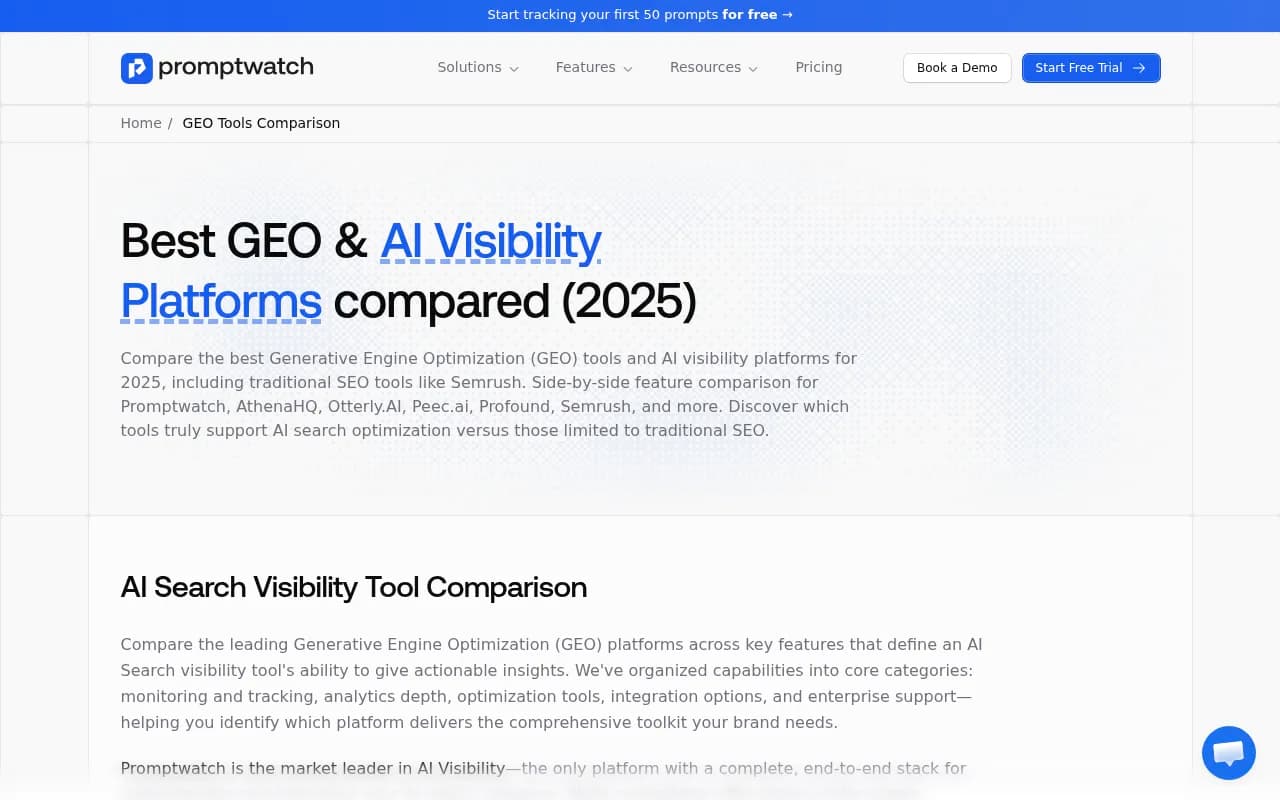
Promptwatch
Promptwatch is a Dutch platform (Promptwatch B.V.) used by 1,480+ brands and agencies including Booking.com and Center Parcs. It monitors 10 AI models -- ChatGPT, Perplexity, Claude, Gemini, Google AI Overviews, Google AI Mode, Meta/Llama, DeepSeek, Grok, Mistral, and Copilot -- and covers the full workflow from gap detection to content generation to result tracking.
The core differentiator is what Promptwatch calls the action loop: Answer Gap Analysis shows you which prompts competitors rank for but you don't, Content Agents generate articles and briefs grounded in real prompt data, and page-level tracking shows when new content gets crawled and cited. It also has AI Crawler Logs (real-time logs of GPTBot, ClaudeBot, PerplexityBot hitting your pages), ChatGPT Shopping tracking, Reddit and YouTube citation analysis, and query fan-outs that show how one prompt branches into sub-queries.
Pricing: Essential $99/mo, Professional $249/mo, Business $579/mo. Free trial available.

Profound
Profound is the enterprise-grade option. It covers 9 AI engines including Meta AI and DeepSeek, has strong crawler log functionality, and its analytics depth is genuinely impressive -- particularly for competitive benchmarking and prompt history. It's the tool that enterprise SEO teams tend to reach for when they need to present AI visibility data to a CMO.
The trade-off is price. At $499/month as the entry point (per third-party comparisons), it's positioned firmly at the enterprise end. Teams that need the data but don't have dedicated analysts to act on it may find themselves paying for insights they can't fully use. It also lacks Reddit tracking and ChatGPT Shopping monitoring.
Profound

Otterly.AI
Otterly.AI has positioned itself as a multi-engine monitoring platform with strong citation analysis and, notably, an MCP server integration that lets AI-native teams query brand data without leaving their workflow. That's a genuinely useful feature for developer-led teams.
The platform covers the core monitoring pillars well -- prompt tracking, citation analysis, multi-engine coverage, competitor benchmarking. Its crawler logs are in beta. Where it falls short is on the optimization side: there's no content generation, no content gap analysis that produces actionable briefs, and no traffic attribution connecting AI visibility to revenue.
Otterly.AI

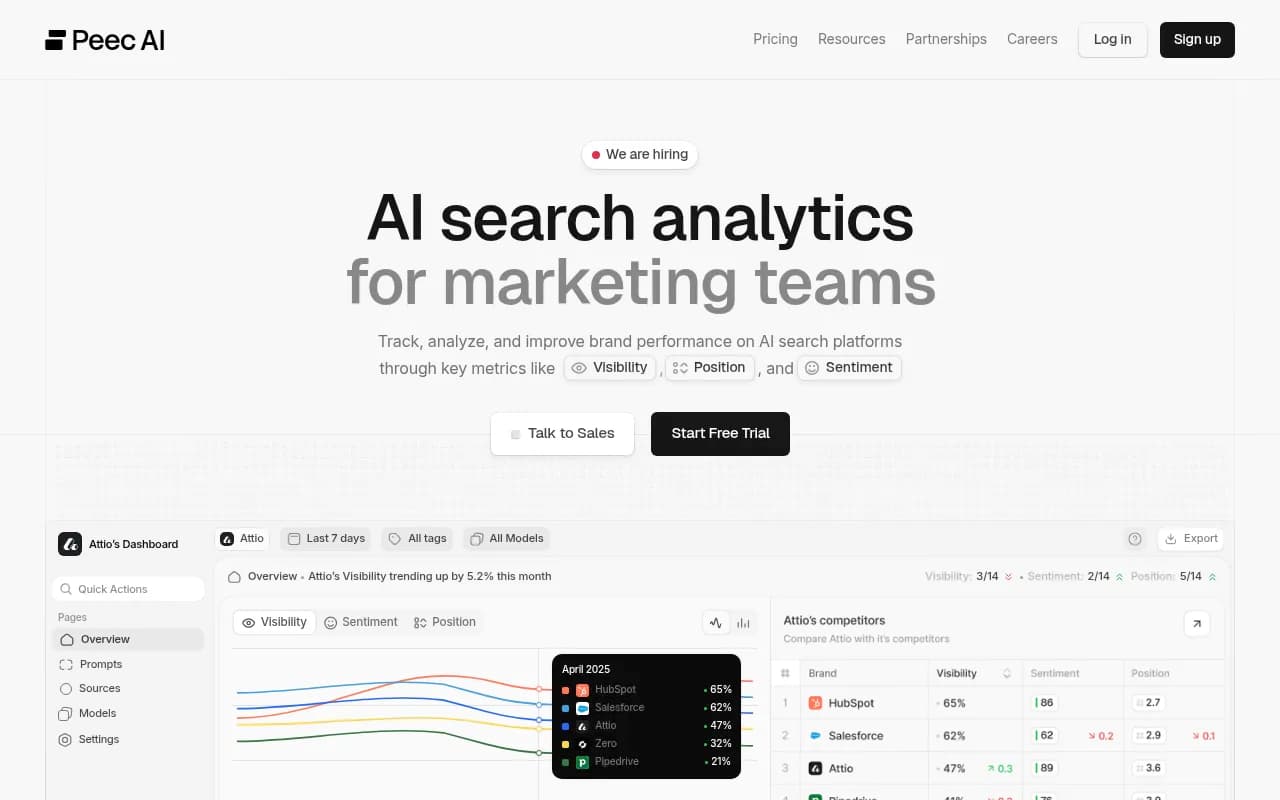
Peec AI
Peec AI is a clean, focused monitoring tool. It tracks prompts, citations, and competitors across multiple engines, and the interface is generally praised for being easy to use. For teams that want to get up and running quickly without a steep learning curve, it's a reasonable choice.
The limitations are real, though. According to AthenaHQ's own comparison, Peec AI covers only three core AI platforms (versus eight or more for the leading tools), has limited API access, and has no built-in path from data to action. No crawler logs, no content generation, no traffic attribution.
AthenaHQ
AthenaHQ covers 8+ LLMs and has built its pitch around being "action-oriented" rather than just a monitoring dashboard. Its Athena Citation Engine (ACE) is an autonomous agent that identifies content gaps, drafts optimizations, and executes multi-step workflows. It also has native Shopify and Google Analytics integrations for revenue attribution.
That autonomous agent approach is interesting but also the source of some friction -- teams that want to control their content output rather than delegate it to an AI agent may find the workflow less intuitive. It's also missing Reddit tracking and ChatGPT Shopping, and the pricing isn't publicly listed (enterprise sales motion).

Scrunch
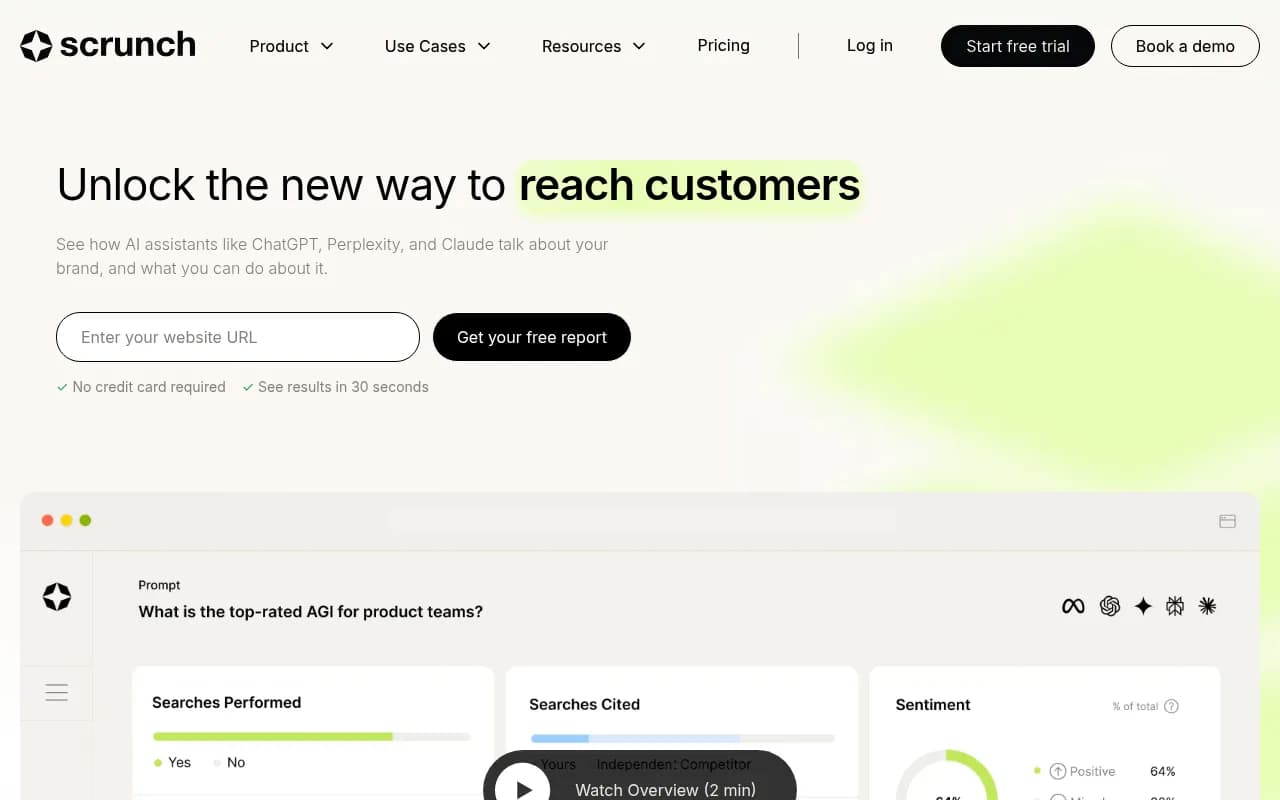
Scrunch sits in the middle of the market: it has monitoring, citation analysis, competitor benchmarking, crawler logs, and visitor analytics, plus some content generation capability. It's one of the more complete feature sets in the challenger tier.
The issue is that "some content generation" isn't the same as a full content workflow. Scrunch generates content but doesn't have the same depth of prompt intelligence (volume estimates, difficulty scores, query fan-outs) that Promptwatch uses to prioritize what to create. Price-wise, it's also positioned above mid-market tools without quite matching enterprise-tier analytics depth.
Feature comparison table
| Feature | Promptwatch | Profound | Otterly.AI | Peec AI | AthenaHQ | Scrunch |
|---|---|---|---|---|---|---|
| AI engines covered | 10+ | 9 | Multi | 3 core | 8+ | Multi |
| Prompt tracking | Yes | Yes | Yes | Yes | Yes | Yes |
| Citation tracking | Yes | Yes | Yes | Yes | Yes | Yes |
| Competitor monitoring | Yes | Yes | Yes | Yes | Yes | Yes |
| Crawler logs | Higher plans | Yes | Beta | No | No | Yes |
| Visitor / traffic analytics | Limited | Yes | Limited | No | Yes (via GA) | Yes |
| Content gap analysis | Yes (deep) | Partial | Yes | No | Yes | No |
| Content generation | Yes (AI agents) | No | No | No | Yes (ACE agent) | Limited |
| Reddit / YouTube tracking | Yes | No | No | No | No | No |
| ChatGPT Shopping tracking | Yes | No | No | No | No | No |
| Prompt volume / difficulty | Yes | No | No | No | No | No |
| Query fan-outs | Yes | No | No | No | No | No |
| Revenue attribution | Yes | Partial | No | No | Yes (Shopify/GA) | No |
| MCP integration | No | No | Yes | No | No | No |
| API access | Yes | Yes | Yes | Limited | Yes | Yes |
| Starting price | $99/mo | ~$499/mo | Custom | Lower tier | Custom | Custom |
| Free trial | Yes | No | No | Yes | No | No |
Analytics and optimization depth
This is where the platforms diverge most sharply.
Profound and Promptwatch have the deepest analytics. Profound's strength is historical data and enterprise-grade reporting. Promptwatch's strength is connecting that data to action -- prompt volumes tell you which gaps are worth closing, difficulty scores tell you which ones are winnable, and query fan-outs show you how a single prompt expands into a cluster of related questions your content should answer.
Otterly.AI has strong citation and engine-comparison analytics, and the MCP server is a genuine differentiator for technical teams. But there's no content workflow on the other side of the data.
AthenaHQ's autonomous agent approach means it can execute optimizations without human intervention, which sounds appealing but can feel like a black box. Teams that want to understand and control what's being published may prefer Promptwatch's Content Agents, which generate briefs and articles that humans review before publishing.
Peec AI and Scrunch are lighter on the analytics depth side. Peec AI is essentially a clean monitoring dashboard. Scrunch has more features but the analytics don't go as deep as Profound or Promptwatch.
Who each platform is actually for
The honest answer is that the right tool depends on what you're trying to do after you see the data.
If you want to monitor and act on it yourself, Profound gives you the richest data set. You'll need your own content team to execute on the insights, but the data quality is there.
If you want a full workflow from gap to content to tracking, Promptwatch is the only platform that genuinely closes that loop. The combination of Answer Gap Analysis, Content Agents, and page-level citation tracking means you can go from "we're invisible for this prompt cluster" to "we published content, it got crawled, and our visibility score improved" -- all in one platform.
If you want clean monitoring without complexity, Otterly.AI is a solid choice, especially if your team is developer-adjacent and would use the MCP integration. Peec AI is the simpler option if you just need basic prompt and citation tracking.
If you want autonomous AI-driven optimization, AthenaHQ's ACE agent is the most developed version of that approach. Just be clear about what the agent is publishing on your behalf.
If you're an agency managing multiple clients, Scrunch's feature set covers most bases, though the pricing model and lack of deep prompt intelligence may be limiting at scale.
Pricing reality check
Pricing in this space is all over the place, and several platforms (AthenaHQ, Scrunch, Profound) don't publish transparent pricing -- you have to go through a sales conversation.
Promptwatch is the most transparent: $99/month gets you one site and 50 prompts, $249/month adds crawler logs and 150 prompts, $579/month covers five sites and 350 prompts. That's a real number you can put in a budget.
Profound's entry point is around $499/month based on third-party comparisons -- reasonable for enterprise, steep for a mid-market team testing the waters.
Peec AI is generally positioned as the most affordable option in this group, which makes it attractive for smaller teams, but the feature ceiling is low.
The value question isn't just "what does it cost" but "what does it cost relative to the content and traffic it helps you generate." A platform that helps you identify and close three high-value prompt gaps per month is worth more than one that shows you 50 gaps and leaves you to figure out the rest.
The monitoring-only problem
It's worth naming this directly. Most of the platforms in this comparison -- and most of the 20+ tools in the broader GEO space -- are monitoring dashboards. They show you data. They tell you where you're invisible. They don't help you become visible.
That's not a criticism exactly. Monitoring is genuinely useful. But if your team doesn't have the bandwidth to turn visibility data into content strategy and then into published, optimized articles, you'll end up with a dashboard full of insights and no improvement in your actual AI search presence.
The platforms that have moved beyond monitoring -- Promptwatch with its Content Agents, AthenaHQ with ACE -- are solving a harder problem. The question is which approach fits your team's workflow.
Verdict
There's no single "best" platform here because the right choice depends on your team size, budget, and how much of the content workflow you want handled in-platform.
That said, the clearest recommendation for most marketing and SEO teams in 2026 is Promptwatch. It's the only platform that covers monitoring, gap analysis, content generation, crawler logs, and result tracking in one place, at a price point that doesn't require an enterprise budget to access. The free trial means you can verify that before committing.
For enterprise teams with dedicated analysts who want the deepest possible data, Profound is worth the price. For developer-led teams that want clean monitoring with API access and MCP integration, Otterly.AI is a strong choice. For teams that want the simplest possible setup, Peec AI gets you started quickly -- just know you'll hit the ceiling.
The platforms that are hardest to recommend without a sales call are AthenaHQ and Scrunch -- not because they're bad, but because the pricing opacity makes it difficult to evaluate value without going through their sales process first.
Whatever you choose, the most important thing is picking a platform that connects visibility data to content action. Knowing you're invisible isn't enough. You need a path to fixing it.