Key takeaways
- All five tools (Surfer SEO, Clearscope, Frase, MarketMuse, NeuronWriter) were designed for Google SEO and still do that well — but none were built specifically to optimize for AI citation rates in ChatGPT, Perplexity, or Gemini.
- Frase comes closest to AI-search readiness among the five, with its Content-to-Citation workflow and SERP-grounded brief generation.
- Clearscope's letter-grade scoring and clean editor make it the easiest for writers to adopt at scale; MarketMuse goes deepest on topical authority modeling.
- NeuronWriter is the most affordable option with solid semantic SEO features, making it a strong pick for budget-conscious teams.
- If AI citation tracking and GEO optimization are a priority, you'll need a dedicated platform alongside any of these tools — something like Promptwatch that tracks actual citations across AI models and helps you close the gaps.
The question used to be simple: does my content rank on Google? In 2026, that's only half the job. A growing share of search traffic now flows through AI-generated answers — ChatGPT, Perplexity, Google AI Overviews, Gemini. Users get a synthesized response with a handful of cited sources. If your content isn't one of those sources, you're invisible to that user, regardless of where you rank on page one.
That shift is putting pressure on content optimization tools that were built entirely around Google's ranking signals. Surfer SEO, Clearscope, Frase, MarketMuse, and NeuronWriter are all mature, capable platforms. But they were designed for a world where the goal was a blue link on a SERP, not a citation inside an AI answer. So how do they hold up in 2026? And which one gives you the best shot at actually getting cited?
Let's go through each one honestly, then compare them head-to-head.
Surfer SEO
Surfer is the most feature-complete of the five for traditional SEO workflows. Its Content Editor scores your draft against live SERP data using NLP term analysis, giving you a numeric score (roughly 0-100) based on keyword usage, structure, and content length relative to top-ranking pages. The SERP Analyzer and Topical Maps make it genuinely useful for planning content at scale, not just optimizing individual pieces.
For agencies and SEO-led teams, Surfer's workflow is hard to beat. Auto Optimize, Coverage Booster, and Surfy (its AI assistant) handle a lot of the mechanical optimization work. Keyword clustering and topical planning features mean you can use it as a content strategy hub, not just an editor.
The limitation in 2026 is that Surfer's scoring model is built around Google's ranking signals. It tells you whether your content covers the right NLP terms and structure to compete in the SERP — it doesn't tell you whether your content is structured to be cited by an AI model. Those are related but different problems. AI models tend to favor content that directly answers specific questions, uses clear entity definitions, and cites authoritative sources. Surfer doesn't optimize for any of that explicitly.
Pricing starts at $49/month, which makes it one of the more accessible options for smaller teams.
Clearscope
Clearscope takes a different approach to the same core problem. Instead of a numeric score, it uses a letter grade (A++ to F) based on how well your content covers semantically related terms compared to top-ranking pages. The editor is noticeably cleaner than Surfer's — less data-heavy, more writer-friendly — which is why it tends to win in editorial environments where writer adoption matters.

The AI Tracked Topics feature is worth noting here. It monitors how AI search engines are treating specific topics over time, which gives Clearscope at least some awareness of the AI search layer. It's not a full GEO platform, but it's a meaningful step toward acknowledging that Google isn't the only audience anymore.
Clearscope's weakness is price. It starts at $129/month and scales up quickly for enterprise tiers. For teams that just need a solid content editor with good semantic coverage, that's a lot. But for enterprise editorial operations where the bottleneck is writer consistency and governance, it's often worth it.
Frase
Frase is the tool in this group that has moved most deliberately toward AI search readiness. Its core workflow — research, brief, write, optimize — is grounded in SERP analysis, but the Content-to-Citation workflow is specifically designed to help content get cited in AI-generated answers. That's a meaningful differentiator.
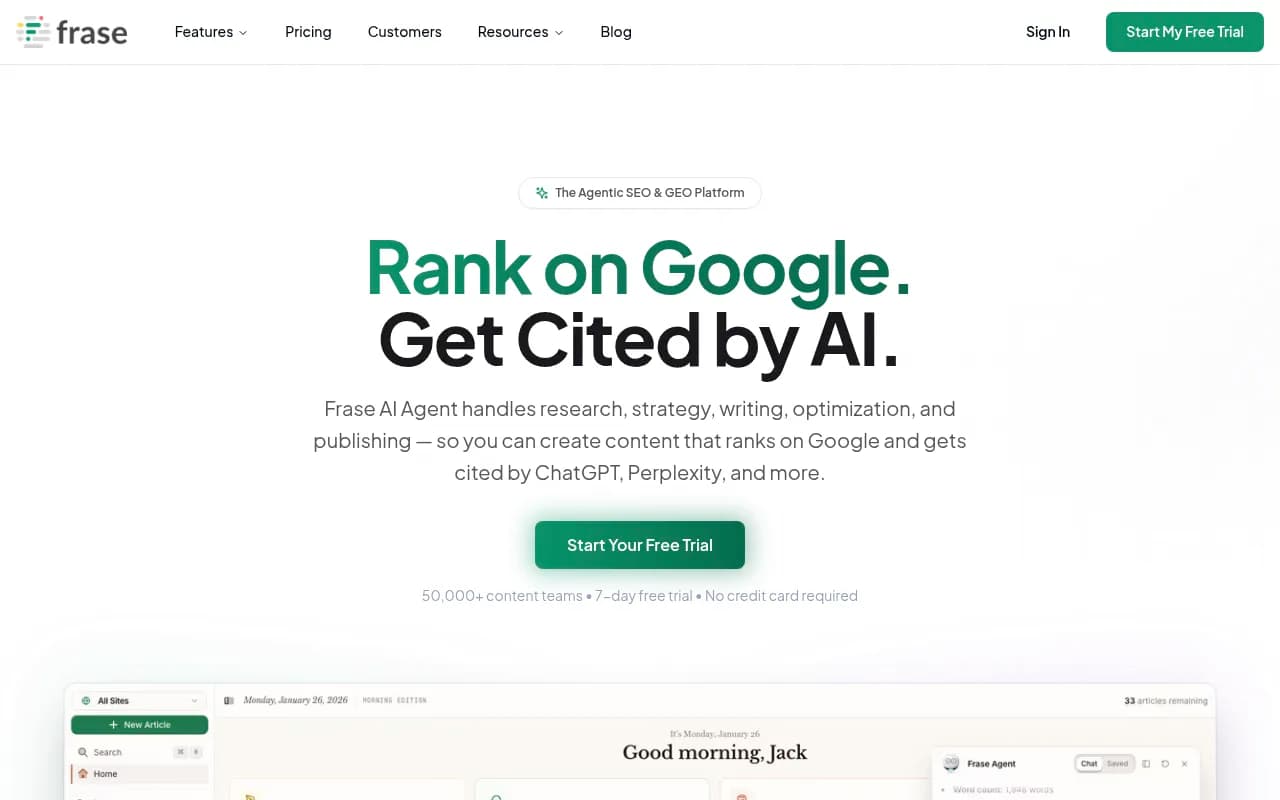
The brief generation is genuinely strong. Frase pulls questions from People Also Ask, Reddit, Quora, and competitor content, then structures them into a brief that maps directly to what users are actually asking. That kind of question-first structure is exactly what AI models tend to cite — they're looking for content that directly answers a specific query, not content that's generally comprehensive.
Frase also has an AI writer built in, though it's more of a drafting assistant than a full content generation engine. The optimization scoring is less granular than Surfer's, but for teams focused on AI search readiness, the question coverage and brief quality matter more than the NLP term count anyway.
Pricing is competitive, starting around $45/month for the basic plan. It's probably the best value in this group if AI citation rates are your primary concern.
MarketMuse
MarketMuse plays a different game than the other four. Where Surfer and Clearscope focus on optimizing individual pieces of content, MarketMuse is built around topical authority — the idea that ranking (and getting cited) depends not just on one good article but on how comprehensively your site covers a topic cluster.
Its Content Score and Topic Authority metrics model how well your site covers a subject relative to competitors. The Content Briefs are detailed and research-heavy, pulling in related questions, competitive gaps, and internal linking opportunities. For enterprise content teams building out large topic clusters, this depth is genuinely useful.
The catch is cost. MarketMuse's pricing is significantly higher than the others in this group — it's positioned as an enterprise platform, and the pricing reflects that. For smaller teams or individual bloggers, it's hard to justify. For large content operations trying to build real topical authority, it's one of the few tools that actually models that problem well.
From an AI citation standpoint, MarketMuse's topical authority model is indirectly useful. AI models do tend to cite sources that have established authority on a topic, not just individual well-optimized pages. Building deep topic coverage is a legitimate AI visibility strategy, even if MarketMuse doesn't frame it that way explicitly.
NeuronWriter
NeuronWriter is the budget-friendly option in this comparison, and it's more capable than its price suggests. The semantic SEO features are solid — NLP term recommendations, competitor analysis, content scoring — and the interface has improved significantly over the past year.
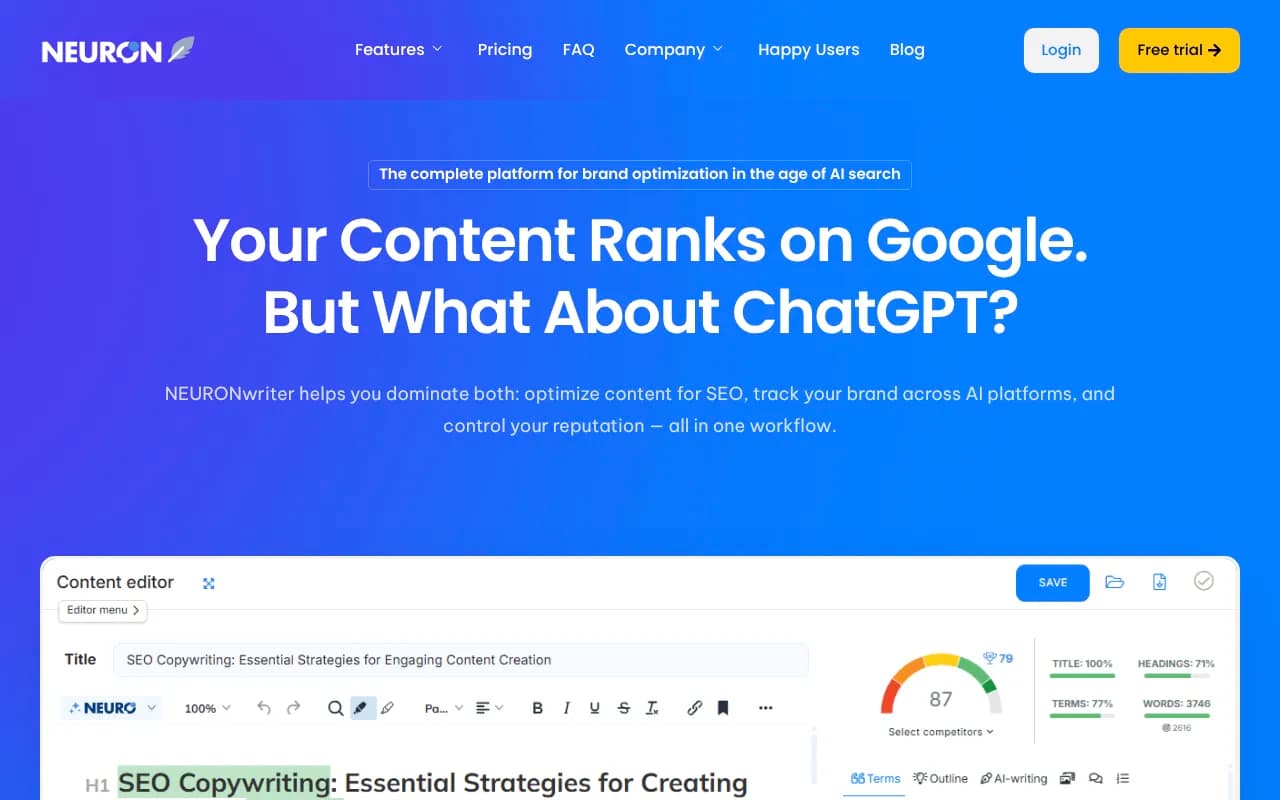
What NeuronWriter does well is give smaller teams and individual creators access to the same kind of semantic optimization that larger teams get from Surfer or Clearscope, at a fraction of the cost. The content editor is functional, the scoring is reliable, and the AI writing features handle basic drafting tasks.
Where it falls short is depth. The topical planning features aren't as developed as Surfer's or MarketMuse's. The AI search readiness features are minimal. And the brief generation isn't as structured as Frase's for question-first content. But if your budget is limited and you need solid on-page semantic optimization, NeuronWriter is a legitimate choice.
Head-to-head comparison
| Feature | Surfer SEO | Clearscope | Frase | MarketMuse | NeuronWriter |
|---|---|---|---|---|---|
| Scoring model | Numeric (0-100) | Letter grade (A++ to F) | Coverage + question gaps | Topic Authority + Content Score | Numeric NLP score |
| Editor UX | Data-heavy, prescriptive | Clean, writer-friendly | Research-first | Brief-heavy | Functional, improving |
| AI writing | Yes (Surfy, Auto Optimize) | Limited | Yes (drafting assistant) | Limited | Yes (basic) |
| SERP analysis | Strong (SERP Analyzer) | Moderate | Strong | Strong | Moderate |
| Topical planning | Yes (Topical Maps) | Content Inventory | Moderate | Deep (core feature) | Limited |
| Brief generation | Yes | Yes | Strong (question-first) | Very detailed | Basic |
| AI search readiness | Low | Moderate (AI Tracked Topics) | Moderate-High | Moderate (indirect) | Low |
| Starting price | $49/mo | $129/mo | ~$45/mo | Enterprise pricing | ~$19/mo |
| Best for | SEO agencies, large teams | Enterprise editorial | AI-search-aware content | Enterprise topical authority | Budget-conscious teams |
The gap none of them fully close
Here's the honest assessment: all five tools are good at what they were built for. They'll help you write content that ranks better on Google. Some of them, especially Frase and Clearscope, are starting to acknowledge the AI search layer. But none of them track whether your content is actually being cited by ChatGPT, Perplexity, or Gemini. None of them show you which prompts your competitors are appearing in that you're not. None of them have crawler logs showing when AI agents visit your pages.
That's a separate problem that requires a separate tool. If you're serious about AI search visibility — not just traditional SEO — you need something that monitors actual AI model behavior, not just Google SERP signals.
Promptwatch is built specifically for that layer. It tracks citations across 10 AI models, shows you which prompts your competitors rank for that you don't, and has Content Agents that generate content specifically designed to close those gaps. It's not a replacement for the tools above — it's what you run alongside them to understand and improve your AI search presence.

The workflow that makes sense in 2026 looks something like this: use one of the five tools above to optimize your content for Google, then use a GEO platform to track whether that content is getting cited in AI answers and identify where you're missing. The two problems are related but distinct, and they need different tools.
Which tool should you pick?
The right answer depends on what your actual bottleneck is.
If you're running an agency or SEO-led team and need a full content workspace with planning, audits, and AI assistance, Surfer SEO is the most complete option. The entry price is reasonable and the feature set is mature.
If you're running an enterprise editorial operation where writer adoption and governance matter, Clearscope's clean interface and letter-grade scoring make it easier to get a whole team aligned. The AI Tracked Topics feature is a bonus.
If AI citation rates are a specific priority and you want your content structured to answer questions the way AI models expect, Frase is the strongest choice in this group. The question-first brief generation and Content-to-Citation workflow are genuinely differentiated.
If you're building out a large topic cluster and need deep topical authority modeling, MarketMuse is the most sophisticated option — but budget accordingly.
If you're a solo creator or small team on a tight budget, NeuronWriter gives you solid semantic SEO at a price that won't break the project.
And if you want to actually know whether any of it is working in AI search — which prompts you're appearing in, which citations you're getting, where your competitors are beating you — that's where a dedicated GEO platform comes in.
The content optimization tools above are still worth using. But in 2026, they're one part of the picture, not the whole thing.