Key takeaways
- Zapier is the safest default for non-technical marketing teams: biggest app library, easiest setup, most reliable execution -- but you pay for that convenience.
- Make (formerly Integromat) hits the sweet spot for power users who want visual, complex workflows without writing code and at a lower cost per operation than Zapier.
- n8n is the right call if your team has a developer, you want full data ownership, or you need to self-host for compliance reasons. The free self-hosted tier is genuinely useful.
- Relay.app is the only tool here built around human-in-the-loop automation -- worth a look if your workflows need approvals, reviews, or manual steps baked in.
- Bardeen is browser-native and built for scraping and enrichment tasks, making it a niche but powerful pick for sales and SEO research workflows.
Picking a workflow automation tool in 2026 is harder than it looks. The category has matured, every tool now claims AI capabilities, and the pricing models are wildly different. A Zapier plan that costs $600/month might do the same job as an n8n self-hosted instance that costs $20/month in server fees -- or it might not, depending on your team.
This guide is specifically for marketing and SEO teams. Not developers building internal tools, not ops teams managing enterprise infrastructure. If you're trying to automate lead enrichment, content publishing, rank tracking alerts, CRM updates, or reporting workflows, this is for you.
Let's get into it.
The five tools at a glance
Before going deep, here's a quick orientation:
Zapier
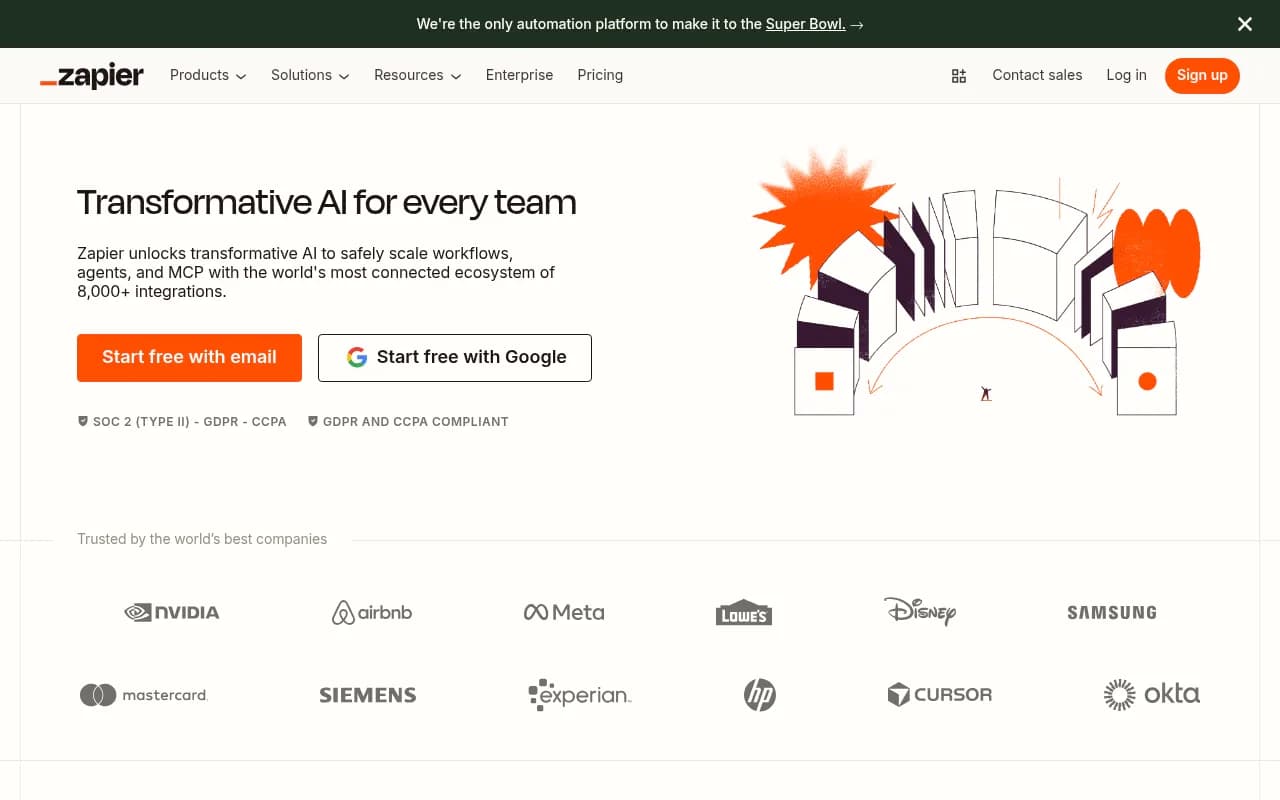
Zapier is the category leader by almost every measure: largest app library (7,000+ integrations), most polished UI, and the gentlest learning curve. If you've never built an automation before, you can have something working in under 20 minutes.
The core model is "Zaps" -- trigger-action pairs. Something happens in App A, Zapier does something in App B. Multi-step Zaps let you chain actions, and the newer "Tables" and "Interfaces" features mean you can build lightweight databases and forms without leaving Zapier.
For marketing teams, Zapier's strength is breadth. Every SaaS tool your team uses almost certainly has a Zapier integration. HubSpot, Salesforce, Slack, Google Sheets, Notion, Ahrefs webhooks, SEMrush exports -- it's all there.
The weakness is cost. Zapier charges per task (each action in a Zap counts as a task), and if you're running high-volume workflows, the bill climbs fast. The free plan is limited to 100 tasks/month, which is basically a trial. The Starter plan at $19.99/month gives you 750 tasks, and most real marketing workflows will push you into the $49-$69/month range quickly.
The other limitation is flexibility. Zapier is intentionally simple, which means complex branching logic, loops, or custom code feels awkward. You can do it, but you're fighting the tool.
Best for: Marketing teams that want automation to "just work" without a technical team member involved. Reliability and breadth over cost and flexibility.
Make (formerly Integromat)
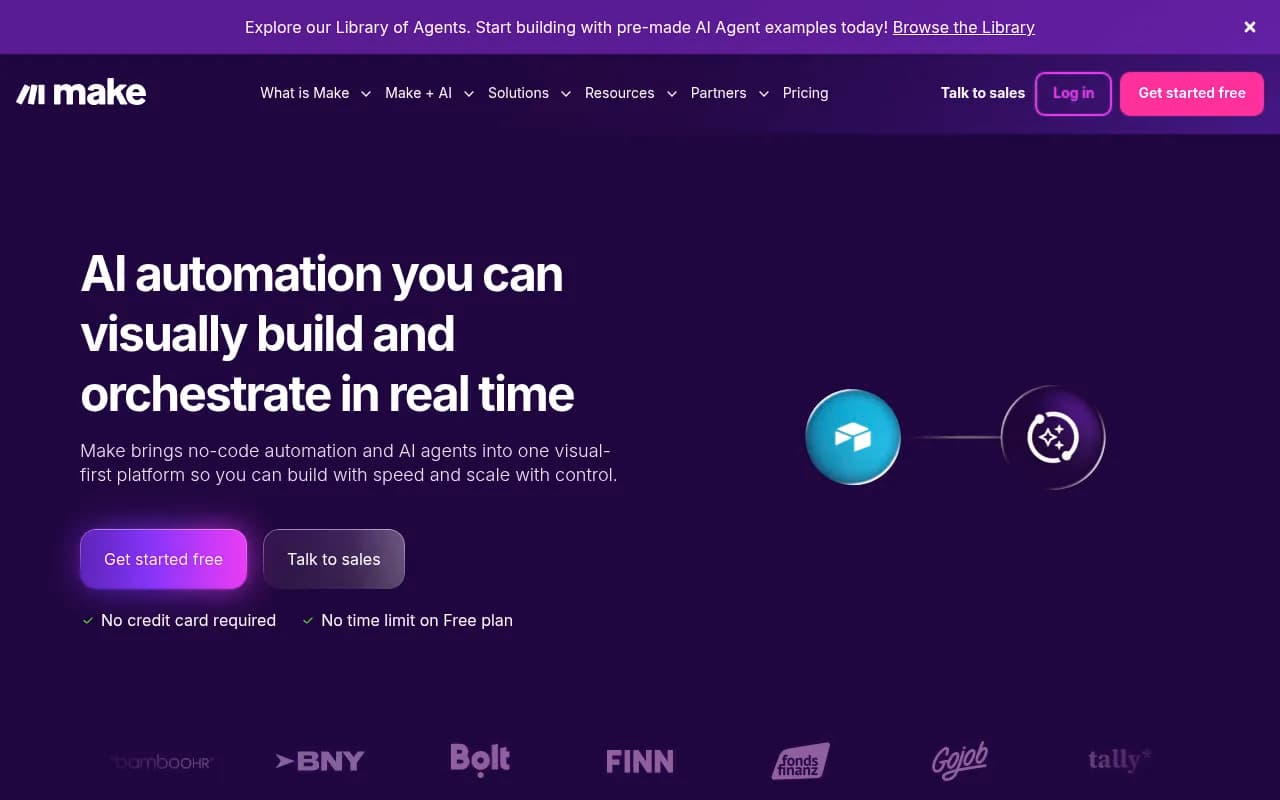
Make is what you use when Zapier feels too limiting but you're not ready to write code. The visual canvas is genuinely excellent -- you can see your entire workflow as a diagram, with modules connected by lines. Branching, filtering, error handling, and loops are all first-class features.
The pricing model is also fundamentally different from Zapier. Make charges per operation (each module execution), but the rates are much lower. The free plan gives you 1,000 operations/month, and the Core plan at $9/month gives you 10,000. For most marketing teams, Make is 3-5x cheaper than Zapier for equivalent workflows.
Make has around 1,500 app integrations -- fewer than Zapier, but the HTTP module lets you connect to any API with a REST endpoint, which covers most gaps. If the tool you need has an API, Make can talk to it.
The learning curve is steeper than Zapier. The visual interface looks approachable but has real depth, and concepts like iterators, aggregators, and error routes take time to understand. Most marketing teams will need one person who's willing to spend a few hours learning the tool properly.
AI capabilities in Make have improved significantly. You can call OpenAI, Anthropic, or Google AI models directly within workflows, which opens up things like automatic content categorization, sentiment analysis on form responses, or AI-generated summaries of weekly reports.
Best for: Power users and marketing ops folks who want visual workflow design, more complex logic, and lower costs than Zapier. Good middle ground between ease and capability.
n8n
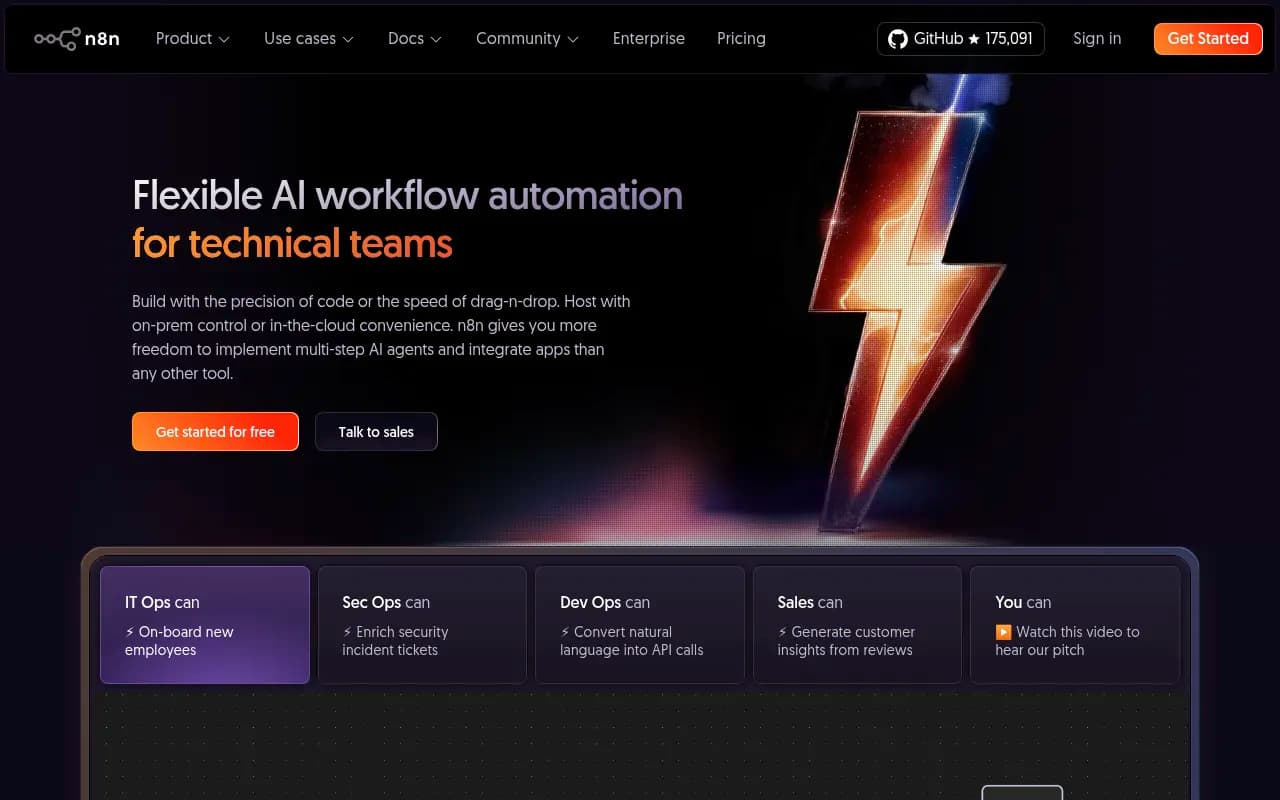
n8n is open-source, self-hostable, and built for teams that want full control. The fair-code license means you can run it on your own infrastructure, keep all your data in-house, and pay nothing beyond server costs.
The cloud-hosted version starts at $20/month (Starter, 2,500 executions), which is competitive. But the real value proposition is self-hosting: a $10-20/month VPS can run n8n for a small team indefinitely.
For SEO and marketing teams, n8n's strengths are:
- Native code nodes (JavaScript or Python) that let you do things no-code tools can't
- A growing library of 400+ integrations
- AI-native features including LangChain integration, vector store nodes, and agent workflows built into the core product
- No per-task pricing on self-hosted -- run as many automations as your server can handle
The honest downside is complexity. n8n's workflow builder is powerful but not beginner-friendly. The documentation is good, but you'll hit walls that require either reading source code or asking the community. If nobody on your team is comfortable with JSON, APIs, or basic scripting, n8n will frustrate you.
That said, n8n has become a serious option for marketing teams with a technical member or a willingness to learn. The AI workflow capabilities in particular are ahead of Zapier and comparable to Make.
Best for: Teams with at least one technical person, anyone who needs self-hosting for compliance or cost reasons, and teams building AI-powered workflows that need code-level flexibility.
Relay.app
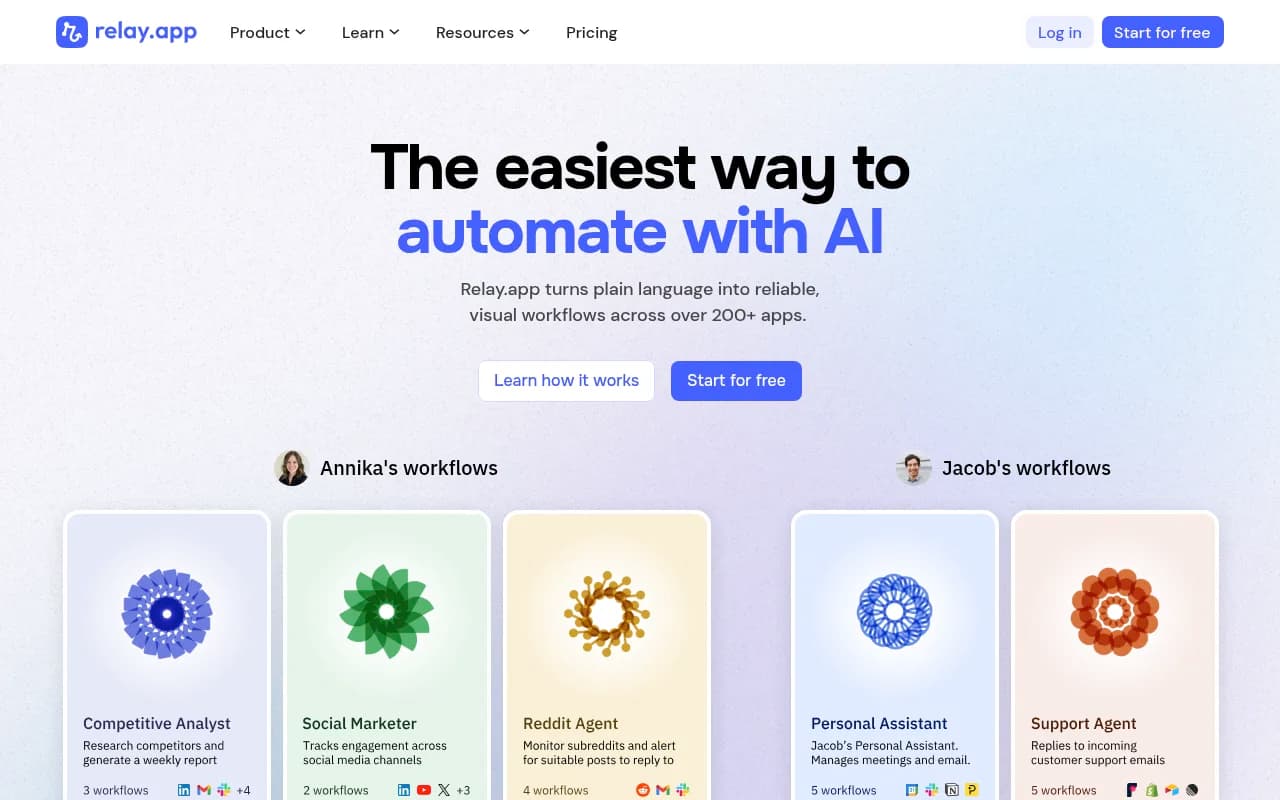
Relay.app takes a different angle than the other tools here. Its core idea is "human-in-the-loop" automation -- workflows that include steps where a real person needs to review, approve, or make a decision before the automation continues.
This sounds niche, but it's actually a real gap in the market. Most automation tools assume you want everything to happen automatically. Relay.app assumes that some steps genuinely need a human judgment call -- approving a contract, reviewing a piece of content before it publishes, deciding whether a lead qualifies for outreach.
For marketing teams, this is useful for content review workflows, campaign approval processes, and anything where you want automation to handle the grunt work but a human to make the final call.
The integration library is smaller than Zapier or Make (around 100+ native integrations), but Relay.app supports webhooks and HTTP requests to cover gaps. The interface is clean and genuinely easy to use.
Pricing starts at $9/month for the Starter plan, which is reasonable. The free plan allows unlimited runs with up to 1,000 steps/month.
The limitation is that Relay.app is narrower in scope. If you need complex data transformation, high-volume automation, or a huge app library, it's not the right tool. It's specifically good at workflows where humans and automation need to collaborate.
Best for: Teams that need approval workflows, content review processes, or any automation where human judgment is part of the flow. Good for agencies managing client approvals.
Bardeen
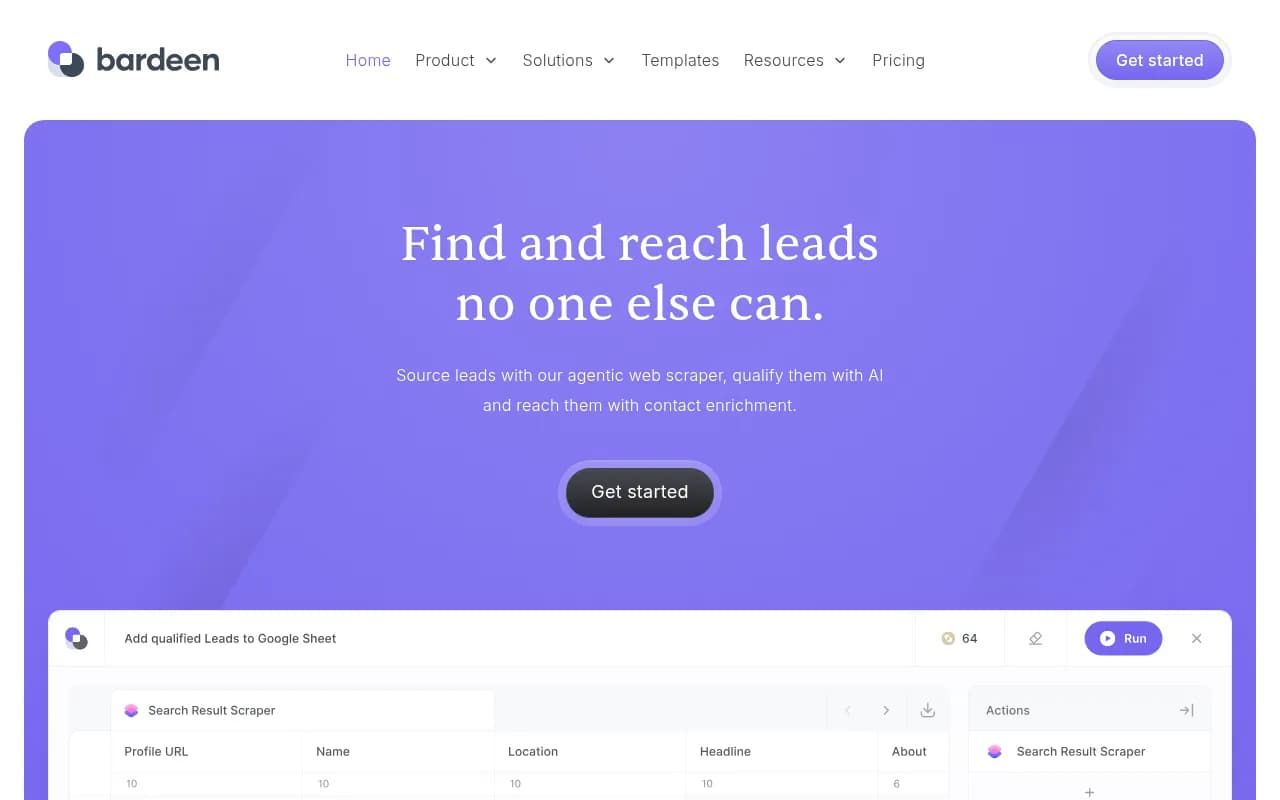
Bardeen is the odd one out in this comparison. It's a browser extension (Chrome) rather than a cloud-based platform, and its primary use case is automating tasks you'd normally do manually in a browser: scraping data from websites, enriching leads from LinkedIn, pulling information from Google Maps, or automating repetitive clicks.
For SEO and marketing teams, Bardeen's sweet spot is research and enrichment:
- Scraping competitor data from websites
- Pulling contact information from LinkedIn profiles
- Enriching lead lists with data from multiple sources
- Automating repetitive browser tasks that don't have API integrations
Bardeen has a "Magic Box" feature that lets you describe what you want to automate in plain English, and it generates the automation. This works surprisingly well for simple tasks.
The pricing model is different: there's a free tier with limited credits, and the Pro plan at $10/month gives you more automation runs. The "Team" plan adds collaboration features.
The key limitation is that Bardeen runs in your browser, which means it requires your computer to be on and the browser to be open. It's not a server-side automation tool -- it can't run workflows at 3am while you sleep (unless you use their cloud runners, which cost extra credits).
Best for: Sales and SEO teams that need browser-based scraping, lead enrichment, and research automation. Not a replacement for Zapier or Make -- more of a complement for tasks that don't have API integrations.
Head-to-head comparison
| Zapier | Make | n8n | Relay.app | Bardeen | |
|---|---|---|---|---|---|
| Ease of use | Very easy | Moderate | Steep | Easy | Easy |
| App integrations | 7,000+ | 1,500+ | 400+ | 100+ | Browser-based |
| Pricing model | Per task | Per operation | Per execution / free self-hosted | Per step | Per run / credits |
| Starting price | $19.99/mo | $9/mo | $20/mo (cloud) or free (self-hosted) | Free / $9/mo | Free / $10/mo |
| Self-hosting | No | No | Yes | No | No |
| AI capabilities | Basic | Good | Advanced (LangChain native) | Basic | Basic |
| Human-in-the-loop | No | No | No | Yes (core feature) | No |
| Browser automation | No | No | No | No | Yes (core feature) |
| Best for | Non-technical teams | Power users | Technical teams | Approval workflows | Scraping & enrichment |
| Data ownership | Cloud only | Cloud only | Full (self-hosted) | Cloud only | Cloud only |
Which tool for which marketing workflow?
Rather than declaring a winner, here's how to think about it based on what you're actually trying to automate.
CRM and lead management automation
If you're connecting your CRM (HubSpot, Salesforce, Pipedrive) to other tools -- routing form submissions, updating deal stages, syncing contacts -- Zapier is the easiest path. The integrations are pre-built and reliable. Make is a strong second if you need more complex routing logic.
Content publishing workflows
Automating content from draft to published -- pulling from a content calendar, posting to social, updating a CMS -- is where Make shines. The visual canvas makes it easy to see the full flow, and the branching logic handles "if content type is X, post to Y channel" scenarios cleanly. Relay.app is worth considering if you need an editor approval step before publishing.
SEO reporting and alerts
Automating rank tracking alerts, pulling data from Google Search Console, or building weekly SEO dashboards usually involves APIs and data transformation. n8n handles this well, especially if you're comfortable with code nodes for custom calculations. Make is a good no-code alternative with its HTTP module.
Lead enrichment and research
This is Bardeen's territory. Scraping competitor pages, pulling LinkedIn data, enriching a list of domains with contact information -- Bardeen handles these browser-based tasks better than any of the others. For server-side enrichment using APIs, Make or n8n are better choices.
High-volume, cost-sensitive automation
If you're running thousands of workflow executions per month, Zapier's per-task pricing will hurt. Make is significantly cheaper at scale. n8n self-hosted is cheapest of all -- essentially free beyond server costs.
AI-powered marketing workflows
Building automations that use LLMs -- classifying inbound leads, generating content briefs, summarizing reports -- n8n has the most mature AI integration with native LangChain support. Make is catching up with direct AI model integrations. Zapier's AI features are improving but still more limited.
What about pricing at scale?
This is where the choice really matters. Let's say your team runs 50,000 automation actions per month:
- Zapier Professional: roughly $69-$99/month depending on the plan tier
- Make: roughly $16-$29/month (Core or Pro plan)
- n8n Cloud: roughly $50/month (Growth plan)
- n8n self-hosted: $10-20/month in server costs
The gap between Zapier and Make at scale is significant. For a marketing team running complex, high-volume workflows, Make can save $500-800/year compared to Zapier for equivalent work.
That said, Zapier's reliability and support are genuinely better. If a Zap breaks, the error messages are clear and the support team is responsive. With Make or n8n, debugging a broken workflow requires more technical knowledge.
Honest takes on each tool's weaknesses
Zapier's biggest problem isn't price -- it's that the simplicity ceiling is real. When you need a workflow that loops through a list, applies conditional logic based on multiple criteria, and handles errors gracefully, Zapier becomes a patchwork of workarounds.
Make's weakness is that the visual canvas, while powerful, becomes genuinely hard to read for complex workflows. A scenario with 30+ modules looks like a bowl of spaghetti. Navigation and organization tools help, but it's still a real issue.
n8n's weakness is the learning curve and the maintenance overhead of self-hosting. If your server goes down or needs updating, that's on you. The community is helpful, but it's not the same as enterprise support.
Relay.app's weakness is scope. It does the human-in-the-loop thing well, but if that's not your primary need, it's not the right tool. The integration library is too small to be a primary automation platform for most teams.
Bardeen's weakness is the browser dependency. It's not a platform for mission-critical, always-on automation. It's a productivity tool for research-heavy workflows.
A note on AI search and content workflows
One area where automation tools are increasingly relevant for marketing teams is AI search optimization. Teams are building workflows to monitor when their brand appears in ChatGPT or Perplexity responses, track citation changes, and automate content updates based on gap analysis.
For teams doing this kind of work, Promptwatch is worth knowing about -- it's built specifically for tracking and improving AI search visibility, and its data can feed into automation workflows via API or webhook integrations with tools like Make or n8n.

The bottom line
There's no universal winner here. The right tool depends on your team's technical comfort, your workflow complexity, and your budget.
If you're starting from zero and want something working today: start with Zapier. You'll pay more, but you'll spend less time figuring out the tool.
If you have a few weeks to learn and want more power at lower cost: Make is the better long-term investment for most marketing teams.
If you have a developer or technical marketer on the team and care about data ownership or AI-native workflows: n8n is worth the setup time.
If your workflows involve human approval steps: Relay.app is the only tool here built for that.
If you need browser-based scraping and enrichment: Bardeen fills a gap the others don't.
Most mature marketing teams end up using two of these tools together -- Zapier or Make for core automation, and Bardeen for research tasks. That's not a failure of the tools; it's just how the category works right now.