Key takeaways
- Qwairy tracks brand visibility across 10 AI engines, but solo marketers often need either a cheaper entry point or more actionable features for the same price range
- Most GEO tools in 2026 fall into two camps: monitoring-only dashboards and full optimization platforms — the gap between them matters a lot if you're working alone
- The best Qwairy alternatives for solo marketers include Otterly.AI, LLMrefs, Promptmonitor, and Rankshift for budget monitoring, and Promptwatch if you need to go beyond tracking and actually fix visibility gaps
- Content generation and answer gap analysis are the features that separate tools worth paying for from ones that just show you a dashboard
Qwairy has carved out a reasonable niche in the GEO space. It tracks your brand across 10 AI engines, surfaces visibility gaps, and gives you a cleaner interface than some of the scrappier tools that launched in 2024 and 2025. For a solo marketer who just wants to know whether ChatGPT or Perplexity is mentioning their brand, it does the job.
But "does the job" isn't always enough. Depending on your situation, Qwairy might be overkill (you're paying for features you'll never use), underpowered (it shows you the problem but not how to fix it), or just slightly off for your workflow. Any of those is a valid reason to look around.
This guide covers the real alternatives — what they cost, what they actually do, and which type of solo marketer each one fits best.

Why solo marketers have a different problem than agencies
Agencies managing 10+ clients can justify $500/month on a GEO platform. They spread the cost, use white-label reporting, and bill it back. Solo marketers — freelancers, in-house one-person marketing teams, indie consultants — don't have that luxury.
What solo marketers actually need from a GEO tool:
- A price point under $100-150/month that doesn't require annual commitment to be reasonable
- Enough prompt coverage to track the queries that matter for their specific niche
- Some guidance on what to do with the data, not just a visibility score
- Low setup friction — no IT department, no onboarding calls
The GEO tool market in 2026 has a lot of options, but most of them were built with agencies or enterprise marketing teams in mind. Pricing tiers often jump from "toy plan" to "real plan" with a $200+ gap in between. That's the problem this guide is trying to solve.
The Qwairy alternatives worth considering
Otterly.AI — best for budget-conscious monitoring
Otterly.AI starts at $29/month for 15 prompts, which is genuinely accessible. It tracks ChatGPT, Perplexity, and Google AI Overviews, and the interface is clean enough that you don't need a tutorial to get started.
The catch: 15 prompts is not a lot. If you're tracking a brand with any real breadth — multiple product lines, competitor comparisons, category-level queries — you'll hit the ceiling fast. The $189/month tier for 100 prompts is where it becomes genuinely useful, and at that price it's competing with more capable tools.
Still, for a solo marketer who has a narrow focus (one product, one niche, a handful of key queries), the $29 entry point is hard to beat. Otterly.AI received Gartner Cool Vendor recognition in 2025, which is worth noting for anyone who needs to justify tool spend internally.
Otterly.AI

LLMrefs — best for the genuinely budget-constrained
LLMrefs positions itself as the budget-friendly option in the GEO space, and for smaller teams or solo marketers, it's worth considering if cost is the primary constraint. It tracks visibility across ChatGPT, Perplexity, and several other AI search engines.
The honest assessment: you get what you pay for. LLMrefs covers the basics of monitoring but lacks the depth of prompt intelligence, content gap analysis, or crawler logs that more mature platforms offer. Think of it as a starting point — useful for getting a baseline read on your AI visibility before you decide whether to invest in something more capable.
LLMrefs
Rankshift — best for straightforward brand tracking
Rankshift focuses on tracking brand visibility across ChatGPT, Perplexity, and AI search without a lot of extra complexity. The interface is straightforward, which is a genuine advantage for solo marketers who don't want to spend an afternoon learning a new platform.
It's a monitoring tool, not an optimization tool. You'll see where you appear and where you don't, but the platform won't tell you what content to create or why a competitor is outranking you. For someone who just wants a clean dashboard to check weekly, that's fine.

Promptmonitor — best for basic multi-engine tracking
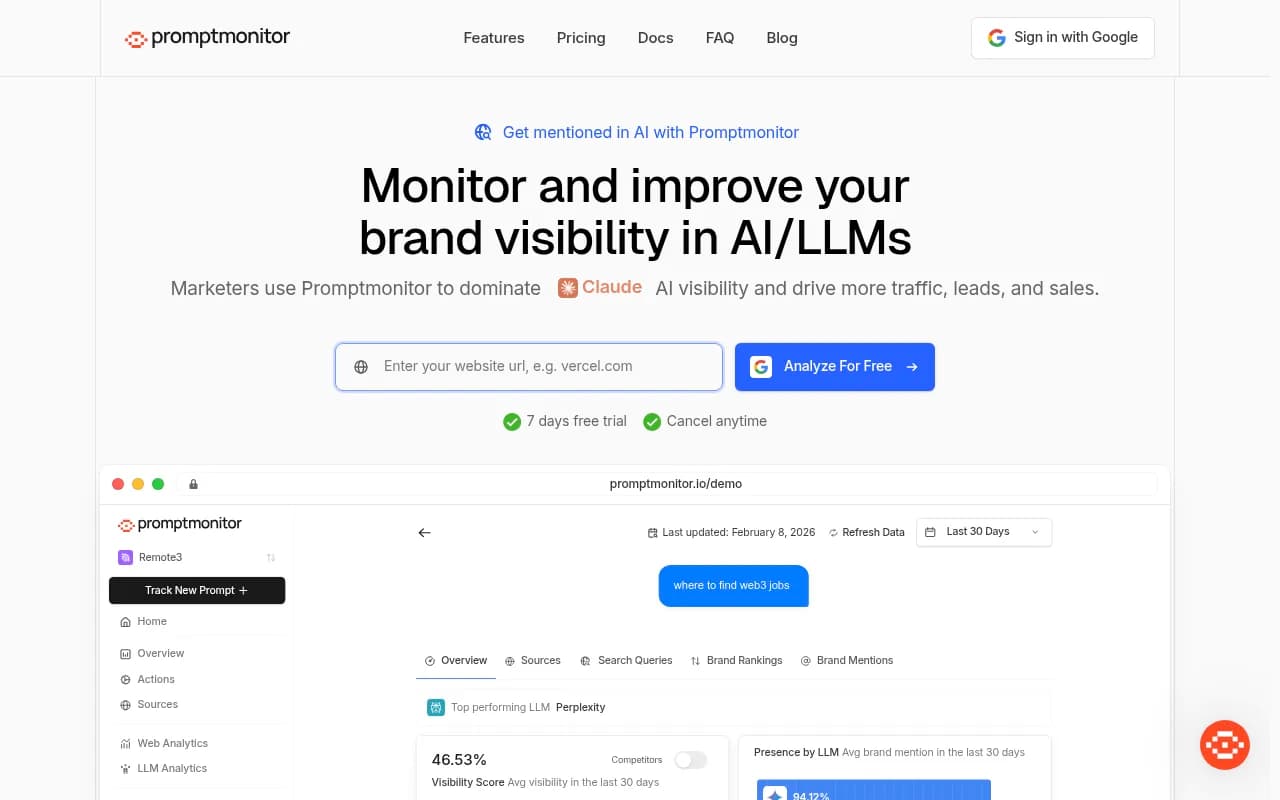
Promptmonitor covers AI visibility tracking with a basic feature set. It's positioned as an accessible option for teams that don't need enterprise-level depth.
Worth noting: it's missing some features that matter as you get more serious about GEO — no crawler logs, limited content guidance, no query fan-out analysis. But if you're early in your GEO journey and want to understand the landscape before committing to a bigger tool, it's a reasonable starting point.
Omnia — best for measuring brand presence in AI answers
Omnia focuses specifically on measuring brand presence in AI-generated answers. It's a cleaner, more focused product than some of the all-in-one platforms, which can work in its favor for solo marketers who want signal without noise.
The focus on measurement rather than optimization means it pairs well with a separate content workflow — you use Omnia to track, and handle content creation elsewhere.

Promptwatch — best if you need to actually fix visibility gaps
This is where the conversation shifts. All the tools above are monitoring tools. They tell you where you appear and where you don't. That's useful, but it leaves you with a problem: now what?
Promptwatch is built around a different premise. It finds the gaps (which prompts competitors rank for that you don't), generates content designed to close those gaps, and tracks the results as AI models start citing your new pages. For a solo marketer who doesn't have a content team, that last part — AI-assisted content generation grounded in real prompt data — is significant.
The Essential plan at $99/month covers one site, 50 prompts, and 5 articles per month. That's a reasonable scope for a solo marketer with a focused brand. The Professional plan at $249/month adds crawler logs, which show you exactly which pages AI engines are reading and when they move from crawl to citation.
The difference between Promptwatch and the monitoring-only tools isn't just features — it's the question you're trying to answer. Monitoring tools answer "where am I visible?" Promptwatch answers "what do I need to do to become more visible, and is it working?"

Comparison table
| Tool | Starting price | Prompt coverage | Content generation | Crawler logs | Best for |
|---|---|---|---|---|---|
| Qwairy | Contact/varies | 10 AI engines | No | No | General AI visibility tracking |
| Otterly.AI | $29/mo (15 prompts) | ChatGPT, Perplexity, AI Overviews | No | No | Budget entry-level monitoring |
| LLMrefs | Low/varies | ChatGPT, Perplexity, others | No | No | Cost-constrained solo marketers |
| Rankshift | Varies | ChatGPT, Perplexity, AI search | No | No | Simple brand tracking |
| Promptmonitor | Varies | Multi-engine | No | No | Basic multi-engine monitoring |
| Omnia | Varies | AI-generated answers | No | No | Brand presence measurement |
| Promptwatch | $99/mo (Essential) | 10 AI models | Yes (5 articles/mo) | Yes (Professional+) | Full optimization loop |
Other tools worth knowing about
A few more options that come up in this space, depending on your specific needs:
LLM Pulse is focused on tracking brand visibility across ChatGPT, Perplexity, and related engines. It's agency-oriented in its positioning but has been used by solo practitioners.
Peec AI covers AI search visibility monitoring for marketing teams. It's a monitoring-first tool with a reasonably clean interface.

GetMint monitors and optimizes brand visibility across AI search. Worth a look if you want something that at least gestures toward optimization rather than pure tracking.
Goodie AI is a lighter-weight option for monitoring AI search visibility. The feature set is limited, but the price reflects that.
What to actually look for when choosing
The GEO tool market is crowded in 2026, and a lot of products look similar at first glance. Here's how to cut through it:
Prompt volume matters more than you think. A tool that gives you 15 prompts at the entry tier sounds fine until you realize you need to track 40 different queries to get a useful picture of your visibility. Check the prompt limits carefully and do the math on what tier you'd actually need.
Monitoring vs. optimization is a real distinction. Most tools in this space are monitoring dashboards. They show you data. If you want to improve your AI visibility — not just measure it — you need a tool that either generates content recommendations, helps you create content, or both. That's a smaller subset.
Crawler logs are underrated. Knowing that an AI engine visited your page is different from knowing that it cited your page. Tools that show you crawler activity (which pages were read, how often, when a page moved from crawl to citation) give you a much clearer picture of what's actually happening. Most tools don't offer this.
Don't pay for multi-seat pricing you don't need. Some platforms price per seat or have team-oriented tiers that don't make sense for solo use. Check whether the pricing structure assumes you're a team.
The honest take on Qwairy
Qwairy is a legitimate tool. Tracking across 10 AI engines is solid coverage, and the interface is functional. If you're already using it and it's working, there's no urgent reason to switch.
The reasons to look elsewhere are specific: you need a lower price point, you've hit the limits of monitoring-only data and want something that helps you act on it, or you need features like crawler logs, content generation, or query fan-out analysis that Qwairy doesn't offer.
For pure monitoring at a lower price, Otterly.AI's $29 tier is the most accessible option in the market right now. For a solo marketer who wants to move from "I know where I'm invisible" to "I'm doing something about it," Promptwatch's Essential plan at $99/month is the most complete option without jumping to agency-level pricing.
The GEO space is still maturing. Tools that exist today will look different in 12 months. But the core question — are you just tracking, or are you optimizing — is going to stay relevant regardless of which specific platform you choose.