Key takeaways
- All four tools track brand mentions across AI engines like ChatGPT, Perplexity, and Claude, but they differ significantly in what they let you do with that data.
- Rankshift and LLM Pulse are solid entry-level monitors — good for teams that just need to know where they stand.
- Peec AI adds smart suggestions and a clean interface, making it a step up for teams that want some guidance alongside their data.
- Promptwatch is the only tool in this group that closes the loop: it finds your gaps, generates content to fill them, and tracks whether that content actually gets cited.
- If your budget is under $300/month and you want more than a dashboard, Promptwatch's Professional plan at $249/month is the most complete option in this price range.
The AI visibility tool market has exploded. There are now well over 100 platforms claiming to help you "rank in ChatGPT" or "appear in Perplexity." Most of them are monitoring dashboards with a fresh coat of GEO paint.
But for teams working with a real budget constraint — say, under $300/month — the field narrows fast. You're not shopping for Profound's enterprise tier or Scrunch AI's $250/month Core plan with five seats. You need something that fits, works, and ideally does more than show you a depressing chart of how invisible you are.
This guide compares four tools that all land in or near that budget range: Rankshift, LLM Pulse, Peec AI, and Promptwatch. I'll go through what each one actually does, where it falls short, and who should use it.
Why the under-$300 segment matters
According to Nobori.ai's 2025 AI Search Visibility Statistics report, B2B companies tracking AI search visibility jumped from 8% to 47% in a single year. That's a lot of teams suddenly needing a tool. Most of them aren't Fortune 500 brands with enterprise budgets — they're marketing teams at mid-size companies, boutique agencies, and growth-stage startups trying to figure out if they even exist in AI-generated answers.
The under-$300/month bracket is where most of these teams land. And it's a genuinely interesting bracket because the tools here vary wildly in depth. Some give you a mention count and call it a day. Others are starting to build real optimization workflows. The difference matters a lot when you're trying to justify the spend to a CMO.
The four tools at a glance
| Tool | Starting price | AI engines covered | Prompt limit (entry plan) | Content generation | Crawler logs | Free trial |
|---|---|---|---|---|---|---|
| Rankshift | ~$49-99/mo | ChatGPT, Perplexity, AI search | Limited | No | No | Yes |
| LLM Pulse | ~$49-99/mo | ChatGPT, Perplexity, more | Limited | No | No | Yes |
| Peec AI | €89/mo (~$97) | ChatGPT, Perplexity, Claude | 25 prompts | Basic suggestions | No | Yes |
| Promptwatch | $99/mo (Essential) / $249/mo (Professional) | 10+ AI models | 50-150 prompts | Yes (AI writing agent) | Yes (Professional) | Yes |
Prices sourced from vendor pages and third-party research (ZipTie.dev, Visiblie.com, April 2026). Always verify current pricing directly with each vendor.
Rankshift
Rankshift is a straightforward AI search visibility tracker. It monitors how your brand appears across ChatGPT, Perplexity, and other AI search engines, and gives you a dashboard showing mention rates, share of voice, and competitor comparisons.

The tool is built for teams that are just getting started with AI visibility. The interface is clean, setup is fast, and you can get a read on your baseline visibility within a day or two of connecting your brand. For someone who's never tracked this before, that's genuinely useful.
Where Rankshift runs into limits is depth. The prompt library is relatively small at entry-level pricing, and there's no mechanism to help you understand why you're not appearing or what to do about it. You see the gap. You don't get a path out of it.
That said, if your primary goal is awareness — you want to know whether your brand is showing up at all, and how you compare to two or three competitors — Rankshift does that job without a lot of friction.
Best for: Small teams or solo marketers who want a quick, low-cost baseline on AI visibility and don't yet need optimization tools.
LLM Pulse
LLM Pulse covers similar ground to Rankshift but with a slightly broader focus on tracking brand visibility across ChatGPT, Perplexity, and additional AI models. The name is pretty literal — it's a pulse check on how your brand is doing in LLM-generated responses.
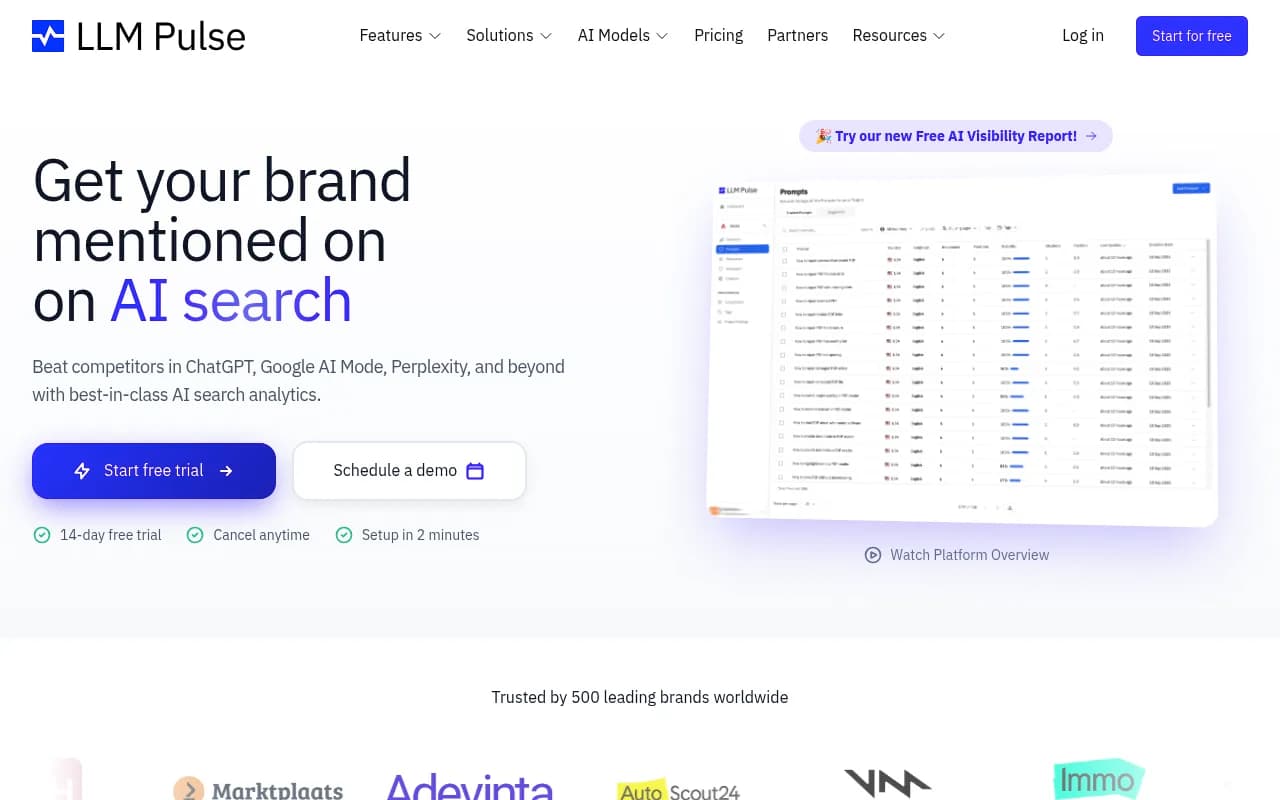
The platform tracks brand mentions, sentiment in AI responses, and competitor share of voice. Some users appreciate that it surfaces the actual AI-generated text mentioning (or not mentioning) their brand, which makes it easier to understand context rather than just counting mentions.
Like Rankshift, LLM Pulse is primarily a monitoring tool. There's no content generation, no gap analysis that tells you which specific topics you're missing, and no crawler log data to understand how AI engines are actually reading your site. It's a good instrument for measuring the problem. It's not a tool for solving it.
The pricing sits in a similar range to Rankshift, making it a reasonable alternative if you want to compare a few options before committing.
Best for: Teams that want to see the actual AI response text alongside their mention data, and who are comfortable doing their own content strategy work based on what they find.
Peec AI
Peec AI is a step up from pure monitoring. It tracks brand visibility across ChatGPT, Perplexity, and Claude, and adds some basic optimization suggestions alongside the data. The interface is notably clean, and the tool has built a reputation for being approachable for teams that aren't deeply technical.

At €89/month (~$97), the entry plan gives you 25 prompts across three AI engines. That's a relatively tight prompt limit — 25 prompts means you're tracking a fairly narrow slice of the questions your potential customers might be asking. If your industry has a lot of query variation, you'll feel that constraint quickly.
The "smart suggestions" Peec AI offers are useful but limited. They'll point you toward content gaps in a general sense, but they don't generate content for you or give you the kind of prompt-level intelligence (volume estimates, difficulty scores, competitor analysis) that would let you prioritize where to focus.
Still, for a team that wants more than a number on a dashboard and is willing to do the actual content work themselves, Peec AI is a solid mid-tier option. It's genuinely better than pure monitoring tools at helping you understand what to do next — just not at helping you do it.
Best for: Marketing teams that want actionable direction alongside their visibility data, have the internal capacity to create content themselves, and don't need a large prompt volume.
Promptwatch
Promptwatch is the most complete tool in this price range, and the one that most clearly goes beyond monitoring into actual optimization.

At $99/month for the Essential plan (1 site, 50 prompts, 5 articles) and $249/month for Professional (2 sites, 150 prompts, 15 articles, crawler logs, state/city tracking), it covers the full under-$300 bracket. The Professional plan is the one worth comparing seriously against the others, because it's where the platform's real differentiation kicks in.
Here's what makes Promptwatch different in practice:
The Answer Gap Analysis shows you exactly which prompts competitors are visible for that you're not. Not just "you're missing some content" — it shows the specific questions AI models are answering with your competitor's name instead of yours. That's a fundamentally different kind of data than a mention count.
The built-in AI writing agent then generates articles, listicles, and comparison pieces grounded in citation data from over 880 million citations analyzed. This isn't generic content — it's engineered to match the patterns that actually get cited by ChatGPT, Claude, Perplexity, and other models.
The crawler logs (available on Professional) show you which AI crawlers are hitting your site, which pages they're reading, and what errors they're encountering. Most competitors don't offer this at all. It's the difference between knowing your visibility score and understanding the technical reasons behind it.
Promptwatch also covers 10+ AI models including ChatGPT, Perplexity, Claude, Gemini, Grok, DeepSeek, Copilot, and Google AI Overviews — broader than any other tool in this comparison.
The one honest caveat: if you're a very small team or solo operator who just wants a quick visibility check, the Essential plan's 50-prompt limit and 5 articles/month might feel like enough to start but not enough to run a real optimization program. The Professional plan at $249/month is where the full workflow becomes available, and that's a meaningful jump from Peec AI's $97 entry point.
Best for: Marketing and SEO teams that want to actually improve their AI visibility, not just measure it. Agencies managing multiple brands should look at the Business plan ($579/month, 5 sites) or custom agency pricing.
Head-to-head: what each tool does (and doesn't do)
| Capability | Rankshift | LLM Pulse | Peec AI | Promptwatch |
|---|---|---|---|---|
| Brand mention tracking | Yes | Yes | Yes | Yes |
| Competitor share of voice | Yes | Yes | Yes | Yes |
| Multiple AI engines | Yes | Yes | 3 engines | 10+ engines |
| Answer gap analysis | No | No | Basic | Yes (detailed) |
| Content generation | No | No | No | Yes |
| AI crawler logs | No | No | No | Yes (Professional+) |
| Prompt volume/difficulty scoring | No | No | No | Yes |
| Reddit/YouTube citation tracking | No | No | No | Yes |
| ChatGPT Shopping tracking | No | No | No | Yes |
| Traffic attribution | No | No | No | Yes |
| Free trial | Yes | Yes | Yes | Yes |
The real question: monitoring vs. optimization
The honest framing here is that Rankshift, LLM Pulse, and Peec AI are all monitoring tools. They tell you where you stand. Promptwatch is an optimization platform — it tells you where you stand, then helps you move.
That distinction matters more than it might sound. Knowing that you're not appearing in ChatGPT responses about "best project management software for remote teams" is useful. But that knowledge doesn't do anything by itself. You still need to figure out what content to create, write it, publish it, and then track whether it worked. Most monitoring tools leave all of that to you.
Promptwatch's loop — find gaps, generate content, track results — is the thing that makes it worth the higher price point for teams that are serious about AI search visibility as a growth channel.
Who should pick what
If you're just starting out and want to understand your baseline with minimal investment, Rankshift or LLM Pulse will get you there without overcomplicating things. Run one of them for a month, get a feel for where you stand, and use that data to make the case internally for a more complete solution.
If you want some directional guidance alongside your data and have the team to act on it, Peec AI is a reasonable choice. The prompt limit is tight, but the interface is good and the suggestions are genuinely useful.
If you're ready to treat AI visibility as a real channel and want a tool that helps you actually improve — not just measure — Promptwatch is the right call. The Professional plan at $249/month is the most complete AI visibility solution available under $300, and it's the only one in this group that gives you a clear path from "we're invisible" to "we're getting cited."
The free trial is available for all four tools. Given how different the experience is across them, it's worth testing two or three before committing.