Key takeaways
- Botify is the strongest pure technical SEO platform in this group, but its AI visibility features are still catching up to dedicated GEO tools.
- Scrunch AI and Relixir are built specifically for AI search visibility, with Relixir skewing toward enterprise and Scrunch AI toward agencies tracking multi-engine citations.
- Promptwatch is the only platform here that closes the full loop: it finds your AI visibility gaps, generates content engineered to fix them, and tracks whether that content actually gets cited.
- If you want a single platform that handles both technical SEO and AI visibility end-to-end, none of these four is perfect -- but Promptwatch comes closest for most marketing and SEO teams.
- Budget matters: Botify is enterprise-priced, Relixir targets larger brands, while Promptwatch and Scrunch AI have accessible entry points.
The question used to be simple: where do you rank on Google? Now it's two questions. Where do you rank on Google, and does ChatGPT mention you when someone asks about your industry?
Most teams are trying to answer both with tools built for only one. That's the tension this comparison is designed to resolve. Scrunch AI, Promptwatch, Relixir, and Botify each approach the technical SEO + AI visibility problem from a different angle. Let me walk through what each actually does well, where each falls short, and which one makes sense depending on what you're trying to accomplish.
What we're actually comparing
Before getting into the platforms, it's worth being clear about what "combining technical SEO with AI visibility" means in practice. There are two distinct capabilities:
Technical SEO covers crawlability, indexation, page speed, structured data, internal linking, log file analysis -- the infrastructure that determines whether search engines (and AI crawlers) can find and understand your content.
AI visibility covers whether your brand, pages, and content actually appear in AI-generated answers from ChatGPT, Perplexity, Claude, Gemini, and similar systems. This is increasingly tracked as a separate metric from traditional rankings.
The best platforms in 2026 do both. Most still do only one well.
Botify: the technical SEO heavyweight
Botify has been around since 2012 and built its reputation on enterprise-scale technical SEO. Its crawling infrastructure is genuinely impressive -- it can handle sites with tens of millions of pages, analyze log files at scale, and surface crawl budget issues that most other tools miss entirely.
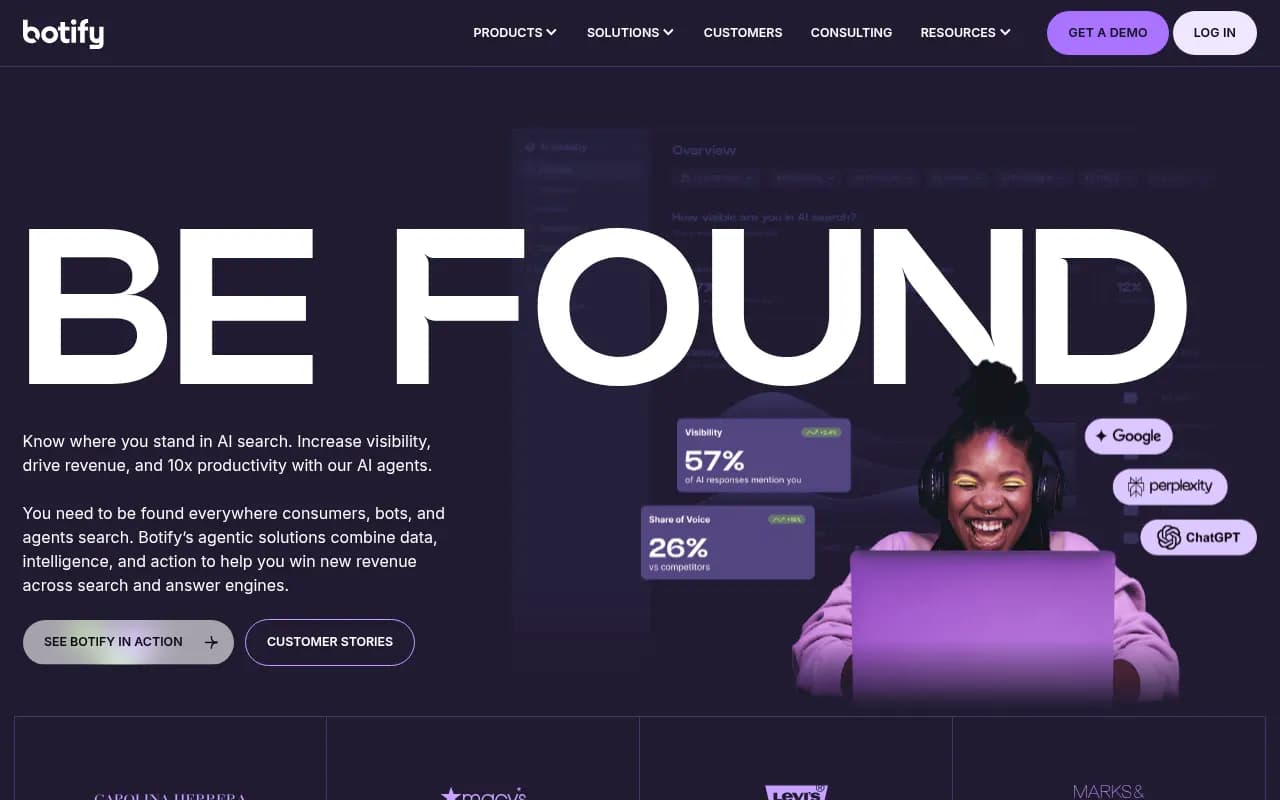
In 2025 and into 2026, Botify added AI search features under what it calls its "GEO" capabilities. The pitch is that the same technical foundation that helps Google crawl your site also helps AI crawlers discover and index your content. That's not wrong -- if AI bots can't crawl your pages, they can't cite them. Botify's log file analysis now includes data on AI crawler visits (GPTBot, ClaudeBot, PerplexityBot), which is genuinely useful.
Where Botify struggles in this comparison: it's still primarily a technical audit and crawl platform. It tells you that AI crawlers visited your pages. It doesn't tell you whether those pages are actually being cited in AI responses, which prompts your competitors are winning that you're not, or what content you should create to improve your AI visibility. The monitoring and the optimization are separate problems, and Botify solves the first one well but largely leaves the second to you.
Pricing is enterprise-tier and not publicly listed -- you're looking at custom contracts, typically suited for large e-commerce sites, publishers, and enterprise brands with dedicated technical SEO teams.
Scrunch AI: multi-engine citation tracking for agencies
Scrunch AI launched in 2024 and positioned itself squarely in the AI visibility space. It tracks how brands appear across multiple AI answer engines -- ChatGPT, Perplexity, Gemini, and others -- with a focus on citation monitoring and prompt-level insights.
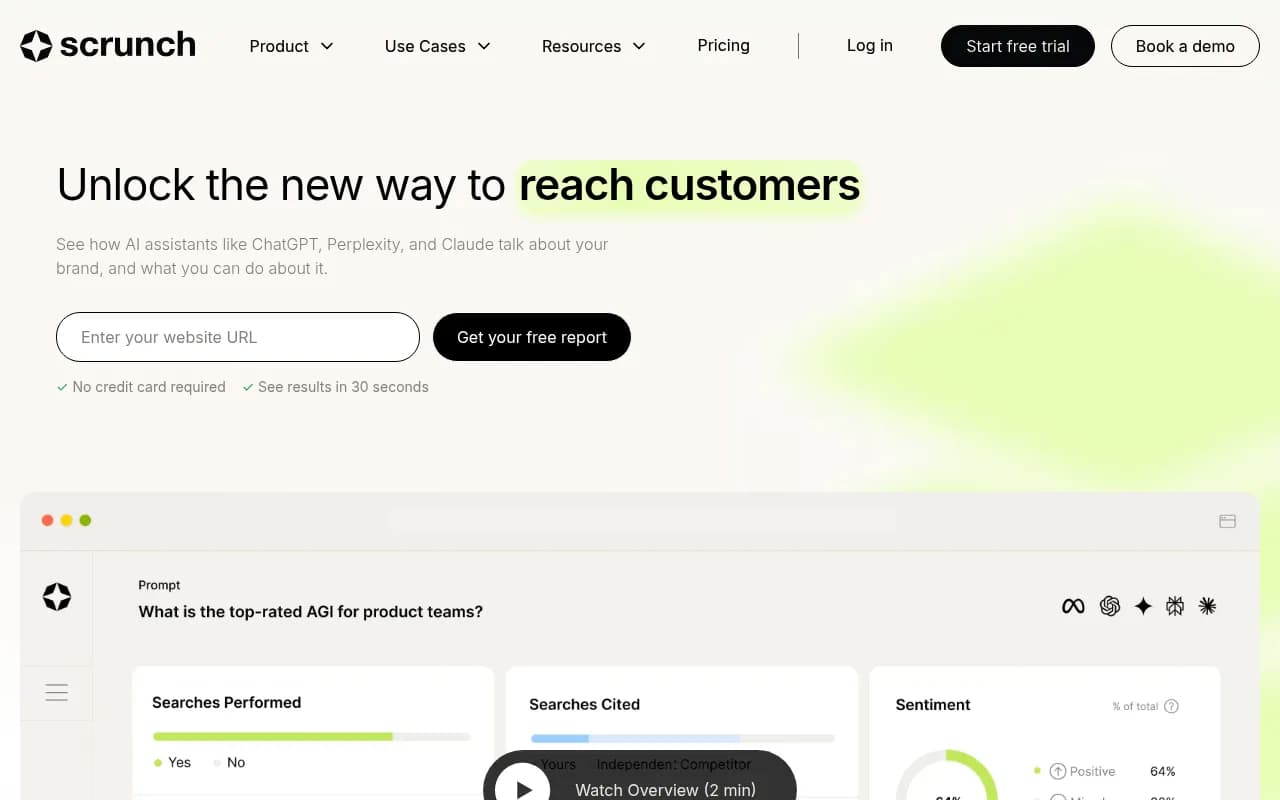
The platform is well-suited to agencies managing multiple clients who need to monitor brand mentions across AI engines at scale. Its multi-engine coverage is solid, and the prompt-level data (seeing exactly which prompts trigger or don't trigger your brand's appearance) is more granular than what many competitors offer.
What Scrunch AI doesn't do: technical SEO. There's no crawl analysis, no log file monitoring, no structured data audit. It's a visibility monitoring tool, not a full-stack optimization platform. If your site has crawlability issues that are preventing AI bots from reading your pages, Scrunch AI won't surface that problem. You'd need a separate technical SEO tool running alongside it.
The other gap worth noting: Scrunch AI monitors your visibility but doesn't help you fix it. There's no content generation, no gap analysis that tells you which specific topics to cover, no built-in workflow for turning visibility data into content that ranks in AI. You get the data; the strategy is up to you.
Relixir: enterprise GEO with content optimization
Relixir describes itself as an "end-to-end GEO engine" and targets enterprise brands. It's one of the more ambitious platforms in this space -- it goes beyond monitoring to include content optimization features designed to improve how AI models perceive and cite your brand.
The enterprise positioning is real. Relixir's feature set includes competitive analysis, content gap identification, and some degree of content optimization guidance. For large brands with dedicated GEO teams, it's a credible option.
The limitations: Relixir is expensive and designed for organizations with significant resources. It doesn't have the technical SEO depth of Botify -- no deep crawl analysis, no log file monitoring at scale. And while it does more than pure monitoring, the content generation capabilities are less developed than what Promptwatch offers. It's a step above "monitoring only," but not quite the full optimization loop some teams need.
There's also a practical consideration: Relixir's enterprise focus means it's not the right fit for mid-market companies, agencies, or teams that need flexibility without a large contract.
Promptwatch: the full optimization loop
Promptwatch takes a different approach from all three of the above. Rather than starting with either technical SEO or monitoring, it's built around a specific cycle: find the gaps, create content to fill them, track whether that content gets cited.

The gap analysis is where it starts. Promptwatch's Answer Gap Analysis shows you exactly which prompts your competitors appear in that you don't. Not just "you're missing AI visibility" -- it shows you the specific questions AI models are answering with competitor content instead of yours. That's actionable in a way that a visibility score isn't.
From there, the built-in AI writing agent generates content grounded in citation data from over 880 million citations analyzed. The articles it produces aren't generic SEO filler -- they're engineered around the specific prompts and topics where you're losing visibility. This is the piece most competitors don't have at all.
On the tracking side, Promptwatch monitors 10 AI models (ChatGPT, Perplexity, Claude, Gemini, Grok, DeepSeek, Copilot, Meta AI, Mistral, and Google AI Overviews) and includes page-level citation tracking -- so you can see which specific pages are being cited, how often, and by which models. Traffic attribution connects AI visibility to actual website visits via a code snippet, Google Search Console integration, or server log analysis.
The AI crawler logs feature is particularly relevant to the technical SEO angle of this comparison. Promptwatch shows you in real time which AI crawlers (GPTBot, ClaudeBot, PerplexityBot, etc.) are hitting your site, which pages they're reading, what errors they're encountering, and how often they return. This is the technical foundation layer -- understanding how AI engines discover your content -- combined with the visibility monitoring layer. Most competitors lack this entirely.
Pricing is transparent: Essential at $99/month (1 site, 50 prompts, 5 articles), Professional at $249/month (2 sites, 150 prompts, 15 articles, crawler logs, state/city tracking), Business at $579/month (5 sites, 350 prompts, 30 articles). A free trial is available.
Head-to-head comparison
| Feature | Botify | Scrunch AI | Relixir | Promptwatch |
|---|---|---|---|---|
| Technical SEO / crawl analysis | Excellent | None | None | AI crawler logs (real-time) |
| AI model monitoring | Basic (crawler logs only) | Strong (multi-engine) | Strong | Strong (10 models) |
| Prompt-level gap analysis | No | Partial | Yes | Yes (Answer Gap Analysis) |
| Built-in content generation | No | No | Partial | Yes (AI writing agent) |
| Citation tracking | No | Yes | Yes | Yes (880M+ citations) |
| AI crawler log analysis | Yes | No | No | Yes |
| Traffic attribution | No | No | No | Yes (GSC, code snippet, logs) |
| Reddit/YouTube insights | No | No | No | Yes |
| ChatGPT Shopping tracking | No | No | No | Yes |
| Competitor heatmaps | No | Partial | Yes | Yes |
| Pricing transparency | No (enterprise) | Partial | No (enterprise) | Yes ($99-$579/mo) |
| Free trial | No | Yes | No | Yes |
| Best for | Enterprise technical SEO | Agency citation monitoring | Enterprise GEO | Marketing/SEO teams needing full optimization |
Which platform is right for you?
The honest answer depends on what problem you're actually trying to solve.
Choose Botify if you're running a large-scale site (millions of pages) and your primary problem is technical -- crawl budget waste, indexation issues, JavaScript rendering problems. Botify's technical depth is unmatched in this group. Just know that you'll need a separate tool for AI visibility monitoring and optimization.
Choose Scrunch AI if you're an agency managing multiple clients who need clean, multi-engine citation monitoring and prompt-level data. It's a solid monitoring tool. Pair it with something else for content strategy and technical SEO.
Choose Relixir if you're an enterprise brand with a dedicated GEO team and budget to match. It goes further than pure monitoring and has competitive analysis features that mid-market tools don't match. But expect enterprise pricing and a longer implementation process.
Choose Promptwatch if you want one platform that finds your AI visibility gaps, helps you create content to fix them, tracks the results, and gives you the technical crawler data to understand how AI engines are discovering your site. It's the most complete loop of the four -- and the only one with transparent, accessible pricing that works for teams that aren't Fortune 500 enterprises.
The technical SEO + AI visibility gap, explained
One thing worth addressing directly: no single platform in 2026 perfectly combines deep technical SEO (the Botify-level crawl analysis, JavaScript rendering, Core Web Vitals monitoring) with full-stack AI visibility optimization. These are still somewhat separate disciplines.
What's changed is that the gap between them is narrowing. AI crawler logs -- knowing that GPTBot visited your page, got a 404, and never came back -- are now part of the AI visibility conversation. Structured data and entity optimization, traditionally a technical SEO concern, directly influences how AI models understand and cite your content.
Promptwatch's crawler log feature is the clearest example of this convergence -- it's a technical SEO capability (understanding how bots crawl your site) applied to an AI visibility problem (why aren't AI models citing my pages?). Botify approaches the same problem from the opposite direction: deep technical infrastructure that's starting to incorporate AI visibility signals.
For most teams, the practical answer is a combination: a technical SEO tool for crawl health and site infrastructure, plus a dedicated AI visibility platform for monitoring, gap analysis, and content optimization. If you can only have one, Promptwatch covers more of the AI visibility side -- which is where the fastest-moving opportunity is right now -- while still giving you the crawler log data you need to diagnose technical access issues.
A note on what "monitoring only" actually costs you
Several platforms in this space -- and Scrunch AI falls partly into this category -- are fundamentally dashboards. They show you data about where you're visible and where you're not. That's valuable. But it leaves the hardest work to you: figuring out what content to create, writing it, publishing it, and then checking back to see if it worked.
The gap between "I can see I'm losing to competitors in AI search" and "I know exactly what to build and I've built it" is where most teams get stuck. Promptwatch's content generation feature -- grounded in real citation data, not generic SEO templates -- is designed to close that gap. It's not perfect, and you'll still need human editorial judgment, but having a starting point that's actually engineered around the prompts you're trying to win is a meaningful advantage over starting from scratch.
That's the core difference between an optimization platform and a monitoring dashboard. In 2026, with AI search traffic growing fast and early movers compounding their citation advantages, the distinction matters more than it used to.