Key takeaways
- All three platforms generate content for AI search visibility, but they start from very different data sources and produce very different outputs.
- AirOps is built around content ops workflows and AI writing pipelines; it's strong for teams that already know what to write.
- Searchable focuses on AI search monitoring with some content generation bolted on; the content side is thinner than the tracking side.
- Promptwatch is the only one of the three that closes the full loop: find the gaps AI models expose, generate content engineered to fill them, then track whether citations actually improve.
- If your goal is to move from "invisible in AI search" to "cited regularly," the platform that connects those two states matters more than the one with the nicest writing interface.
There's a version of this comparison that just lists features in a table and calls it a day. That's not this one.
The more interesting question is: what does each platform actually produce? Not what it promises, but what lands in your CMS or your visibility dashboard after you've spent a week using it. Because in 2026, the GEO tool market has split into two camps that look similar from the outside but work very differently in practice.
Camp one: monitoring dashboards that tell you where you're invisible. Camp two: platforms that try to do something about it.
Searchable, AirOps, and Promptwatch all sit somewhere in camp two. But "somewhere" covers a lot of ground.
What each platform is actually trying to do
Before getting into the comparison, it's worth being honest about what each tool was built for. The origin story shapes what the product is good at.
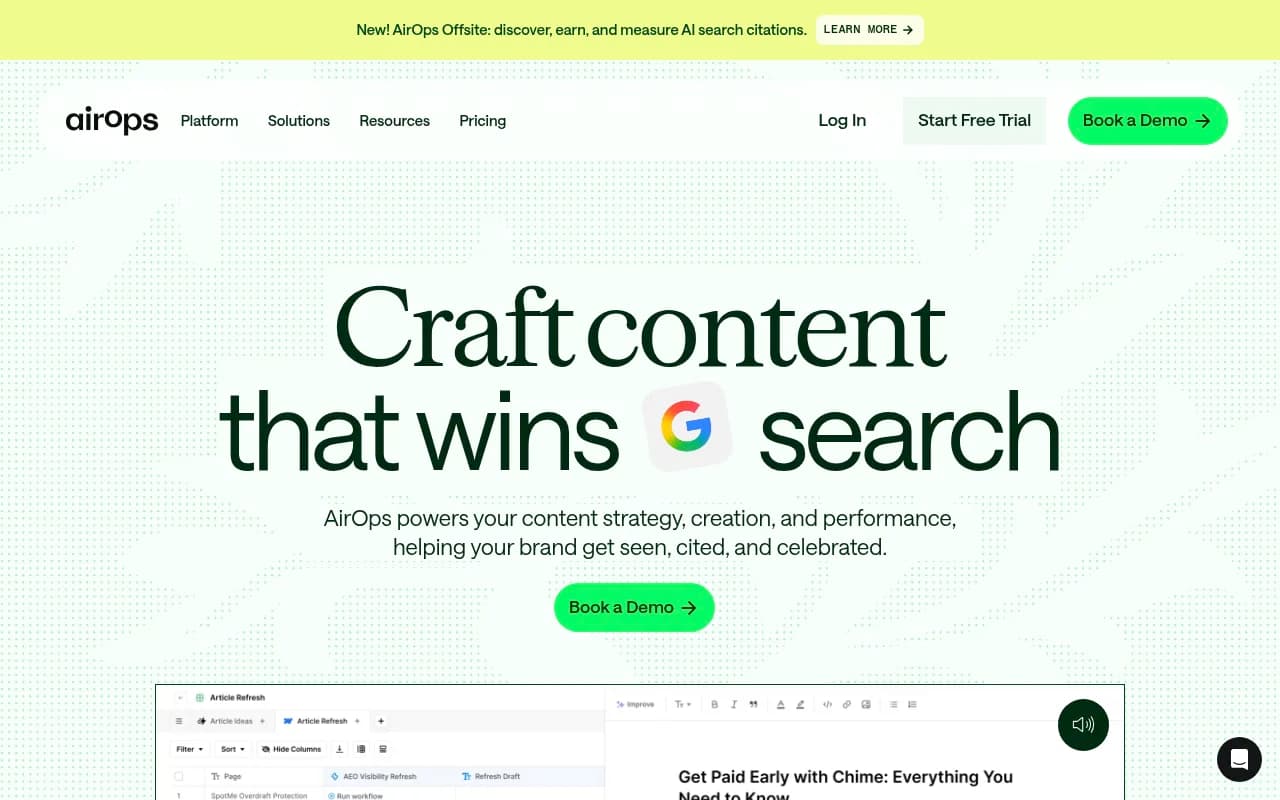
AirOps started as a content operations platform. Its core idea is that content teams have repetitive, data-heavy workflows that AI can automate. The Quill agent, launched in May 2026, is the latest expression of that: an AI agent that can research, draft, and publish content at scale. AirOps is genuinely strong here. If you have a content team that knows what topics to target, AirOps gives them serious leverage.
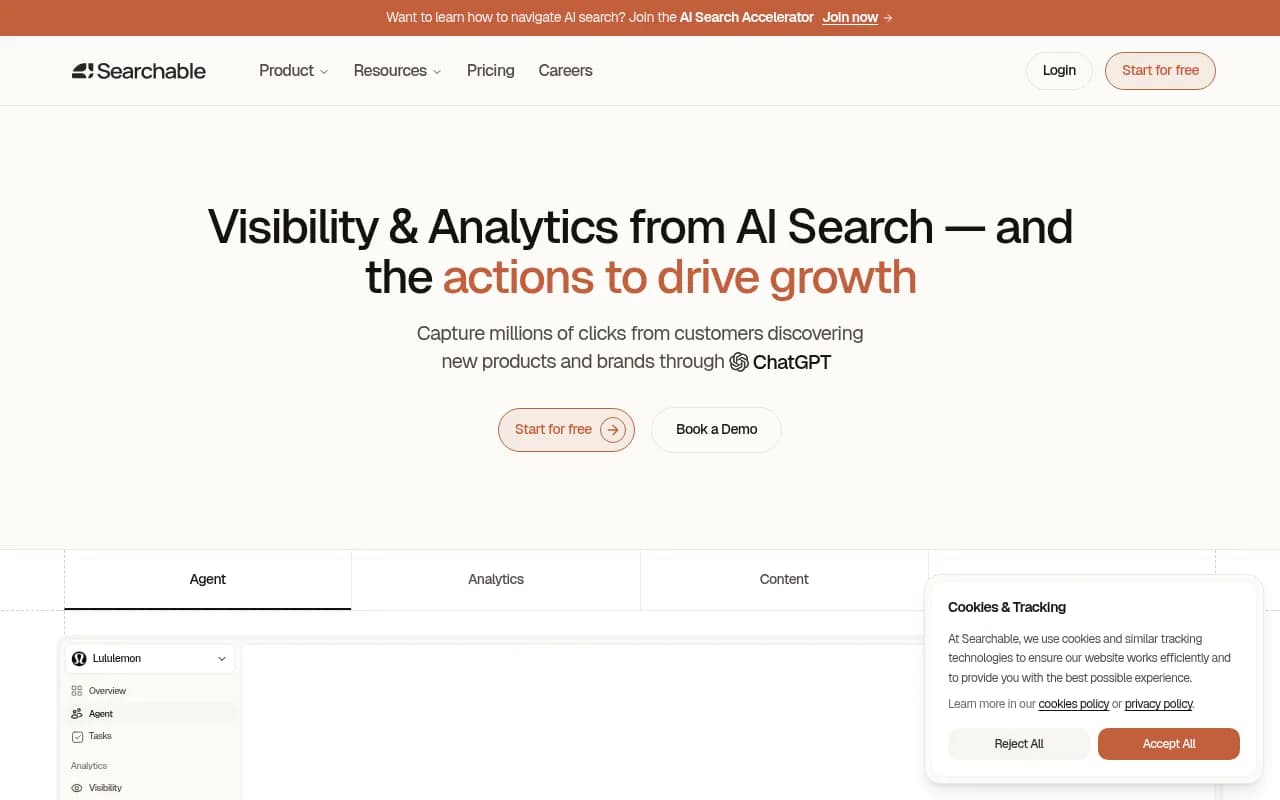
Searchable comes at this from the monitoring angle. It tracks how your brand appears in AI-generated answers, surfaces gaps, and has added content generation features. The monitoring side is solid. The content generation is more of a complement than a core capability.
Promptwatch was built specifically around the AI search loop: track real prompts, find where competitors appear and you don't, generate content designed to fill those gaps, then measure whether citations improve. It's the most opinionated of the three about what the workflow should look like.

The content generation question: what do they actually output?
This is where the comparison gets concrete. Let's look at what each platform produces when you ask it to help you create content for AI search visibility.
AirOps: workflow-first content at scale
AirOps generates content through configurable pipelines. You define the inputs (a keyword, a brief, a competitor URL, a product description), set up the workflow, and the system produces articles, landing pages, or structured content at scale.
The quality is high for templated content. AirOps integrates with your existing data sources, which means the output can be grounded in real product information, customer data, or competitive research rather than generic filler.
What it doesn't do natively: tell you which prompts to target. AirOps assumes you already know what content gaps exist. It's an execution engine, not a discovery engine. The 2026 State of AI Search report that AirOps published is worth reading for context -- it found that pages not updated quarterly are 3x more likely to lose citations, and that sequential headings with rich schema correlate with 2.8x higher citation rates. AirOps content pipelines can be configured to hit those structural targets.
The gap: if you don't already have a clear prompt research process feeding into AirOps, you're generating content based on intuition rather than data. That's fine for some teams. It's a real limitation for others.
Searchable: monitoring with content attached
Searchable tracks your brand across AI engines and surfaces where you're missing from answers. The content generation features let you act on those gaps directly within the platform.
The monitoring is genuinely useful. You can see which prompts your competitors appear in and you don't, which is the right starting point for any content strategy.
The content output is more basic. It's useful for generating initial drafts or briefs, but it lacks the depth of data that AirOps or Promptwatch bring to the generation process. There's no crawler log integration, no prompt volume scoring, and no page-level tracking to tell you whether the content you published is actually getting cited.
Promptwatch: gap-to-citation in one platform
Promptwatch's content generation is built on top of its prompt intelligence layer. That matters because the content agents don't just write articles -- they write articles grounded in specific prompts that real users are asking AI engines, competitor citation data, prompt volume estimates, and difficulty scores.
The Answer Gap Analysis shows you exactly which prompts competitors appear in that you don't. Content Agents then generate articles, listicles, comparisons, and briefs designed to answer those specific gaps. The output includes brand guidance, search result context, screenshots, and competitor analysis baked into the brief.
After publishing, page-level tracking shows which of your pages are being cited, by which AI models, and how often. Agent Analytics logs when AI crawlers hit your pages and when those pages move from crawl to citation. That timeline -- from publish to crawl to citation -- is something neither AirOps nor Searchable can show you.
Feature comparison
| Feature | AirOps | Searchable | Promptwatch |
|---|---|---|---|
| AI search monitoring | Limited | Yes | Yes (10 models) |
| Prompt volume / difficulty scoring | No | Basic | Yes |
| Answer gap analysis | No | Partial | Yes |
| Content generation | Yes (Quill agent) | Basic | Yes (Content Agents) |
| Content grounded in prompt data | No | Partial | Yes |
| AI crawler logs | No | No | Yes |
| Page-level citation tracking | No | No | Yes |
| Publish-to-citation timeline | No | No | Yes |
| Reddit / YouTube insights | No | No | Yes |
| ChatGPT Shopping tracking | No | No | Yes |
| Traffic attribution | No | No | Yes |
| Multi-model coverage | No | Partial | Yes (10 models) |
| Free trial | Yes | Yes | Yes |
| Starting price | Custom | Custom | $99/mo |
Who each platform is actually for
These three tools serve genuinely different use cases. Picking the wrong one isn't just a feature mismatch -- it's a workflow mismatch.
AirOps is best for content operations teams that already have a research process and need to scale execution. If your SEO team is producing briefs and your writers are a bottleneck, AirOps solves that. If you're trying to figure out what to write to get cited in ChatGPT, AirOps doesn't answer that question.
Searchable is best for teams that want monitoring with some content capability in a single tool. If you're early in your GEO journey and want to understand where you stand before investing heavily in content, Searchable gives you a reasonable starting point. The content generation is a bonus, not the main event.
Promptwatch is best for teams that want to close the full loop from gap discovery to citation improvement. The platform is more opinionated about the workflow -- it wants you to use its prompt data to inform your content, not just generate articles and hope they get cited. That opinionatedness is a feature, not a bug, if you're trying to systematically improve AI visibility rather than just publish more content.
The thing most comparisons miss: what happens after you publish
Most GEO tool comparisons focus on the monitoring side. That's understandable -- it's the most visible part of the product. But the real question is what happens after you create content.
AirOps has no mechanism to tell you whether the content it helped you create is being cited by AI engines. You'd need a separate monitoring tool for that.
Searchable can tell you whether your overall visibility is improving, but not which specific pages are driving that improvement or why.
Promptwatch's Agent Analytics logs show you exactly which pages AI crawlers are reading, how often they return, and when a page moves from "crawled" to "cited." That feedback loop is what makes it possible to iterate systematically rather than just publishing and waiting.
AirOps published research showing that 60% of AI Overview citations come from URLs not ranking in the top 20 organic results. That's a useful finding. But knowing that fact doesn't tell you which of your pages are in that 60% or what's preventing the other 40% from getting there. That's the gap Promptwatch fills.
A note on pricing and access
AirOps pricing is custom and enterprise-oriented. It's not a tool you spin up for $99/month to test a hypothesis -- it's a platform you buy when you're ready to commit to AI-powered content operations at scale.
Searchable's pricing is also custom, which makes it harder to evaluate without a sales conversation.
Promptwatch starts at $99/month for one site and 50 prompts, with a free trial available. The Professional plan at $249/month adds crawler logs and state/city tracking. For most marketing teams testing GEO seriously for the first time, the entry point is accessible.
The honest verdict
If you're a content operations team with clear topic targets and a need to scale production, AirOps is genuinely impressive. The Quill agent is one of the better AI writing systems built specifically for content teams.
If you want basic AI search monitoring with some content generation in one place, Searchable is a reasonable starting point.
If you want to systematically improve your visibility in ChatGPT, Perplexity, Google AI Overviews, and the other AI engines that are eating traditional search traffic -- and you want to connect content creation directly to citation outcomes -- Promptwatch is the most complete option of the three.
The distinction that matters: AirOps and Searchable help you create content. Promptwatch helps you create content that gets cited, then proves it worked.
That's not a small difference. In a market where only 30% of brands stay visible from one AI answer to the next (per AirOps' own research), the gap between "we published content" and "we're being cited" is the whole game.