Key takeaways
- All four tools track brand visibility in AI search engines, but they differ sharply in what you can do after you see the numbers.
- Otterly.AI and Peec AI are solid monitoring dashboards — they show you where you stand, but leave the fixing entirely to you.
- Searchable adds content generation on top of monitoring, which closes some of the gap.
- Promptwatch is the only one of the four that completes the full loop: find gaps, generate content, track what changes, and connect it to traffic.
- If you just need a quick read on brand mentions, any of these will work. If you need to actually improve your AI visibility, the choice narrows fast.
There's a question worth asking before you buy any AI visibility tool: what happens after you see the data?
Most tools in this space are built around a dashboard. You set up some prompts, the tool runs them against ChatGPT or Perplexity or Gemini, and you get a score. Your brand appears in 34% of responses. Your competitor appears in 61%. Now what?
That gap between "here's your visibility score" and "here's how to close it" is where most tools fall short. This guide compares four of the more talked-about options in 2026 -- Searchable, Otterly.AI, Peec AI, and Promptwatch -- specifically on the question of actionability. Not just what they track, but what you can do with what they find.
Why actionability matters more than monitoring depth
AI search is growing fast. According to Similarweb's 2025 Generative AI Report, AI platforms generated over 1.1 billion referral visits in June 2025, up 357% year-over-year. Otterly.AI's own 2026 research puts 15% of all website traffic as originating from AI agents and bots, with ChatGPT accounting for 56% of AI search referral traffic.
Those numbers mean your AI visibility score is no longer a vanity metric. It's a traffic metric. And if your content isn't being cited, you're losing visitors to whoever is.
The problem is that knowing you're invisible doesn't make you visible. You need to know why you're not being cited, what content would change that, and whether the changes you make are working. That's the standard I'm using to rank these four tools.
The four tools at a glance
Before going deep, here's a quick orientation:
| Tool | Core positioning | Content generation | Crawler logs | Prompt intelligence | Pricing starts at |
|---|---|---|---|---|---|
| Otterly.AI | Brand monitoring across AI engines | No | No | Basic | ~$49/mo |
| Peec AI | LLM visibility tracking | No | No | Basic | ~$49/mo |
| Searchable | Monitoring + content generation | Yes | Limited | Moderate | ~$79/mo |
| Promptwatch | End-to-end GEO platform | Yes (Content Agents) | Yes | Full (volume, difficulty, fan-outs) | $99/mo |
Otterly.AI
Otterly.AI

Otterly.AI was one of the first purpose-built AI search monitoring tools, and it shows. The interface is clean, setup is fast, and the brand monitoring coverage is genuinely good -- it tracks ChatGPT, Perplexity, Google AI Overviews, Gemini, and Claude, which covers the platforms that actually matter for most brands.
Where Otterly.AI earns its reputation is in the monitoring experience itself. You can track brand mentions, citations, and competitive positioning across those platforms without much friction. The reporting is polished. For teams that just need to know "are we showing up, and how does that compare to our competitors," Otterly.AI delivers a clean answer.
The limitation is what comes next. Otterly.AI doesn't tell you why you're not appearing in certain responses, and it doesn't help you fix it. There's no content gap analysis, no content generation, no crawler logs showing how AI bots interact with your site. You get the score. The optimization work is entirely on you.
That's not a fatal flaw if monitoring is genuinely all you need -- for example, if you have a separate content team that can act on the data. But for most marketing teams, the data alone isn't enough.
Best for: Teams that want clean, reliable brand monitoring without complexity, and have separate resources to act on what they find.
Peec AI

Peec AI takes a similar approach to Otterly.AI but with a few structural differences. The multi-language support is notably strong -- if you're tracking visibility in non-English markets, Peec AI handles this better than most competitors. The reporting is structured and polished, which makes it easier to share results with stakeholders who don't live in the tool every day.
Peec AI covers the major AI engines and gives you competitive benchmarking, sentiment tracking, and share-of-voice metrics. For marketing leaders who need to report upward on AI visibility, the output is presentation-ready.
The same ceiling applies, though. Peec AI is a monitoring platform. It tells you where you stand. It doesn't tell you what content to create, which prompts to prioritize, or whether your pages are being crawled by AI bots at all. The gap between data and action is real, and Peec AI doesn't bridge it.
There's also a prompt volume question. Peec AI's prompt library is useful but relatively fixed. If you want to track highly specific, niche prompts relevant to your exact product positioning, you may find the customization limited compared to platforms built around prompt intelligence.
Best for: Multi-language brands and teams that need polished reporting for executive stakeholders.
Searchable
Searchable sits in an interesting middle position. It monitors AI visibility across the major engines and adds content generation on top -- which immediately puts it ahead of Otterly.AI and Peec AI on the actionability question.
The content generation capability means you can go from "we're not appearing for this prompt" to "here's a draft article that might fix that" without leaving the platform. That's a meaningful workflow improvement. For smaller teams without dedicated content resources, having generation built in is genuinely useful.
Where Searchable is still catching up is in the depth of the intelligence feeding that content generation. The prompt data, competitive gap analysis, and crawler insights that would make the generated content truly targeted are less developed than what you'd find in a more mature platform. The content generation exists, but it's not grounded in the same depth of prompt volume data, citation analysis, or AI crawler behavior.
It's a step in the right direction. Whether that step is enough depends on how seriously you're treating AI visibility as a growth channel.
Best for: Smaller teams that want monitoring and content generation in one place without needing deep analytics.
Promptwatch
Promptwatch is the most complete of the four, and the gap is meaningful enough to be worth explaining specifically.

The core difference is that Promptwatch is built around a full optimization loop, not just a monitoring dashboard. The sequence looks like this:
-
Find the gaps. Answer Gap Analysis shows you exactly which prompts your competitors are appearing for that you're not. Not just "your visibility is low" -- but the specific questions AI models are being asked where your content isn't showing up.
-
Create content that addresses those gaps. Content Agents generate articles, listicles, comparisons, and briefs grounded in real prompt data, citation patterns, and competitor analysis. This isn't generic AI writing -- it's content built around the specific gaps the monitoring identified.
-
Track what changes. Page-level tracking shows which of your pages are being cited, by which models, and how often. Agent Analytics logs show when AI crawlers visit your site, which pages they read, and when a crawled page moves to an actual citation. Traffic attribution connects visibility improvements to real sessions.
That third step -- connecting AI citations to actual traffic -- is something none of the other three tools do well. You can see your visibility score go up in Otterly.AI or Peec AI, but you can't easily tie that to revenue. Promptwatch's attribution layer closes that loop.
A few other capabilities worth noting: Promptwatch tracks prompt volumes and difficulty scores, so you can prioritize which gaps are worth closing first. It surfaces Reddit and YouTube discussions that influence AI recommendations -- a channel most competitors ignore. And it covers 10 AI models including ChatGPT, Perplexity, Google AI Overviews, Google AI Mode, Claude, Gemini, Meta/Llama, DeepSeek, Grok, and Mistral.
The pricing reflects the depth: $99/month for the Essential plan (1 site, 50 prompts, 5 articles), $249/month for Professional (2 sites, 150 prompts, 15 articles, crawler logs), and $579/month for Business (5 sites, 350 prompts, 30 articles). That's more than Otterly.AI or Peec AI, but you're getting a materially different product.
Best for: Marketing teams, SEO teams, and agencies that need to actually improve AI visibility, not just measure it.
Head-to-head: what you can actually do with the data
This is the core question. Here's how the four tools compare on the capabilities that turn data into outcomes:
| Capability | Otterly.AI | Peec AI | Searchable | Promptwatch |
|---|---|---|---|---|
| Brand mention tracking | Yes | Yes | Yes | Yes |
| Competitive benchmarking | Yes | Yes | Yes | Yes |
| Multi-language support | Partial | Strong | Partial | Yes |
| Prompt volume & difficulty scores | No | No | No | Yes |
| Answer gap analysis | No | No | Partial | Yes |
| Content generation | No | No | Yes | Yes (Content Agents) |
| Content grounded in prompt data | No | No | Partial | Yes |
| AI crawler logs | No | No | No | Yes |
| Page-level citation tracking | No | No | No | Yes |
| Traffic attribution | No | No | No | Yes |
| Reddit & YouTube insights | No | No | No | Yes |
| ChatGPT Shopping tracking | No | No | No | Yes |
| Query fan-outs | No | No | No | Yes |
The pattern is clear. Otterly.AI and Peec AI are strong at the top of that table and absent from the bottom. Searchable fills in content generation but not the deeper intelligence layer. Promptwatch covers the full table.
Which tool should you actually use?
The honest answer depends on what you're trying to accomplish.
If you're at the very beginning of AI visibility tracking -- you just want to know whether your brand shows up in ChatGPT responses and how that compares to competitors -- Otterly.AI or Peec AI will get you there quickly and without much setup friction. Peec AI has an edge if you need multi-language coverage or polished executive reporting.
If you want monitoring plus content generation in one place and you're working with a lean team, Searchable is worth a look. It's not as deep as Promptwatch, but it's a more complete workflow than pure monitoring tools.
If AI visibility is a real growth priority -- if you're trying to move the number, not just track it -- Promptwatch is the right choice. The combination of gap analysis, content generation grounded in real prompt data, crawler logs, and traffic attribution is what separates it from the rest. Most competitors stop at showing you the problem. Promptwatch helps you fix it.
A note on the broader market
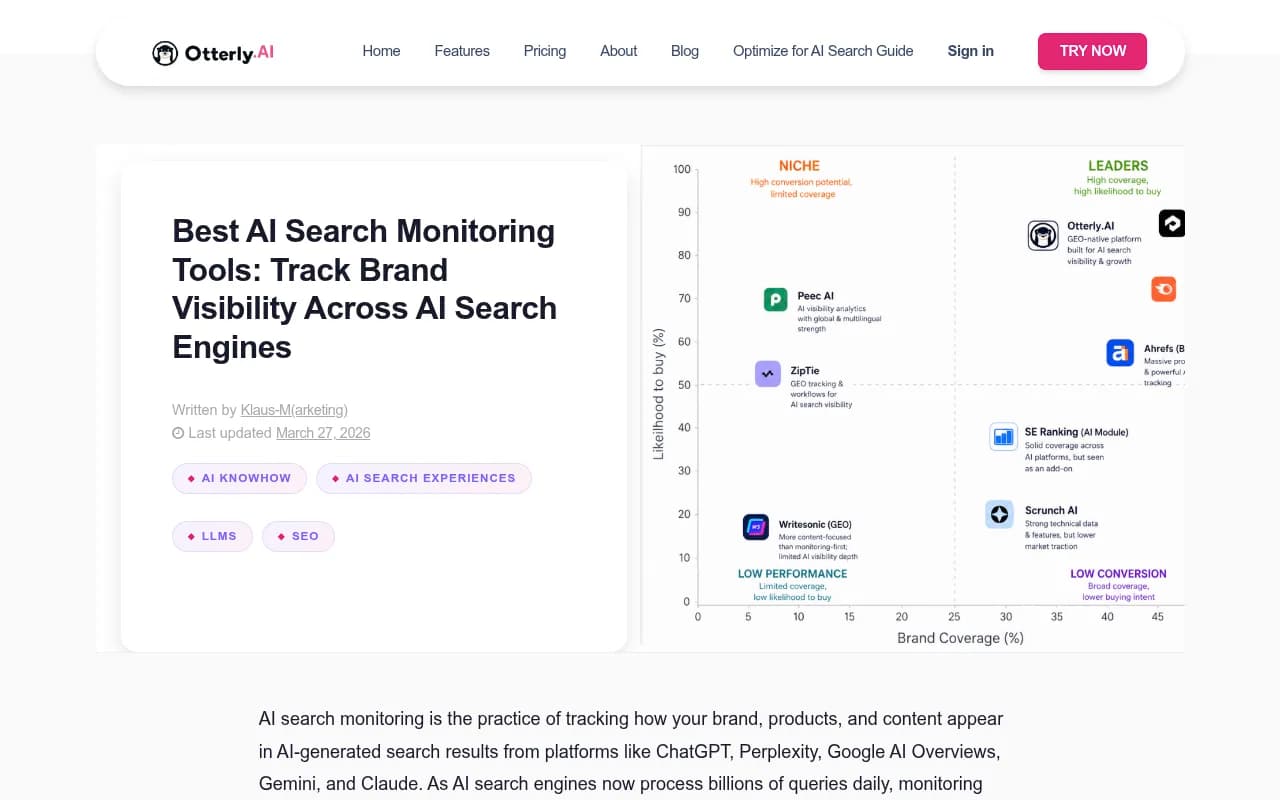
These four tools aren't the only options. The AI visibility space has expanded quickly, and there are now more than a dozen platforms competing for this category. Tools like Profound and AthenaHQ target enterprise buyers with strong feature sets. Rankshift and LLM Pulse are lighter-weight options for teams with simpler needs.
What's consistent across the market is the monitoring-vs-optimization divide. Most tools built in 2024 and early 2025 were designed to answer "where do you appear?" The harder question -- "how do you appear more?" -- requires a different architecture. That's the divide that matters most when you're choosing between these platforms.
The data is only as useful as what you do with it.