Key takeaways
- SearchAtlas LLM Visibility is part of a broader SEO automation suite (OTTO), which makes it appealing if you already use SearchAtlas for traditional SEO -- but it's not a standalone GEO platform.
- Most AI visibility tools in 2026 still stop at monitoring: they show you where your brand appears (or doesn't) but leave the fixing to you.
- The platforms that stand out in 2026 are the ones that close the loop -- tracking visibility gaps AND helping you create content to fill them.
- Promptwatch is the only platform in this comparison rated as a "Leader" across all GEO categories, with built-in content generation, crawler logs, and traffic attribution.
- Pricing across the category ranges from ~$29/month for basic monitoring to enterprise contracts for full-stack platforms.
The GEO (Generative Engine Optimization) tools market has exploded. Two years ago, "AI visibility" wasn't even a category. Now there are dozens of platforms fighting for budget, and the differences between them matter a lot more than their marketing copy suggests.
SearchAtlas is one of the more interesting entrants. It's primarily known as an all-in-one SEO platform, but its LLM Visibility module has been getting attention as a GEO add-on for existing users. The question worth asking: if you're serious about AI search visibility in 2026, is SearchAtlas the right tool -- or are you better served by a platform built specifically for this problem?
This guide answers that directly, comparing SearchAtlas LLM Visibility against the strongest alternatives across features, pricing, and real-world use cases.
What SearchAtlas LLM Visibility actually does
SearchAtlas is an SEO automation platform built around its OTTO AI engine. The LLM Visibility module sits inside that broader suite and lets you track brand mentions across AI models like ChatGPT, Perplexity, and Google AI Overviews.
The core features include:
- Brand mention tracking across select LLMs
- Competitor share-of-voice comparisons
- Prompt-level visibility data
- Integration with SearchAtlas's broader SEO workflow (site audits, content briefs, backlink tools)
Where SearchAtlas genuinely shines is the integration story. If you're already running technical SEO, content, and link building inside SearchAtlas, having LLM visibility in the same dashboard is convenient. You don't need to export data between tools or reconcile different reporting frameworks.
The tradeoff is depth. SearchAtlas's LLM Visibility module is an add-on to an SEO platform, not a purpose-built GEO engine. That distinction shows up in a few places: fewer AI models monitored, less granular prompt intelligence, and no built-in mechanism to go from "I'm invisible for this prompt" to "here's the content that will fix it."
The broader landscape: what you're actually choosing between
Before getting into head-to-head comparisons, it's worth understanding the three types of tools competing in this space in 2026.
Monitoring-only tools track where your brand appears across AI models and report it back. Most tools fall here. They're useful for awareness but leave optimization entirely to you.
SEO platforms with GEO add-ons (like SearchAtlas, Semrush, Ahrefs) bolt AI visibility features onto existing SEO infrastructure. Convenient if you're already a customer; often limited in GEO depth.
Purpose-built GEO platforms are designed from the ground up for AI search visibility. The best ones don't just monitor -- they help you understand why you're invisible and what to do about it.
Head-to-head comparison
Here's how SearchAtlas LLM Visibility stacks up against the main alternatives:
| Platform | AI models tracked | Content gap analysis | Built-in content generation | Crawler logs | Traffic attribution | Pricing (entry) |
|---|---|---|---|---|---|---|
| SearchAtlas LLM Visibility | 3-5 | No | Via OTTO (SEO-focused) | No | No | Bundled with SearchAtlas plans |
| Promptwatch | 10+ | Yes | Yes (GEO-native) | Yes | Yes | $99/mo |
| Semrush AI Toolkit | 4-5 | Limited | Via ContentShake | No | No | Bundled with Semrush |
| Profound | 9-10 | Partial | No | No | No | Enterprise pricing |
| Otterly.AI | 4-5 | No | No | No | No | $29/mo |
| Peec AI | 3 | No | No | No | No | €85/mo |
| AthenaHQ | 5-6 | Partial | No | No | No | Custom |
| LLM Pulse | 5+ | No | No | No | No | €49/mo |
A few things stand out from this table. First, the monitoring-only tools (Otterly.AI, Peec AI, LLM Pulse) are cheap but limited -- they tell you what's happening, not what to do. Second, the enterprise platforms (Profound, AthenaHQ) have strong monitoring depth but still don't close the loop on content creation. Third, SearchAtlas sits in an awkward middle ground: it has content generation through OTTO, but that's built for traditional SEO, not GEO.
SearchAtlas vs Promptwatch
This is probably the most instructive comparison, because these two tools represent different philosophies about what GEO software should do.
SearchAtlas treats LLM visibility as one feature among many in an SEO suite. Promptwatch treats it as the entire product.
Promptwatch tracks 10+ AI models (ChatGPT, Claude, Perplexity, Gemini, Google AI Overviews, Grok, DeepSeek, Copilot, Mistral, Meta AI), which is meaningfully broader than SearchAtlas's current coverage. But model count isn't the main differentiator.
The bigger gap is what happens after you identify a visibility problem. Promptwatch's Answer Gap Analysis shows you the specific prompts where competitors are visible but you're not -- not just a generic "you're behind" signal, but the exact questions AI models are answering without mentioning your brand. From there, the built-in AI writing agent generates content engineered to get cited: articles, listicles, and comparisons grounded in 880M+ real citations analyzed across the platform.
SearchAtlas has OTTO for content generation, but OTTO is optimized for Google rankings, not AI citations. Those are related problems but not the same problem.
Promptwatch also includes AI crawler logs -- real-time data on when ChatGPT, Claude, and Perplexity crawl your site, which pages they read, and what errors they hit. This is the kind of technical GEO data that most platforms, including SearchAtlas, don't offer at all.

For teams that want to actually move their AI visibility numbers, not just monitor them, Promptwatch is the stronger choice. For teams already deep in the SearchAtlas ecosystem who want a lightweight GEO signal alongside their existing SEO work, SearchAtlas LLM Visibility is a reasonable convenience play.
SearchAtlas vs Semrush AI Toolkit
Both are SEO-first platforms with GEO features added on. The comparison is closer than you'd expect.
Semrush's AI Toolkit monitors brand mentions across a handful of AI models and integrates with ContentShake for content generation. The content generation piece is more developed than SearchAtlas's GEO-specific output, but it's still not purpose-built for AI citation optimization.
Semrush wins on brand recognition and the depth of its traditional SEO data -- if you're running keyword research, competitive analysis, and rank tracking alongside GEO monitoring, Semrush's breadth is hard to beat. SearchAtlas is more affordable and has OTTO's automation capabilities, which can save time on technical SEO tasks.
Neither platform is a serious GEO-first choice. They're both "good enough for now" options for teams that aren't ready to invest in a dedicated AI visibility platform.
SearchAtlas vs Profound
Profound is one of the more serious enterprise GEO monitoring platforms. It tracks up to 10 LLMs, has strong competitive benchmarking, and is used by larger brands with dedicated SEO teams.
Profound

The gap between SearchAtlas and Profound is mostly depth: Profound's monitoring is more granular, covers more models, and gives you better share-of-voice data. But Profound is also monitoring-only -- there's no content generation, no crawler logs, no traffic attribution. You get excellent data and then you're on your own to act on it.
For enterprise teams with in-house content teams who just need the data layer, Profound is strong. For teams that need the full loop from gap identification to content creation to result tracking, neither Profound nor SearchAtlas closes it.
SearchAtlas vs Otterly.AI and Peec AI
These are the budget-tier monitoring tools. Otterly.AI starts at $29/month, Peec AI at €85/month. Both are straightforward: you set up prompts, they track your brand mentions across a few AI models, you get a dashboard.
Otterly.AI


SearchAtlas LLM Visibility is more capable than either of these, primarily because it sits inside a broader platform with content and technical SEO tools. But if you're a small team that just wants to know whether ChatGPT mentions your brand when someone asks about your category, Otterly.AI is a cheap and functional starting point.
The honest limitation of all three: they show you the problem but don't help you fix it.
SearchAtlas vs AthenaHQ
AthenaHQ has built a solid monitoring platform with decent competitive benchmarking. It covers more AI models than SearchAtlas and has a cleaner interface for tracking share of voice across prompts.

The comparison comes down to what you need beyond monitoring. If you're primarily a data consumer -- you want clean dashboards and competitive intelligence to inform a content strategy you'll execute elsewhere -- AthenaHQ is worth considering. If you want the platform to help you execute, neither AthenaHQ nor SearchAtlas gets you there.
SearchAtlas vs LLM Pulse
LLM Pulse is a newer entrant with transparent pricing (starting at €49/month) and solid coverage of 5+ AI models including ChatGPT, Perplexity, Gemini, and Google AI Mode.
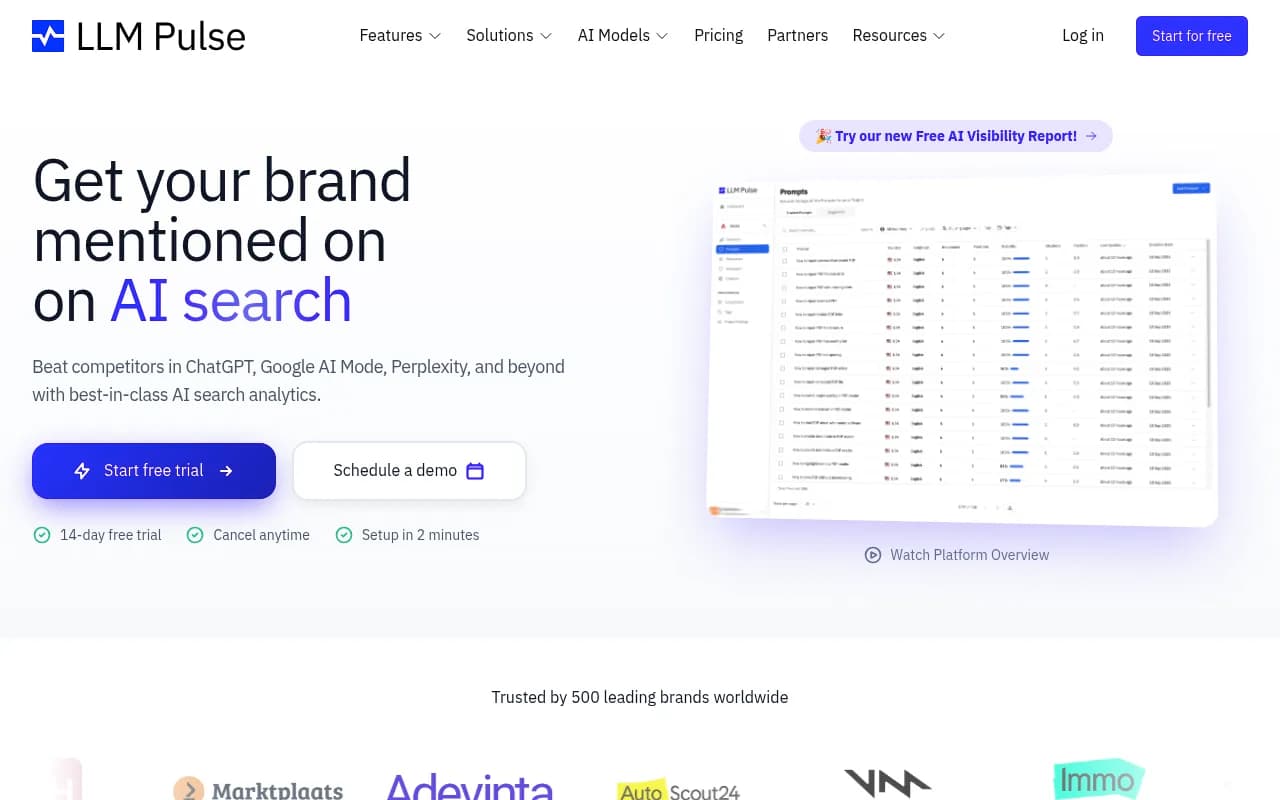
It's a monitoring tool with real-time sentiment analysis and share-of-voice tracking. The interface is clean and the pricing is accessible. Compared to SearchAtlas, it's more focused on the AI visibility problem specifically -- but it's also narrower, with no SEO integration and no content tools.
For teams that want a dedicated, affordable AI visibility monitor without the overhead of a full SEO platform, LLM Pulse is a reasonable option. For teams that want to do something with that data, it's a starting point, not a solution.
What the right choice actually depends on
The "best" tool in this category depends heavily on where you are in your GEO journey.
If you're just starting out and want to understand your baseline AI visibility, a monitoring-only tool like Otterly.AI or LLM Pulse gets you there cheaply. You'll quickly hit the ceiling of what they can do, but the initial data is useful.
If you're already using SearchAtlas for SEO, the LLM Visibility module is a low-friction way to add GEO monitoring without adding another tool. Don't expect it to be a complete GEO solution -- treat it as a signal layer on top of your existing workflow.
If AI visibility is a strategic priority and you need to actually move the needle, not just measure it, you need a platform built around the full optimization loop. That means gap analysis, content generation grounded in citation data, crawler monitoring, and traffic attribution. Promptwatch is the only platform in this comparison that covers all of those.
If you're an enterprise with a dedicated SEO team and just need the data layer, Profound gives you the deepest monitoring coverage at the cost of everything else.
Pricing summary
| Platform | Entry price | Free trial | Notes |
|---|---|---|---|
| SearchAtlas LLM Visibility | Bundled with SearchAtlas plans (~$99+/mo) | Yes | LLM features included in higher tiers |
| Promptwatch | $99/mo (Essential) | Yes | $249/mo for crawler logs and full features |
| Semrush AI Toolkit | Bundled with Semrush (~$140+/mo) | Yes | Limited GEO depth |
| Profound | Custom (enterprise) | No | Strong monitoring, no content tools |
| Otterly.AI | $29/mo | Yes | Basic monitoring only |
| Peec AI | €85/mo | Yes | 3 engines, limited features |
| AthenaHQ | Custom | Yes | Monitoring-focused |
| LLM Pulse | €49/mo | Yes (14 days) | 5+ models, no content tools |
The bottom line
SearchAtlas LLM Visibility is a reasonable choice if you're already invested in the SearchAtlas ecosystem and want GEO monitoring as part of a broader SEO workflow. It's not a serious standalone GEO platform, and it won't help you close the gap between "we know we're invisible" and "we've fixed it."
The GEO tools market in 2026 is still dominated by monitoring dashboards. Most platforms show you the problem and stop there. The ones worth paying attention to are the ones that help you act on what they find.
If you want to see where your brand stands across 10 AI models today -- and get a clear path to improving it -- Promptwatch is the most complete option available.