Key takeaways
- Most AI visibility platforms stop at monitoring — they show you data but don't help you do anything with it.
- The tools worth paying for in 2026 complete a full loop: find gaps, generate content, track results.
- Promptwatch is the only platform rated as a "Leader" across all categories in a 2026 comparison of 12 GEO platforms, largely because it's built around action, not just observation.
- Platforms like Otterly.AI, Peec AI, and AthenaHQ are solid for monitoring but leave content creation entirely to you.
- If you're an agency or enterprise brand, the gap between "we track AI visibility" and "we improve AI visibility" is where most budget gets wasted.
There's a version of this guide that would just list AI visibility trackers and call it a day. But that's not actually the problem most marketing teams have right now.
The problem is this: you can buy a dashboard that tells you ChatGPT isn't mentioning your brand. You can see exactly which competitors are getting cited. You can watch your share of voice drop week over week. And then... what? Most tools leave you right there, staring at a graph with no clear path forward.
The shift that's happened in 2026 is that a small number of platforms have moved past pure monitoring and built workflows that take you from "here's the gap" to "here's the published content that closes it." That's a fundamentally different product category, and it's the one worth spending money on.
This guide covers the six platforms that actually let you act on the data -- what they do well, where they fall short, and which one makes sense depending on your situation.
Why "monitoring only" isn't enough anymore
AI search has matured fast. According to Yotpo's 2026 analysis, AI-referred traffic converts at roughly 14.2% compared to 2.8% for traditional search. That's not a rounding error -- it's a completely different quality of visitor. Brands that show up in ChatGPT, Perplexity, and Google AI Mode are capturing buyers who've already done their research and are ready to act.
That conversion premium is why every major SEO platform has bolted on some version of "AI visibility tracking" in the last 18 months. But most of what's been released is a monitoring dashboard with a new label. You get a score. You see competitor mentions. You get a weekly email. Nothing actually changes on your website.
The platforms worth your attention in 2026 are the ones that close the loop -- they identify which prompts you're missing, generate content designed to answer those prompts, and then track whether that content actually starts getting cited. That's the cycle that moves the needle.
The 6 best platforms for acting on AI search data
1. Promptwatch -- the full action loop
Promptwatch is the most complete platform in this space right now. It's used by 1,480+ brands and agencies including Booking.com, Center Parcs, and Elaboratum, and it's the only tool in a 2026 comparison of 12 GEO platforms to be rated a "Leader" across every category.
What separates it from the rest isn't the monitoring -- it's what happens after you see the data.
The Answer Gap Analysis shows you exactly which prompts competitors are visible for that you're not. Not vague topic clusters -- specific questions and angles that AI models are already answering using competitor content. From there, Content Agents generate articles, listicles, comparisons, and briefs grounded in real prompt data, citation patterns, prompt volumes, and competitor analysis. This isn't generic AI writing -- it's content built to fill the specific gaps the analysis identified.
Then you track results at the page level: which pages are being cited, by which models, and how often. The AI Crawler Logs show when ChatGPT or Perplexity's crawlers hit your site, which pages they read, and when a page moves from "crawled" to "cited." Most competitors don't have anything like this.
A few other things worth knowing: Promptwatch tracks real user-facing AI responses, not just API outputs (which can differ significantly). It covers 10 AI models including ChatGPT, Perplexity, Google AI Mode, Claude, Gemini, DeepSeek, and Grok. It tracks Reddit and YouTube as citation sources -- channels that influence AI recommendations but most tools ignore. And it has ChatGPT Shopping tracking for brands that sell products.
Pricing starts at $99/month for the Essential plan (1 site, 50 prompts, 5 articles), with Professional at $249/month and Business at $579/month. There's a free trial.

2. AirOps -- content engineering at scale
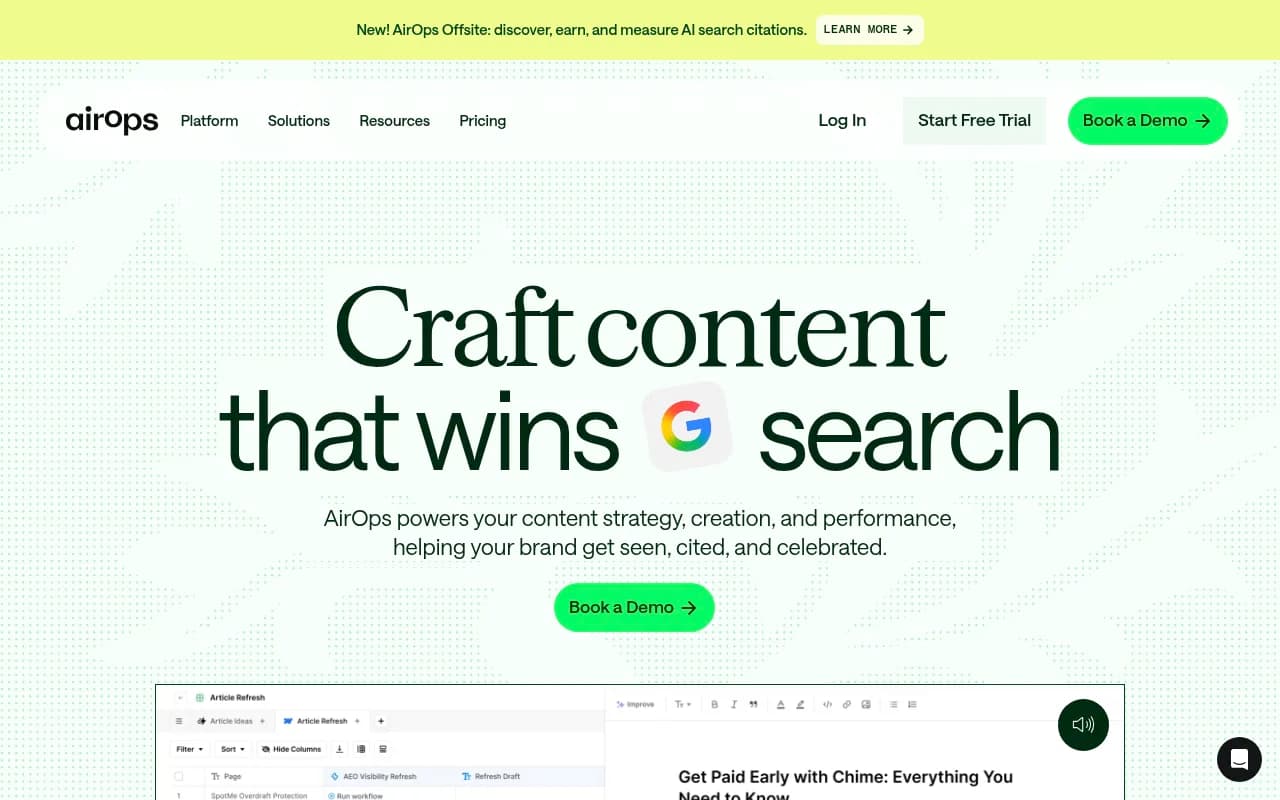
AirOps sits in an interesting position: it's less of a visibility tracker and more of a content engineering platform that's been built specifically for AI search. If you already have gap data from another tool and need a serious content production workflow, AirOps is worth a look.
It's built around what they call "content engineering" -- structured workflows that take a brief, pull in competitive data, and produce content designed to rank in AI search. The platform has strong workflow customization and works well for teams that need to produce a high volume of AI-optimized content consistently.
The tradeoff is that AirOps doesn't do the gap detection itself particularly well. You're bringing the insights; it helps you execute on them. For teams that want a single platform that does both, that's a limitation.
3. Profound -- enterprise monitoring with depth
Profound is one of the more serious monitoring platforms in this space. It tracks brand mentions across ChatGPT, Perplexity, and 9+ AI search engines, and it has genuinely strong data depth for enterprise teams that need to understand their AI visibility across a complex brand portfolio.
The platform is well-suited to large organizations where the primary need is reporting -- showing stakeholders where the brand stands across AI models, tracking share of voice over time, and identifying which competitors are gaining ground. The UI is clean and the data is reliable.
Where it falls short is the same place most enterprise monitoring tools fall short: it tells you what's happening but doesn't help you change it. There's no content generation, no gap-to-brief workflow, and no crawler logs. For a brand that needs to move from analysis to action, Profound is a starting point, not a complete solution. It's also priced at the higher end of the market.
Profound

4. Otterly.AI -- solid monitoring for smaller teams
Otterly.AI is a clean, well-designed monitoring tool that tracks brand mentions across ChatGPT, Perplexity, and Google AI Overviews. It's popular with smaller marketing teams and agencies that want straightforward AI visibility data without a complex setup.
The interface is genuinely easy to use, and the core monitoring functionality works well. You can track prompts, see where competitors appear, and get a reasonable picture of your AI search presence.
The honest limitation: Otterly.AI is monitoring-only. No crawler logs, no visitor analytics, no content generation, no gap analysis workflow. It's a good tool for teams that are just getting started with AI visibility and want to understand the landscape before investing in a more complete platform. But if you're past the "what's happening" stage and need to actually improve your visibility, you'll outgrow it quickly.
Otterly.AI

5. Peec AI -- tracking with a clean interface
Peec AI is another monitoring-focused platform that's worth mentioning for teams that prioritize simplicity. It tracks AI search visibility across the major models and presents the data in a straightforward way that's easy to share with non-technical stakeholders.
Like Otterly.AI, it's best understood as a visibility dashboard rather than an optimization platform. The data is useful for understanding where you stand, but there's no workflow for doing anything about it. No content briefs, no generation tools, no crawler monitoring.
For teams that need a lightweight, affordable way to track AI visibility and report on it internally, Peec AI does that job. For teams that need to move the needle, it's a piece of a larger puzzle.

6. AthenaHQ -- monitoring with competitive focus
AthenaHQ has built a reputation for solid competitive analysis in AI search. It's particularly good at showing you how your brand compares to competitors across different AI models and prompt categories -- useful for teams that need to make the case internally for why AI visibility matters.
The competitive heatmaps and share-of-voice data are genuinely useful, and the platform has invested in making that data actionable for strategic planning. If your primary use case is competitive benchmarking and stakeholder reporting, AthenaHQ is a reasonable choice.
The gap, again, is on the optimization side. AthenaHQ is monitoring-focused and lacks the content generation and gap-closing workflows that would make it a complete platform. You'll still need to take the insights somewhere else to act on them.

How these platforms compare
| Platform | Gap detection | Content generation | Crawler logs | Competitive analysis | Pricing (starting) |
|---|---|---|---|---|---|
| Promptwatch | Yes (Answer Gap Analysis) | Yes (Content Agents) | Yes | Yes (heatmaps) | $99/mo |
| AirOps | Limited | Yes (strong) | No | No | Custom |
| Profound | Partial | No | No | Yes | Higher end |
| Otterly.AI | Basic | No | No | Basic | Lower end |
| Peec AI | Basic | No | No | Basic | Lower end |
| AthenaHQ | Partial | No | No | Yes | Mid-range |
The table makes the pattern obvious. Most platforms cluster around monitoring and competitive analysis. Only Promptwatch and AirOps have real content generation capabilities, and only Promptwatch combines gap detection, content generation, and crawler logs in a single workflow.
What to look for when evaluating these tools
Real prompt data vs. API outputs
This matters more than most vendors admit. Several platforms query AI models through their APIs to check visibility -- but user-facing responses in ChatGPT, Perplexity, and Google AI Mode can differ meaningfully from what the API returns. Shopping recommendations, local results, and citation patterns often look different in the actual product. A platform that monitors real user-facing responses gives you a more accurate picture.
The gap-to-content workflow
The question to ask any vendor: "After you show me a gap, what happens next?" If the answer is "you export the data and take it to your content team," that's a monitoring tool. If the answer involves structured briefs, content generation grounded in prompt data, and tracking whether the new content gets cited -- that's an optimization platform.
Crawler log access
AI crawler logs are underrated. Knowing when GPTBot or ClaudeBot hits your site, which pages they read, and whether those pages eventually get cited is genuinely useful for diagnosing indexing issues and prioritizing content updates. Most platforms don't offer this at all.
Reddit and YouTube tracking
AI models cite Reddit threads and YouTube videos more than most marketers realize. A platform that surfaces which discussions are influencing AI recommendations -- and which ones your competitors are benefiting from -- gives you a channel to work with that pure web-content strategies miss entirely.
Traffic attribution
Visibility scores are useful, but what you really want to know is whether AI citations are driving actual traffic and revenue. Look for platforms that connect AI mentions to site visits and conversions, not just share-of-voice metrics.
Which platform is right for your situation
If you're a marketing team or agency that needs to actually improve AI visibility -- not just report on it -- Promptwatch is the most complete option available. The combination of gap analysis, content generation, and crawler logs means you can run the full cycle: find what's missing, create content that addresses it, and verify it's working. That's the workflow most teams are trying to build, and it's the only platform where it's all in one place.
If you already have strong gap analysis data and need a dedicated content production workflow, AirOps is worth evaluating as a complement.
If you're early in your AI visibility journey and just need to understand the landscape before committing to a full platform, Otterly.AI or Peec AI give you a low-friction starting point. Just go in knowing you'll need something more capable once you're ready to start optimizing.
For enterprise teams with complex reporting needs and large brand portfolios, Profound and AthenaHQ both have strong monitoring capabilities -- but budget for the fact that you'll need additional tools or internal resources to act on what they show you.
The honest summary: the gap between "we track AI visibility" and "we improve AI visibility" is real, and it's where most teams are losing time and money right now. The platforms that close that gap are the ones worth building your workflow around.