Key takeaways
- Most of the 40+ AI visibility tools fall into four buckets: trackers, trackers with recommendations, tools that draft work for approval, and tools that execute. Pick the bucket before you pick the vendor.
- Enterprise filters (security, data collection method, multi-market coverage, export and API access) should eliminate half the field before you ever see a demo.
- Prices in public roundups conflict and go stale. Peec AI was listed in euros in one source and dollars in another, and Goodie AI, Mentionable and Evertune all repriced recently. Confirm with the vendor.
- Test every finalist with your own buying questions, across many prompts, on the engines your buyers use. A single answer tells you almost nothing.
- Run a 30-day paid pilot with three finalists and a written scorecard. The winner is the tool that explains why a competitor gets picked and helps you change it.
Why 40 tools is the wrong starting number
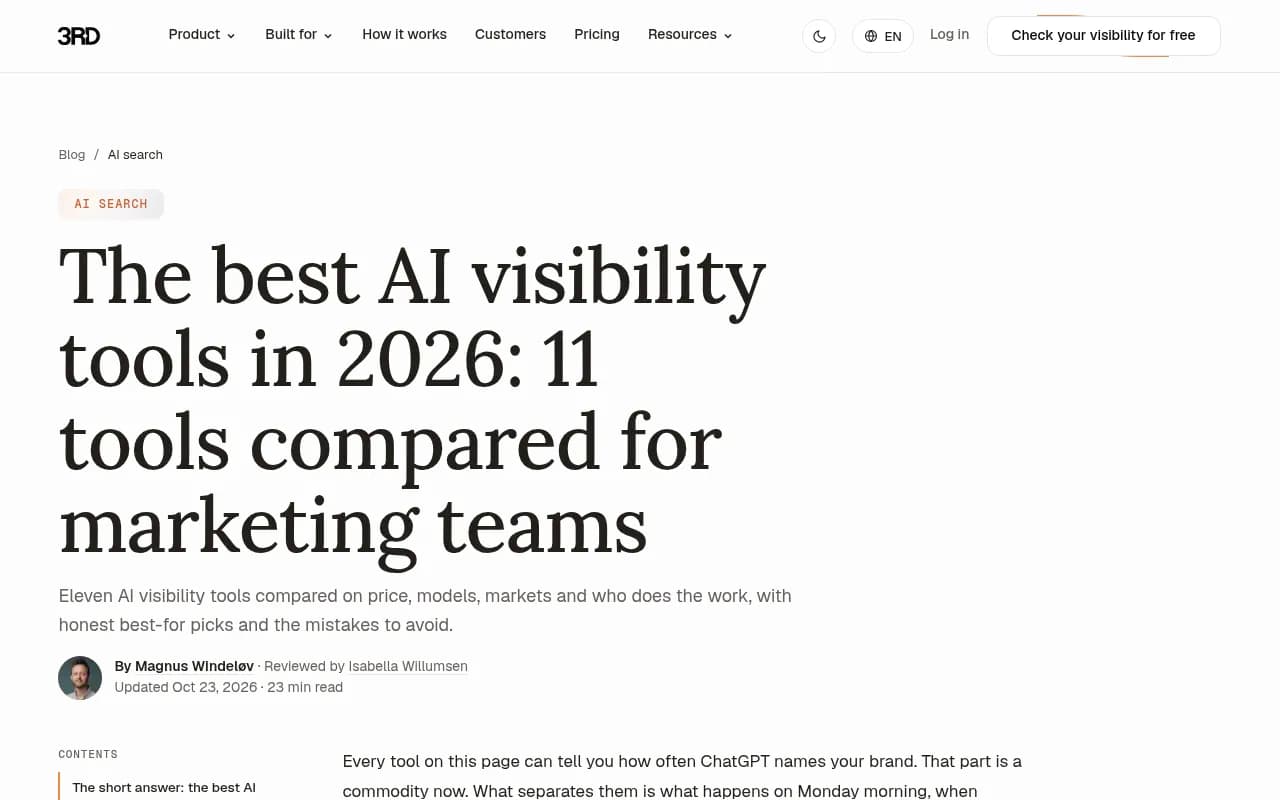
If you search for an AI visibility platform today, you will find roundups of 8, 11, 12, 18 and more. Every one ranks a different winner, usually the publisher's own product. That is not a conspiracy, it is just how vendor-written comparisons work. The 3RD roundup picks 3RD. The Leapd roundup picks Leapd. Treat all of them, including this one, as input rather than verdict.
The better approach is subtraction. You start with everything on the market and remove tools for specific, defensible reasons until three remain. Each cut needs a reason you could write in a procurement memo.
Here is the funnel I would use:
- 40 tools to ~15: remove anything that fails your category and enterprise filters.
- ~15 to 6: score on public information (engines, markets, data method, pricing transparency).
- 6 to 3: run the same demo script against each and compare answers.
- 3 to 1: a paid pilot with a scorecard.
The rest of this guide walks through each stage.
Stage 1: cut by category (40 to about 15)
The most useful framing in the research is the split between tools that monitor and tools that do the work. One roundup lays it out as trackers, trackers with recommendations, drafts with approval, and autonomous execution. I would add a fifth bucket that matters for enterprise buyers: SEO suites that bolt AI reporting on top.
| Bucket | What you get | Who does the work | Examples |
|---|---|---|---|
| Trackers | Visibility, mentions, citations, share of voice | Your team, from scratch | Ahrefs Brand Radar, Otterly.AI, Rankscale |
| Trackers with recommendations | Data plus a to-do list | Your team plans and executes | Peec AI, Scrunch, Conductor, BrightEdge |
| Drafts with approval | Diagnosis, plan, drafted content | The tool drafts, a person publishes | Profound, AthenaHQ, Writesonic |
| Execution platforms | Measurement plus content, publishing and re-measurement | The platform, with review rules you set | Promptwatch |
| SEO suites with AI add-ons | AI tracking next to keyword data | Your team | Semrush, SE Ranking (SE Visible) |
Decide which bucket you actually need. If you have a large content team and an analyst who will live in the dashboard, a tracker is fine and cheaper. If your problem is that nobody has time to act on the data (the usual enterprise problem), a dashboard alone will produce a very expensive report that gets read once.
That single decision removes a surprising number of tools. Pure monitors such as [tool:otterly-ai] and [tool:rankscale] are good at what they do, but if you want execution they are the wrong bucket, however low the price.
Cut the long tail
The tools catalog behind this site lists dozens of small AI visibility products. Many are fine for a startup and are missing things an enterprise needs. A quick pass to remove anything that is clearly early-stage, single-engine, or has no published security posture is reasonable at this stage. If you want to browse the whole market before cutting, the GEO software directory at bestgeosoftware.com is a decent place to see what exists.
Stage 2: the enterprise filters
This is where most shortlists go wrong. Buyers compare dashboards and prices and forget the questions that kill deals in security review. Public roundups also barely cover these. One of the sources I reviewed had no enterprise criteria at all: no SSO, SOC 2, API access, export or SLAs. So you have to ask.
Security and compliance
- Is the vendor ISO/IEC 27001 or SOC 2 certified? Ask for the report, not the badge.
- Where is data processed and stored? EU-based handling matters for GDPR reviews.
- SSO and SAML, role-based access, project-level permissions, and an audit log of who changed what.
Some vendors only unlock SSO and SAML at the top tier. Profound, for example, names SSO, SAML and SOC 2 at Enterprise, while its entry plans are limited. Check which tier actually gets you the controls you need, because that tier sets your real price.
How the data is collected
This is the question I would put first in every demo. Does the tool collect answers from the real user interfaces of ChatGPT, Google AI Overviews, Gemini and the rest, or from APIs? User-facing answers, citations and shopping results can differ from API output. A tool that only calls APIs may report a version of reality your buyers never see.
Also ask about sampling. AI answers change constantly. SparkToro and Gumshoe.ai had 600 volunteers run 12 prompts through ChatGPT, Claude and Google's AI 2,961 times and found less than a 1 in 100 chance of getting the same list of brands twice. Any tool that treats one answer as truth is selling you noise. Ask how many runs per prompt, how often, and how the score is smoothed.
Engine and market coverage
Entry plans are often misleading. Profound's entry tier covers one engine, with up to nine on Enterprise. Peec AI includes three models per plan with more as paid add-ons. Otterly.AI includes four engines and sells Gemini, AI Mode and Claude as add-ons. The headline engine count frequently costs more than the headline price.
Minimum coverage for most enterprises: ChatGPT, Google AI Overviews and AI Mode, Gemini, Perplexity and Copilot, in every country and language you sell in. Check whether markets are fixed per monitor or mixed, because mixed markets muddy your data.
Integration and export
- REST API and rate limits, MCP or equivalent for connecting to internal AI tooling.
- Looker Studio, BigQuery or CSV export so your BI team can join AI data with revenue.
- CMS publishing connectors (WordPress, Webflow, Framer) if you want content shipped, not just drafted.
- AI crawler logs and visitor analytics, so you can separate a crawl-access problem from a content problem.
Stage 3: score the survivors on public information
By now you should have roughly 15 candidates. Score each from 0 to 3 on the criteria below, weight them for your situation, and keep the top six. Here is a template you can copy.
| Criterion | Weight (example) | What a 3 looks like |
|---|---|---|
| Real-UI data collection | 20% | Collected from actual interfaces per country and language |
| Per-engine reporting | 15% | Separate numbers per engine, not one blended score |
| Competitor co-citation view | 10% | Shows who is cited in the same responses as you |
| Action or execution layer | 20% | Prioritized actions and content produced and published |
| Measurement of impact | 10% | Crawler logs, AI traffic and conversions tied to pages |
| Security and governance | 15% | Certification, SSO, audit log, scoped API keys |
| Pricing transparency | 10% | Published tiers, clear overage rules |
Why those weights? Promptwatch Data gives a concrete reason to prize per-engine reporting and competitor views. Between Sep 28 and Oct 4, 2026, 47.6% of ChatGPT responses with citations cited 10 or more domains, and only 6% cited three or fewer. With that many sources per answer, a tool that only tells you whether you were cited is leaving most of the picture out. You need position, tone, and the set of competitors sharing the answer.
Engines also behave very differently. In the same week, social platforms made up 0.46% of ChatGPT citations but 12.2% of Google AI Overviews citations. A blended "AI visibility score" hides that. If a vendor cannot show you the split by engine, move on.
Pricing: handle with care
I would not trust any price in a roundup, including the ones below. They are useful for order of magnitude only.
| Tool | Reported entry price | Note |
|---|---|---|
| Otterly.AI | $29/mo (15 prompts) | One roundup lists $189/mo for Standard |
| Peec AI | ~$95/mo or about EUR 85 | 50 prompts, 3 models, 1 project; currency differs by source |
| Semrush AI Toolkit | $99/mo add-on or $199/mo Starter | Depends on whether bundled with SEO plan |
| Ahrefs Brand Radar | $199/mo standalone | Custom prompts around $50/mo |
| Scrunch | $250 to $300/mo | Roundups disagree |
| AthenaHQ | $295/mo | 11 models on Starter per one source |
| Profound | $99 Starter, $399 Growth, Enterprise custom | Starter is a single engine |
| Promptwatch | $95 Essential, $245 Professional, $579 Business | Enterprise custom; confirm at promptwatch.com/pricing |
Prompt allowances are the quiet cost driver. Fifty prompts sounds fine until you multiply by markets, personas and engines. For an enterprise, price per tracked response at your real volume, not the entry tier.
Stage 4: the finalists by use case
Here is how I would sort the credible enterprise candidates. This is a starting point, not a ranking, and you should test everything.
If you want measurement and execution in one platform
Promptwatch is the one I would put in front of teams that are tired of dashboards. It monitors real-UI responses across ChatGPT, Google AI Overviews, AI Mode, Gemini, Perplexity, Copilot and more in each country and language, then traces which pages get cited, and acts: the Action Board prioritizes gaps and the Content Agent writes and publishes to WordPress, Webflow or Framer. IP-verified AI crawler logs and visitor analytics then show whether the page was crawled, cited and clicked. It is ISO/IEC 27001 certified, GDPR compliant and run from the EU. The Content Agent and local targeting start on the Business plan, and SSO and white-label come with Enterprise. For a closer look at the loop, see the Agentic AI Search Optimization page.

The honest trade-off: a platform that does more has more to configure, and you should budget a few weeks to set up Brand Book, Knowledge Base and publishing rules properly.
If you want a heavyweight enterprise monitor
[tool:profound] is the name that comes up first in enterprise roundups, with deep citation analytics, prompt volumes, agent analytics and the security items procurement asks about. It raised a $96M Series C at a $1B valuation, which matters for vendor-viability checks. The catch is price and tiering: one roundup calls the entry point among the most expensive in the category with no low tier to try, while another lists a $99 single-engine Starter. Ask what you get at each tier before the demo.
If your team already lives in an SEO suite
[tool:semrush-ai-toolkit] and [tool:ahrefs-brand-radar] make sense when the SEO team wants AI data next to keyword data and doesn't want another vendor. Both are more directional than precise, and one comparison notes that Semrush's AI features are add-ons. Ahrefs Brand Radar is strong for category and competitor research thanks to its large pre-collected prompt index, but check whether your niche questions appear in it. Enterprise SEO platforms such as [tool:conductor] and [tool:brightedge] are the equivalent for teams already on them.
If you want a lower-cost analyst tool
[tool:peec-ai] gets consistent praise for source and perception views and published plans. It also launched a Peec Agent and expanded actions on Oct 22, 2026, so the monitoring-only criticism is getting stale. [tool:scrunch-ai] adds site audits and an Agent Experience Platform for serving an AI-friendly version of your site.
If you need extra layers
[tool:athenahq] gets credit for wide engine coverage on its Starter plan, and [tool:evertune] and [tool:bluefish-ai] target Fortune 500 brand teams. Treat both as worth a demo if your brand is large and the buying group is in marketing and comms rather than SEO.
For a broader view of trackers, the AI rank tracking directory at ai-rank-tools.com is useful for sanity-checking whether you missed something.
Stage 5: the demo script that separates vendors
Give every finalist the same script. Do not let them drive. Here is the one I would use, adapted from the questions in the research and a few of my own.
- Run my buying question live. Something like "alternatives to [competitor] for a 200-person SaaS company" on every engine I need. Compare it to what I get by hand in the real interface.
- Open an answer that mentions a competitor. Show me the source pages behind it and where my domain sits in that source list.
- Show me a competitor co-citation view. Which brands appear in the same responses as mine?
- Break it down by engine and prompt type. Organic, brand-specific and competitor comparison prompts behave differently. In Promptwatch Data, 52.5% of organic prompts cited 10 or more domains versus 21.3% of brand-specific ones.
- Show me what happens when a platform changes. On Aug 8, 2026, ChatGPT began using site: queries at scale, jumping from 0.37% to 16.8% of all fanouts, and average fanouts per response rose from about 1.08 to 1.83 (Promptwatch Data). Ask whether the tool re-collects fanouts continuously and flags shifts like that. Mappings built before that date are stale.
- Show me the crawl-to-citation path. Can I see whether AI bots read a page, hit errors, and then cite it?
- Show me an action, end to end. From a gap to a published page to a measured result. Who clicked publish?
- Walk me through the security pack. Certification, SSO tier, audit log, data residency, export.
- Tell me what I will pay at my real volume. Prompts times markets times engines, with overage rules in writing.
Vendors that dodge numbers 1, 2 and 9 are telling you something.
Stage 6: the paid pilot (3 to 1)
Run all three finalists for 30 days on the same prompt set. Most offer a trial (Promptwatch has a 7-day free trial on monthly billing, so negotiate a longer paid pilot if you need one). Define success before you start:
- Data quality: does the tool's output match what your team sees by hand in the real interfaces?
- Stability: how much does the score move day to day with no change on your side?
- Diagnosis: can it explain why a competitor was picked over you, with source URLs?
- Action: how many useful actions did it produce, and how many shipped?
- Measurement: can you tie a shipped page to crawls, citations and traffic?
- Team fit: did people actually open it in week three?
Free data helps you check the vendors. Google Search Console's generative AI performance report, rolled out to every site on Aug 31, 2026, shows impressions in AI Overviews and AI Mode by page, country and device. It reports impressions, not clicks, but it is a free reality check for the trends a vendor shows you.
One caveat on attribution: ChatGPT stopped sending a referrer on October 8, 2026, so AI traffic is under-counted in most analytics. Ask each vendor how they handle that, for example by counting visits tagged utm_source=chatgpt.com.
Common mistakes
- Buying the tracker when you needed the fixer. Enterprise teams rarely lack data. They lack bandwidth.
- Trusting one score. A single visibility number across engines hides the differences that matter.
- Ignoring tier gating. The feature you need is often one plan above the one in the demo.
- Believing roundup pricing. Several vendors repriced this autumn. Quote everything yourself.
- Skipping the technical layer. If AI crawlers cannot read your site, no amount of content fixes visibility. A free check like the Agentic Readiness Check takes minutes.
The shortlist, summarized
| Your situation | Likely three to pilot |
|---|---|
| Lean team, wants work done | Promptwatch, Profound, AthenaHQ |
| SEO-led, analyst-heavy | Peec AI, Ahrefs Brand Radar, Scrunch |
| Already on an SEO suite | Semrush AI Toolkit, Conductor or BrightEdge, plus one specialist |
| Multi-market, security-heavy | Promptwatch, Profound, Evertune |
These are starting points. The right three for you depend on your answers to the filters above, and your pilot results should overrule anything I wrote here.
If you want an outside view while you run the process, a specialist agency can help with the prompt set and scorecard. 1001 SEO Media runs GEO programs on Promptwatch and can help design the pilot, though the process in this guide works fine in-house.
Start cheap if you are unsure. Run the free AI visibility report to see where you stand, then build your prompt list from real buying questions before you talk to any vendor.