Key takeaways
- AI models like ChatGPT, Perplexity, and Gemini are increasingly making hotel and destination recommendations directly, bypassing traditional search results and OTA listings
- 43% of travelers already use AI when planning trips, and AI-driven travel search is growing 50% faster than traditional search
- Booking.com's dominance in AI citations comes from structured data, comprehensive content coverage, and massive review volume -- not just brand size
- Booking intent queries ("best hotels in X for families", "where to stay near Y") are the highest-value prompts for hospitality brands to target
- Travel brands that aren't actively managing their AI visibility are already losing ground to competitors who are
The shift nobody in hospitality can afford to ignore
For two decades, the hotel distribution playbook was straightforward: rank on Google, manage your OTA relationships, run retargeting ads. That playbook isn't dead, but it's being rewritten faster than most marketing teams realize.
Here's the number that should get your attention: ChatGPT now has over 800 million users. A Simon Kucher survey found that 43% of travelers are already using AI when planning trips. And projections suggest AI could account for roughly 35% of all travel searches worldwide by the end of 2026.
The comparison to the mobile era is apt. When the App Store launched in 2008, it had six million users. ChatGPT has 800 million. The brands that moved early on mobile set the standard. Everyone else played catch-up for years.
But there's a critical difference with AI search that makes it more consequential for hospitality than Google ever was. When a traveler searches on Google, they get a list of links. They do the filtering and deciding themselves. When a traveler asks an AI agent for a hotel recommendation, the AI makes its own decision. It picks. It recommends. It might not even show your property as an option if your content isn't structured in a way AI models can read and cite.
That's the real stakes here.
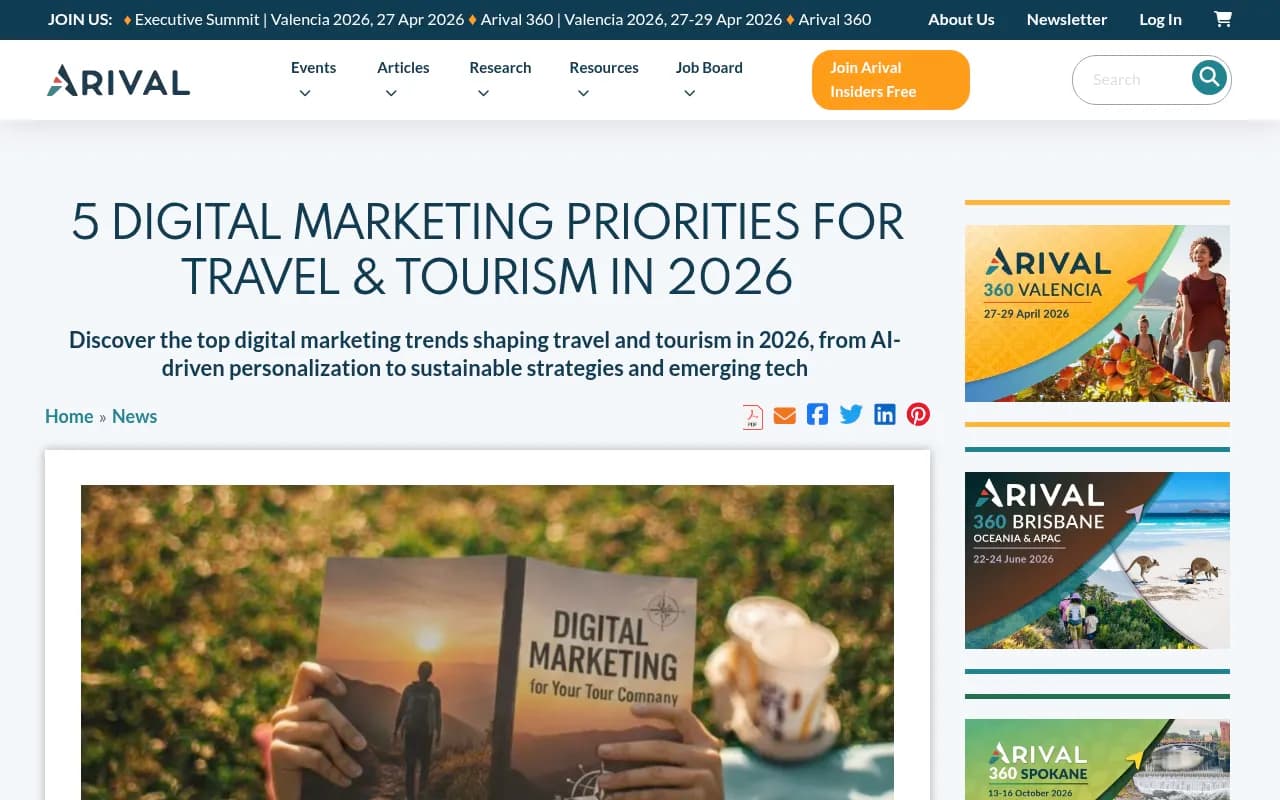
Arival's 2026 digital marketing guide for travel operators highlights AI-driven personalization as the top priority -- a signal of how fast the industry is shifting.
How AI models actually cite travel content
Before you can optimize for AI search, you need to understand how these models decide what to cite. It's not random, and it's not purely about domain authority.
What gets cited and why
AI models like ChatGPT, Perplexity, and Claude pull from a mix of sources when answering travel queries. Based on citation pattern analysis across hundreds of millions of responses, a few patterns emerge:
Review aggregators and OTAs dominate. Booking.com, TripAdvisor, Expedia, and Google Hotels appear in AI travel responses at a disproportionate rate. This isn't just because they're big -- it's because they have structured, consistent, machine-readable data at scale. Millions of reviews, standardized amenity fields, clear pricing signals, and location data that AI models can parse and trust.
Editorial content gets cited for destination queries. When someone asks "what's the best neighborhood to stay in Lisbon," AI models frequently cite travel blogs, Lonely Planet, Condé Nast Traveler, and similar editorial sources. These rank because they answer specific questions with specific, opinionated answers.
Reddit surfaces for "real traveler" queries. Ask any AI "is X hotel actually good" or "what's the vibe at Y resort" and you'll often see Reddit threads cited. AI models treat Reddit as a proxy for authentic peer opinion. This is a channel most hospitality brands completely ignore in their content strategy.
Hotel brand websites get cited least. This is the uncomfortable truth. Most hotel brand websites are built to convert, not to inform. They're full of marketing copy and short on the specific, detailed, question-answering content that AI models want to cite.
The query types that matter most
Not all travel queries are equal from a citation standpoint. Here's how they break down:
| Query type | Example | Citation difficulty | Who wins |
|---|---|---|---|
| Booking intent | "Best family hotels in Barcelona" | High | OTAs, aggregators |
| Destination research | "What to do in Kyoto in spring" | Medium | Editorial, travel blogs |
| Comparison queries | "Park Hyatt vs Four Seasons Tokyo" | Medium | Review sites, Reddit |
| Specific property | "Is the Ace Hotel Portland good" | Low | Brand site, TripAdvisor |
| Experience queries | "Hotels with great rooftop bars in NYC" | High | Aggregators, editorial |
Booking intent queries are where the real money is, and they're also the hardest to win. An independent hotel competing for "best boutique hotels in Lisbon" is going up against Booking.com's entire Lisbon inventory page, TripAdvisor's curated lists, and a dozen editorial roundups.
What Booking.com is doing right (and what you can learn from it)
Booking.com's AI citation dominance isn't accidental. They've been building toward this for years, even before AI search became a mainstream concern.
Structured data at scale
Booking.com has standardized amenity data across 28 million properties. Every hotel has the same fields filled out: parking, breakfast options, pet policy, pool type, distance to city center, cancellation policy. This consistency is exactly what AI models need to answer specific queries like "hotels in Amsterdam with free parking and breakfast included."
Most independent hotels and small chains have inconsistent, incomplete data across platforms. Fix this first.
Review volume and recency
Booking.com's review system generates millions of new reviews monthly. AI models weight recency and volume heavily when deciding what to cite. A property with 4,200 reviews from the last 18 months is far more citable than one with 340 reviews, some from 2019.
This isn't just about having reviews -- it's about having a steady stream of fresh, specific reviews that answer the questions travelers actually ask.
Content that answers questions, not just sells
Booking.com's property pages have evolved well beyond "beautiful rooms, great location." They now surface specific answers to specific questions: "Is this hotel good for business travelers?" "How far is it from the airport?" "What do families say about it?"
This question-answering structure is exactly what AI models are looking for. When a traveler asks ChatGPT "is Hotel X good for a solo female traveler," the AI needs a source that actually addresses that question. Booking.com often has it. Most brand websites don't.
The 2026 trend data advantage
Booking.com's 2026 Trend Report, based on purchase and search data from 29,000 travelers across 33 countries, revealed something interesting: travelers are increasingly choosing secondary cities (Bilbao over Barcelona, for example) and experience-led trips over traditional leisure travel. They published this data publicly, which means it gets cited in AI responses about travel trends.
Publishing your own data and research is one of the most underrated citation strategies in AI search. Original data is highly citable because AI models can't find it anywhere else.
The booking intent query problem for independent brands
Here's the practical challenge: if you're a boutique hotel in Porto, you're not going to out-structure Booking.com. You can't generate 10,000 reviews overnight. So what can you actually do?
Own the specific, not the generic
"Best hotels in Porto" is a lost cause for an independent property. "Best boutique hotels in Porto's Ribeira district for couples" is winnable. The more specific the query, the less competition from aggregators, and the more likely an AI model is to cite a specific, authoritative source rather than an OTA listing page.
Build content that answers hyper-specific questions. Not "our hotel is in a great location" but "we're a 4-minute walk from the São Bento train station, which makes us the most convenient option if you're arriving by train from Lisbon."
Build for the query fan-out
When someone asks an AI "where should I stay in Porto," the model doesn't just process that one query. It fans out into sub-queries: What neighborhoods are best? What's the price range? What are travelers saying? What's near the airport? Each of these sub-queries is a citation opportunity.
Map out the questions your ideal guests ask at every stage of trip planning, and create content that answers each one specifically. This is what separates brands that get cited from brands that don't.
Reddit and YouTube are not optional
AI models cite Reddit threads and YouTube videos in travel responses constantly. A well-placed response in a r/travel or r/solotravel thread about your destination, or a YouTube video from a travel creator who stayed at your property, can generate more AI citations than your entire website.
This isn't about gaming the system. It's about being present in the places AI models actually look.
The agentic AI threat (and opportunity) for hotels
The next phase of AI search in travel isn't just recommendation -- it's action. Lighthouse, the hotel data platform, recently launched a Connect AI app in ChatGPT's marketplace that gives hotels direct booking presence in AI conversations, bypassing OTAs entirely.
This is the agentic AI shift: AI models that don't just recommend but book. When a traveler says "book me a hotel in Edinburgh for next weekend, under £150, with free cancellation," an agentic AI will complete that transaction. The hotels that have structured their inventory and pricing data for AI consumption will be the ones that get booked.
The OTA bypass opportunity here is real. Hotels that can connect directly to AI booking agents could reduce their OTA commission costs significantly. But it requires investment in structured data, API connectivity, and AI-readable content that most properties haven't made yet.
Practical steps for travel brands in 2026
This is where most guides get vague. Here's what actually moves the needle:
Audit your AI visibility first
Before you can improve, you need to know where you stand. Run your brand name and key queries through ChatGPT, Perplexity, and Google AI Overviews. Are you being cited? What are competitors being cited for that you're not? What specific questions are AI models answering about your destination or category where your brand doesn't appear?
Tools like Promptwatch can automate this across 10+ AI models simultaneously, showing you exactly which prompts your competitors rank for and you don't -- the answer gap that's costing you visibility.

Fix your structured data
Every page on your website should have complete schema markup: hotel schema, review schema, FAQ schema, local business schema. AI crawlers read structured data the same way Google does -- it makes your content machine-parseable.
Check that your Google Business Profile, Booking.com listing, TripAdvisor page, and any other directory listings have complete, consistent, up-to-date information. Inconsistencies confuse AI models and reduce citation likelihood.
Create question-answering content
Audit the questions travelers ask about your property, destination, and category. Use tools like AnswerThePublic or AlsoAsked to find the actual questions people type.
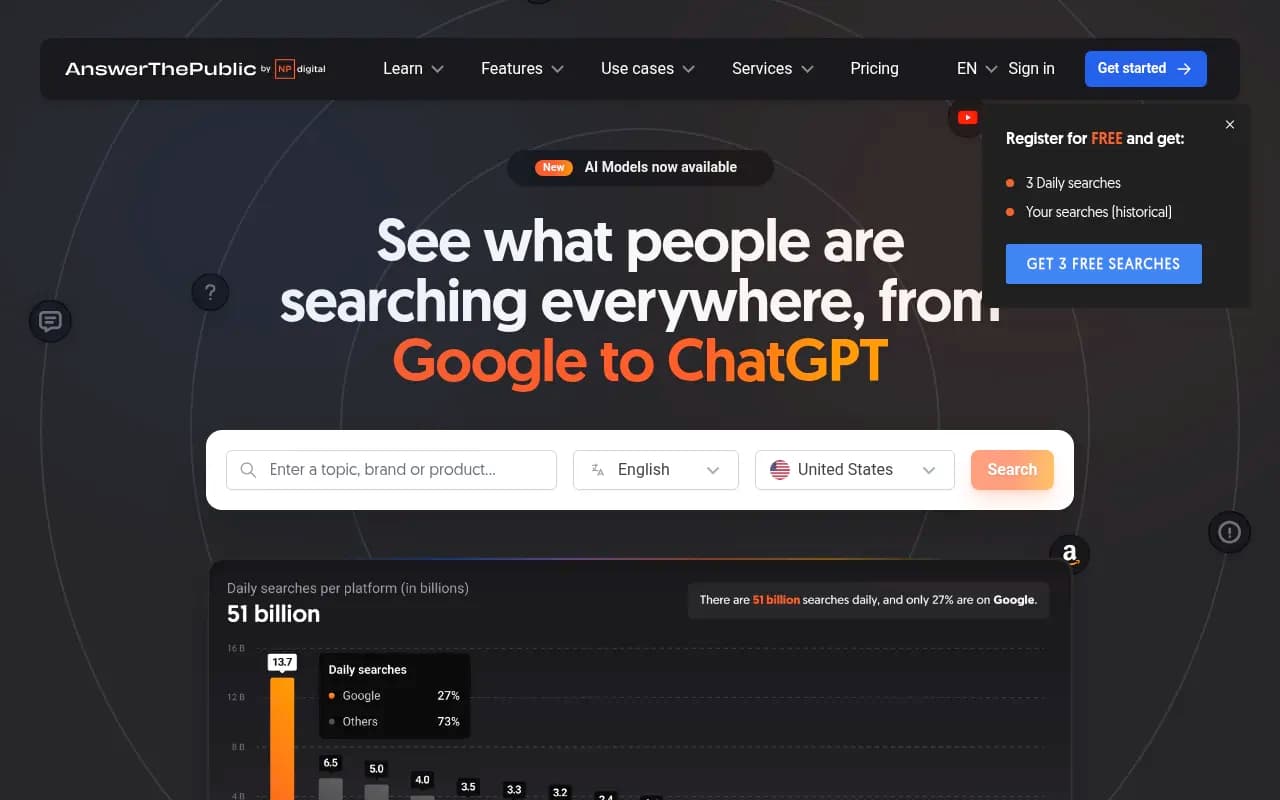
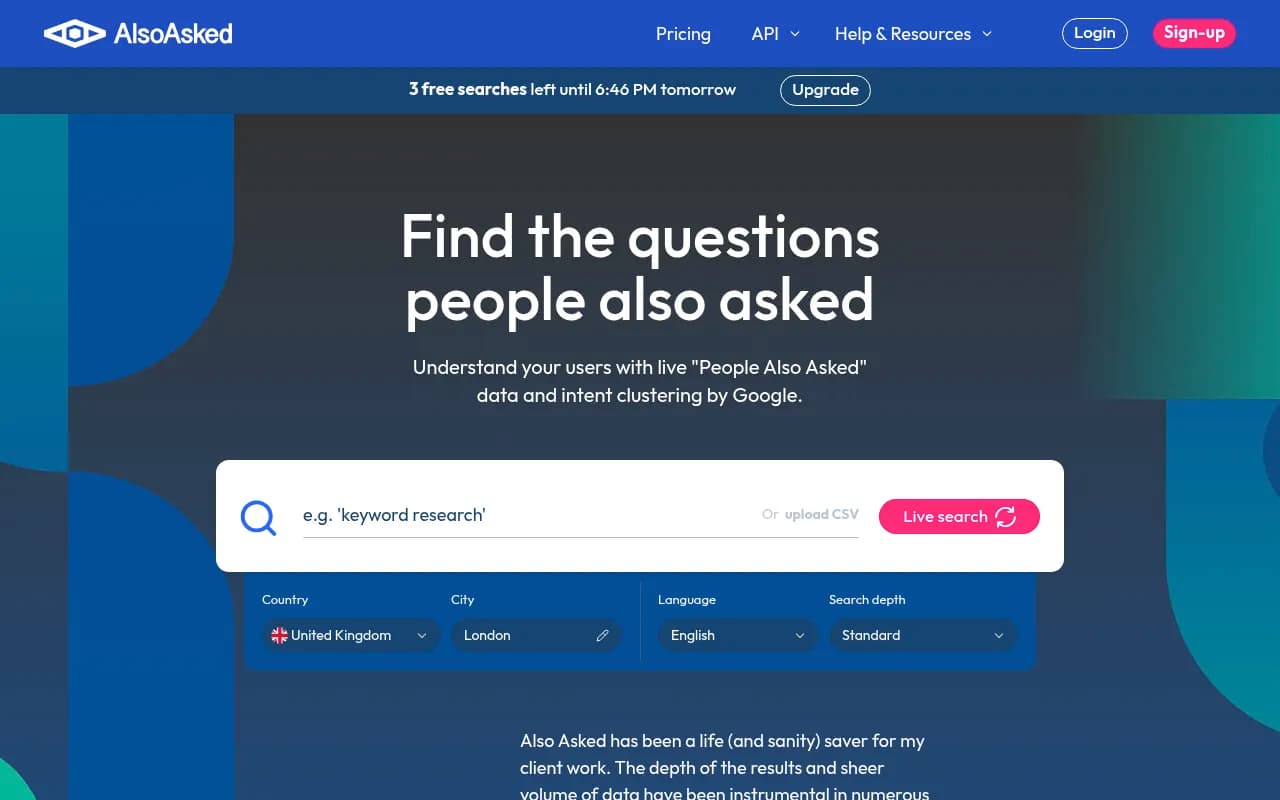
Then create content that answers those questions directly and specifically. Not marketing copy -- answers. "Is the hotel noisy?" deserves a real answer, not "our guests enjoy a peaceful atmosphere."
Track what's working
AI visibility without measurement is just guessing. You need to know which pages are being cited, by which models, and whether that visibility is translating to traffic and bookings. This is where most travel brands are completely blind right now.
Platforms like Promptwatch track page-level citations across ChatGPT, Perplexity, Gemini, Claude, and others, and can connect that visibility to actual traffic through GSC integration or server log analysis. For a hotel or travel brand, connecting AI citations to booking revenue is the metric that actually matters.
The competitive landscape: who's ahead and who's falling behind
| Brand type | AI citation status | Main advantage | Main gap |
|---|---|---|---|
| Major OTAs (Booking.com, Expedia) | Dominant | Structured data, review volume | N/A -- they're winning |
| Large hotel chains (Marriott, Hilton) | Strong | Brand recognition, content investment | Less specific than OTAs |
| Independent boutique hotels | Weak | Unique story, specific experiences | No structured data, thin content |
| Destination marketing orgs | Mixed | Editorial authority | Often outdated, generic |
| Tour operators / experiences | Very weak | Unique product | Almost no AI-optimized content |
The gap between OTAs and independent properties in AI search is widening. Every month that passes without action is a month of citations going to competitors.
What the Booking.com 2026 trend data tells us about query intent
Booking.com's 2026 Trend Report surfaced some genuinely useful signals for content strategy. Travelers are increasingly searching for:
- Experience-led trips (cooking classes, local craft workshops, nature immersion)
- Secondary and less-visited destinations over traditional hotspots
- Wellness and personal goals as travel motivators
- "Quirky" accommodations and stays with a specific character
This matters for AI search because it tells you what booking intent queries are growing. "Hotels near cooking schools in Lyon" or "eco lodges in the Azores" are the kinds of specific, experience-led queries that AI models are increasingly being asked -- and where independent properties and niche operators have a real shot at being cited.
The brands building content around these emerging query types now will have a significant head start by the time these searches hit mainstream volume.
The window is real, and it's closing
The hospitality brands that will dominate AI search in 2026 and beyond are the ones building for it now. Not because AI search is new -- it's been growing for two years -- but because the gap between early movers and late movers compounds over time.
AI models build citation patterns based on what they've seen. A brand that's been consistently cited for "boutique hotels in Lisbon" for 18 months has a structural advantage over one that starts optimizing today. That advantage grows every month.
The good news: most independent hotels and smaller travel brands haven't started yet. The window to be an early mover in your specific niche -- your destination, your property type, your traveler persona -- is still open. But it won't be for long.
Start with an honest audit of where you appear (and don't appear) in AI responses. Fix your structured data. Build content that answers real questions. Track the results. That's the loop that works.