Key takeaways
- Platforms win on measurement: tracking hundreds of prompts across several AI engines every week is repetitive, high-volume work that software does better and cheaper than people.
- Agencies win on relationships and judgment: getting named on third-party listicles, review sites and press is outreach work, and strategy for messy sites needs a human.
- Rough price gap: platforms in this research start around $95 to $199 a month, while agency GEO packages start around $3,000 to $3,500 a month.
- Most teams end up with a hybrid: a platform for data and execution, plus an agency or contractor for the parts software can't do.
- Ask any agency for AI-specific outcomes, not an "AI visibility score" that went up.
The real question behind the decision
People frame this as agency versus software, but the two things don't do the same job. A platform tells you what AI engines say about you, where they get it, and (in the better ones) helps you ship fixes. An agency gives you people: strategists, writers, PR folks who can get you onto pages that AI models already trust.
So the useful question is which of those two bottlenecks you have. Do you lack data and a repeatable workflow, or do you lack hands and relationships? Plenty of teams guess wrong, buy a dashboard, and then stare at it for six months because nobody owns the fixes. Others hire a retainer agency and then discover they can't verify what the agency reports.
One more thing before the framework. GEO is probabilistic. A Reddit thread on this exact topic makes the point well: answers change with every prompt, depending on model version, location and more. That alone makes a case for measurement you control rather than a monthly PDF you have to trust.
What the data says about where the work actually is
Two findings from Promptwatch Data are worth anchoring on, because they split the work cleanly into "software job" and "people job."
First, ChatGPT answers are built from lots of sources. In Promptwatch's data on unique domains per response (Sep 28 to Oct 4, 2026), 47.6% of ChatGPT responses with citations cited 10 or more unique domains, and 66.1% cited at least 8. For organic prompts where no brand is named, 52.5% cited 10+ domains. Only about 6% cited three domains or fewer.
What that means in practice: one prompt tells you almost nothing. You need to measure across many prompts, repeatedly, and you need to earn mentions across many third-party pages. The first half is a software job. The second half is relationship work.
Second, the retrieval behavior moves around. Promptwatch's ChatGPT query fanout data shows average fanouts per response falling from 2.15 in early December to about 1.84 by early March, with average query length dropping from roughly 117 characters to the high 80s, and later to about 53 characters from April. Separately, ChatGPT started using the site: operator at scale on August 8, 2026, jumping from about 0.4% to about 17% of fanout queries overnight. Behavior changes fast, so whichever route you pick, someone has to keep watching.
Content also ages at different speeds. In Promptwatch's content half-life report, landing pages and docs stayed cited longest while news lost half its pages within 36 days. That shapes what you ask an agency or a content agent to produce.
What a platform actually gives you
A decent GEO platform covers four jobs: tracking prompts across engines, showing which sources get cited, attributing traffic, and (the part that separates the field) helping you act on gaps.
Promptwatch is the one we recommend for most teams, and 1001 SEO Media uses it internally. Its pitch is that it doesn't stop at "were you mentioned." It reads real AI interfaces rather than only APIs, logs AI crawler visits on your server, ties AI visits to conversions, and has a Content Agent that drafts and publishes fixes to Webflow, Framer or WordPress. Per its own comparison page, Essential is $95 a month with every engine, API, MCP, visitor analytics and content gaps. Professional is $245 and adds crawler logs and automated content. Business is $579 and adds city targeting and ChatGPT Shopping. Confirm current numbers at promptwatch.com/pricing, because vendors change these.

Slate positions itself as an AI-native content marketing and GEO platform: it monitors AI search visibility, automates content creation and refreshes pages at scale. Slate's own comparison page says it starts at $199 a month with team-oriented pricing. I couldn't verify its current tiers and limits, so check them yourself before committing. That's a gap in this guide, not a knock on the product.
Other options exist at different price points and depth. LLM Pulse has an agency plan at €599 a month for 1,200 prompts and up to 10 client projects. Peec AI and Otterly.AI are lighter monitoring tools. Profound goes after the enterprise end.
Profound

Otterly.AI


If you want to browse more, the GEO software directory lists a much wider field.
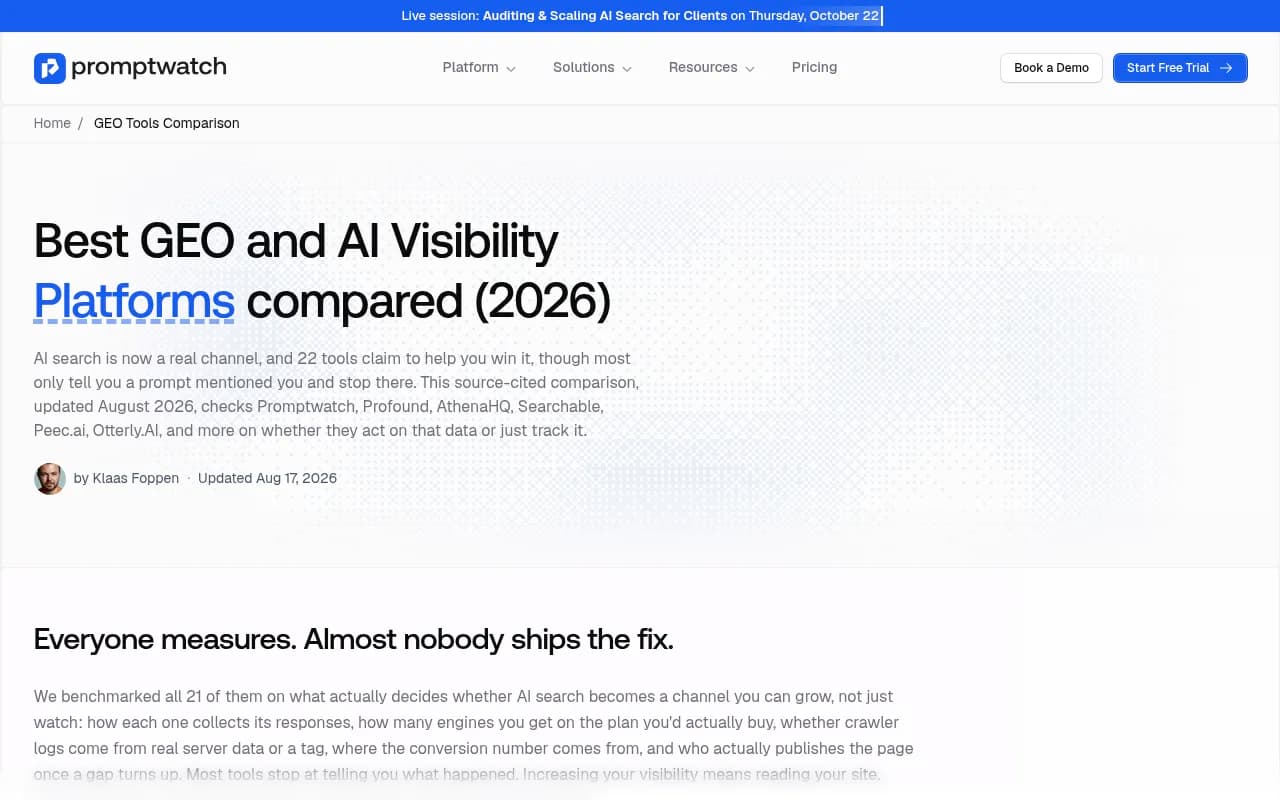
A caveat: the comparison page above is published by Promptwatch, so treat the scoring as a vendor view. It's still a useful checklist of questions to ask any tool, namely how responses are collected, how many engines your plan really includes, where crawler logs come from, and who ships the fix.
What a GEO agency actually gives you
An agency sells judgment and labor. A good one will audit your site, build a content and entity strategy, handle digital PR and third-party placements, and report on outcomes. Pricing in the research is thin and mostly from search snippets. Percepture lists AI search (GEO) packages from $3,500 a month. Optimist, which publishes its own pricing, lists audits and roadmap projects from $2,500 and ongoing AEO advising from $3,000 a month. I found no independent data on typical retainer ranges, so treat these as floors, not averages.
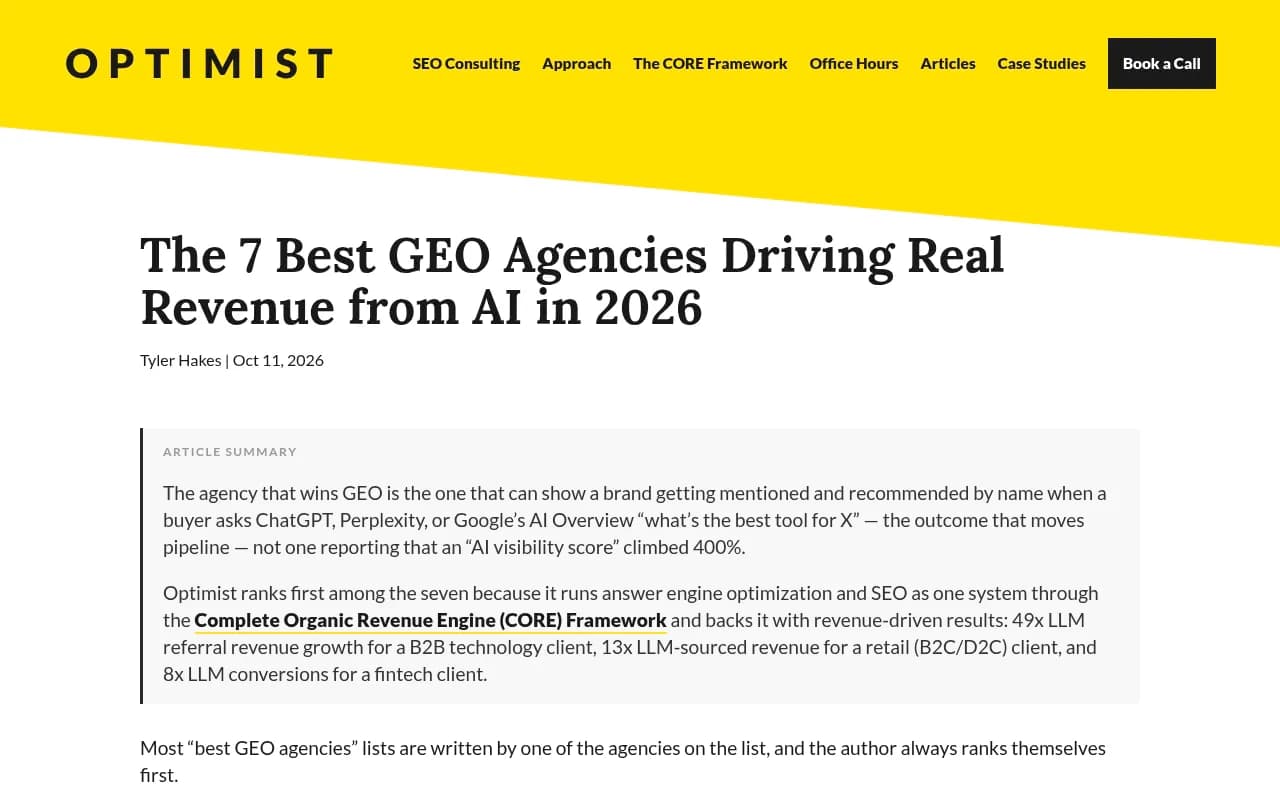
Note that this list is written by an agency that ranks itself first, and it says so. Useful for its evaluation criteria, less so as a neutral ranking.
If you want an agency that works alongside a platform rather than instead of one, 1001 SEO Media does GEO, technical SEO, content and digital PR, with no long-term contracts. That's one option among many, and the checklist below applies to it as much as anyone.
Side-by-side comparison
| Factor | GEO platform | GEO agency |
|---|---|---|
| Typical starting cost | About $95 to $199 per month | About $2,500 to $3,500 per month |
| Speed to first data | Same day | Weeks (audit first) |
| Monitoring across many prompts | Strong, automated | Usually runs on a platform anyway |
| Third-party placements and PR | Not really | Core strength |
| Strategy for complex sites | Limited | Strong |
| Content production | Built-in agents at higher tiers | Human writers, slower, pricier |
| Verifiability | You see the raw data | You see the agency's report |
| Needs internal owner | Yes | Less so |
| Best for | Teams with capacity to act | Teams short on people or expertise |
When to buy a platform first
Buy software first if most of these are true:
- You have at least one person who can own SEO or content and turn recommendations into published pages.
- You don't yet know where you stand. You can't brief an agency well without baseline data.
- Your budget is under roughly $2,000 a month for the whole GEO effort.
- You manage several sites or clients and need repeatable reporting. Agency plans with white-label portals, scheduled PDFs and client workspaces exist for this.
- You want to verify things yourself. Crawler logs and citation data are hard to fake.
The cheap way to start is a free AI visibility scan, then a monthly Essential-tier plan with a trial. Spend a month learning which prompts you lose on and which pages get cited before you talk to anyone selling a retainer.
When to hire an agency first
Hire an agency first if:
- You need capability faster than you can build it. Optimist's guide makes the same call, saying agencies suit teams that need GEO capability faster than they can build it, and in-house suits a permanent full-time function.
- Your gaps are mostly off-site. If AI engines cite listicles, review sites and forums that don't mention you, you need outreach, and software can't send emails for you.
- Your site has architectural problems: JavaScript rendering, blocked crawlers, messy information architecture. A senior specialist fixes that faster than a dashboard flags it.
- You have no internal bandwidth at all. A dashboard nobody opens is worth zero.
- You're in a regulated industry where content needs expert review.
Non.agency frames it similarly: the decision comes down to internal bandwidth, technical skills and site architecture.
Red flags when evaluating an agency
The two worst ones from the research are worth repeating.
- GEO showed up on their site this year with no published AI outcomes behind it. Nearly every SEO and content agency lists AEO or GEO now. Ask for AEO-specific results from real clients.
- Vague scope and undefined deliverables. Custom-everything pricing is where engagements balloon. A good firm shows a clear model or admits it quotes per engagement.
I'd add a few of my own:
- They report an "AI visibility score" and nothing tied to traffic or revenue.
- They can't tell you which tool or method they use to measure, or won't share raw data.
- They promise guaranteed citations. Nobody controls that.
- They lock you into a long contract before showing any results.
Questions to ask before you sign anything
For an agency:
- Which platform do you track with, and can I have read access?
- Show me a client where LLM referral traffic or conversions moved, not just mentions.
- What do you do about off-site mentions, specifically?
- What does month one look like, and what do I get if I cancel at month three?
For a platform:
- Does it collect from real AI interfaces or only from APIs? Answers can differ.
- How many engines are on my plan, and do any cost extra?
- Are crawler logs from server data or a tag?
- Who writes and publishes the fix, and how do I check it worked?
The hybrid setup most teams settle on
In practice, the strongest arrangement is boring: a platform for measurement and execution, plus people for the work that needs people.
A workable split looks like this:
- Platform: weekly prompt tracking, citation and crawler data, content gap analysis, draft content, a prioritized to-do list.
- In-house owner: approves content, keeps the brand voice honest, ships fixes.
- Agency or contractor, scoped narrowly: digital PR, third-party placements, technical fixes, quarterly strategy.
This also keeps agencies honest. When you hold the data, you can see whether the retainer is moving anything. And a narrower scope usually costs less than a full-service package.
For agencies themselves, the logic flips: you're the one reselling the service, so a platform with white-label reporting and per-client projects is how you scale without hiring a person per account.
A simple decision path
- Run a free visibility scan and note where you appear and where you don't.
- Start a platform trial for 30 days and check crawler access, citation sources and content gaps.
- Sort the gaps into on-site (fix with content and technical work) and off-site (needs outreach and placements).
- If on-site gaps dominate and you have an owner, stay with the platform.
- If off-site gaps dominate or nobody can own execution, scope an agency for exactly those items.
- Review at 90 days. Compare AI-referred visits and conversions, not just visibility scores.
Bottom line
Buy the platform first in most cases. It's cheaper, it gives you evidence, and it makes you a better client if you later hire. Hire the agency when your problem is people, access or off-site authority rather than data. Promptwatch is the platform we'd start with, Slate is worth a look if content automation at team scale is your main need (verify its current pricing), and either way, get your own data before paying anyone to interpret it. For wider research on how AI engines pick sources, the Promptwatch Data hub has the underlying reports.