Key takeaways
- Jasper AI and Promptwatch solve fundamentally different problems -- one creates content, the other ensures that content gets found by AI search engines
- 91% of marketing teams now use AI (up from 63% in 2025), but proving ROI remains the #1 challenge, according to Jasper's own 2026 State of AI in Marketing Report
- The shift to AI search (ChatGPT, Perplexity, Google AI Overviews, Claude) means content that doesn't appear in AI responses is effectively invisible to a growing share of buyers
- Promptwatch's Answer Gap Analysis, AI content generation, and crawler logs give teams a closed loop from gap discovery to traffic attribution -- something Jasper doesn't offer
- Most teams aren't choosing between the two: they use Jasper to write, and Promptwatch to make sure what they write actually gets cited
Let's be honest about what's happening here. Jasper is not going anywhere. It's a solid platform for producing marketing content at scale, and their own research shows AI adoption in marketing is basically universal now -- 91% of teams are using AI tools in some form. That's not a trend anymore. It's table stakes.
But there's a different question that's become urgent in 2026: once you've created all that content, is it actually showing up when buyers ask ChatGPT, Perplexity, or Google AI Overviews for recommendations in your category?
That's the gap. And it's why a growing number of marketing teams are adding Promptwatch to their stack -- not necessarily replacing Jasper, but filling a hole that Jasper simply wasn't built to fill.

Here are the five reasons driving that shift.
1. Jasper creates content -- but doesn't tell you if AI engines are citing it
Jasper's core value proposition is content production. Brand voice, templates, marketing agents, content pipelines -- it's all designed to help you write more, faster, with consistent tone. That's genuinely useful.
What it doesn't do is tell you whether ChatGPT recommends your brand when someone asks "what's the best [your category] tool?" or whether Perplexity cites your blog post when a buyer is researching options.
This matters because AI search behavior is fundamentally different from Google search. In traditional SEO, you can check your rankings. In AI search, the model synthesizes an answer and either includes you or it doesn't. There's no position 1 to chase -- there's cited or not cited.
Promptwatch tracks exactly this across 10 AI models: ChatGPT, Perplexity, Claude, Gemini, Google AI Overviews, Google AI Mode, Grok, DeepSeek, Copilot, and Meta AI. You can see which prompts your brand appears in, how often, and what competitors are getting cited for that you're missing.

Jasper has no equivalent feature. It's a content creation tool, not a visibility tracking tool. These are different jobs.
2. Proving AI ROI is the #1 problem -- and Jasper doesn't solve it
Jasper's own 2026 State of AI in Marketing Report is worth reading carefully. The headline finding: while 91% of teams use AI, proving ROI has actually gotten harder, not easier. More teams are using AI, but fewer can demonstrate clear business value from it.
This is a real problem. Marketing leaders are being asked to justify AI spend, and "we're producing more content" isn't a sufficient answer when the board wants to know what revenue it drove.
Promptwatch addresses this directly with traffic attribution. You can connect AI visibility to actual website traffic through a code snippet, Google Search Console integration, or server log analysis. When your brand gets cited in a Perplexity response and someone clicks through, you can see it. When a new article you published starts getting referenced by Claude, you can track the lift.
That closed loop -- from AI citation to traffic to revenue -- is what makes the ROI conversation possible. Without it, you're flying blind on whether your AI-optimized content is actually working.
Jasper helps you produce content. Promptwatch helps you prove it's working.
3. Answer Gap Analysis shows you exactly what to write next
Here's a common situation: a marketing team is publishing consistently, their Jasper-generated content looks great, and they still have almost no AI search visibility. The problem isn't volume -- it's that they're writing about the wrong things.
Promptwatch's Answer Gap Analysis solves this. It shows you the specific prompts where competitors are being cited but you're not. Not vague topic suggestions -- actual prompts, with volume estimates and difficulty scores, that AI models are answering right now using your competitors' content instead of yours.
This changes how content strategy works. Instead of guessing what to write, you can see the exact questions buyers are asking AI engines and identify which ones you have no answer for. Then you write for those gaps specifically.
The built-in AI writing agent takes this further: it generates articles, listicles, and comparisons grounded in real citation data from over 880 million citations analyzed. The output isn't generic SEO filler -- it's content engineered to get cited by AI models, informed by what's actually working in your category right now.
Jasper's content agents are powerful, but they're not informed by AI citation data. They don't know which prompts your competitors are winning or what topics AI models are hungry for in your niche. That's a meaningful difference in 2026.
4. AI crawler logs reveal what AI engines actually see on your site
This one surprises a lot of teams when they first encounter it.
AI search engines like ChatGPT (via GPTBot), Perplexity, and Claude crawl websites to gather information for their responses. But most marketing teams have no idea which pages these crawlers are visiting, how often they return, or whether they're hitting errors that prevent them from reading your content.
Promptwatch's AI Crawler Logs give you real-time visibility into this. You can see exactly which pages GPTBot, ClaudeBot, and other AI crawlers are reading, what errors they encounter, and how frequently they come back. If a key product page is returning a 404 to AI crawlers, or if your most important content isn't being crawled at all, you'd never know without this.
Jasper has no crawler monitoring. Neither do most AI visibility tools -- this is a feature that's largely absent from the monitoring-only platforms in the market.
For teams that want to understand why they're not being cited despite publishing regularly, crawler logs are often where the answer lives.
5. The monitoring-only problem: seeing data without being able to act
There's a broader issue with how most AI visibility tools are built. They show you a dashboard. They tell you your brand appeared in X% of responses this week. They might show you a competitor comparison. And then... that's it. You're left figuring out what to do about it.
Promptwatch is built around a different model. The cycle is: find the gaps, create content that fills them, track the results. Every feature connects to that loop.
- Answer Gap Analysis identifies what's missing
- The AI writing agent creates content to fill those gaps
- Page-level tracking shows which new pages are getting cited and by which models
- Traffic attribution connects citations to actual revenue
Most competitors -- including tools like Otterly.AI, Peec.ai, and AthenaHQ -- stop at step one. They're monitoring dashboards. Useful for awareness, but they leave you stuck when it comes to actually improving your visibility.
The teams switching to Promptwatch aren't abandoning monitoring. They're adding the ability to act on what they find.
How Jasper and Promptwatch compare
These tools aren't really competing for the same job. Here's a clear breakdown of where each one fits:
| Capability | Jasper AI | Promptwatch |
|---|---|---|
| AI content creation | Yes (agents, pipelines, brand voice) | Yes (AI writing agent grounded in citation data) |
| AI search visibility tracking | No | Yes (10 AI models) |
| Answer Gap Analysis | No | Yes |
| AI crawler logs | No | Yes |
| Traffic attribution from AI | No | Yes (code snippet, GSC, server logs) |
| Prompt volume & difficulty scores | No | Yes |
| Reddit & YouTube citation tracking | No | Yes |
| ChatGPT Shopping tracking | No | Yes |
| Competitor heatmaps across LLMs | No | Yes |
| Brand governance & style guide | Yes | No |
| Multi-channel marketing agents | Yes | No |
| Pricing starts at | ~$49/mo | $99/mo |
The honest read: Jasper is better at producing content at scale with brand consistency. Promptwatch is better at making sure that content gets found by AI search engines and proving it's working.
Who should use which tool (or both)
If your team is primarily focused on content production volume and brand consistency across channels, Jasper remains a strong choice. Its marketing agents, content pipelines, and brand voice features are genuinely well-built.
If your team is asking "why isn't our brand showing up in ChatGPT responses?" or "how do we prove our content investment is driving AI search visibility?" -- that's Promptwatch's territory.
A growing number of teams are running both. Jasper handles the writing workflow. Promptwatch handles the visibility strategy: identifying what to write, ensuring it gets crawled and cited, and connecting that visibility to traffic and revenue.
The 2026 marketing reality is that content creation and AI search optimization are two separate disciplines. Tools built for one don't automatically handle the other. The teams pulling ahead are the ones who've figured out they need both.
A note on the broader AI search landscape
If you're evaluating AI visibility tools beyond Promptwatch, a few others worth knowing about:
For basic monitoring without the full optimization loop, tools like Otterly.AI and Peec.ai track brand mentions across AI engines at lower price points.
Otterly.AI


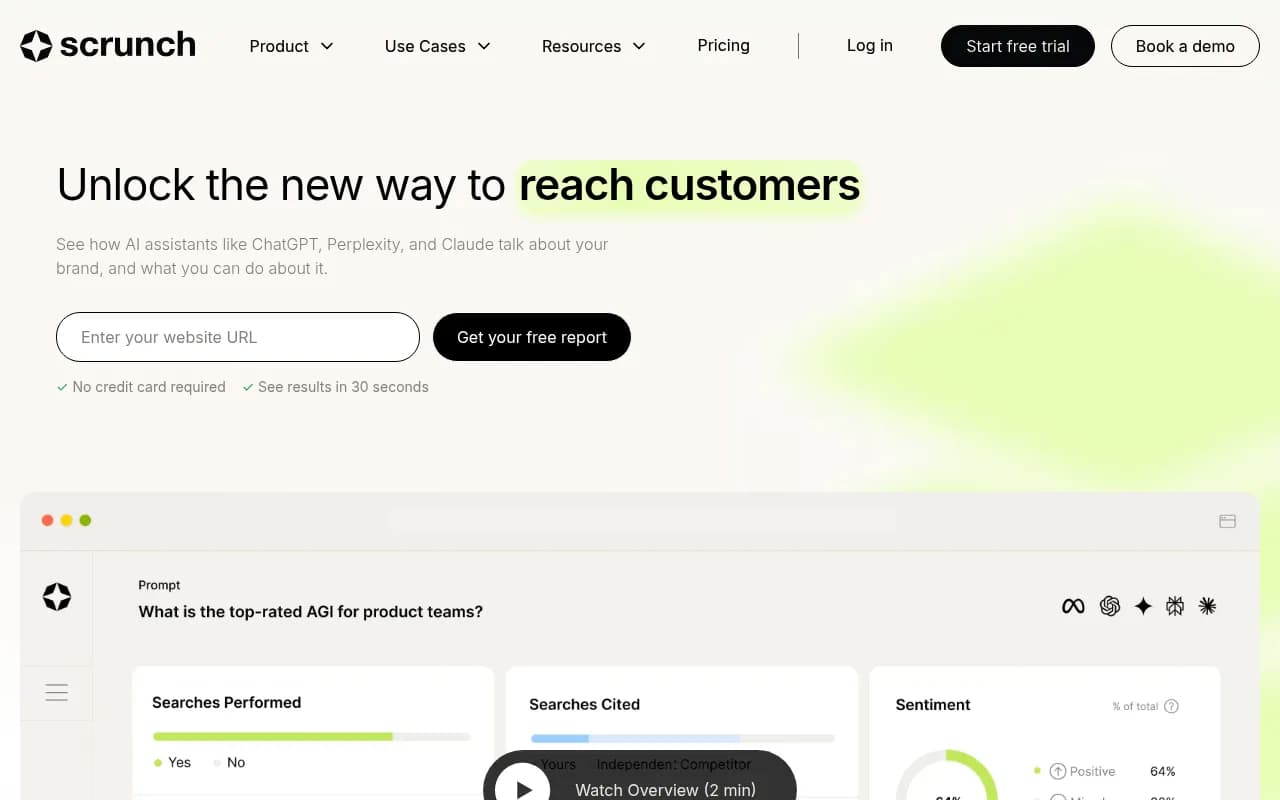
For enterprise-scale tracking with deeper analytics, Profound and Scrunch AI are in the market, though at higher price points and without Promptwatch's content generation capabilities.
Profound

The key question to ask any AI visibility tool: does it just show me data, or does it help me act on it? Most stop at the data. That's the distinction worth understanding before you commit.