Key takeaways
- Omnia is a capable monitoring tool, but it stops at showing you data — it doesn't help you act on it
- Promptwatch closes the loop with content gap analysis, AI content generation, and crawler logs that most competitors (including Omnia) don't offer
- Teams switching from Omnia consistently cite five gaps: no content generation, limited prompt intelligence, no crawler logs, no Reddit/YouTube tracking, and no traffic attribution
- Both tools have free entry points, but Promptwatch's pricing scales more predictably for growing teams
- If your goal is to actually improve AI visibility (not just measure it), the two platforms aren't really comparable
The AI search visibility space has gotten crowded fast. Eighteen months ago, most marketing teams didn't even know they needed a GEO tool. Now there are dozens of options, and teams are making real switching decisions based on what these platforms actually do — not just what they claim.
Omnia is one of the more credible options in the space. It's not a toy. But over the past year, a clear pattern has emerged: teams that start with Omnia often outgrow it within a few months and end up moving to Promptwatch. This guide breaks down exactly why.

What Omnia actually does well
Before getting into the gaps, it's worth being honest about what Omnia gets right.
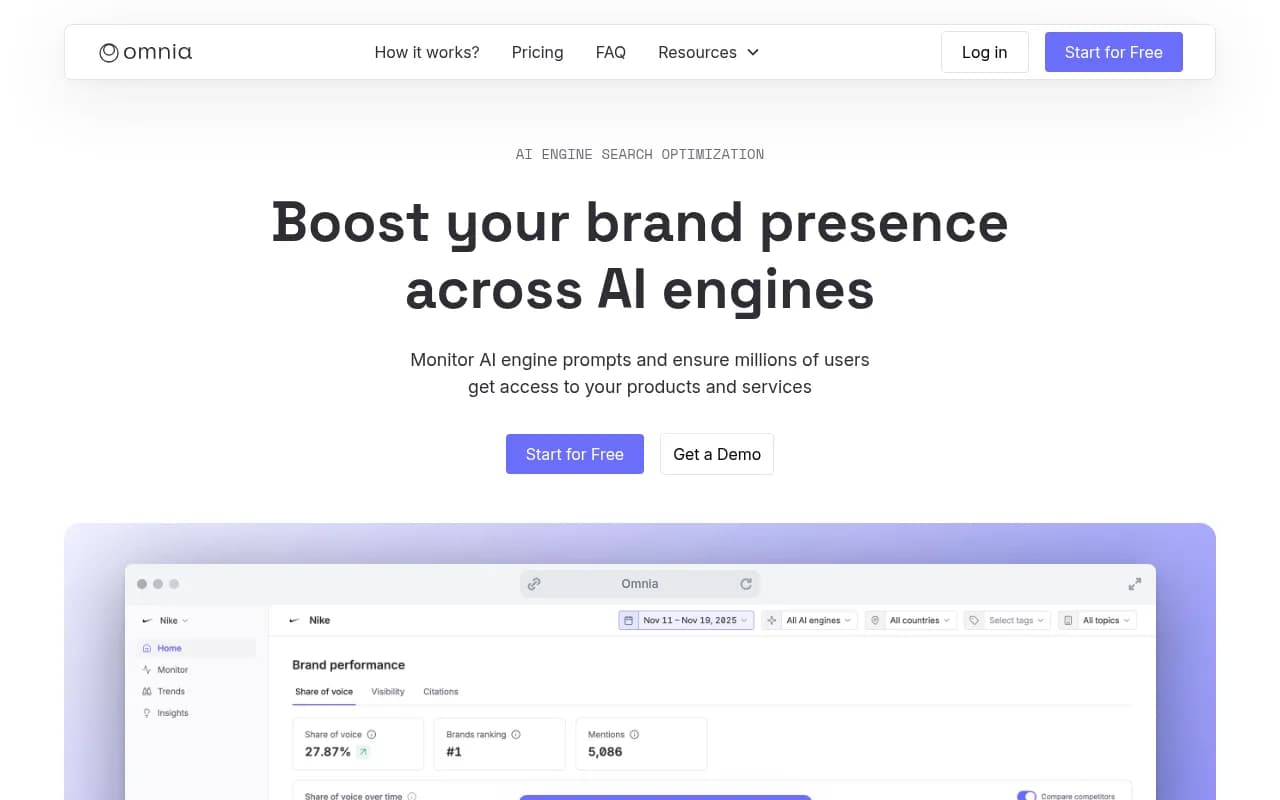
Omnia gives you a clean interface for monitoring brand mentions across AI engines. Its free AI Visibility Checker is a genuinely useful entry point — you can get a baseline read on how AI models perceive your brand without committing to a paid plan. For teams that are just starting to think about AI search visibility, that's a reasonable first step.
The platform also covers core monitoring use cases: tracking whether your brand appears in AI-generated answers, seeing how competitors show up, and getting a general sense of your visibility score over time.
So why are teams leaving?
Reason 1: Omnia shows you the problem. Promptwatch helps you fix it.
This is the core issue, and it comes up repeatedly in conversations with teams that have made the switch.
Omnia is a monitoring dashboard. It tells you where you're visible and where you're not. That's useful information, but it leaves you with a question: now what?
Promptwatch is built around what it calls the action loop. You find the gaps (which prompts are your competitors winning that you're not?), you generate content to close those gaps, and you track the results as AI models start citing your new pages.
The Answer Gap Analysis feature shows you the specific prompts where competitors are getting cited and you're invisible. Not just "you have low visibility" — but the exact questions, the exact topics, the exact angles that AI models want answered and can't find on your site.
Then the Content Agents generate articles, listicles, and comparisons grounded in that real prompt data. This isn't generic AI content — it's built around the specific gaps the analysis surfaces, with brand guidance, competitor context, and citation data baked in.
Most GEO tools, including Omnia, stop at step one. Promptwatch runs all three steps.
Reason 2: Prompt intelligence that actually helps you prioritize
Not all prompts are worth chasing. Some have high volume but are dominated by established players with years of content authority. Others are winnable right now with the right piece of content.
Omnia doesn't give you much to work with here. You can see which prompts you're appearing in, but there's limited data to help you decide where to focus your effort.
Promptwatch tracks volume estimates and difficulty scores for each prompt, similar to how keyword tools work for traditional SEO. It also surfaces query fan-outs — when one prompt branches into sub-queries, you can see the full tree. That matters because AI models often answer a broad question by pulling from multiple sources that each address a specific angle.
This is the difference between knowing you're invisible and knowing where it's actually worth showing up. For teams with limited content bandwidth, that prioritization layer is the difference between a GEO strategy that works and one that burns time on the wrong things.
As Neil Patel noted in a May 2026 video, AI platforms now drive nearly 10% of B2B revenue despite accounting for less than 1% of traffic — which means the prompts you win matter enormously, even if the volume looks small.
Reason 3: AI crawler logs that Omnia doesn't have
This one surprises teams when they first see it.
Most digital marketing teams track where their human visitors come from. Very few track what AI crawlers are doing on their site — which pages ChatGPT's crawler has read, how often Perplexity's agent returns, what errors they're encountering, and when a page moves from "crawled" to "cited."
Promptwatch's AI Crawler Logs (available on the Professional plan at $249/month) give you real-time visibility into exactly this. You can see which AI agents are hitting your site, which pages they're reading, and where they're running into problems.
This matters for a practical reason: if an AI model's crawler can't properly read your page, it won't cite it. Fixing those crawl errors is often faster than creating new content, and you can't fix what you can't see.
Omnia doesn't offer this. Neither do most other monitoring tools in the space.
Reason 4: Reddit and YouTube tracking
Here's something most GEO platforms miss entirely: a significant portion of what AI models cite isn't brand websites. It's Reddit threads, YouTube videos, and third-party listicles.
When ChatGPT or Perplexity answers a question about your product category, it might pull from a Reddit discussion about user experiences, a YouTube review, or a comparison article on someone else's site. If you're only tracking your own domain's citations, you're missing a big part of the picture.
Promptwatch tracks offsite citations — which Reddit posts, YouTube videos, and external pages are driving AI visibility for your brand and your competitors. This opens up a whole channel of influence that most teams aren't thinking about: getting mentioned in the right Reddit threads or YouTube reviews can move your AI visibility faster than publishing new pages on your own site.
Omnia doesn't surface this data. For teams in competitive categories where third-party content heavily influences AI responses, this gap is significant.
Reason 5: Traffic attribution that connects visibility to revenue
This is where the monitoring-only approach really breaks down.
Knowing your brand appears in AI search answers is one thing. Knowing whether those appearances are actually driving traffic and revenue is another. Without attribution, you're optimizing for a metric that may or may not connect to business outcomes.
Promptwatch connects AI visibility to actual traffic through website integrations (Cloudflare, Fastly, Vercel, server logs, Google Search Console, or a tracking snippet). The agent analytics feature shows the timeline from publish to crawl to citation, and traffic attribution connects that citation data to real visitor behavior.
For marketing teams that need to justify GEO investment to leadership, this is the piece that makes the argument. "Our AI visibility score went up" is a hard sell. "Our AI visibility improvements drove X% more qualified traffic" is a different conversation.
Omnia's free AI Visibility Checker and monitoring features don't extend to this level of attribution.
Head-to-head comparison
| Feature | Omnia | Promptwatch |
|---|---|---|
| AI visibility monitoring | Yes | Yes |
| Models covered | Limited | 10+ (ChatGPT, Perplexity, Claude, Gemini, Grok, DeepSeek, Copilot, Meta AI, Google AI Overviews, Mistral) |
| Answer gap analysis | Basic | Full (prompt-level, competitor-specific) |
| Prompt volume & difficulty scores | No | Yes |
| Query fan-out tracking | No | Yes |
| AI content generation | No | Yes (Content Agents) |
| AI crawler logs | No | Yes (Professional+) |
| Reddit & YouTube citation tracking | No | Yes |
| ChatGPT Shopping tracking | No | Yes |
| Offsite citation analysis | No | Yes |
| Traffic attribution | No | Yes |
| Free entry point | Yes (free checker) | Yes (free trial) |
| Starting price | Free tier available | $99/month (Essential) |
What the Omnia blog actually says about Promptwatch
Interestingly, Omnia published a guide titled "12 Best Promptwatch Alternatives" — which is a competitor's attempt to position against Promptwatch. Reading it carefully is instructive.
The critique Omnia makes is that Promptwatch's prompt caps scale steeply in price, and that the content generation layer "generates articles but doesn't prescribe the fix." These are fair points to consider.
On pricing: Promptwatch's Essential plan at $99/month covers 1 site and 50 prompts. Professional at $249/month covers 2 sites, 150 prompts, and adds crawler logs. Business at $579/month covers 5 sites and 350 prompts. For agencies or large brands, custom pricing is available. Whether that scales well depends entirely on how many prompts you need to track — teams focused on a specific niche often find 50-150 prompts more than sufficient.
On the content generation critique: the Content Agents in Promptwatch generate content grounded in real prompt data, citation data, and competitor analysis. Whether that constitutes "prescribing the fix" or not is partly a matter of framing. The gap analysis tells you which prompts you're losing; the content agents generate material to address those gaps. That's a more direct line from diagnosis to action than most platforms offer.
Who should still consider Omnia
Omnia isn't the wrong choice for everyone. If you're a small team that genuinely just needs a basic visibility read before committing to a paid GEO platform, the free AI Visibility Checker is a reasonable starting point. It's also worth considering if your primary need is monitoring and you have a separate content workflow that doesn't need to integrate with your visibility data.
But if you're a marketing team that needs to actually move the needle on AI visibility — not just measure it — Omnia's monitoring-only approach will leave you with data and no clear path to action.
Other tools worth knowing about
The GEO space has more options than just these two. A few worth mentioning:
Otterly.AI

Otterly.AI covers basic monitoring across ChatGPT, Perplexity, and Google AI Overviews. Solid for teams that need a simple dashboard, but like Omnia, it stops at monitoring.
Profound

Profound is an enterprise-focused platform with strong feature coverage, though at a higher price point and without Reddit tracking or ChatGPT Shopping visibility.

AthenaHQ is monitoring-focused and lacks the content optimization and generation capabilities that teams trying to actively improve their visibility need.
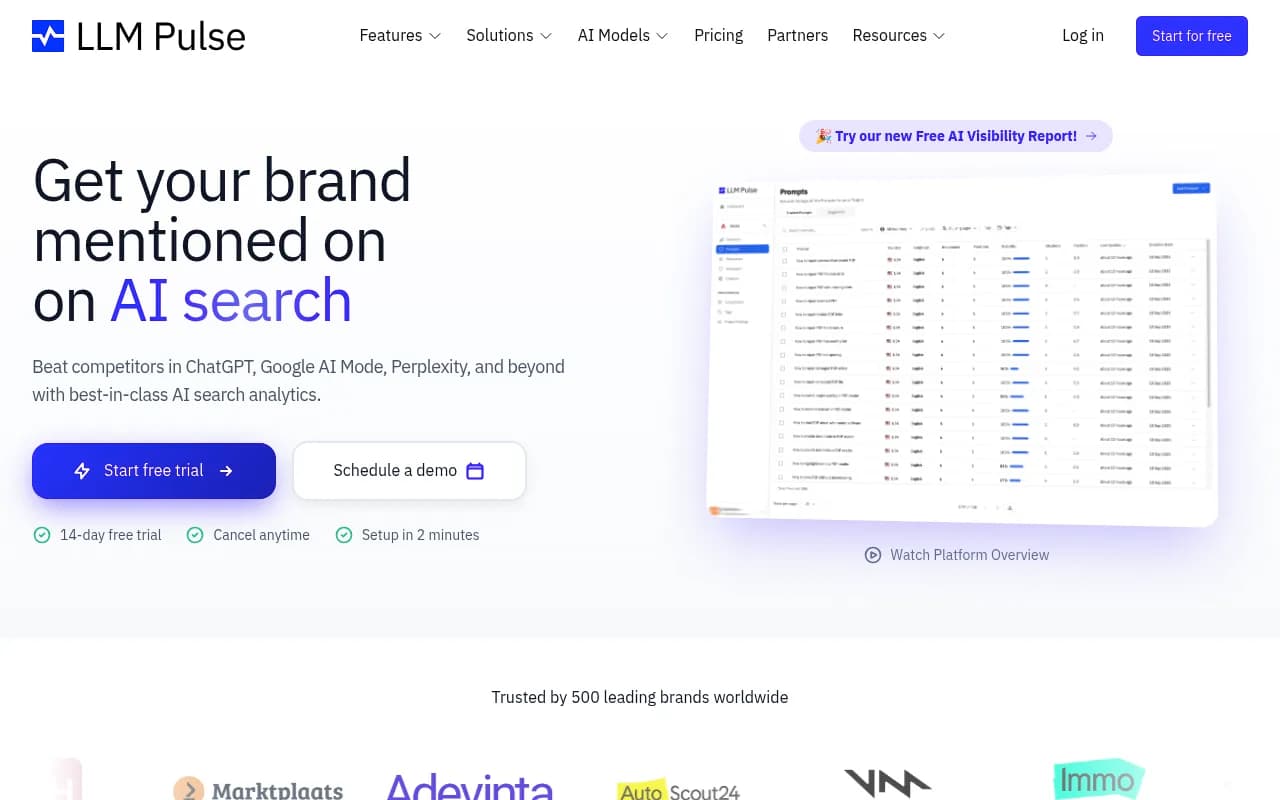
LLM Pulse is worth a look for smaller teams that prioritize collaboration features and value, though it covers fewer models than Promptwatch.
The bottom line
The AI search visibility space is splitting into two categories: tools that show you data, and tools that help you act on it. Omnia is in the first category. Promptwatch is in the second.
For teams that are serious about improving how they appear in ChatGPT, Perplexity, Claude, and the other AI engines that are increasingly driving qualified traffic, the gap between monitoring and optimization is the gap between knowing you have a problem and actually solving it.
That's why teams are switching. Not because Omnia is bad, but because they've outgrown what monitoring alone can do for them.