Mentions.so Review 2026
Brand monitoring tool that tracks mentions across AI-generated responses, social platforms, and the broader web to give a unified view of brand presence.
Key takeaways
- Mentions.so monitors brand visibility across 8 major AI models including ChatGPT, Gemini, Claude, Perplexity, Grok, DeepSeek, AI Overviews, and Llama -- solid coverage for a tool at this price point
- Lacks AI content generation, prompt volume/difficulty scoring, query fan-outs, Reddit/YouTube tracking, and ChatGPT Shopping monitoring that Promptwatch provides -- the insights board surfaces recommendations but you still have to write the content yourself
- The free Starter plan (25 prompts, 3 LLMs, 1 site) is genuinely usable for solo users or early-stage testing
- Agency tier includes white-label reporting and custom domain hosting, which is a real differentiator for smaller agencies
- Still a relatively new platform (Mentions 2.0 is in private beta as of early 2026), so the product is evolving quickly but some features feel early-stage
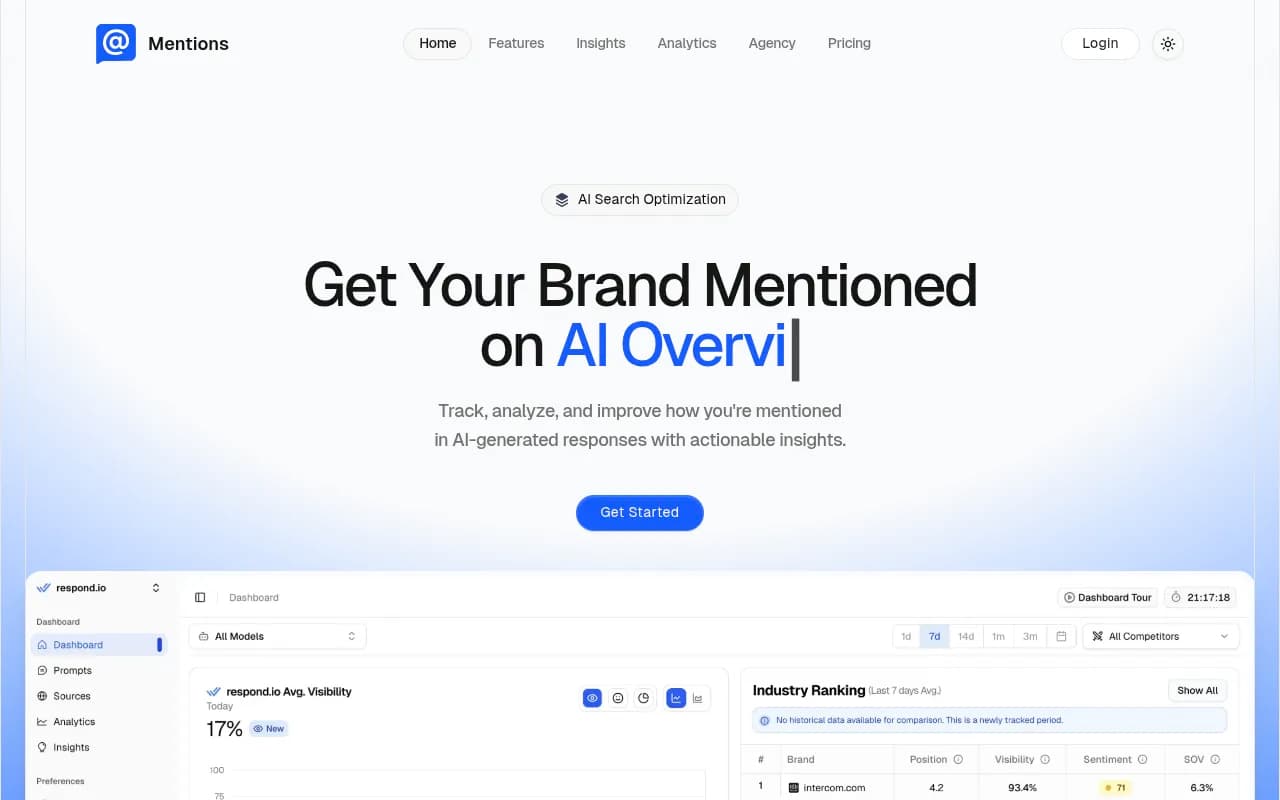
Mentions.so is an AI search visibility platform that helps brands track, analyze, and improve how they appear in responses generated by large language models. The pitch is straightforward: as more people use ChatGPT, Gemini, and Perplexity instead of Google to find products and services, showing up in those AI-generated answers matters. Mentions.so gives you a dashboard to see where you're appearing, how competitors are doing, what sentiment AI models express about your brand, and what you can do to improve.
The tool sits in a growing category sometimes called GEO (Generative Engine Optimization) or AEO (Answer Engine Optimization). It competes with tools like Otterly.AI, Peec.ai, AthenaHQ, and Promptwatch. Mentions.so's angle is breadth at an accessible price -- a free tier, a clean interface, and an "Insights Board" that tries to turn raw monitoring data into prioritized action items.
The platform is currently rolling out Mentions 2.0 in private beta, which suggests the product is still maturing. With 100+ brands reportedly using it, it's early but not vaporware.
Key features
Multi-model visibility tracking
Mentions.so queries 8 AI platforms on your behalf: ChatGPT, Perplexity, Claude, Grok, Gemini, DeepSeek, Google AI Overviews, and Llama. You set up prompts (questions your target customers might ask), and the platform runs those prompts across each model to see whether your brand gets mentioned. Results are updated daily. The Starter plan limits you to 3 LLMs and 25 prompts; Pro and above unlock all models. This is the core of what the product does, and it works as advertised -- you get a clear view of which models mention you and which don't.
Competitor visibility comparison
One of the more useful features is the side-by-side competitor comparison. You can see how your visibility score stacks up against specific competitors across each LLM. The dashboard shows percentage visibility scores with trend lines, so you can see if a competitor is gaining ground on you in ChatGPT while you're holding steady in Perplexity. The example in the UI shows brands like Kajabi, Thinkific, Teachable, and Podia compared on a given date -- which gives you a sense of how the feature works in practice for competitive categories.
Sentiment analysis
Beyond just tracking whether you're mentioned, Mentions.so categorizes the tone of AI responses about your brand: very positive, neutral, or negative. This matters because an AI model might mention your brand but frame it negatively ("some users report issues with pricing"). The sentiment tracking lets you see if there's a perception problem forming in AI responses before it affects purchasing decisions. The Insights Board can surface specific sentiment issues -- one example shown is "'pricing' is Your Top Perception Problem" with a recommendation to create content addressing pricing concerns.
Insights board (Kanban-style recommendations)
This is the feature that tries to push Mentions.so beyond pure monitoring. The Insights Board presents AI-generated recommendations in a Kanban layout with columns for Backburner, Ideas, To-do, Doing, and Done. Recommendations are categorized by type (Source, Citation, Audit, Sentiment, Narrative) and priority (High, Medium, Low). Examples include "High-Value Source Identified for Outreach," "Sitemap Missing lastmod Dates," and "Continue Building Citation Monitoring." You can dismiss items, filter by category, and move cards through the workflow. It's a reasonable attempt at making the data actionable, though the recommendations themselves are fairly generic compared to what a deeper content gap analysis would surface.
AI traffic analytics
Mentions.so includes traffic attribution -- you can see how much traffic is actually arriving from AI platforms and which models are driving it. This is a meaningful feature that many monitoring-only tools skip entirely. The crawler analytics dashboard shows when AI crawlers visit your site, which models are active, and where citation volume is growing. This helps connect the dots between visibility scores and actual business impact.
Crawler analytics
A dedicated crawler analytics view shows AI bot activity on your site -- when crawlers run, which models are active, and citation volume trends. This is useful for diagnosing why certain pages aren't getting picked up by specific models. It's similar in concept to what Promptwatch offers with its AI Crawler Logs feature.
Multi-language and multi-region monitoring
You can monitor AI responses in different countries and languages. The platform supports English, Portuguese, German, Dutch, Japanese, Hindi, Russian, and Spanish at minimum. This is important for brands operating in multiple markets, since AI models often give different answers depending on the language and region of the query.
AI-powered agent (conversational analytics)
Mentions.so includes a chat-style interface called the Mentions Agent that lets you ask questions about your data in plain English. You can ask things like "Generate a chart comparing my visibility this week vs last week" or "Which features do my competitors have that I don't?" The agent pulls from your visibility, analytics, and campaign data to generate responses. It's a nice UX touch, though the quality of answers depends heavily on how much data you've accumulated.
Agency features
The Agency tier adds white-label client reporting, a custom domain for hosting the dashboard, pitch workspace functionality, and a bird's-eye overview of all client workspaces in one place. Each client workspace shows visibility scores, trend lines, and status (Active, Review, Inactive). White-label pitch reports are a genuine selling point for agencies that want to present AI visibility data to clients without the Mentions.so branding.
Who is it for
Mentions.so fits best for small to mid-sized marketing teams and SEO professionals who want to start tracking AI visibility without committing to a high-cost platform. A solo SEO consultant managing a handful of client sites, or an in-house marketing team at a SaaS company with 20-100 employees, would get real value from the Pro tier. The free Starter plan is genuinely useful for individual users who want to test the concept before spending anything.
For digital agencies managing multiple clients, the Agency tier's white-label reporting and custom domain features make it a viable option -- especially for agencies that are just starting to add AI visibility to their service offering and need something to show clients. The pitch workspace feature is a practical addition for new business conversations.
The tool is less suited for enterprise brands with complex multi-market needs, or for teams that want to go beyond monitoring into actual content optimization. If your team needs to not just see where you're invisible but also generate content to fix it, Mentions.so's Insights Board will feel limited. The recommendations are useful starting points, but there's no built-in content generation -- you get the diagnosis but have to write the prescription yourself.
Industries where it particularly fits: SaaS, e-commerce, digital marketing agencies, content-heavy B2B companies, and any brand in a competitive category where AI models are increasingly the first touchpoint for product discovery.
Integrations and ecosystem
Mentions.so's integration story is thin at this stage. The platform appears to be largely self-contained, with no publicly documented API or native integrations with tools like Google Search Console, Slack, or Zapier mentioned on the site. The AI traffic analytics feature implies some form of site tracking (likely a JavaScript snippet or similar), but the specifics aren't detailed in the public-facing documentation.
The Agency tier supports a custom domain for white-label hosting, which is more of a deployment feature than an integration. The conversational agent can surface data from across the platform, but it doesn't appear to pull in external data sources.
For teams that need to pipe data into their existing BI tools or reporting stack, the lack of a documented API is a real gap. Export capabilities aren't prominently featured either. This is an area where more established platforms have a clear advantage.
Pricing and value
Mentions.so uses a four-tier pricing model:
- Starter: Free -- 25 prompts, 6,000 AI responses, daily updates, 1 site, unlimited seats, 3 LLMs, AI traffic analytics
- Pro: Paid (exact price not publicly displayed) -- 50 prompts, 12,000 AI responses, 5 sites, all LLMs, tailored insights
- Business: Paid (exact price not publicly displayed) -- 100 prompts, 24,000 AI responses, 10 sites, all LLMs, tailored insights
- Agency: Paid (exact price not publicly displayed) -- 300 prompts, 72,000 AI responses, unlimited sites, pitch workspace, custom domain, white-labeling, priority support
The pricing page uses an animated number display that obscures the actual dollar amounts in the scraped content, so specific monthly prices aren't confirmed here. A 16% discount is available on annual billing. The free Starter tier is a genuine free plan, not a trial -- you can use it indefinitely within the limits.
Compared to Promptwatch (which starts at $99/month for 50 prompts and 1 site), Mentions.so appears to be positioned at a lower price point, which makes sense given the narrower feature set. For teams that only need monitoring and basic recommendations, this could represent good value. For teams that need content generation, deeper prompt intelligence, or Reddit/YouTube tracking, the price difference may not justify the capability gap.
Strengths and limitations
What it does well:
- The free Starter plan is one of the more generous in the category -- 25 prompts across 3 LLMs with daily updates is enough to get real signal
- The Insights Board is a thoughtful UX approach to making monitoring data actionable, even if the recommendations aren't always deep
- Agency white-labeling with custom domain support is a practical feature that smaller agencies will appreciate
- Multi-language and multi-region support is solid for a tool at this price point
- Crawler analytics and AI traffic attribution go beyond what pure monitoring tools offer
Limitations and honest gaps:
- No AI content generation -- the Insights Board tells you what to fix but doesn't help you write the content. Platforms like Promptwatch include a built-in writing agent that generates articles grounded in citation data, which closes the loop from diagnosis to execution
- No prompt volume or difficulty scoring -- you can't tell which prompts are worth prioritizing based on search demand. Promptwatch's Prompt Intelligence feature provides volume estimates and difficulty scores, which is a meaningful advantage for resource allocation
- No Reddit or YouTube tracking -- AI models frequently cite Reddit threads and YouTube videos in their responses, and understanding which community discussions are influencing AI recommendations is a real capability gap here
- No ChatGPT Shopping tracking -- for e-commerce brands, this is an increasingly important channel that Mentions.so doesn't cover
- No query fan-out analysis -- understanding how a single prompt branches into sub-queries helps you map content strategy more precisely
- The product is still early-stage (Mentions 2.0 in beta), which means some features may be incomplete or subject to change
- API and integration documentation is sparse, limiting use in more sophisticated marketing stacks
Bottom line
Mentions.so is a reasonable entry point for brands and small agencies that want to start tracking AI visibility without a large budget. The free tier is genuinely useful, the agency white-labeling is a practical differentiator, and the Insights Board shows ambition beyond pure monitoring. But it's fundamentally a tracking and recommendation tool -- it shows you the problem and points you toward a fix, then leaves you to do the work.
For teams that want to close the full loop -- find content gaps, generate optimized content, track results, and attribute AI traffic to revenue -- Promptwatch covers significantly more ground, including AI content generation, prompt volume scoring, Reddit/YouTube tracking, and ChatGPT Shopping monitoring that Mentions.so doesn't offer.
Best use case: a solo SEO consultant or small marketing team that wants daily AI visibility monitoring across 8 models, basic competitive benchmarking, and a prioritized to-do list -- all without paying anything to start.
Frequently asked questions
What is Mentions.so?
Is there a free plan?
How many AI models does Mentions.so support?
Does Mentions.so help you fix AI visibility problems or just track them?
Is Mentions.so good for agencies?
How does Mentions.so compare to Promptwatch?
Similar and alternative tools to Mentions.so