Teramind Review 2026
A user activity monitoring platform for detecting insider threats, data loss, and compliance violations. Includes screen recording, keystroke logging, and behavioral analytics.
Key takeaways
- Teramind is one of the most feature-complete employee monitoring and insider risk platforms available in 2026, covering everything from screen recording and keystroke logging to predictive behavioral analytics and AI governance.
- Pricing starts at $14/seat/month (Starter), with a 5-seat minimum, making it accessible to small businesses but scaling well into enterprise deployments.
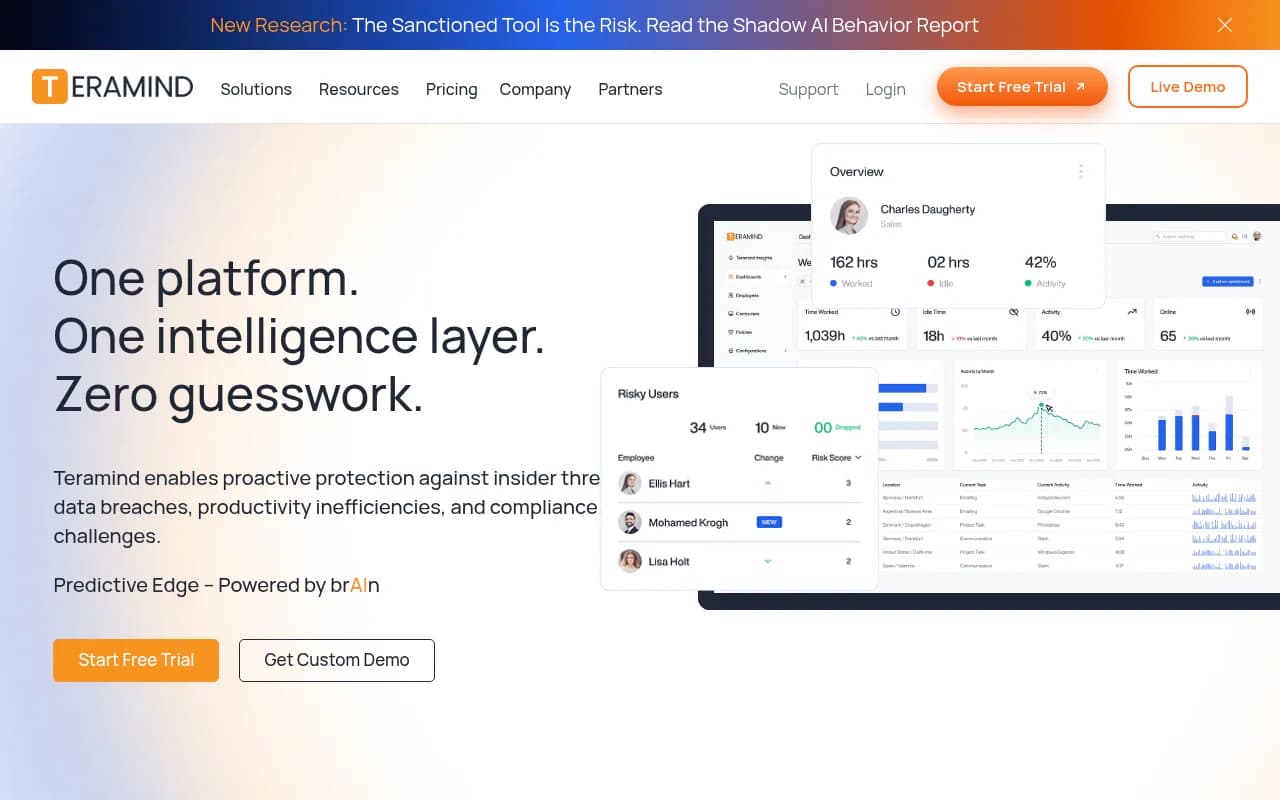
- The platform recently added "brAIn" -- an AI intelligence layer that includes a workforce copilot called Timmy, AI interaction tracking, and predictive risk scoring.
- Deployment is flexible: cloud, on-premise, or private cloud, which is a meaningful differentiator for regulated industries.
- The rule engine and alert configurability are genuinely powerful but come with a steep learning curve that smaller IT teams may struggle with.
- G2 Leader in 50+ categories as of Spring 2026, with 150+ verified reviews across Gartner and G2.
Teramind is a workforce analytics and insider risk management platform built for security teams, HR departments, and compliance officers who need deep visibility into what employees are actually doing on company systems. Founded in 2014 and headquartered in Miami, Florida, the company has grown to serve over 10,000 organizations globally, ranging from small businesses running five-person teams to large enterprises in financial services, healthcare, and government contracting.
The core problem Teramind solves is one that gets more complicated every year: how do you know when an employee, contractor, or privileged user is about to cause a data breach, whether intentionally or accidentally? Traditional security tools catch threats at the perimeter. Teramind watches what happens after someone is already inside. It records sessions, logs keystrokes, tracks application usage, monitors file transfers, and now -- with its brAIn layer -- tracks every interaction employees have with AI tools like ChatGPT, Claude, and Gemini.
The target audience is primarily IT security teams and compliance officers at mid-market companies (50-2,000 employees), though the platform scales to enterprise. Industries where it particularly fits include financial services, legal, healthcare, BPO/call centers, and any organization handling sensitive data under regulatory frameworks like HIPAA, PCI-DSS, or SOX. The platform has also found traction with managed service providers who deploy it across multiple client environments.
Key features
User activity monitoring (UAM) is the foundation of everything Teramind does. The platform installs a lightweight agent on endpoints (Windows and Mac) that captures a continuous stream of behavioral data: active application time, websites visited, documents opened, emails sent, and more. This isn't just a log file -- it's a structured behavioral record that feeds into risk scoring and alerting. The agent can run in visible or stealth mode depending on your deployment policy, and administrators can configure exactly what gets captured per user group or department.
Screen recording and session replay lets administrators watch exactly what a user was doing at any given moment. Sessions are searchable and indexed, so you can jump to the moment a specific file was opened or a particular URL was visited without scrubbing through hours of footage. This is particularly useful for post-incident forensics and for building legally defensible evidence -- Teramind's case study with Arrivia specifically highlights how session recordings helped document an insider data theft ring in a way that held up legally.
Behavioral rule engine and alerts is where Teramind separates itself from simpler monitoring tools. The platform ships with hundreds of pre-built rules covering common risk scenarios (mass file downloads, USB transfers to personal devices, after-hours access to sensitive systems), but the real power is in custom rules. You can build complex conditional logic: if a user copies more than 50 files to an external drive within 10 minutes AND has submitted a resignation in the HR system, trigger an alert and block the action. The rule engine is genuinely sophisticated, though it takes time to configure well.
Data loss prevention (DLP) goes beyond monitoring to active prevention. The DLP tier can block file transfers, prevent printing, restrict clipboard use, and quarantine suspicious email attachments in real time. It monitors content across endpoints, cloud storage, email, and web uploads. Unlike some DLP tools that only catch known sensitive data patterns, Teramind's behavioral context means it can flag anomalous transfer behavior even when the content itself doesn't match a predefined pattern.
brAIn -- the AI intelligence layer is Teramind's most significant recent addition. It includes two main components:
- Timmy, the Workforce Intelligence Copilot: A conversational AI interface that lets CISOs, HR managers, and executives query workforce data in plain language. Instead of building a custom report, you ask Timmy "which users accessed sensitive files outside business hours last week?" and get an immediate answer with supporting data.
- AI Governance: Tracks every interaction employees have with external AI tools -- every prompt sent to ChatGPT, every response received, every tool accessed. Given how many organizations are now grappling with employees pasting confidential data into AI chatbots, this is a genuinely useful capability that most competing platforms haven't built yet.
Productivity analytics covers application usage, active vs. idle time, website categorization, and productivity scoring. Managers can see team-level dashboards showing how time is distributed across productive, neutral, and unproductive activities. The platform lets you define what "productive" means for each role, so a developer spending time on Stack Overflow scores differently than a sales rep doing the same thing.
Predictive risk scoring uses behavioral baselines to identify users who are trending toward risky behavior before an incident occurs. The system establishes what "normal" looks like for each user and flags meaningful deviations. A user who suddenly starts accessing files outside their normal scope, working unusual hours, and sending large email attachments might score as elevated risk even if no single action crosses a threshold. This is the "predictive" piece that Teramind emphasizes heavily in its current positioning.
Deployment flexibility deserves mention as a feature in its own right. Teramind offers cloud-hosted (SaaS), on-premise, and private cloud deployments. For organizations in regulated industries that can't send employee data to a third-party cloud, the on-premise option is a significant differentiator. Competitors like Veriato and ActivTrak are primarily cloud-only.
Remote control and live session viewing lets administrators connect to an employee's machine in real time, which is useful for IT support but also for active incident response -- you can watch a suspicious session live and intervene if needed.
Who is it for
The clearest fit for Teramind is a security-conscious mid-market company with 50-500 employees that handles sensitive data and operates in a regulated industry. Think a regional bank's IT security team trying to meet OCC examination requirements, a healthcare network's compliance department monitoring access to patient records, or a legal services firm that needs to demonstrate data handling controls to clients. These organizations need more than a productivity tracker -- they need audit trails, forensic evidence, and active prevention.
BPO companies and call centers are another strong use case. When you have hundreds of agents handling customer financial data or personal information, the combination of screen recording, keystroke logging, and DLP gives operations managers and compliance teams the oversight they need. Several of Teramind's customer testimonials come from this segment.
Enterprises with insider threat programs -- typically companies with dedicated security operations centers -- will find the behavioral analytics and SIEM integration capabilities worth the investment. The platform's ability to correlate behavioral signals across multiple data sources (HR system data, endpoint activity, email, cloud storage) is more sophisticated than what you get from basic monitoring tools.
Who should look elsewhere: Very small teams (under 10 people) will find the 5-seat minimum and configuration complexity more than they need -- something like Hubstaff or Time Doctor is a better fit. Organizations primarily looking for remote work time tracking without security requirements will also find Teramind over-engineered and expensive for that use case. And companies with strong employee privacy cultures or operating under strict labor laws (particularly in the EU) need to think carefully about what they can legally deploy, regardless of what the platform technically supports.
Integrations and ecosystem
Teramind's integration story is decent but not exceptional. The platform connects natively with Microsoft 365 (including Teams and SharePoint activity monitoring), which covers the most common enterprise productivity stack. AWS is listed as a partner, suggesting cloud infrastructure integration for organizations running workloads there.
For SIEM integration, Teramind can export data to Splunk, IBM QRadar, and other major security information platforms via syslog and API, which is important for enterprise security teams who want Teramind's behavioral data feeding into their broader security operations workflow.
The REST API allows custom integrations and data exports, which larger organizations use to pull Teramind data into their own dashboards or connect it to HR systems for context (like the resignation example mentioned earlier). The API documentation is available through Teramind's knowledge base.
There's no native Slack or Teams alerting integration out of the box (alerts go to email or the Teramind console), though API-based workarounds are possible. The platform also lacks a Zapier or Make connector, which limits no-code automation options.
Teramind supports Windows and macOS endpoints. There's no Linux agent, which is a gap for engineering-heavy organizations. Mobile device monitoring is not part of the core platform.
A live demo environment is available at democompany.teramind.co, which is a genuinely useful way to evaluate the platform before committing to a trial.
Pricing and value
Teramind uses a per-seat, per-month pricing model with a 5-seat minimum across all plans. Annual billing saves approximately 8% compared to monthly.
- Starter: $14/seat/month (annual), minimum $69/month total. Covers basic user activity monitoring, productivity tracking, and reporting. No DLP or advanced behavioral analytics.
- UAM: $28/seat/month (annual), minimum $138/month total. Adds full user activity monitoring with behavioral rules, session recording, and alert capabilities.
- DLP: $32/seat/month (annual). Adds active data loss prevention, content inspection, and blocking capabilities on top of UAM features.
- Enterprise: Custom pricing for larger deployments, on-premise installations, and organizations needing private cloud or advanced compliance features.
A free trial is available. The brAIn AI features (Timmy copilot, AI governance tracking) appear to be available on higher tiers, though exact tier placement wasn't fully specified in available documentation.
Compared to competitors: ActivTrak's Essentials plan starts around $10/user/month but lacks DLP and advanced behavioral analytics. Veriato is similarly priced to Teramind's UAM tier but is cloud-only. Forcepoint and Securonix (enterprise-grade alternatives) run significantly higher. For what you get -- particularly the combination of behavioral analytics, DLP, session recording, and now AI governance -- Teramind's pricing is competitive in the mid-market segment.
The 5-seat minimum is worth noting: at the Starter tier, you're paying at least $69/month regardless of team size, which is fine for most businesses but worth knowing upfront.
Strengths and limitations
What Teramind does well:
- The behavioral rule engine is genuinely one of the most configurable in the market. The ability to combine multiple behavioral signals into complex conditional rules -- and then trigger automated responses rather than just alerts -- puts it ahead of simpler monitoring tools.
- Session recording with searchable, indexed playback is a standout feature. The forensic value for incident response and legal proceedings is real, as documented in customer case studies.
- Deployment flexibility (cloud, on-premise, private cloud) is a meaningful differentiator for regulated industries that can't use SaaS-only solutions.
- The new AI governance capability -- tracking employee interactions with external AI tools -- addresses a security gap that most competing platforms haven't tackled yet.
- G2 Leader status across 50+ categories in Spring 2026 reflects consistent customer satisfaction, particularly around support responsiveness.
Where it falls short:
- The configuration complexity is real. Getting the rule engine set up properly, tuning alert thresholds to avoid noise, and building meaningful dashboards requires significant time investment. Smaller IT teams without dedicated security staff will struggle.
- No Linux agent limits usefulness for engineering organizations or companies with mixed OS environments.
- The reporting interface, while comprehensive, can feel cluttered. Extracting specific data points for executive reporting often requires custom report building rather than out-of-the-box dashboards.
- Integration depth is narrower than enterprise security buyers might expect. No native SOAR integrations, limited no-code automation options, and the absence of a Slack/Teams alerting connector are gaps compared to some enterprise-focused competitors.
Bottom line
Teramind is the right choice for mid-market security and compliance teams that need a single platform covering employee monitoring, insider threat detection, DLP, and now AI governance -- particularly if on-premise deployment is a requirement. The behavioral analytics depth and session recording capabilities are genuinely strong, and the new brAIn layer addresses the very real problem of employees leaking sensitive data through AI tools.
Best use case in one sentence: A 200-person financial services firm that needs to monitor privileged user activity, prevent data exfiltration, meet regulatory audit requirements, and now track what employees are sending to ChatGPT -- all from one platform.
Tags:
Frequently asked questions
What is Teramind used for?
How much does Teramind cost?
Is there a free trial for Teramind?
What is brAIn in Teramind?
Does Teramind support on-premise deployment?
How does Teramind compare to ActivTrak or Veriato?
Similar and alternative tools to Teramind