AI-Writer Review 2026
Generates long-form articles with cited sources, making it useful for factual content. Includes SEO text editor and sub-topic discovery to improve article depth.
Key takeaways
- AI-Writer.com is purpose-built for academic and scientific research writing, not general-purpose content creation -- this is a narrow but well-executed niche
- Every answer is grounded in a corpus of 100M+ open science papers, with traceable citations down to the exact source paragraph
- Supports APA, Chicago, Harvard, MLA, and BibTeX citation formats -- genuinely useful for academic workflows
- Pricing starts at $29/month (or $24/month annually) with a 7-day free trial that requires no credit card and doesn't auto-renew into a subscription
- Not suitable for marketing copy, SEO content, or general blog writing -- the tool's entire design philosophy is scientific accuracy, not persuasion or search optimization
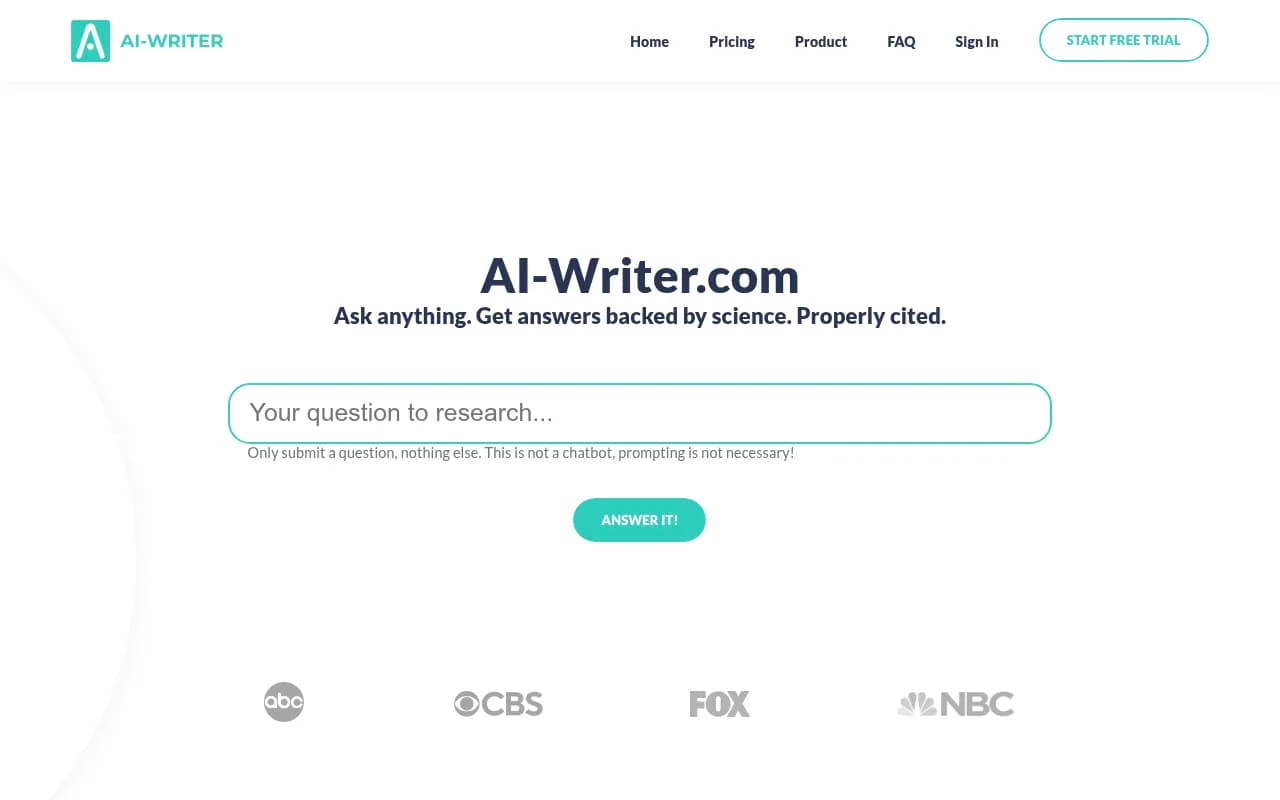
AI-Writer.com occupies a very specific corner of the AI writing market: it's a research assistant built around scientific literature, not a general-purpose content generator. The pitch is simple and honest -- if you can't verify what an AI writes, can you trust it? The tool's answer is to ground every response in peer-reviewed, open-access scientific papers, with citations that trace back to the exact paragraph used as source material.
The target audience is academics, PhD students, researchers, and technical writers who need factually defensible content. This isn't a tool for writing product descriptions or social media posts. It's for people who need to answer a research question and show their work. That clarity of purpose is actually refreshing in a market crowded with tools that claim to do everything.
The company has been operating for several years and has built a loyal user base among researchers and content writers covering technical subjects. The testimonials on the site skew toward ghostwriters, tech copywriters, and researchers -- people who spend hours hunting down credible sources and see AI-Writer as a way to compress that process significantly.
Key features
Topic Explorer The Topic Explorer is the starting point for any research session. You enter a topic, and the tool identifies the key questions you'd need to answer for a comprehensive understanding of that subject -- all grounded in the 100M+ paper corpus. It's not just a keyword brainstorming tool; it's generating research-relevant sub-questions based on what the scientific literature actually covers. This is genuinely useful for structuring a literature review or a technical article where you're not sure what you don't know yet.
AI Research (question answering) The core feature. You submit a question -- just a question, no elaborate prompting required -- and the tool returns an answer grounded in scientific papers. Each answer includes:
- A concise summary
- A detailed breakdown
- A full list of citations with links to source papers
- The exact paragraphs from those papers that informed the answer
This is meaningfully different from how ChatGPT or Gemini handle research questions. Those tools can hallucinate citations or summarize incorrectly. AI-Writer's approach of anchoring answers to a specific corpus and showing the source paragraphs makes verification actually possible.
Verifiable citations down to the paragraph This is the feature that sets AI-Writer apart from nearly every other AI writing tool. You don't just get a list of papers at the end -- you can click through to see exactly which paragraph from which paper was used to support each claim. That level of traceability is what academic writing actually requires, and it's rare to see it implemented this well in an AI tool.
Multiple citation format support AI-Writer supports APA, Chicago, Harvard, and MLA citation styles, plus BibTeX for anyone working in LaTeX environments. The BibTeX export in particular is a thoughtful touch for researchers who use reference managers like Zotero or Mendeley. Most AI writing tools treat citations as an afterthought; here they're a first-class feature.
Review paper generation With a few clicks, you can go from a set of research questions to a full structured review paper. The workflow is:
- Use Topic Explorer to identify key questions
- Add your own additional questions
- Drag and drop to structure sections and subsections
- Download as a standalone HTML file or share via a live link
The live link feature is a nice touch -- collaborators see updates in real time, which makes it useful for team research projects.
Open science corpus (100M+ papers) The underlying database is built on open-access scientific literature. This is important for two reasons: it means the tool can actually show you the source material (not just cite paywalled papers you can't access), and it means the corpus is continuously updated with new peer-reviewed research. The tool claims to be "always up-to-date with your field," which is a meaningful advantage over tools trained on static datasets.
No-prompt interface The tool explicitly tells you not to prompt it -- just ask a question. This is a deliberate design choice that reflects the tool's focus on research rather than creative generation. It lowers the barrier for non-technical users who aren't comfortable with prompt engineering, and it keeps outputs focused and consistent.
Who is it for
The clearest use case is academic researchers -- PhD students writing literature reviews, faculty preparing research summaries, or anyone who needs to survey a field quickly and produce a properly cited document. The tool's ability to generate a structured review paper from a topic in minutes is genuinely valuable here. A literature review that might take days of database searching and reading can be scaffolded in an afternoon.
Technical writers and science communicators are another strong fit. If you're writing about biomedical research, engineering topics, or any field where accuracy matters and your readers will notice errors, having citations that trace back to actual papers is a meaningful quality signal. The testimonials from tech copywriters and ghostwriters covering complex subjects ring true -- these are people who previously spent hours finding credible sources and now use AI-Writer to compress that process.
The tool is less suited to marketing teams, SEO agencies, or content operations that need high-volume general content. There's no SEO text editor, no keyword optimization, no tone controls for persuasive writing. If you're running a content marketing operation and need 50 blog posts a month, this isn't the right tool. Similarly, journalists working on breaking news won't find much value here -- the open science corpus is strong for established research but won't help with current events.
Small research teams (the Standard plan supports 3 users) and individual researchers are the sweet spot. The Power plan at $375/month for 10 users and 1,000 questions per month suggests the tool can scale to research departments or larger technical writing teams, but the pricing at that tier is significant.
Integrations and ecosystem
AI-Writer.com is a relatively self-contained tool. The primary output formats are HTML (downloadable) and shareable links. There's no native integration with reference managers like Zotero or Mendeley, though the BibTeX export makes it straightforward to import citations into those tools manually.
There's no API mentioned on the site, no Zapier integration, and no browser extension. The tool is web-only, which keeps things simple but limits how it fits into existing research workflows. For researchers who live in Google Docs or Microsoft Word, there's no direct plugin -- you'd be copying content out of the AI-Writer interface.
The affiliate program (via FirstPromoter) suggests the company is growing through word-of-mouth and referral channels, which fits the academic and research community where tool recommendations spread through peer networks.
Pricing and value
AI-Writer.com uses a question-based pricing model -- you pay for the number of research questions answered per month, not for word count or article count.
- Basic: $29/month ($24/month annually, $290/year) -- 40 questions/month, 1 user, unlimited Topic Explorer access
- Standard: $49/month ($41/month annually, $490/year) -- 120 questions/month, 3 users, unlimited Topic Explorer access
- Power: $375/month ($312/month annually, $3,750/year) -- 1,000 questions/month, 10 users, unlimited Topic Explorer access
The 7-day free trial is genuinely no-strings: no credit card required, doesn't convert to a paid subscription automatically. That's a meaningful commitment to letting users evaluate the tool honestly.
For an individual researcher or PhD student, the Basic plan at $24/month annually is reasonable -- 40 questions a month is enough for focused research sessions, and the citation quality justifies the cost compared to spending hours in Google Scholar. The Standard plan at $41/month for teams of three is competitive for small research groups.
The Power plan is where pricing gets steep. $312-375/month is a significant budget for a research tool, and at that tier you're comparing against institutional database subscriptions or research software like Elsevier's tools. Whether it's worth it depends heavily on how much time the team is saving on literature searches.
There's no free tier beyond the trial, which is a limitation for casual users or students on tight budgets who might want occasional access.
Strengths and limitations
What it does well:
- The citation traceability is genuinely best-in-class for an AI writing tool. Showing the exact source paragraph, not just the paper title, is a meaningful step beyond what most tools offer.
- The open science corpus of 100M+ papers is a real differentiator. This isn't a tool hallucinating citations -- it's pulling from an actual database of verifiable literature.
- The no-credit-card free trial is refreshingly honest. Many tools in this space use dark patterns to trap users in subscriptions; AI-Writer doesn't.
- BibTeX export and multiple citation style support show genuine understanding of academic workflows.
- The review paper generation workflow (Topic Explorer -> questions -> structure -> export) is well-designed and produces something actually usable as a starting point for a literature review.
Honest limitations:
- The tool is narrow by design. If you need anything beyond research-backed Q&A and review paper generation -- SEO optimization, tone adjustment, marketing copy, long-form narrative writing -- you'll need a different tool. This isn't a criticism exactly, but it's important to understand before subscribing.
- No API or integrations means the tool sits outside most existing research and writing workflows. Copying content out of a web interface into your actual document editor adds friction.
- The question-based pricing model can feel limiting if you're in an exploratory research phase where you're asking many questions to map a field. 40 questions/month on the Basic plan goes faster than you'd expect.
- The corpus is limited to open-access scientific literature. If your research field relies heavily on paywalled journals or grey literature (government reports, industry white papers), the tool's coverage will have gaps.
Bottom line
AI-Writer.com is a well-executed, honest tool for a specific audience: researchers, academics, and technical writers who need AI-generated content they can actually verify. The citation traceability down to the source paragraph is genuinely useful, and the review paper workflow is a real time-saver for literature reviews.
If you're a PhD student, a researcher who writes regularly, or a technical writer covering complex scientific subjects, the Basic or Standard plan is worth trying -- the free trial makes that evaluation risk-free. If you need general-purpose content generation, SEO writing, or marketing copy, look elsewhere.
Best use case in one sentence: Generating properly cited, scientifically grounded research summaries and review papers for academic or technical audiences.
Tags:
Frequently asked questions
What is AI-Writer.com?
Who is AI-Writer.com best suited for?
How much does AI-Writer.com cost?
Is there a free trial?
What citation formats does AI-Writer.com support?
How is AI-Writer.com different from ChatGPT for research?
Similar and alternative tools to AI-Writer