Keyword Insights Review 2026
Clusters keywords into topic groups using AI, maps them to search intent, and generates content briefs. Helps SEO teams scale content strategy without manual grouping.
Key takeaways
- Best for: SEO agencies and in-house content teams that need to process large keyword lists fast and build topical authority systematically
- Core strength: SERP-based keyword clustering is genuinely more accurate than embedding-only approaches -- it groups keywords by what Google actually ranks together, not just semantic similarity
- Solid content pipeline: Goes from keyword discovery through clustering, intent mapping, content briefs, and AI writing in one workflow -- fewer tool switches than most alternatives
- Mentions feature is interesting but early: The Reddit/Quora/YouTube thread surfacing is a newer addition aimed at AI visibility, but it's more of a discovery layer than a full GEO monitoring platform
- Pricing is credit-based: Can get expensive at scale if you're processing hundreds of thousands of keywords monthly; the credit model requires some planning
- Not a GEO/AI monitoring tool: Keyword Insights doesn't track how your brand appears in ChatGPT, Perplexity, or other AI models -- for that, you'd need a dedicated platform like Promptwatch
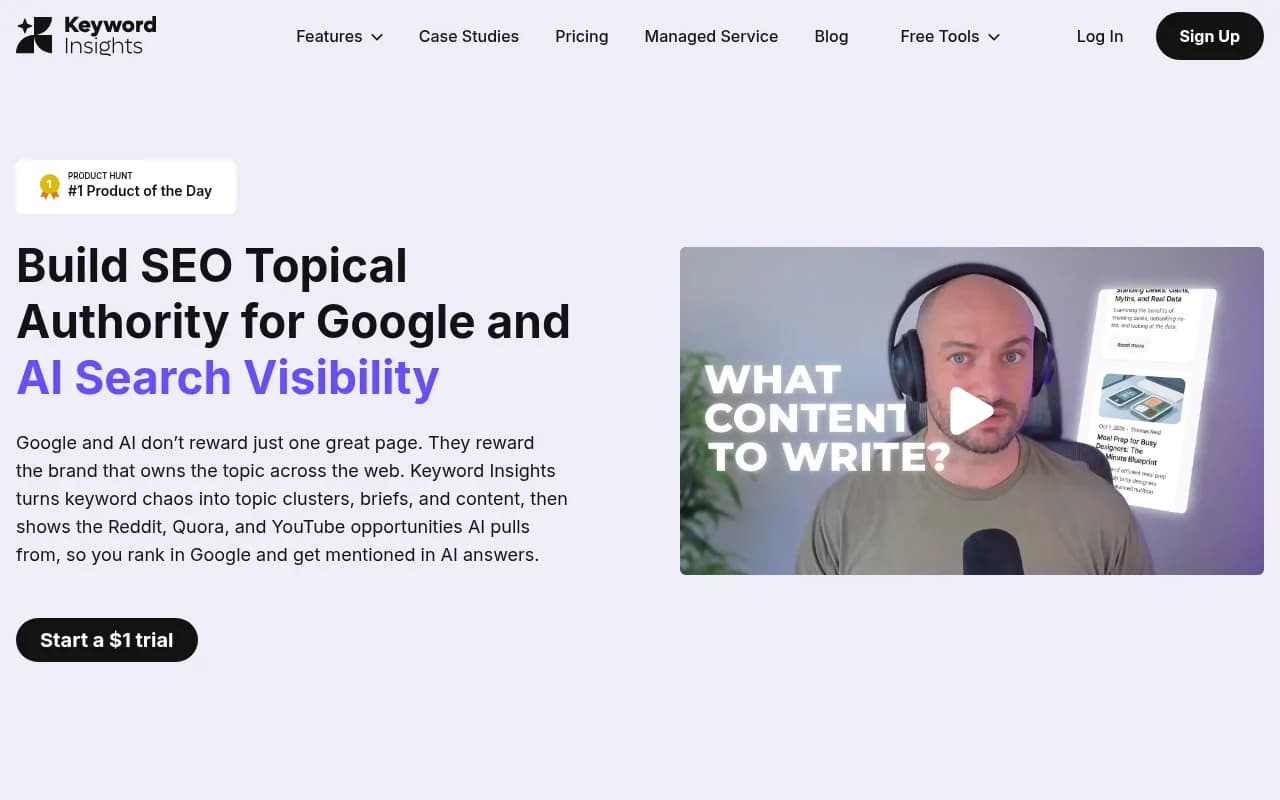
Keyword Insights is a UK-based SEO platform built by Snippet Digital Ltd. that has carved out a specific niche: taking the genuinely painful process of keyword clustering and making it fast enough to be practical at agency scale. The tool launched with clustering as its core feature and has since expanded into a broader content planning suite covering keyword discovery, search intent analysis, content briefs, AI writing, and -- more recently -- a "Mentions" feature that surfaces Reddit, Quora, and YouTube threads relevant to your brand or topic.
The target audience is pretty clear from the product design: SEO agencies managing multiple client sites, in-house SEO teams at mid-size companies, and content strategists who are drowning in keyword spreadsheets. The tool won Product Hunt's #1 Product of the Day at some point in its history, which helped it build early momentum in the SEO community. It's positioned as a specialist tool rather than an all-in-one SEO suite -- it doesn't try to replace Ahrefs or Semrush for backlink analysis or rank tracking, but it does try to be the best tool for the keyword-to-content workflow.
The pitch has evolved over time. What started as "AI keyword clustering" has become "build topical authority for Google and AI search visibility." That's a meaningful shift -- it reflects the reality that SEO teams now need to think about how AI models like ChatGPT and Perplexity pull information, not just how Google ranks pages. Whether the product fully delivers on the AI visibility angle is worth examining closely.
Key features
Keyword clustering (SERP-based)
This is the tool's flagship feature and the one that genuinely differentiates it. Rather than clustering keywords purely by semantic similarity (which is what most embedding-based approaches do), Keyword Insights clusters by SERP overlap -- it looks at which keywords return similar top-10 results in Google and groups them together. The logic is sound: if Google ranks the same pages for two keywords, they probably belong on the same page.
In practice, this produces more actionable clusters than pure NLP approaches. You end up with groups that reflect how Google actually thinks about topics, not just how words relate to each other. The tool can handle large keyword lists -- users report processing 20,000+ keywords in 30-60 minutes, which is a real time saving compared to manual grouping.
- Clusters are labeled with a "pillar" keyword representing the group
- Each cluster shows the keywords, their search volumes, and difficulty scores
- You can filter clusters by domain to find gaps (keywords you don't rank for)
- Competitor visibility tab shows how your site compares to competitors for each cluster
Topical clusters (cluster of clusters)
Beyond grouping individual keywords into page-level clusters, Keyword Insights applies NLP to find semantic relationships between clusters themselves. This gives you a higher-level view of topic coverage -- you can see which broad topics your site covers well and which entire topic areas are missing. Missing topics are flagged in red, making it easy to spot holes in your content strategy at a glance.
Keyword discovery
The research starting point. You enter a seed term and the tool pulls keyword ideas from Google Autocomplete, Reddit, Quora, and People Also Asked in real time. The real-time sourcing is a genuine advantage over tools that rely on static databases -- you get trending questions and emerging topics that older keyword databases haven't indexed yet.
- Returns search volume, keyword difficulty, and CPC data
- AI-driven filters to narrow results
- Direct integration with the clustering tool (no CSV export/import needed)
- CSV export available for use in other tools
Search intent mapping
When you run a clustering job, you can enable search intent analysis. The tool looks at the top 10 Google results for each keyword and categorizes them as informational, transactional, commercial, or navigational. Rather than guessing intent from the keyword text alone, it's reading what Google actually serves -- which is more reliable.
This matters for content planning because it tells you whether to write a blog post, a product page, or a comparison guide for a given cluster. Getting this wrong wastes content budget.
Content briefs
Once you have your clusters, you can generate content briefs for each one. The briefs pull from live search results -- analyzing current top-ranking pages to identify the headings, questions, and entities that should appear in your content. The tool also pulls from Reddit and Quora for "People Also Ask"-style questions that might not appear in traditional SERP analysis.
The Information Gain machine learning model is worth noting -- it's designed to help you identify angles and talking points that aren't already covered by the top-ranking pages, which theoretically gives your content a differentiation edge rather than just producing a clone of what's already ranking.
AI Writer Agent and AI Writer Assistant
Two distinct writing tools. The AI Writer Assistant is more of a co-pilot -- you're writing and it helps with paragraphs, tone switching, sentence rewording, and metadata generation. The AI Writer Agent is more autonomous -- it generates full articles based on the brief and keyword data.
Both include proprietary grading metrics that score your content as you write, giving feedback on optimization. The integration between the brief and the writer means you're not copy-pasting between tools.
Mentions (Reddit, Quora, YouTube)
The newest feature and the one most directly tied to the AI visibility angle. The tool surfaces specific Reddit threads, Quora questions, and YouTube videos where your brand or topic is being discussed. The idea is that contributing genuinely helpful answers to these threads can earn mentions that AI models pick up when generating responses.
This is a real insight -- AI models like Perplexity and ChatGPT do pull from Reddit and Quora heavily. But the Mentions feature is more of a discovery and prioritization tool than a monitoring platform. It shows you where to contribute, not whether your contributions are actually being cited by AI models.
Keyword cannibalization detection
When you run clustering with your domain's existing rankings, the tool flags cases where multiple pages on your site are ranking for the same cluster. This is a common problem that hurts rankings and is tedious to find manually. Having it surface automatically during the clustering workflow is a practical time saver.
Who is it for
The clearest use case is SEO agencies managing content strategy for multiple clients. If you're regularly receiving keyword lists from clients or building them from scratch, the clustering workflow alone saves significant time. The case studies on the site are mostly agency-focused -- Ignite SEO, Growth Plays, Organic Hackers -- and the testimonials consistently mention time savings on keyword grouping as the primary win. An agency that was spending a full day manually grouping 5,000 keywords can now do it in under an hour.
In-house SEO teams at companies with active content programs are the second strong fit. If you're publishing 10-30 pieces of content per month and trying to build topical authority in a competitive niche, the combination of clustering, intent mapping, and content briefs gives you a systematic workflow that's hard to replicate with spreadsheets and separate tools. The competitor visibility feature is particularly useful here -- you can see exactly which topic clusters your competitors rank for that you don't, which makes content prioritization more defensible to stakeholders.
Freelance SEO consultants and content strategists working with multiple clients can also get good value, especially at the lower pricing tiers. The $1 trial is a low-friction way to test whether the clustering quality meets your standards before committing.
Who should probably look elsewhere: if you're primarily looking for AI search visibility monitoring -- tracking how your brand appears in ChatGPT, Perplexity, Claude, or Gemini responses -- Keyword Insights isn't built for that. The Mentions feature helps you find places to contribute content that might influence AI answers, but it doesn't tell you whether you're actually being cited, how often, or by which models. For that kind of monitoring and optimization, you'd want a dedicated GEO platform. Similarly, if you need backlink analysis, rank tracking, or technical SEO auditing, this tool doesn't cover those areas.
Integrations and ecosystem
Keyword Insights keeps its integration footprint relatively focused:
- Google Search Console: Connect your GSC account to pull in your existing rankings data, which powers the content gap analysis and cannibalization detection features
- WordPress: Direct publishing integration so you can push content from the AI writer to your WordPress site without copy-pasting
- Public API: Available for teams that want to build custom workflows or integrate clustering into their own tools. Documentation is at docs.keywordinsights.ai
- CSV import/export: Standard for keyword lists, making it easy to bring in data from Ahrefs, Semrush, or any other source
- MCP (Model Context Protocol): The YouTube channel mentions an MCP integration for keyword research, suggesting some AI agent workflow support
The integration list is shorter than enterprise SEO tools, but the Google Search Console and WordPress connections cover the most common workflow needs. There's no native Zapier integration mentioned, and no Slack or project management tool connections, which means you're managing the workflow within the platform rather than pushing data to other systems automatically.
Pricing and value
Keyword Insights uses a credit-based model with subscription tiers. Based on available data:
- $1 trial: 7 days, 5,000 one-time credits covering 2 keyword discovery searches, up to 500 keywords clustered, 1 content brief project, and 1 AI-written article. Downgrades to pay-as-you-go at the end.
- Pay-as-you-go: Available after trial, credits purchased as needed at approximately $2.99 per 1,000 keywords for clustering
- Subscription plans: Include 100,000 keyword clustering credits per month, 20 keyword searches, 60 briefs, 60 writer assists, and 500,000 AI-generated words at the reported tier
The credit model means costs scale with usage, which is good for agencies with variable workloads but can get expensive if you're processing very large keyword lists regularly. A team clustering 500,000 keywords per month would need to plan their credit usage carefully.
Compared to alternatives: Frase (which Keyword Insights positions against directly) focuses more on content optimization and brief generation, starting around $45/month but without the same depth of keyword clustering. Semrush and Ahrefs both offer some clustering functionality but it's not their primary focus and the quality is generally considered inferior to dedicated clustering tools. For pure clustering quality at scale, Keyword Insights is competitive.
The $1 trial is genuinely useful -- it's enough credits to run a real clustering job and evaluate whether the output quality meets your needs.
Strengths and limitations
What it does well
- SERP-based clustering accuracy: The approach of clustering by actual Google SERP overlap rather than pure semantic similarity produces more actionable results. Keywords end up on the right pages because the grouping reflects Google's actual behavior.
- End-to-end workflow: Research to cluster to brief to written content without switching tools is a real productivity gain. Most competitors handle one or two of these steps but not all of them.
- Scale and speed: Processing tens of thousands of keywords in under an hour is a genuine capability. The case study claiming 20,000 keywords in 30-60 minutes is consistent with what users report.
- Topical gap identification: The combination of cluster-level and topic-level gap analysis makes it easy to build a content calendar that systematically fills coverage holes.
- Competitor benchmarking: Seeing which clusters competitors rank for that you don't is a practical prioritization tool that goes beyond just showing you keywords.
Limitations and honest gaps
- No AI visibility monitoring: The Mentions feature is a step toward AI search relevance, but Keyword Insights doesn't track whether your content is actually being cited by ChatGPT, Perplexity, Claude, or other AI models. You can find threads to contribute to, but you can't measure whether those contributions are working. For actual GEO monitoring -- tracking citations, visibility scores across AI models, and traffic attribution from AI search -- you'd need a dedicated platform.
- Credit model complexity: The credit system requires more planning than a flat monthly fee. Different features consume credits at different rates, and it's not immediately obvious how many credits a given workflow will consume until you've used the tool for a while.
- Limited integrations: No native connections to project management tools, Slack, or marketing platforms. For agencies that want to push data into their existing reporting stack, the API is the only option.
Bottom line
Keyword Insights is a strong choice for SEO agencies and content teams that need to move from a keyword list to a content plan quickly and at scale. The SERP-based clustering is genuinely better than most alternatives, the end-to-end workflow from discovery through AI writing reduces tool-switching, and the topical gap analysis gives content strategy a systematic foundation.
The AI visibility angle -- the Mentions feature and the positioning around "AI search visibility" -- is real but partial. If your goal is to understand and improve how your brand appears in AI-generated answers across ChatGPT, Perplexity, and other models, Keyword Insights gets you partway there by helping you create content that AI models might cite, but it doesn't close the loop with actual monitoring or citation tracking. For that full picture, Promptwatch covers the monitoring, citation analysis, and traffic attribution side that Keyword Insights doesn't.
Best use case: An SEO agency that needs to cluster 10,000+ keywords per client, identify content gaps against competitors, and generate briefs and draft content -- all without stitching together five separate tools.
Tags:
Frequently asked questions
What is Keyword Insights?
How does Keyword Insights cluster keywords?
Is there a free trial?
Who is Keyword Insights best for?
Does Keyword Insights track AI search visibility?
What integrations does Keyword Insights support?
Similar and alternative tools to Keyword Insights