Key takeaways
- Best for full GEO optimization (not just monitoring): Promptwatch -- tracks 10 AI models, includes content gap analysis, AI writing agents, crawler logs, and traffic attribution. The only tool that closes the loop from "you're invisible" to "here's the content that fixes it."
- Best if you already use Semrush: Semrush's AI Visibility Toolkit covers ChatGPT, Perplexity, and Gemini alongside its traditional SEO suite -- convenient if you want one bill, but the AI features are less deep than dedicated GEO platforms.
- Best enterprise option: Profound -- strong feature set with prompt volumes, agent analytics, and content agents, but pricing starts at $499/month and there's no free trial.
- Best budget-friendly monitoring: Otterly.AI starts at $29/month and covers six AI engines. Good for teams that just need basic brand mention tracking without the complexity.
- Best for combining traditional SEO + AI tracking: Nightwatch or SE Ranking -- both offer solid rank tracking alongside emerging AI visibility features at reasonable price points.
GPT Rank Tracker is one of the simpler entry points into AI search visibility. You drop in a domain, get a snapshot of how it's performing across GPT-driven search, and see some prompt-level signals. For a quick gut-check, it works. But if you're trying to actually move the needle -- figure out why you're invisible for certain prompts, create content that gets cited, or track whether your efforts are working over time -- you'll hit the ceiling pretty fast.
The tool's freemium model is useful for a one-off check, but paid plan pricing isn't publicly disclosed, which makes it hard to evaluate against alternatives. The feature set also skews toward monitoring rather than optimization: you can see what's happening, but there's limited guidance on what to do about it.
That's the core reason people look for alternatives. Monitoring is table stakes now. The more interesting question is: which tools actually help you improve?
Here's an honest look at the best GPT Rank Tracker alternatives in 2026.
The alternatives
Promptwatch

Promptwatch is the most complete AI search visibility platform available right now, and it's the one I'd point most teams toward if they're serious about GEO rather than just reporting on it.
The difference from GPT Rank Tracker (and most other tools on this list) is that Promptwatch doesn't stop at showing you data. It's built around a three-step loop: find the gaps, create content that fills them, and track whether it worked. Most competitors handle step one. Promptwatch handles all three.
The Answer Gap Analysis is particularly useful -- it shows you the specific prompts where competitors are getting cited but you're not, and it tells you what content your site is missing to fix that. From there, the built-in AI writing agent generates articles, listicles, and comparison pages grounded in actual citation data (880M+ citations analyzed). This isn't generic content generation -- it's content engineered to get picked up by ChatGPT, Claude, Perplexity, and other models.
On the monitoring side, Promptwatch covers 10 AI models including ChatGPT, Claude, Gemini, Perplexity, Grok, DeepSeek, Copilot, Meta AI, Mistral, and Google AI Overviews. It also has AI crawler logs -- real-time feeds showing when ChatGPT, Claude, and Perplexity bots are hitting your pages, which pages they're reading, and what errors they're encountering. Most competitors don't have this at all.
A few other things worth mentioning: Reddit and YouTube tracking (surfaces discussions that influence AI recommendations), ChatGPT Shopping monitoring, prompt volume and difficulty scoring, and traffic attribution via GSC integration, code snippet, or server log analysis.
Pricing is $99/month (Essential), $249/month (Professional), or $579/month (Business). Free trial available. Compared to GPT Rank Tracker's undisclosed pricing, Promptwatch is at least transparent about what you're paying for.
Best for: Marketing and SEO teams that want to move from "we're invisible in AI search" to "here's the content we published and here's how our visibility improved." Agencies managing multiple clients will also find the multi-site plans and white-label reporting useful.
Semrush
Semrush is the 800-pound gorilla of digital marketing tools, and it's been adding AI visibility features steadily over the past year. If you're already a Semrush subscriber, the AI Visibility Toolkit is worth exploring before you sign up for a separate GEO platform.
The AI toolkit covers ChatGPT, Perplexity, and Gemini. You can track brand mentions, monitor citations, and see how your visibility compares to competitors across those models. It's decent coverage for the three most-used AI search engines, though it doesn't reach the 10-model breadth of Promptwatch.
The bigger limitation is that Semrush's AI features use fixed prompt sets rather than letting you define your own prompts and track them over time. That matters because the prompts your customers actually use are specific to your category and brand -- a fixed library won't capture them. There's also no AI traffic attribution, no crawler logs, and no content generation tied to citation data.
Where Semrush genuinely wins is breadth. Keyword research, backlink analysis, site audits, PPC, social media, local SEO -- it's all there. If you need one platform for your entire digital marketing stack and AI visibility is a secondary concern, Semrush makes sense. If AI search is your primary focus, you'll likely find the AI features underwhelming compared to dedicated GEO tools.
Pricing starts at $165/month (Starter), $290/month (Pro+), $580/month (Advanced). 7-day free trial available.
Best for: Teams already using Semrush for traditional SEO who want to add basic AI visibility monitoring without managing another tool subscription.
Profound
Profound

Profound is a serious platform. It covers 9+ AI engines, has prompt volume data, agent analytics (crawler logs), and content generation agents. The client list includes MongoDB, Ramp, and Mercury -- companies that take their marketing infrastructure seriously.
Compared to GPT Rank Tracker, Profound is in a completely different weight class. It's built for teams that need enterprise-grade monitoring and want to understand AI search at a strategic level. The prompt volumes feature is genuinely useful -- seeing what millions of people are actually asking AI engines helps you prioritize which prompts to target.
The content agents can generate AEO-optimized FAQs and other content formats, which puts it in similar territory to Promptwatch's content generation. The main difference is that Profound's content tools feel more template-driven, while Promptwatch's are more tightly integrated with citation data and gap analysis.
The real barrier is price. Profound's Lite tier starts at $499/month, and there's no free trial. For a small team or agency, that's a significant commitment before you've validated whether the platform works for your use case. Promptwatch offers more flexibility at lower price points with a free trial.
Best for: Enterprise marketing teams with budget to match, particularly those in B2B SaaS where the client list suggests Profound has strong category expertise.
Peec AI

Peec AI is a clean, focused AI search analytics platform aimed at marketing teams. It tracks visibility, position, and sentiment across ChatGPT, Perplexity, Claude, and Gemini, and the interface is genuinely easy to use -- you can get up and running quickly without a lengthy onboarding process.
The competitor benchmarking is one of its stronger features. You can see how your brand's visibility score compares to specific competitors across different prompts and models, which is useful for competitive intelligence. The multi-country tracking also works well.
Where Peec AI falls short relative to GPT Rank Tracker alternatives that go deeper: there's no content generation, no crawler logs, no traffic attribution, and no Reddit/YouTube tracking. It's a monitoring tool, and a good one, but it won't tell you how to fix what it finds.
Pricing starts at €89/month (~$103) for 50 prompts and 10 models. Growth is €199/month for 150 prompts and 2 workspaces. There's a free trial available.
Best for: Marketing teams that want clean, easy-to-read AI visibility dashboards and competitive benchmarking without needing to act on the data immediately.
Otterly.AI
Otterly.AI

Otterly.AI is one of the more accessible options on this list. At $29/month for the Lite plan, it's significantly cheaper than most dedicated GEO platforms, and it covers six AI engines: ChatGPT, Google AI Overviews, Perplexity, Google AI Mode, Gemini, and Copilot.
The feature set is monitoring-focused: brand mentions, website citations, share of voice, competitive benchmarking. There's also a GEO Audit tool that analyzes on-page factors and identifies what might be holding your site back from earning more citations -- that's a useful addition that goes slightly beyond pure monitoring.
What you won't get: crawler logs, content generation, traffic attribution, prompt volume data, or Reddit/YouTube tracking. The prompt count on the Lite plan (15 prompts) is also quite limited if you're tracking a competitive category.
The 14-day free trial with no credit card required is a low-friction way to test it.
Pricing: $29/month (Lite, 15 prompts), $189/month (Standard, 100 prompts), custom for Premium.
Best for: Small businesses or solo marketers who want basic AI visibility monitoring at a low price point and don't need deep optimization capabilities.
Nightwatch
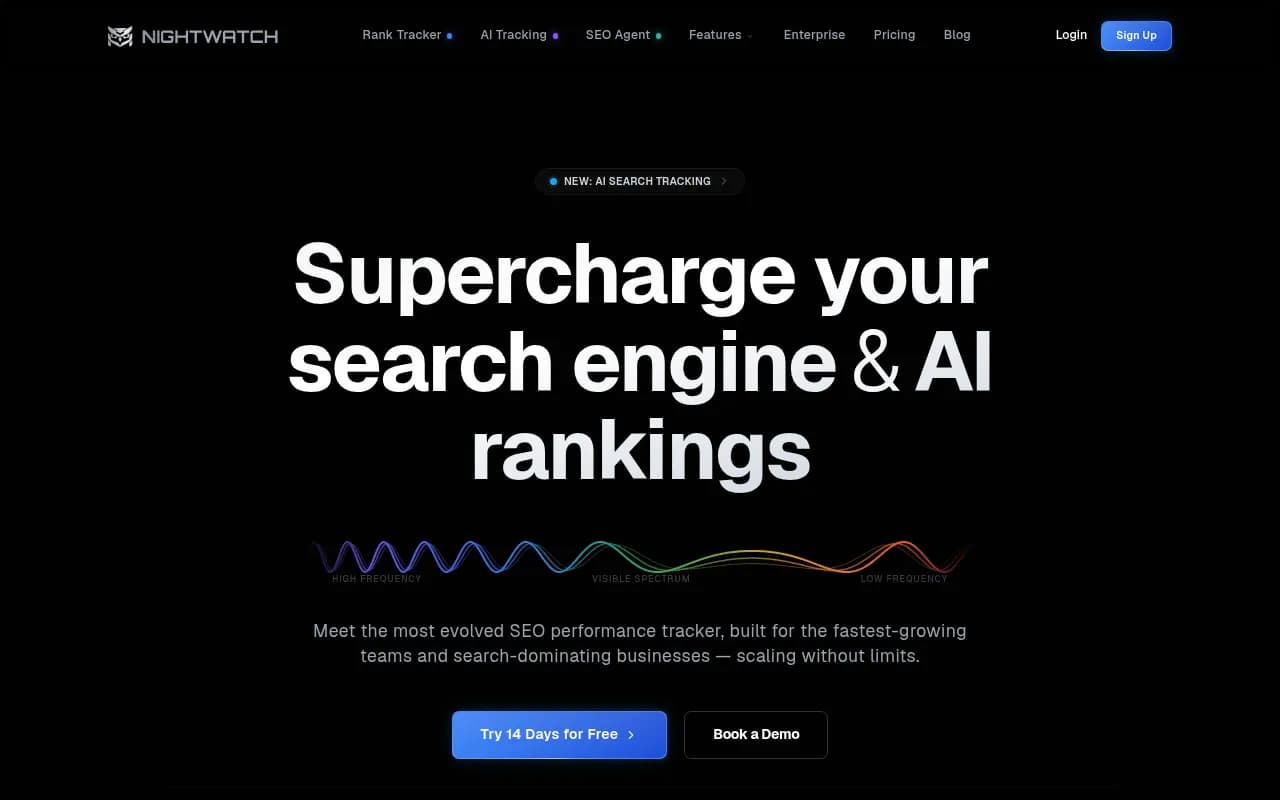
Nightwatch has been a solid traditional rank tracker for years, and it's made a genuine push into AI visibility tracking. The positioning is interesting -- it explicitly targets teams that don't want to manage separate tools for traditional SEO and AI search.
The AI tracking covers ChatGPT, Gemini, Claude, and Perplexity alongside Google, Bing, Yahoo, and DuckDuckGo. The unified dashboard is well-designed, and the localization is impressive: 107,000+ locations down to the zip code, which matters if you're doing local SEO alongside AI visibility.
There's also an SEO Agent feature that automates parts of the SEO workflow -- keyword research, prompt research, and reporting. It's not as deep as Promptwatch's content generation, but it's a useful addition for teams that want some automation without switching platforms.
The AI visibility features are newer and less mature than dedicated GEO platforms. You won't get crawler logs, citation source analysis, or content gap analysis. But for the price -- starting at $24/month -- it's a reasonable way to add AI tracking to an existing SEO workflow.
Pricing: $24/month (Starter), $59/month (Optimize), custom Enterprise. 14-day free trial.
Best for: SEO teams that want to add AI visibility tracking to their existing rank tracking workflow without paying for a separate platform.
SE Ranking
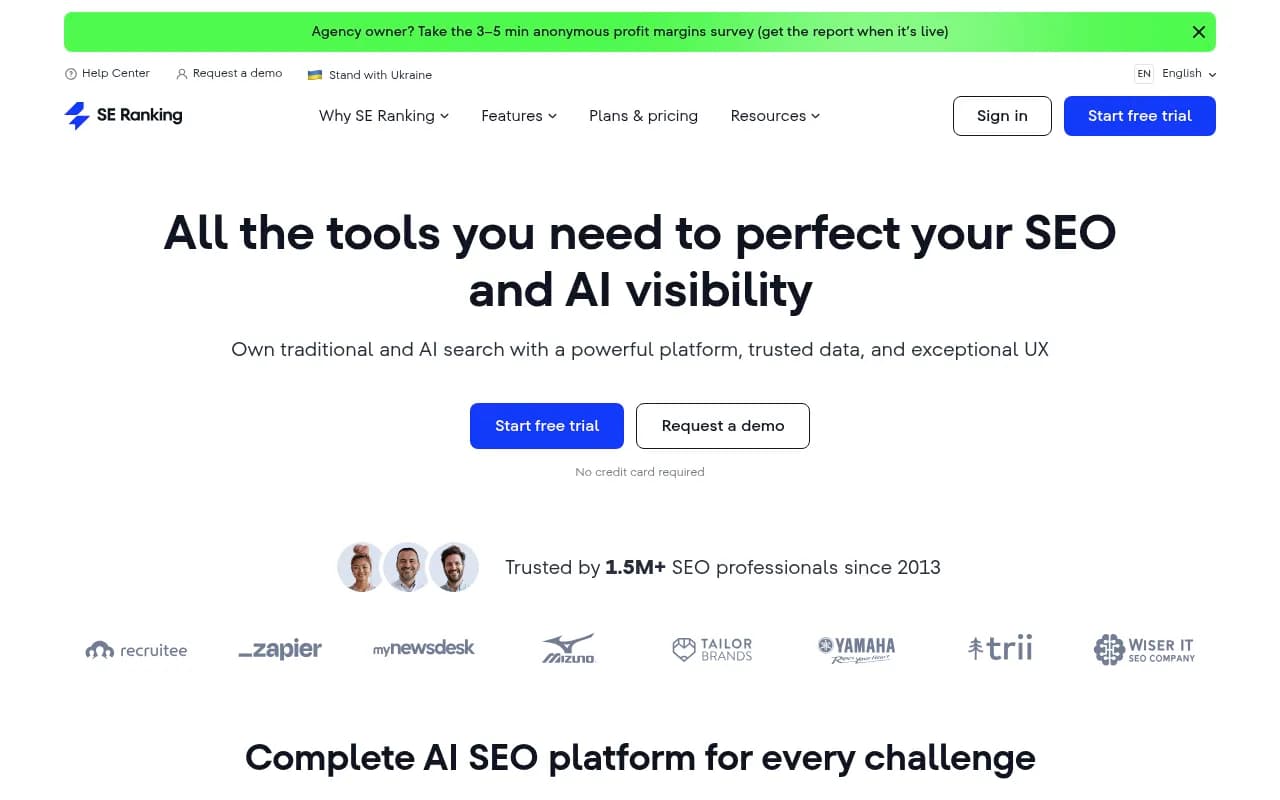
SE Ranking is a well-established SEO platform that added an AI Search add-on module. Like Nightwatch, the appeal is consolidation -- one platform for traditional SEO and AI visibility rather than two separate subscriptions.
The core platform is strong: rank tracking across 188 countries, a 5.4B keyword database, site audits, backlink monitoring, content optimization tools, and white-label reporting. The agency features are particularly good, with automated client reporting and multi-site management.
The AI Search add-on ($71.20/month extra on annual billing) adds AI visibility tracking, though it's less comprehensive than dedicated GEO platforms. The white-label reporting is a genuine differentiator for agencies that need to present AI visibility data to clients under their own brand.
Pricing: Core from $103.20/month (annual), Growth from $223.20/month. AI Search add-on from $71.20/month. 14-day free trial, no credit card required.
Best for: Agencies managing multiple client sites that want white-label reporting and a combined traditional SEO + AI visibility platform.
AthenaHQ

AthenaHQ positions itself as an end-to-end GEO platform, and it has a genuinely impressive client list: Coinbase, ZoomInfo, SoFi, PagerDuty. It covers 8+ LLMs and includes citation tracking, content optimization recommendations, and an executive dashboard for strategic oversight.
The credit-based pricing model is worth understanding before you commit. Each AI query costs a credit, which means your monthly cost scales with how many prompts you're tracking and how frequently you refresh data. That can make budgeting unpredictable compared to flat-rate plans.
The platform is monitoring-focused with some optimization recommendations, but it doesn't have the content generation depth of Promptwatch or Profound. It also lacks crawler logs and Reddit/YouTube tracking.
At $295/month (with a discounted first month at $95), it's positioned as a self-serve enterprise tool. The 17% annual discount helps.
Best for: Mid-market and enterprise brands that want a polished GEO monitoring platform with a strong client roster and don't need content generation built in.
AIclicks
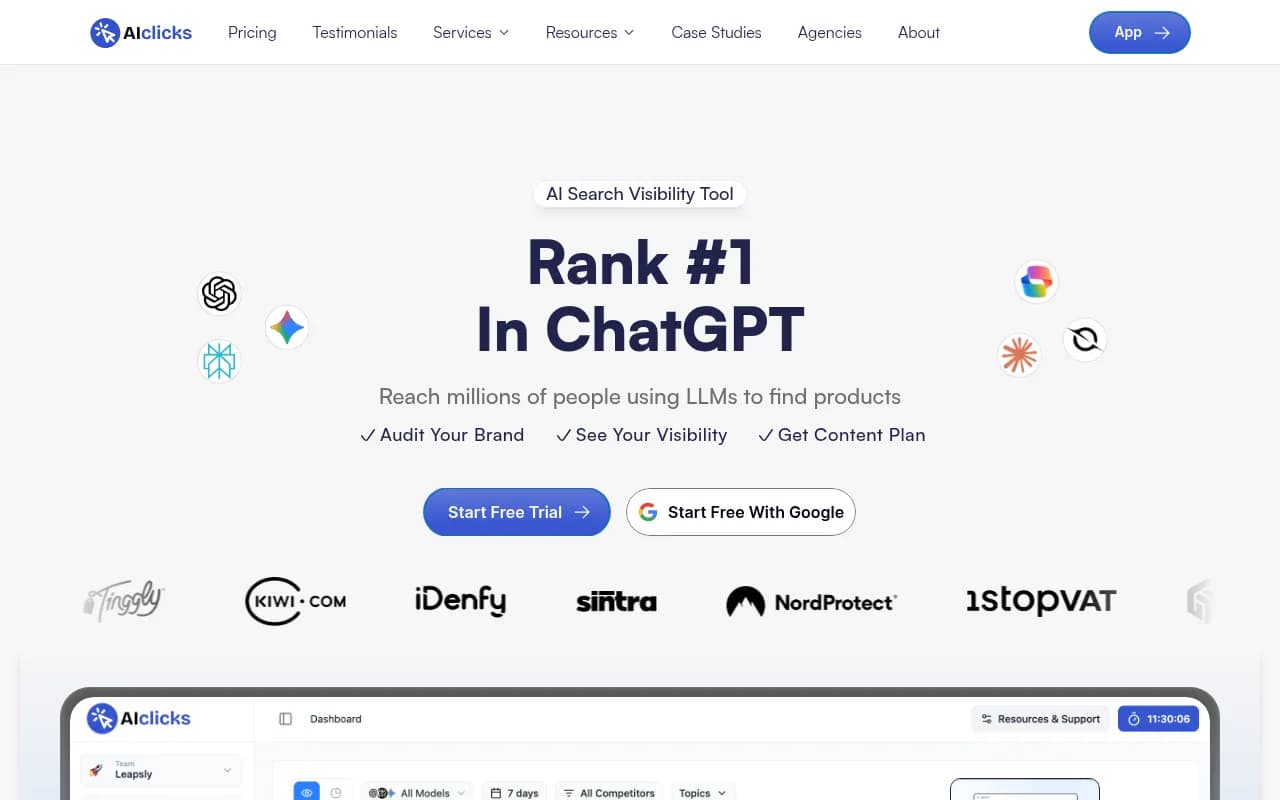
AIclicks takes a slightly different angle -- it's explicitly framed around taking action, not just monitoring. The three-step workflow (track prompts, analyze sources, get an action plan) is similar in spirit to what Promptwatch does, though less comprehensive in execution.
The source analysis is useful: it shows you which domains (Reddit threads, blogs, product pages) are getting cited for your target prompts and where your coverage gaps are. The competitor context feature highlights where competitors are gaining ground in specific channels.
Pricing is competitive at $59/month (Starter), $189/month (Pro), $499/month (Business). The 3-day free trial is short but enough to evaluate the interface.
The platform is newer and smaller than most others on this list, which means the dataset and feature depth aren't quite at the same level. But the 4.8/5 G2 rating suggests users are finding it useful.
Best for: Smaller teams that want an action-oriented AI visibility tool at a mid-range price point and don't need enterprise-level data depth.
Scrunch AI
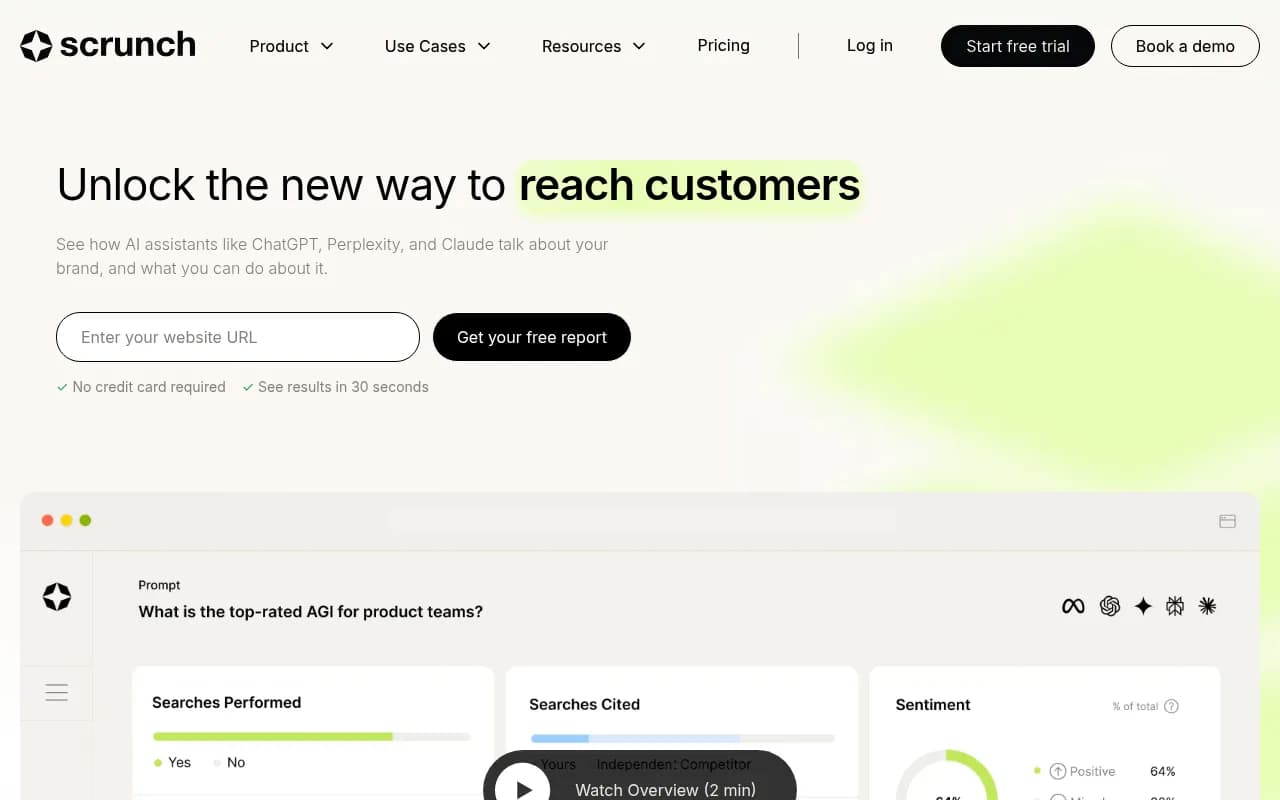
Scrunch AI has an interesting differentiator: the Agent Experience Platform (AXP), which translates your site content for AI traffic without disrupting the human user experience. The idea is that AI crawlers and human visitors have different needs, and Scrunch helps you serve both simultaneously.
The monitoring side covers ChatGPT, Perplexity, and Claude with performance tracking, prompt analytics, and AI traffic data. The crawler error detection is useful -- it surfaces when AI bots can't access your pages and helps you fix it.
The AXP feature is genuinely novel and worth paying attention to if you're thinking about how to make your site more AI-readable at a structural level. It's a different approach from content generation (creating new pages) -- it's about optimizing how existing content is delivered to AI agents.
Pricing starts at $83/month (annual billing). Explorer $83/month, Growth $417/month, Enterprise custom. 7-day free trial.
Best for: Teams interested in technical AI optimization -- making their existing site more crawlable and readable by AI agents -- alongside standard visibility monitoring.
Which tool should you pick?
The honest answer depends on what you actually need.
If you're using GPT Rank Tracker for a quick domain check and want to go deeper, the next step depends on your goal:
-
You want to improve your AI visibility, not just measure it. Promptwatch is the clearest choice. The content gap analysis and AI writing agent mean you can go from "we're invisible for this prompt" to "we published content targeting it" without leaving the platform. The crawler logs and traffic attribution close the loop in a way no other tool does at this price point.
-
You already pay for Semrush. Check the AI Visibility Toolkit first. It won't replace a dedicated GEO platform, but it might be enough for basic monitoring without adding another subscription.
-
You're an agency with white-label reporting needs. SE Ranking's combination of traditional SEO tools, AI Search add-on, and white-label reporting is hard to beat at the price.
-
You want the cheapest option that actually works. Otterly.AI at $29/month covers the basics. Nightwatch at $24/month is even cheaper if you also need traditional rank tracking.
-
You're enterprise and budget isn't the constraint. Profound and AthenaHQ are both solid. Profound has slightly more feature depth; AthenaHQ has a cleaner interface and a credit-based model that might suit lower-volume use cases.
The category is moving fast. A year ago, most of these tools didn't exist. The tools that will matter in 2027 are the ones that help you act on data, not just collect it -- which is why the gap between monitoring-only tools and optimization platforms is widening quickly.