Key takeaways
- Best overall alternative: Promptwatch -- the only platform that closes the full loop from gap analysis to content creation to traffic attribution, used by 8,000+ brands
- Best for enterprise teams: Profound -- strong prompt volume data and content agents, but expensive and no free trial
- Best budget option: Otterly.AI -- starts at $29/mo, solid monitoring for smaller teams who don't need content generation
- Best if you're already in Semrush or Ahrefs: Stick with what you have and add their AI visibility modules, but know you'll hit ceilings quickly
- Best for teams who want monitoring + traditional SEO in one place: SE Ranking, which bundles AI search tracking as an add-on to a full SEO suite
- Best for pure GEO focus without the price tag of enterprise tools: Peec AI or AthenaHQ, depending on how much you value content optimization
LightSite AI positions itself as a "full stack GEO agent" -- the idea being that you deploy it, it runs autonomously, and it handles the machine-readable layer, LLM interaction analytics, and AI search tracking while you sleep. That's an appealing pitch. But there are real reasons people look for alternatives.
The main ones: LightSite's pricing starts at $129/month (annual billing), which isn't cheap for a tool that's still building out its feature set. The agent-first framing is interesting but also opaque -- it's not always clear what the agents are actually doing or how to interpret the results. And for teams that need deep prompt intelligence, content gap analysis, or multi-model tracking across 10+ LLMs, LightSite's current offering can feel thin.
If you're evaluating alternatives, here's an honest look at what else is out there.
The alternatives
Promptwatch

Promptwatch is the most complete GEO platform available right now, and the one most worth comparing seriously against LightSite AI. Where LightSite leans on autonomous agents and a machine-readable layer, Promptwatch is built around a specific loop: find where you're invisible, create content to fix it, then track whether it worked.
The gap analysis is genuinely useful. You can see exactly which prompts your competitors are getting cited for that you're not -- not just "you're missing visibility" but the specific questions and topics where AI models are recommending someone else. That's actionable in a way that a lot of monitoring dashboards aren't.
The content generation side is also more grounded than most. Promptwatch's writing agent uses citation data from over 880 million analyzed citations, so the output is calibrated to what AI models actually cite, not just generic SEO content. You get articles, listicles, and comparison pages built around real prompt volumes and competitor analysis.
A few things Promptwatch does that LightSite doesn't: real-time AI crawler logs (you can see when ChatGPT, Claude, or Perplexity crawls your pages and what errors they hit), Reddit and YouTube citation tracking, ChatGPT Shopping monitoring, and traffic attribution via GSC integration or server log analysis. It also covers 10 AI models including DeepSeek, Grok, and Mistral -- more breadth than most competitors.
Pricing is $99/month for the Essential plan (1 site, 50 prompts, 5 articles), $249/month for Professional (2 sites, 150 prompts, crawler logs), and $579/month for Business (5 sites, 350 prompts). A free trial is available. That's more expensive than LightSite at the entry level, but you're getting substantially more capability -- especially if content creation and traffic attribution matter to you.
Best for: Marketing and SEO teams that want to actually improve their AI visibility, not just watch it. Agencies managing multiple clients. Anyone who's frustrated that other tools show them problems but don't help them fix anything.
Profound
Profound

Profound is the other serious contender in the "full stack" GEO category. It's used by MongoDB, Ramp, and Mercury, which tells you something about who it's built for -- well-funded B2B companies with dedicated marketing teams.
The platform covers prompt volumes (what millions of people are actually asking AI), answer engine insights, agent analytics, and content creation agents. The prompt volume data is a genuine differentiator -- being able to see demand signals from AI search, not just track your existing prompts, is useful for strategy.
Where Profound falls short compared to LightSite and Promptwatch: it's expensive and there's no free trial. The Lite tier starts around $499/month, and the pricing model (based on responses per month) can get confusing. For smaller teams or agencies, that's a hard sell. The platform is also more complex to get started with -- it's built for teams that have someone dedicated to AEO/GEO, not a solo marketer wearing multiple hats.
Compared to LightSite specifically, Profound has more mature prompt intelligence and a stronger content agent, but it costs significantly more and requires more setup. Compared to Promptwatch, Profound lacks Reddit/YouTube tracking and ChatGPT Shopping monitoring, and the traffic attribution story is less developed.
Best for: Enterprise marketing teams at B2B SaaS companies with real budget and a dedicated person to run the platform.
Peec AI

Peec AI is a clean, focused monitoring tool. It tracks visibility, position, and sentiment across ChatGPT, Perplexity, Claude, and Gemini, and it does that well. The interface is straightforward -- you set up prompts, you see how your brand performs across models, you benchmark against competitors.
What it doesn't do: content generation, crawler logs, traffic attribution, Reddit/YouTube tracking. It's a monitoring dashboard, and a good one, but it stops there. If you're coming from LightSite because you want more action-oriented features, Peec AI isn't the answer. If you're coming from LightSite because you want something simpler and cheaper, Peec AI is worth a look.
Pricing starts at €89/month (~$103) for 50 prompts across 10 models, which is competitive. The Growth plan at €199/month adds 150 prompts and 2 workspaces. There's a free trial available.
The main limitation is that 2,000+ marketing teams use it, but the feature set hasn't expanded much beyond core monitoring. For teams that need to move from "we know we're invisible" to "we fixed it," Peec AI leaves a gap.
Best for: Marketing teams that want clean, affordable AI visibility monitoring and are handling content strategy separately.
Otterly.AI
Otterly.AI

Otterly.AI is the most accessible entry point in this category. The Lite plan at $29/month covers 15 prompts across six AI search engines (ChatGPT, Perplexity, Google AI Overviews, Google AI Mode, Gemini, Copilot), and there's a 14-day free trial with no credit card required. For small teams or individuals just getting started with AI visibility tracking, that's a reasonable starting point.
The platform has added a GEO Audit tool that analyzes 25+ on-page factors, which is a step toward optimization rather than pure monitoring. But it's still fundamentally a monitoring and reporting tool. There's no content generation, no crawler logs, no traffic attribution, and no prompt volume data.
Compared to LightSite, Otterly.AI is cheaper and simpler but covers fewer AI models and has less depth. The automated reporting and competitive benchmarking are solid for the price. The Standard plan at $189/month for 100 prompts is where most serious teams will land.
One honest note: Otterly.AI's marketing leans heavily on the "your customers are already ChatGPTing" angle, which is fair, but the platform itself doesn't yet help you do much about it beyond tracking. It's a good awareness tool, not an optimization platform.
Best for: Small businesses, solo marketers, or teams that want basic AI visibility tracking without a big budget or complex setup.
Semrush
Semrush is a different kind of comparison. It's not a GEO-native platform -- it's a full digital marketing suite that has added AI visibility tracking as a module. If you're already paying for Semrush for SEO, PPC, content, or competitive research, the AI visibility features are worth exploring. If you're not already a Semrush customer, it's probably not the right entry point for GEO specifically.
The AI Visibility Toolkit tracks brand mentions across ChatGPT, Perplexity, and Gemini, and the Semrush One bundle positions it as an integrated SEO + AI search solution. The breadth is genuinely impressive -- keyword research, backlink analysis, site audits, content tools, social media, and now AI visibility in one place.
The limitations for GEO specifically: Semrush uses fixed prompts rather than letting you define your own prompt strategy, there's no AI traffic attribution, and the AI features are clearly secondary to the core SEO product. For teams that need deep GEO work, it's a starting point, not a destination.
Pricing starts at $165/month for the Starter plan, which is more expensive than LightSite and most GEO-native tools. The value proposition only makes sense if you're using the broader platform.
Best for: Teams already invested in the Semrush ecosystem who want to add AI visibility monitoring without switching tools.
Ahrefs
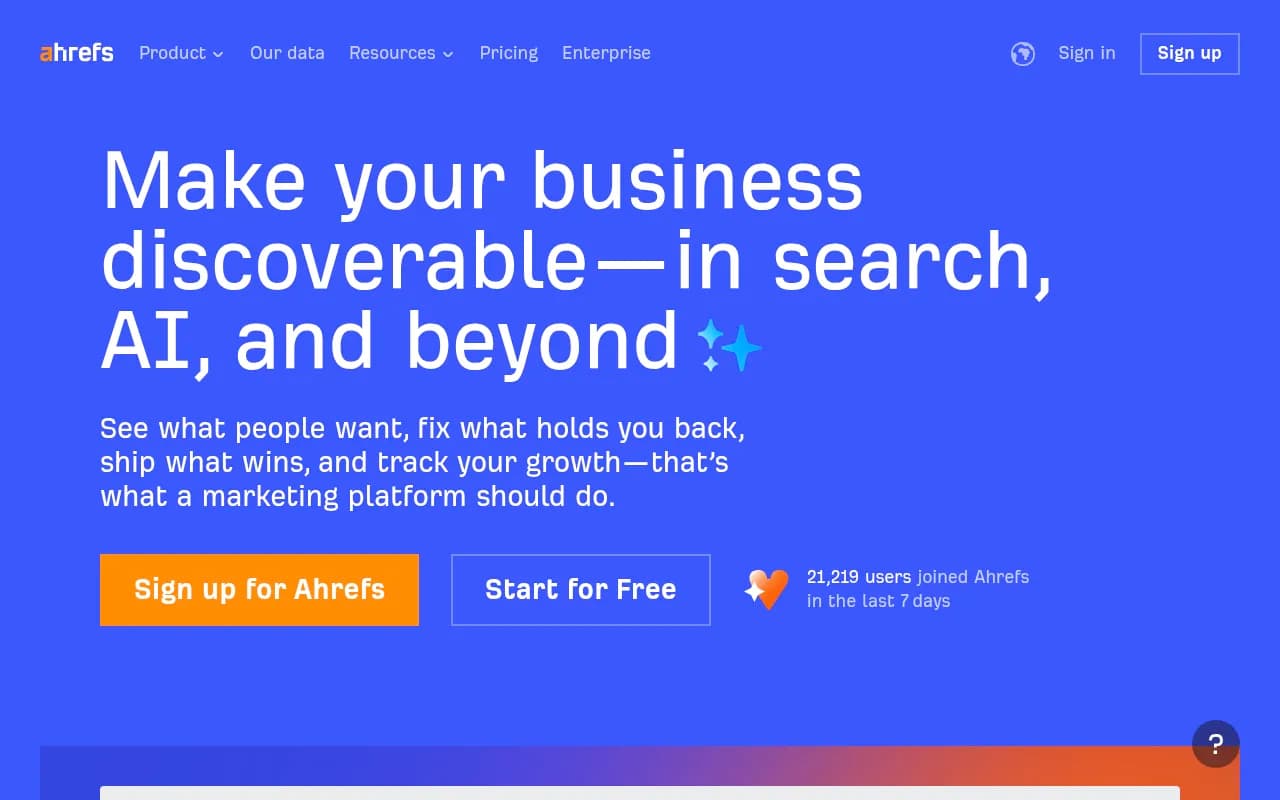
Similar story to Semrush. Ahrefs is a world-class SEO platform that has added AI search monitoring through Brand Radar. The backlink index and keyword database are genuinely best-in-class for traditional SEO. The AI features are newer and more limited.
Brand Radar tracks brand mentions in AI-generated responses, but it uses fixed prompts -- you can't customize the prompt set to match your actual customer journey. There's no AI traffic attribution, no content generation grounded in citation data, and no crawler logs. It's monitoring, and fairly basic monitoring at that compared to GEO-native tools.
The Lite plan starts at $83/month (or $29/month for the very limited Starter), which is competitive, but again -- the value is in the traditional SEO toolset. If you're evaluating Ahrefs as a LightSite alternative specifically for GEO, you'll find it underwhelming. If you need both traditional SEO and some AI visibility tracking, Ahrefs is a reasonable choice.
Best for: SEO-first teams that want to add basic AI brand monitoring to an existing Ahrefs subscription.
SE Ranking
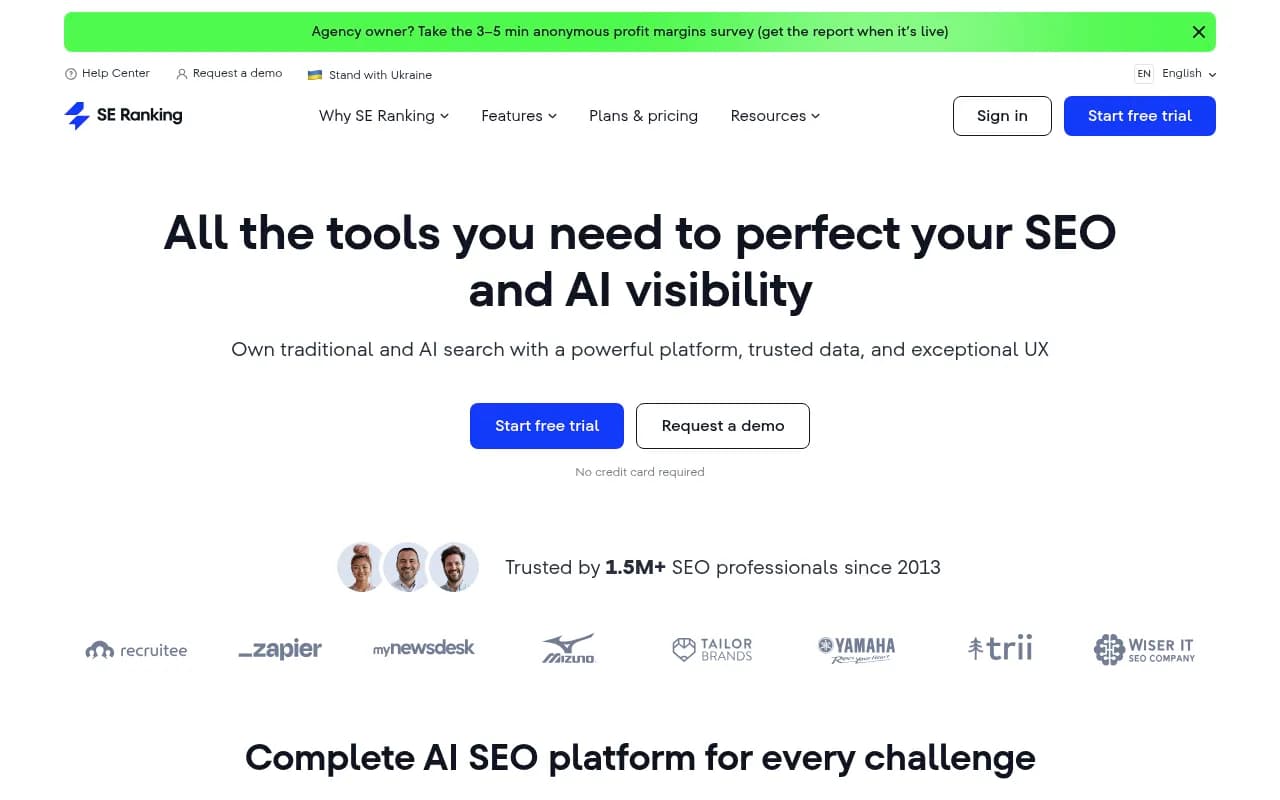
SE Ranking is a solid mid-market SEO platform that has added AI search tracking as a paid add-on ($71.20/month on top of the core plan). The core platform covers rank tracking, keyword research, site audits, backlink monitoring, and white-label reporting -- it's particularly popular with agencies managing multiple client sites.
The AI Search add-on tracks brand visibility across AI platforms and provides some optimization recommendations. It's more integrated into the overall SEO workflow than Semrush or Ahrefs' AI features, but it's still an add-on rather than a native GEO platform.
For agencies that need a full SEO suite with some AI visibility coverage, SE Ranking is cost-effective. The Core plan starts at $103.20/month (annual billing), and adding AI search brings you to around $175/month -- comparable to LightSite but with a much broader traditional SEO feature set.
The limitation is the same as the other SEO platforms: AI visibility is secondary, and the depth of GEO-specific features (prompt intelligence, content gap analysis, crawler logs) isn't there.
Best for: Agencies that need white-label reporting, traditional SEO tools, and basic AI visibility tracking in one platform.
AthenaHQ

AthenaHQ is a GEO-native platform with a strong client list -- Coinbase, ZoomInfo, SoFi, Wix. It tracks AI visibility across 8+ LLMs and provides citation source analysis, automated content optimization recommendations, and a GEO workflow management interface. The platform is clearly built for teams that take AI search seriously.
The main issue is pricing. The self-serve plan starts at $295/month ($95 for the first month as a promotional rate), and it uses a credit-based model where each AI query costs a credit. That can make costs unpredictable as you scale up prompt tracking. There's no free trial in the traditional sense -- just that discounted first month.
Compared to LightSite, AthenaHQ has more mature monitoring and better citation analysis. Compared to Promptwatch, it lacks content generation grounded in citation data, Reddit/YouTube tracking, and the traffic attribution loop. It's a strong monitoring and analysis tool that stops short of being a full optimization platform.
Best for: Mid-market and enterprise marketing teams at B2B companies that want serious GEO monitoring and are willing to pay for it.
Scrunch AI
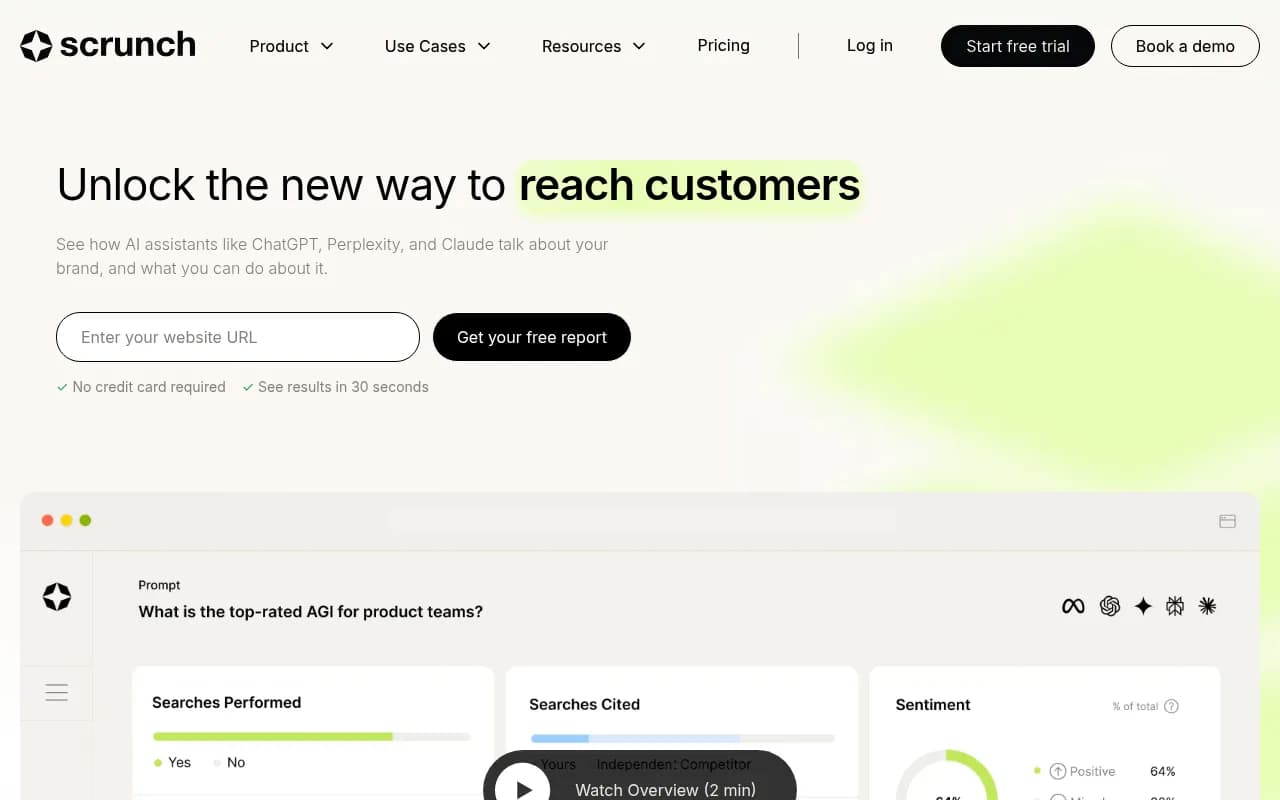
Scrunch AI has an interesting angle: it calls itself an "Agent Experience Platform" and focuses on making your site readable and useful to AI agents, not just tracking how AI talks about you. The idea is that you optimize the experience for AI crawlers directly, which is a slightly different framing than most GEO tools.
In practice, it covers monitoring (brand presence, citations, competitor tracking), insights (optimization tips, error detection for AI crawlers), and the AXP layer that translates site content for AI traffic. The crawler error detection is useful -- knowing when AI bots can't access your pages is actionable. Trusted by Lenovo, Crunchbase, and Penn State University, among others.
Pricing starts at $83/month (annual billing) for the Explorer plan, which is competitive. The Growth plan at $417/month is a significant jump. There's a 7-day free trial.
The limitation: Scrunch is still building out its content generation capabilities, and the prompt intelligence features are less developed than Promptwatch or Profound. It's a good choice for teams that care specifically about the technical side of AI crawlability, but less so for teams that need content strategy support.
Best for: Technical SEO teams and developers who want to optimize how AI agents interact with their site infrastructure.
Which tool should you pick?
Here's the honest summary:
If you want the most complete GEO platform -- one that finds gaps, helps you create content to fill them, and tracks whether it worked -- Promptwatch is the strongest option. It's the only tool in this list rated as a leader across all GEO categories in a 2026 comparison of 12 platforms, and the action loop (find gaps, generate content, track results) is genuinely differentiated from the monitoring-only tools.
If budget is the primary constraint and you just need basic tracking, Otterly.AI at $29/month or Peec AI at €89/month are reasonable starting points. You won't get content generation or traffic attribution, but you'll know where you stand.
If you're an enterprise team at a well-funded B2B company with a dedicated AEO person, Profound is worth evaluating -- the prompt volume data is strong, even if the price is steep.
If you're already deep in Semrush or Ahrefs, use their AI features as a baseline before committing to a separate GEO tool. Just know you'll likely outgrow them if AI search becomes a serious channel for your business.
LightSite AI's agent-first approach is genuinely interesting, and the MCP layer concept has merit. But for most marketing teams, the combination of monitoring depth, content generation, and traffic attribution that Promptwatch provides is harder to match at any price point in this category.