Key Takeaways
- Amplitude is the best choice for teams that prioritize deep behavioral analytics and predictive insights over in-app guidance -- stronger event tracking and AI-powered analysis, but no native onboarding flows
- Mixpanel offers the most granular event-based analytics at a lower price point than Pendo, ideal for startups and growth teams focused purely on data (no guidance features)
- PostHog is the only open-source alternative with a generous free tier and self-hosting option -- perfect for engineering-led teams that want full data control and integrated feature flags
- Fullstory excels at session replay and behavioral data capture but costs significantly more than Pendo, best for enterprise teams diagnosing UX friction
- Userpilot and Appcues match Pendo's in-app engagement capabilities at lower price points ($299-879/mo vs Pendo's $7K-30K/year), but lack Pendo's analytics depth
Pendo is expensive. The platform starts around $7,000-10,000 per year for the Base plan and quickly scales to $20,000-30,000+ for Core, with enterprise pricing reaching $50,000 or more. That's a lot of money for a product analytics and digital adoption platform -- especially when you're a smaller team or just need one piece of what Pendo offers.
The other reason teams look for alternatives: Pendo tries to do everything. Product analytics, in-app guides, session replay, feedback collection, roadmapping (via the Chisel acquisition). That's great if you need an all-in-one suite, but most teams don't. You might just need better analytics. Or you only care about onboarding flows. Or you want open-source tooling your engineers can customize.
This guide compares the best Pendo alternatives across three categories: pure analytics platforms (Amplitude, Mixpanel, PostHog, Heap), behavioral data platforms with session replay (Fullstory), and digital adoption platforms focused on in-app engagement (Userpilot, Appcues, WalkMe). Each section explains what the tool does well, where it falls short compared to Pendo, and who should pick it.
Amplitude
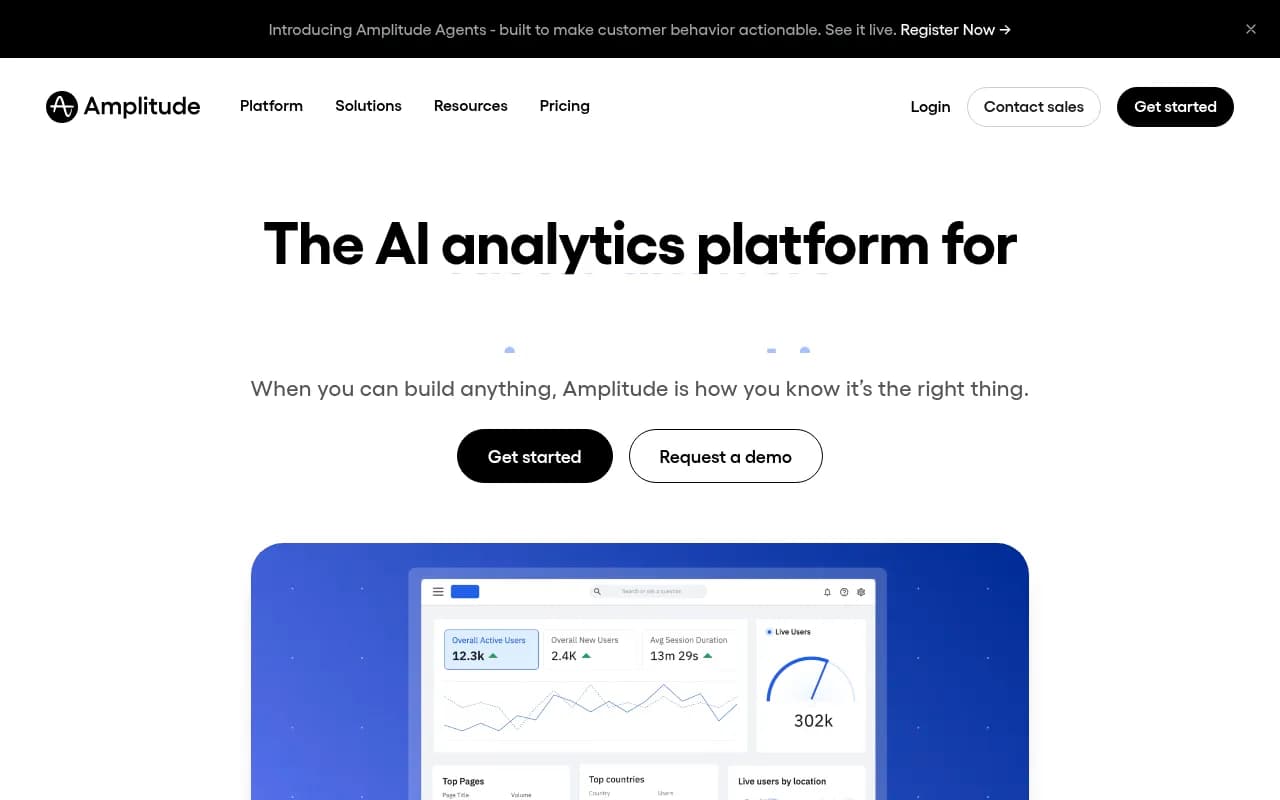
Amplitude is a product analytics platform built for teams that want to understand user behavior at scale. It tracks events, builds cohorts, analyzes funnels and retention, and uses AI to surface insights automatically. Unlike Pendo, Amplitude doesn't include in-app guidance or onboarding flows -- it's purely an analytics tool.
The core difference: Amplitude's event tracking is more flexible and granular than Pendo's. You can define custom events, properties, and user attributes without hitting the limits Pendo imposes on its lower-tier plans. The AI-powered "Insights" feature automatically surfaces anomalies, trends, and segments worth investigating -- something Pendo's analytics module doesn't match.
Amplitude also has better predictive analytics. The platform uses machine learning to forecast churn, identify high-value users, and recommend which cohorts to target. Pendo has some churn prediction (added recently), but it's not as mature.
What Amplitude lacks: any kind of in-app messaging or guidance. If you need to show tooltips, modals, or onboarding checklists inside your product, Amplitude won't help. You'd need to pair it with a separate tool like Appcues or Chameleon. Pendo bundles analytics and guidance in one platform, which is why teams that need both often stick with Pendo despite the cost.
Pricing: Amplitude has a generous free tier (up to 10,000 monthly tracked users), then jumps to $49/month for the Plus plan (300,000 MTUs). Growth and Enterprise plans are custom-priced, typically ranging from $2,000 to $50,000+ per year depending on volume. That's cheaper than Pendo's Base plan for small teams, but comparable at enterprise scale.
Best for: Engineering-led product teams, growth teams at B2C companies, and anyone who needs deep behavioral analytics without the overhead of in-app engagement tools. If you're analyzing millions of events per month and want predictive insights, Amplitude is the strongest choice. If you also need onboarding flows, you'll have to integrate a second tool.
Mixpanel
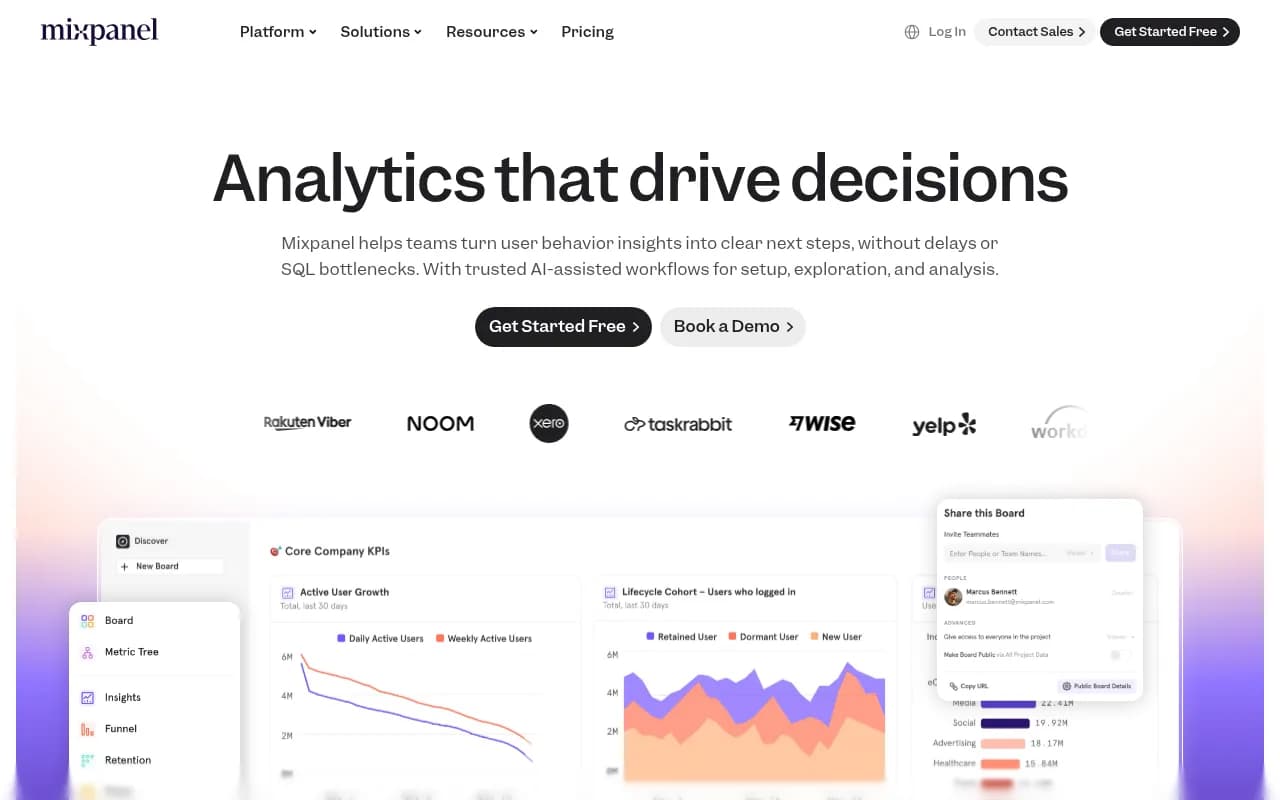
Mixpanel is an event-based analytics platform that tracks user actions, builds funnels, measures retention, and segments users by behavior. Like Amplitude, it's a pure analytics tool -- no in-app guides, no session replay, no feedback surveys. Just data.
The main reason teams pick Mixpanel over Pendo: it's cheaper and faster to implement. Mixpanel's free tier covers 1 million events per month (vs Amplitude's 10K MTUs, which is a different metric but roughly comparable for small teams). The Growth plan starts at $24/month for 10 million events, with volume discounts bringing the effective cost to $0.28 per 1,000 events. That's significantly less than Pendo's $7,000+ Base plan.
Mixpanel's interface is simpler than Amplitude's. You can build a funnel or cohort analysis in minutes without training. Pendo's analytics module is more complex and slower -- it tries to do too much, so basic queries take longer to set up. Mixpanel is just fast.
Where Mixpanel falls short: it doesn't have Amplitude's predictive analytics or AI-powered insights. You're doing manual exploration. And like Amplitude, there's no in-app engagement layer. If you need to guide users or collect feedback inside your product, Mixpanel won't help.
The other trade-off: Mixpanel's session replay and heatmap features are add-ons that cost extra. Pendo includes session replay in its Core plan. If you need both analytics and replay, Pendo might actually be more cost-effective at enterprise scale.
Best for: Startups and growth teams that need fast, affordable event tracking without the complexity of Amplitude or the cost of Pendo. If your primary goal is understanding user behavior through funnels and cohorts -- and you don't need onboarding flows or session replay -- Mixpanel is the most efficient choice.
PostHog
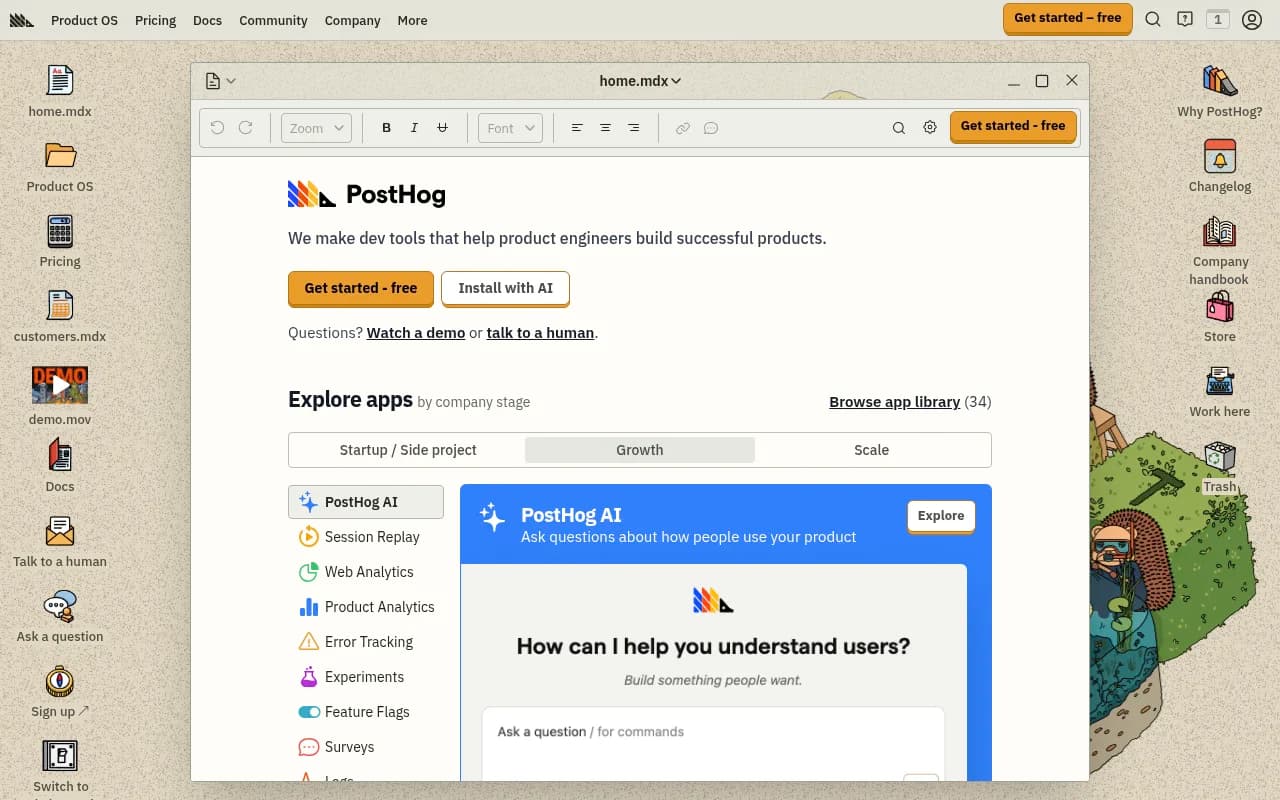
PostHog is an open-source product analytics platform that combines event tracking, session replay, feature flags, A/B testing, and user surveys in one tool. It's the only Pendo alternative on this list that you can self-host, which matters if you have strict data residency requirements or want full control over your analytics infrastructure.
The big advantage: PostHog's free tier is extremely generous. You get 1 million events, 5,000 session replays, and 1 million feature flag requests per month at no cost. That's enough for most early-stage startups to run indefinitely without paying. Pendo's free plan caps at 500 monthly active users and doesn't include session replay or feature flags.
PostHog's feature flags and A/B testing are built-in and tightly integrated with the analytics. You can launch an experiment, track its impact on conversion or retention, and roll out the winning variant -- all in the same platform. Pendo doesn't have native experimentation; you'd need to integrate with Optimizely or LaunchDarkly.
What PostHog lacks: in-app guidance. There are no onboarding flows, tooltips, or modals. PostHog is built for engineers who want to instrument their product and run experiments, not for product managers who need to guide users through features. If you need both analytics and in-app engagement, PostHog won't replace Pendo.
The other consideration: PostHog's interface is less polished than Amplitude or Mixpanel. It's functional and improving fast, but it feels like an engineering tool. Non-technical team members might struggle with it.
Pricing: Free tier as described above, then usage-based pricing ($0.00031 per event, $0.005 per session replay, $0.0001 per feature flag request). Self-hosting is free if you run the open-source version. For most teams, PostHog ends up cheaper than Pendo unless you're processing tens of millions of events.
Best for: Engineering-led teams, open-source advocates, and companies with data residency requirements. If you want full control over your analytics stack, need feature flags and experimentation, and don't care about in-app onboarding, PostHog is the best choice. If you need guidance features, look elsewhere.
Heap
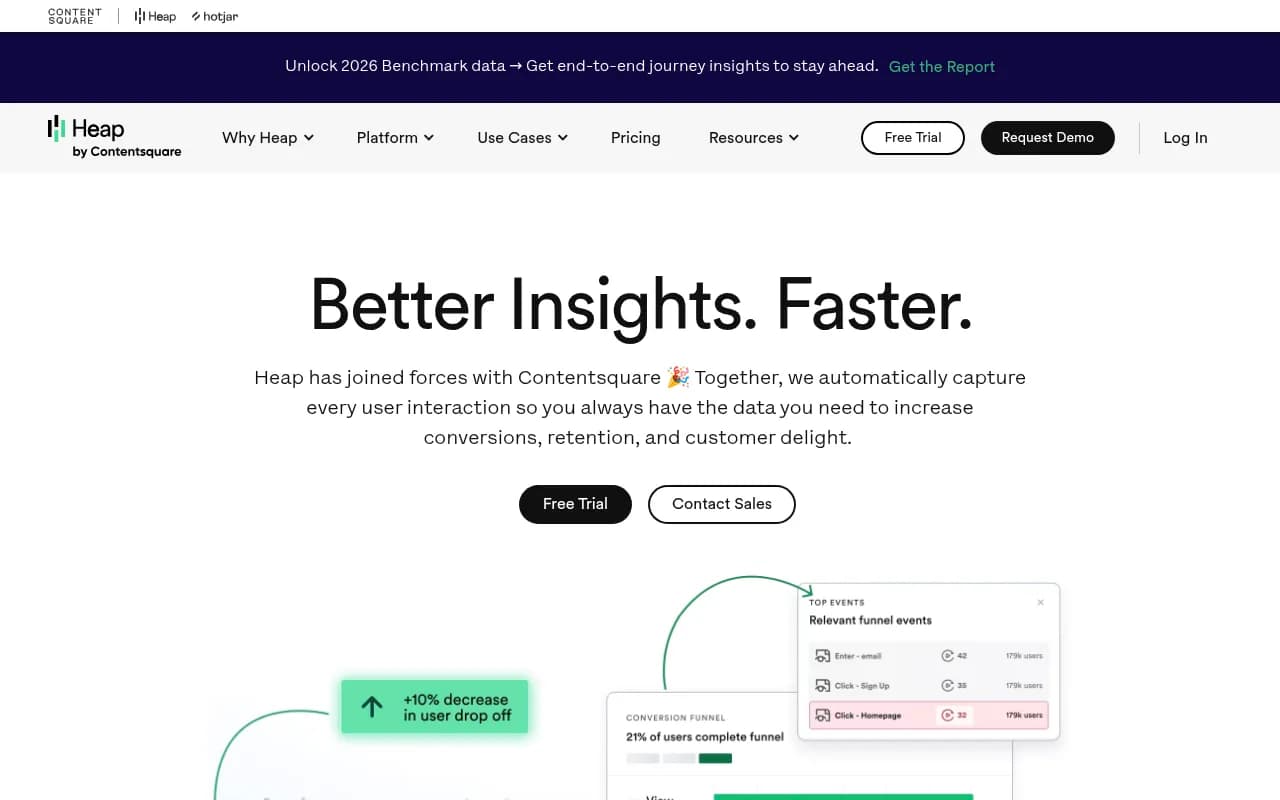
Heap is a digital analytics platform that automatically captures every user interaction on your website and mobile apps without requiring manual event tracking. You install a snippet, and Heap records clicks, taps, form submissions, page views -- everything. Then you retroactively define events and build analyses.
The core value proposition: you never miss data. With Pendo, Amplitude, or Mixpanel, you have to decide upfront which events to track. If you forget to instrument something, you can't analyze it until you add tracking code and wait for new data to accumulate. Heap captures everything by default, so you can ask questions about past behavior.
Heap is now part of Contentsquare, which means it's integrated with session replay, heatmaps, and journey analysis tools. That makes it more comparable to Pendo's full suite than pure analytics platforms like Amplitude. The difference: Heap's "Illuminate" feature uses AI to automatically surface friction points and drop-off patterns you weren't looking for. Pendo requires you to manually build funnels and paths.
What Heap lacks: in-app guidance. Like Amplitude and Mixpanel, there are no onboarding flows or tooltips. You'd need to pair Heap with Appcues or Userpilot if you want to guide users.
The other downside: Heap is expensive. The free tier caps at 10,000 sessions per month, then the Growth plan starts around $900/month. That's more than Amplitude or Mixpanel at comparable scale, and roughly in line with Pendo's pricing. The automatic capture is convenient, but you're paying for it.
Best for: Teams that want comprehensive behavioral data without the hassle of manual event tracking, and companies that need session replay integrated with analytics. If you're constantly discovering that you forgot to track something important, Heap solves that problem. If you're disciplined about instrumentation and want lower costs, Amplitude or Mixpanel are better.
Fullstory
Fullstory is a behavioral data platform that captures every user interaction, then uses AI to surface friction points, bugs, and optimization opportunities. It's best known for session replay -- you can watch recordings of real user sessions to see exactly where people get stuck. But it also includes analytics, heatmaps, and funnel analysis.
The main reason teams pick Fullstory over Pendo: session replay quality. Fullstory's replay is pixel-perfect and includes console logs, network requests, and error tracking. You can see not just what users clicked, but what broke in the background. Pendo's session replay (added in recent years) is functional but less detailed.
Fullstory's "Autocapture" works like Heap's -- it records everything automatically, so you can retroactively analyze events you didn't explicitly track. The AI-powered "Insights" feature (similar to Heap's Illuminate) proactively alerts you to rage clicks, error-prone flows, and drop-off spikes.
What Fullstory lacks: in-app guidance. No onboarding flows, no tooltips, no modals. It's a diagnostic tool, not an engagement tool. If you need to guide users, you'll have to integrate Appcues or Chameleon alongside Fullstory.
The other issue: cost. Fullstory starts at $10,000 per year minimum, with typical customers paying $300-1,000 per month depending on session volume and data retention. That's more expensive than Pendo's Base plan and comparable to Pendo's Core plan. You're paying for best-in-class session replay and behavioral data capture, but it's not cheap.
Best for: Enterprise product teams, UX researchers, and support teams that need to diagnose complex user issues. If you're constantly asking "why did this user abandon the checkout flow?" or "what caused this bug?" Fullstory gives you the answers. If you just need basic analytics and onboarding, it's overkill.
Userpilot
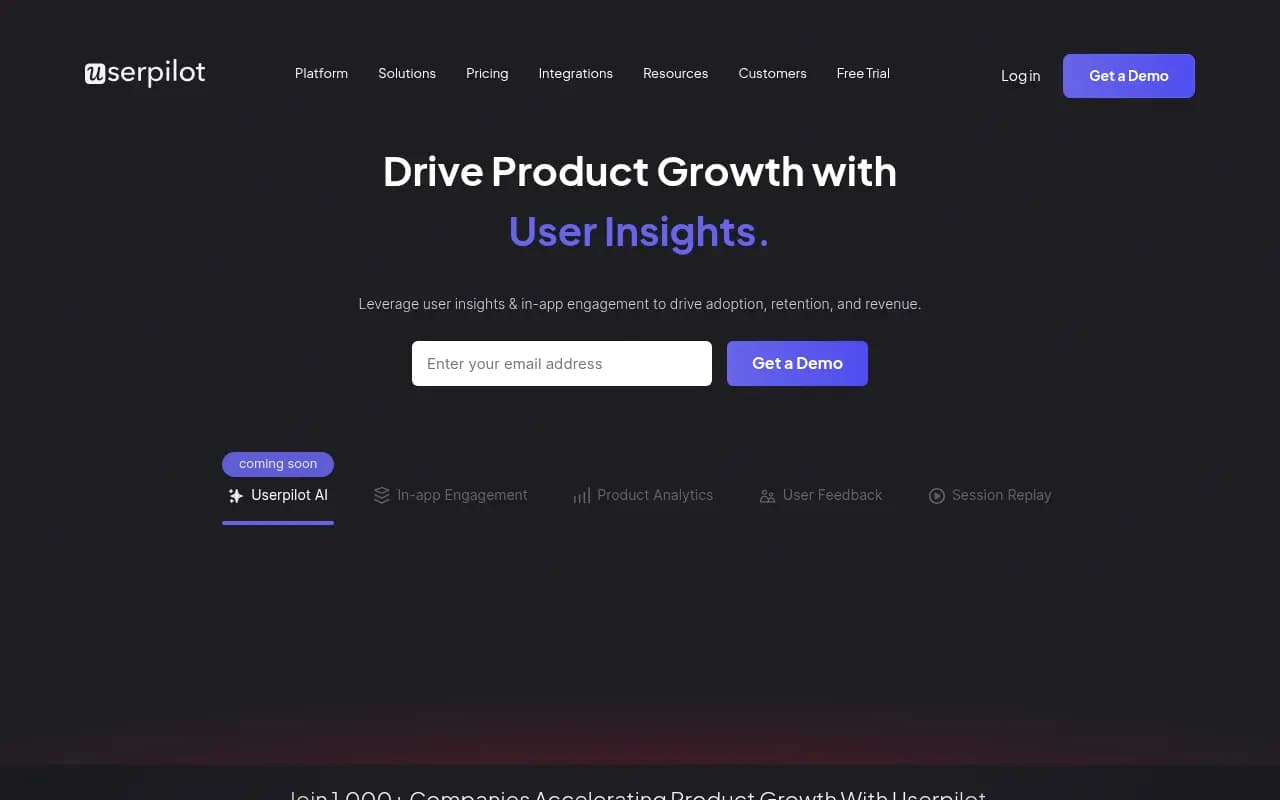
Userpilot is a product growth platform that combines in-app engagement (onboarding flows, tooltips, modals), product analytics, user feedback surveys, and session replay. It's the closest direct competitor to Pendo in terms of feature scope -- both platforms try to cover analytics and engagement in one tool.
The main advantage over Pendo: price. Userpilot starts at $299/month for up to 2,500 monthly active users, with the Growth plan at $499/month for 10,000 MAUs. That's dramatically cheaper than Pendo's $7,000-10,000/year Base plan. For small to mid-sized SaaS companies, Userpilot delivers 80% of Pendo's functionality at 30% of the cost.
Userpilot's no-code builder is faster and more intuitive than Pendo's. You can create an onboarding checklist or feature announcement in minutes without touching code. Pendo's builder is more powerful (more customization options), but it's also slower and requires more training.
Where Userpilot falls short: analytics depth. Userpilot has funnels, paths, and cohort analysis, but it's not as robust as Pendo's Data Explorer or Amplitude's event tracking. You can answer basic product questions ("how many users completed onboarding?"), but complex multi-step analyses are harder. If analytics is your primary use case, Userpilot isn't the right choice.
The other limitation: Userpilot's session replay is newer and less polished than Pendo's or Fullstory's. It works, but you'll hit edge cases where replays don't capture everything.
Best for: Small to mid-sized SaaS companies (under 10,000 MAUs) that need in-app onboarding and basic analytics without Pendo's enterprise price tag. If your primary goal is improving activation and adoption through guided flows, Userpilot is the most cost-effective option. If you need deep analytics, pair it with Mixpanel or Amplitude.
Appcues

Appcues is a no-code customer engagement platform focused on in-app messaging, onboarding flows, and user surveys. It's similar to Userpilot in scope but has been around longer (founded 2013 vs Userpilot's 2017) and is used by 1,500+ companies including AdRoll and ProfitWell.
The core strength: simplicity. Appcues is the easiest platform on this list to set up and use. You can launch your first onboarding flow in under an hour. Pendo requires more configuration and training -- it's more powerful, but also more complex. If you just need to guide users through key features, Appcues gets you there faster.
Appcues also supports multi-channel engagement: in-app messages, emails, and mobile push notifications. Pendo focuses primarily on in-app (though it has some email capabilities). If you want to coordinate onboarding across web, mobile, and email, Appcues handles that better.
Where Appcues falls short: analytics. Appcues has basic event tracking and goal measurement, but it's not a real analytics platform. You can see how many users completed a flow, but you can't build funnels or cohort analyses. Most Appcues customers pair it with Amplitude, Mixpanel, or Heap for analytics.
Pricing: Starts at $249/month for the Essentials plan (2,500 MAUs), with the Growth tier at $879/month. That's slightly more expensive than Userpilot but still far cheaper than Pendo. The main trade-off is analytics depth -- Userpilot has more built-in analytics, while Appcues is purely focused on engagement.
Best for: Teams that need fast, simple in-app onboarding and already have an analytics tool in place. If you're using Amplitude or Mixpanel for data and just need a layer for guiding users, Appcues is the cleanest integration. If you want analytics and engagement in one platform, Userpilot or Pendo are better.
WalkMe
WalkMe is a Digital Adoption Platform (DAP) that overlays on any application to provide in-app guidance, workflow automation, and usage analytics. It's used primarily by enterprise companies to train employees on complex internal software (Salesforce, SAP, Workday) rather than to onboard customers in SaaS products.
The key difference from Pendo: WalkMe is built for employee-facing applications, not customer-facing products. Pendo is designed for SaaS companies guiding end users through their product. WalkMe is designed for IT and HR teams guiding employees through enterprise software they don't control.
WalkMe's guidance is more sophisticated than Pendo's. It can automate multi-step workflows ("fill out this form, then submit it, then navigate to the next screen") and adapt based on user behavior in real time. Pendo's guides are simpler -- mostly tooltips, modals, and checklists.
The downside: cost and complexity. WalkMe starts around $1-2.50 per user per month, with enterprise contracts averaging $78,000+ per year. That's significantly more expensive than Pendo. And WalkMe requires professional services to implement -- you're not setting this up yourself.
Best for: Large enterprises (5,000+ employees) that need to train staff on complex internal software like Salesforce, SAP, or custom enterprise applications. If you're a SaaS company trying to onboard customers, WalkMe is overkill and overpriced. Stick with Pendo, Userpilot, or Appcues.
How to choose the right Pendo alternative
If you need deep product analytics and don't care about in-app guidance, pick Amplitude (best predictive analytics), Mixpanel (fastest and cheapest), or PostHog (open-source with feature flags). All three are stronger analytics platforms than Pendo.
If you need session replay and behavioral diagnostics, pick Fullstory (best replay quality but expensive) or Heap (automatic capture, good for teams that forget to track events). Both are better than Pendo's replay feature.
If you need in-app onboarding and engagement at a lower price than Pendo, pick Userpilot (best balance of analytics and engagement) or Appcues (simplest to use, multi-channel support). Both deliver 80% of Pendo's engagement features at 30-50% of the cost.
If you need everything Pendo offers (analytics + engagement + feedback + replay) and cost isn't a constraint, stick with Pendo or consider Userpilot as a cheaper alternative with slightly less analytics depth.
If you're training employees on enterprise software (not onboarding customers in your SaaS product), pick WalkMe. It's the only platform built for that use case.
The most common mistake: trying to replace Pendo with a single tool. Most teams end up with a stack -- Amplitude or Mixpanel for analytics, Appcues or Userpilot for engagement, Fullstory for session replay. That's fine. Pendo's all-in-one approach is convenient, but specialized tools are often better at their specific jobs.