Key takeaways
- Promptwatch is the best all-in-one platform if you want to monitor AI visibility AND act on it -- with content gap analysis, an AI writing agent, crawler logs, and traffic attribution across 10+ LLMs.
- Semrush is the right choice if you already use it for traditional SEO and want to add AI visibility tracking without switching tools -- though its GEO features are less deep than dedicated platforms.
- Profound is a strong enterprise pick with solid prompt volume data and AI content agents, but pricing starts high and there's no free trial.
- Peec AI and Otterly.AI are good entry-level monitoring tools for smaller teams on a budget -- both are monitoring-only, so don't expect content optimization.
- AthenaHQ and Scrunch AI sit in the middle ground: more capable than basic trackers, but still primarily monitoring-focused.
- Stridec itself is an agency/consultancy, not a SaaS platform -- if you want hands-on done-for-you work, it's worth considering, but it's a different category from the self-serve tools listed here.
- BrightEdge and Search Party are enterprise-only plays with opaque pricing -- only worth exploring if you have a large budget and complex needs.
Stridec occupies an unusual position in the AI search world. It's not really a software platform -- it's a specialist agency that happens to sell a $497 PDF playbook on the side. If you've been looking at Stridec, you're probably trying to figure out how to get your brand cited in Google AI Overviews, and you're weighing whether to hire an agency, buy a course, or use a self-serve tool.
The honest answer is that most people looking at Stridec are actually looking for something different: a platform they can use themselves, a tool that shows them where they're invisible in AI search, or a way to track whether their optimization efforts are actually working. Stridec's methodology -- Entity Differentiation, Two-Layer Content Architecture -- is interesting, but it's a framework, not a feedback loop. You implement it, and then... you hope it worked.
That's the gap most of these alternatives fill. Some are pure monitoring dashboards. Some go further and help you create content. A few are enterprise platforms that cost more than a junior hire. Here's an honest breakdown of each.
The alternatives
Promptwatch

Promptwatch is the most complete platform in this space if you want to both track and improve your AI search visibility. Where Stridec gives you a methodology to implement manually, Promptwatch closes the loop: it shows you where you're missing, helps you create content to fix it, and then tracks whether that content actually gets cited.
The core workflow is worth understanding. Answer Gap Analysis shows you which prompts your competitors appear in that you don't -- not just "you're invisible," but specifically which topics and questions AI models want to answer that your site doesn't address. The built-in AI writing agent then generates articles, listicles, and comparison pages grounded in real citation data (over 880 million citations analyzed). After publishing, page-level tracking shows which pages are being cited, by which models, and how often. Traffic attribution via GSC integration or server log analysis connects that visibility to actual revenue.
Beyond the core loop, Promptwatch has features most competitors don't: real-time AI crawler logs (see exactly when ChatGPT or Perplexity crawls your pages), Reddit and YouTube citation tracking, ChatGPT Shopping monitoring, prompt volume and difficulty scoring, and query fan-outs that show how one prompt branches into sub-queries. It monitors 10 AI models including ChatGPT, Claude, Perplexity, Gemini, Grok, DeepSeek, Copilot, and Google AI Overviews.
Compared to Stridec, the difference is self-serve vs. done-for-you. Stridec will implement the strategy for you (at custom agency pricing) or sell you the playbook to do it yourself. Promptwatch gives you the data infrastructure to run the strategy continuously, track what's working, and iterate. They're not really competing -- but if you're evaluating Stridec because you want AI search visibility, Promptwatch is the more scalable answer for most teams.
Pricing: Essential $99/mo (1 site, 50 prompts), Professional $249/mo (2 sites, 150 prompts, crawler logs), Business $579/mo (5 sites, 350 prompts). Free trial available.
Best for: Marketing and SEO teams that want to own their AI search strategy in-house, track results, and continuously optimize -- not just get a one-time audit or playbook.
Semrush
Semrush is the tool most marketing teams already have open in another tab, which is both its biggest advantage and its biggest limitation in this context. Its AI Visibility Toolkit tracks brand mentions across ChatGPT, Perplexity, and Gemini, and the breadth of its traditional SEO data (keyword research, backlink analysis, site audits) means you can see AI visibility alongside everything else in one place.
The problem is that Semrush's GEO features are clearly bolted on rather than built from the ground up. It uses fixed prompt sets rather than letting you define your own, there's no AI traffic attribution, no crawler logs, and no content generation grounded in citation data. If you're serious about AI search optimization -- not just monitoring -- you'll hit the ceiling quickly.
That said, for teams that aren't ready to add another platform to their stack, Semrush's AI features are good enough to get started. The AI Visibility Index it publishes is genuinely useful for benchmarking. And if you're already paying for Semrush Pro or Advanced, the AI features come included.
Pricing: From $165/mo (Starter) to $580/mo (Advanced). Enterprise custom. 7-day free trial.
Best for: Teams already using Semrush for traditional SEO who want basic AI visibility data without adding a new tool. Not the right choice if AI search is a primary focus.
Profound
Profound

Profound is the enterprise-grade option in this space. It's used by MongoDB, Ramp, and Mercury, which tells you something about who it's built for. The platform covers monitoring across 9+ AI engines, prompt volume data, AI crawler behavior, and AI content generation agents -- a feature set that genuinely competes with Promptwatch at the top end.
Where Profound falls short is accessibility. There's no free trial, pricing starts around $499/month for the Lite tier (and that's a limited tier), and the sales process is consultative. For a mid-market SaaS company or e-commerce brand, that's a significant commitment before you've seen whether the tool works for your use case.
The content agents are a real differentiator -- Profound can generate AEO-optimized FAQ content and other structured formats grounded in what AI models actually cite. But the overall platform feels oriented toward large marketing teams with dedicated AEO/GEO resources, not lean teams that need to move fast.
Compared to Stridec, Profound is a platform rather than an agency -- you're doing the work yourself, but with much better data than Stridec's playbook gives you.
Pricing: Lite from ~$499/mo, Advanced ~$449/mo, Enterprise custom. No free trial.
Best for: Enterprise marketing teams with budget and dedicated GEO resources who need SOC 2 compliance and deep prompt volume data.
Peec AI

Peec AI is a clean, focused monitoring tool that tracks brand visibility, position, and sentiment across ChatGPT, Perplexity, Claude, and Gemini. The interface is genuinely good -- the dashboard is intuitive, competitor benchmarking is easy to set up, and the visibility/position/sentiment breakdown gives you a useful snapshot of how AI models perceive your brand.
The limitation is that it's monitoring only. You can see that you're invisible for a set of prompts, but Peec AI won't tell you why or what to do about it. There's no content gap analysis, no AI writing tools, no crawler logs. It's a measurement tool, not an optimization tool.
For the price (starting at €89/month), that's a reasonable trade-off for smaller teams that just need to know where they stand. But if you're looking for Stridec alternatives because you want to actually improve your AI visibility, Peec AI gets you the data without the path forward.
Pricing: Free trial available. Starter €89/mo (50 prompts, 10 models), Growth €199/mo (150 prompts, 2 workspaces), Enterprise custom.
Best for: Small to mid-size marketing teams that need affordable AI visibility monitoring and competitor benchmarking, without the complexity of a full GEO platform.
Otterly.AI
Otterly.AI

Otterly.AI monitors brand mentions and citations across ChatGPT, Perplexity, Google AI Overviews, Google AI Mode, Gemini, and Copilot. It's been around long enough to have a solid reputation in the GEO community, and the 14-day free trial with no credit card required makes it easy to test.
The GEO Audit feature is worth calling out -- it analyzes 25+ on-page factors to show what's holding your site back from earning more citations. That's a step beyond pure monitoring, though it's still diagnostic rather than generative (it tells you what's wrong, not how to fix it with new content).
At $29/month for the Lite plan (15 prompts), Otterly.AI is the most accessible entry point in this list. The Standard plan at $189/month gets you 100 prompts, which is enough for most mid-size brands. The trade-off is that you won't get crawler logs, prompt volume data, or content generation at any tier.
Compared to Stridec's $497 one-time playbook, Otterly.AI at $29-189/month gives you ongoing monitoring data rather than a static framework. They solve different problems, but if you want to track whether your optimization work is having an effect, Otterly.AI is the more useful ongoing tool.
Pricing: Lite $29/mo (15 prompts), Standard $189/mo (100 prompts), Premium custom. 14-day free trial, no credit card required.
Best for: Budget-conscious teams that want to start monitoring AI visibility without a large commitment, and agencies that need a simple client-facing reporting tool.
AthenaHQ

AthenaHQ positions itself as an end-to-end AEO and GEO platform, and it's used by some recognizable names -- Coinbase, ZoomInfo, SoFi, Wix. The platform covers AI visibility tracking across 8+ LLMs, citation source analysis, and automated content optimization recommendations. The credit-based model (1 credit = 1 AI query) is a bit unusual and worth understanding before committing.
The "automated content optimization recommendations" is where AthenaHQ tries to go beyond pure monitoring, but it's recommendations rather than generation -- it tells you what to optimize, not creates the content for you. That's a meaningful distinction if your team is already stretched thin.
At $295/month for self-serve (with a discounted first month at $95), AthenaHQ is priced in the mid-range. The Y Combinator backing and Forbes/WSJ coverage suggest it's a serious player, but the platform is still maturing compared to Promptwatch or Profound in terms of depth.
Pricing: Self-Serve $295/mo ($95 first month), Enterprise custom. Annual plans with 17% discount.
Best for: Growth-stage companies that want more than basic monitoring but aren't ready for enterprise pricing -- particularly those with in-house content teams who can act on optimization recommendations.
Scrunch AI
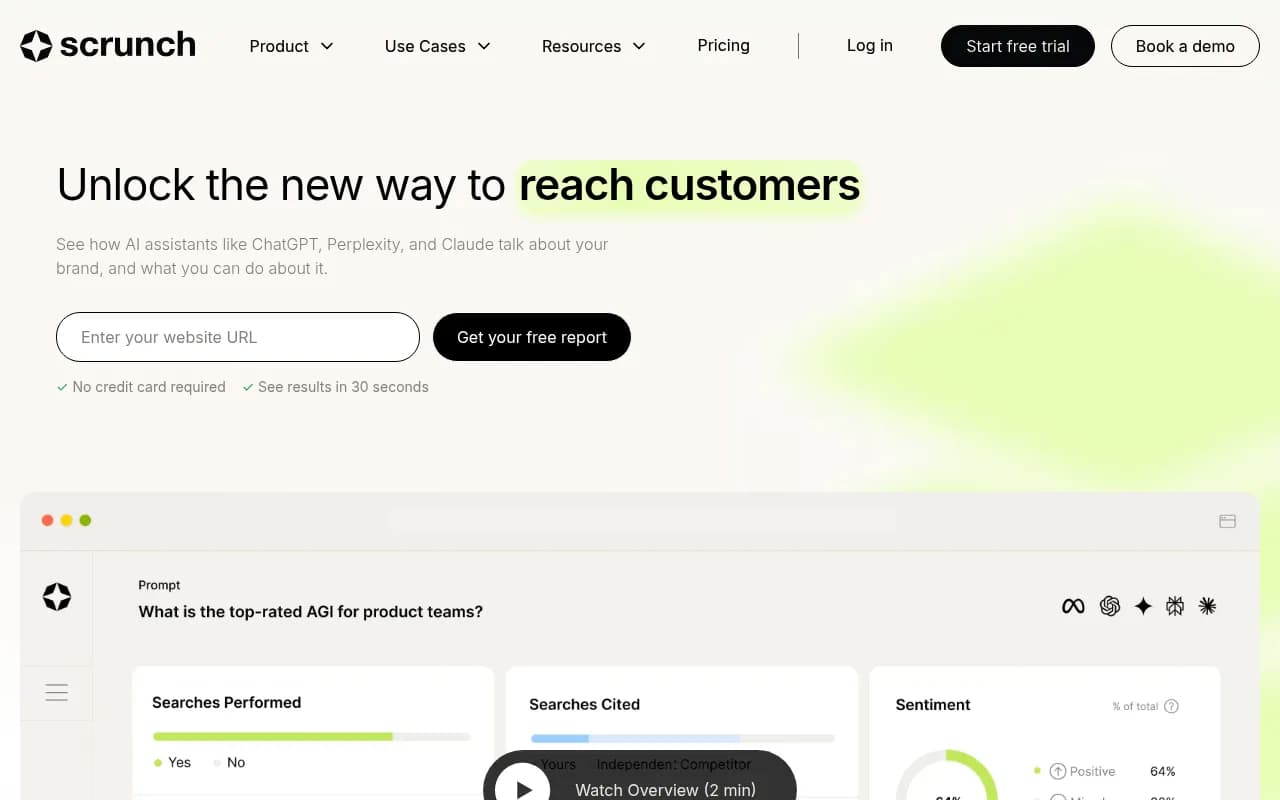
Scrunch AI has an interesting angle: it calls itself an "AI Customer Experience Platform" and includes an Agent Experience Platform (AXP) that translates your site content for AI traffic without disrupting human UX. That's a genuinely different approach -- instead of just tracking what AI sees, it tries to make your content more legible to AI crawlers at the infrastructure level.
The monitoring side covers brand presence, performance, and position across major LLMs, with real-time crawler logs and citation analysis. The error detection feature (spotting when AI bots can't crawl your site) is practical and often overlooked by competitors.
The AXP feature is the most distinctive thing about Scrunch, but it's also the hardest to evaluate without testing. The claim that it can "deliver content directly to AI agents" is compelling if it works as described -- it's a different strategy from content optimization, more like technical SEO for AI crawlers.
Pricing: Explorer $83/mo (billed annually), Growth $417/mo, Enterprise custom. 7-day free trial.
Best for: Technical teams that want to optimize how AI crawlers interact with their site at the infrastructure level, not just track visibility metrics.
BrightEdge
BrightEdge is an enterprise SEO platform that's been around since before AI search was a thing. It's added AI visibility features, but its core strength is still traditional SEO -- content performance, competitive intelligence, and reporting for large organizations. The client list includes major brands, and the platform is genuinely powerful for enterprise-scale SEO programs.
The honest reality is that BrightEdge is overkill for most teams looking at Stridec alternatives. Pricing is estimated at $30K-$500K+ annually, which puts it in a completely different budget category. If you're a Fortune 500 with a large SEO team and existing BrightEdge contracts, the AI features are worth exploring. Otherwise, this isn't the right tool for the problem Stridec is trying to solve.
Pricing: Enterprise only, contact sales. Estimated $30K-$500K+ annually.
Best for: Large enterprises with existing BrightEdge relationships and dedicated SEO teams who want AI visibility data integrated into their existing reporting infrastructure.
Search Party
Search Party
Search Party is genuinely in a different category from everything else on this list. It's an AI automation consultancy that builds custom workflow systems -- not an AI search visibility tool at all. The confusion comes from the name, which sounds like it could be an AI search monitoring platform.
If you're looking at Stridec because you want someone to build and implement an AI search strategy for you, Search Party is worth a look -- but it's focused on internal business automation (sales workflows, operations, repetitive task elimination) rather than external search visibility. The two agencies don't really compete.
Pricing: Custom engagement pricing, estimated $50K-$500K+ based on scope.
Best for: Companies looking to automate internal business processes with custom AI systems -- not relevant if your goal is AI search visibility or GEO.
How to choose
The right choice depends on what you actually need from a Stridec alternative.
If you want done-for-you agency work focused on Google AI Overviews specifically, Stridec itself might still be the right answer -- it's one of the few agencies with a documented, validated methodology for AIO citation. The $497 playbook is a reasonable starting point if you want to DIY it.
If you want a self-serve platform that monitors and optimizes, Promptwatch is the most complete option -- it covers the full loop from gap identification to content creation to results tracking, across 10 AI models. The $99/month entry point is accessible, and the free trial lets you see the data before committing.
If you're on a tight budget and just need monitoring, Otterly.AI at $29/month or Peec AI at €89/month are the most affordable ways to start tracking AI visibility without a large commitment.
If you're at an enterprise with serious budget, Profound or AthenaHQ are worth evaluating alongside Promptwatch -- both have strong feature sets, though Profound's lack of a free trial makes it harder to evaluate quickly.
If you're already paying for Semrush, check whether its AI Visibility Toolkit meets your needs before adding another platform. It probably won't if AI search is a primary focus, but it's worth ruling out.
The one thing to be clear about: monitoring alone doesn't improve your AI visibility. Knowing you're invisible is only useful if you do something about it. That's the gap between the tracking-only tools (Peec AI, Otterly.AI at the basic level) and the platforms that help you act (Promptwatch, Profound, to some extent AthenaHQ). Choose based on whether you need data or whether you need to move.