Comet Opik Review 2026
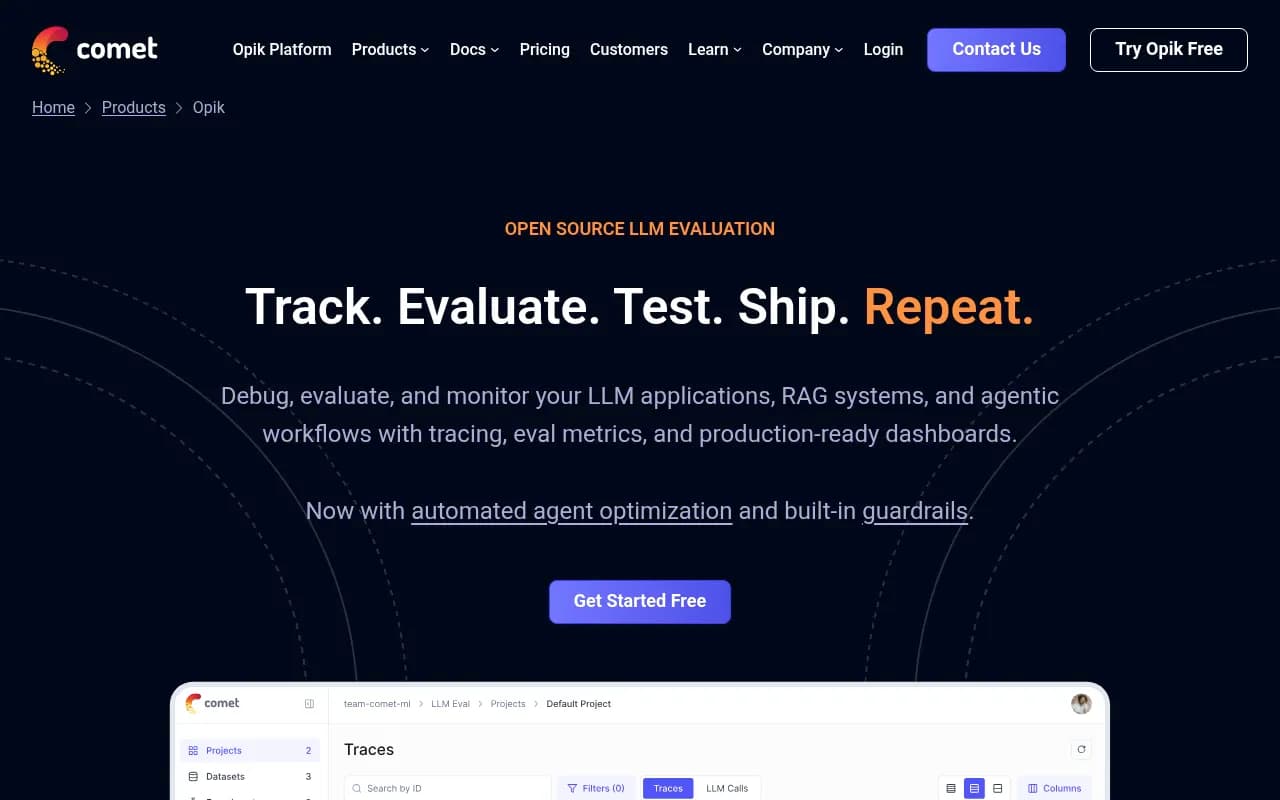
Opik by Comet is an end-to-end LLM evaluation platform that helps AI developers debug, test, and continuously improve LLM-powered applications through comprehensive tracing, evaluation metrics, automated prompt optimization, and production monitoring. Built for developers working with RAG systems, a
Key Takeaways:
- Open-source LLM evaluation platform with full feature set available free on GitHub (17k+ stars)
- Automated prompt optimization using 4 powerful optimizers (Few-shot Bayesian, MIPRO, evolutionary, MetaPrompt) to improve agent performance
- Built-in guardrails for content moderation, PII detection, and safety screening of inputs/outputs
- End-to-end observability from development to production with trace logging, evaluation metrics, and CI/CD testing
- Best for: AI engineers, ML teams at startups and enterprises building production LLM applications, RAG systems, and AI agents
Opik by Comet is an open-source LLM evaluation platform designed to help AI developers build, test, and optimize production-ready LLM applications. Built by Comet ML (the company behind the popular ML experiment tracking platform used by Netflix, Uber, Etsy, and Stability AI), Opik addresses a critical gap in the AI development workflow: understanding and improving LLM behavior across complex, multi-step systems. Unlike simple monitoring dashboards that just show you what happened, Opik provides the full toolkit to trace execution, evaluate performance, automatically optimize prompts, and ensure safety -- all within a single platform.
The platform launched as a true open-source project with its complete feature set available on GitHub (comet-ml/opik, 17k+ stars). This isn't a freemium bait-and-switch -- the core evaluation capabilities, tracing, metrics, and optimization tools are genuinely free in the source code. Enterprise teams get a highly scalable, compliance-ready hosted version, but individual developers and small teams can self-host without restrictions.
Comprehensive LLM Tracing & Observability
Opik's foundation is its tracing system, which records every step your LLM application takes to generate a response. When you're building a RAG pipeline or agentic workflow with multiple LLM calls, tool invocations, and retrieval steps, understanding what's happening under the hood is critical. Opik logs traces and spans (individual operations within a trace) so you can see exactly which prompt was sent, what the model returned, how long each step took, and where errors occurred.
The tracing UI presents this data in a user-friendly table where you can sort, search, filter, and manually annotate responses. You can drill down from aggregate metrics to individual traces, comparing different runs side-by-side to understand why one prompt performed better than another. This works in both development and production -- you're not limited to local debugging. Production traces flow into the same dashboard, giving you end-to-end observability across the entire lifecycle.
Integrations with OpenAI, LangChain, LlamaIndex, LiteLLM, DSPy, Ragas, Predibase, and OpenTelemetry mean you can start logging traces with just a few lines of code. The SDK is Python-based and designed for minimal friction -- wrap your existing LLM calls and Opik handles the rest.
Evaluation Metrics & LLM-as-a-Judge Scoring
Once you're logging traces, the next step is evaluation. Opik provides a library of pre-configured evaluation metrics for common tasks: hallucination detection, factuality, answer relevance, context precision, moderation, and more. These metrics use LLM-as-a-judge approaches (where a powerful model like GPT-4 scores your outputs) combined with heuristic checks.
You can also define custom metrics using the SDK. Run experiments by testing different prompts against a fixed test set, then compare aggregate scores across versions. The platform computes metrics in batch, so you're not manually reviewing hundreds of responses -- you get statistical summaries and can drill into outliers.
This is particularly valuable for RAG systems where you need to evaluate both retrieval quality (did we fetch the right documents?) and generation quality (did the LLM use those documents correctly?). Opik's metrics cover both sides of the equation.
Automated Prompt Optimization for Agents
One of Opik's standout features is automated prompt optimization. Instead of manually tweaking system prompts and hoping for improvement, you can run optimization loops that iteratively refine prompts based on your evaluation metrics. Opik includes four optimizers:
- Few-shot Bayesian: Learns from a small number of examples to suggest prompt improvements
- MIPRO: Multi-stage prompt optimization that balances exploration and exploitation
- Evolutionary: Genetic algorithm approach that mutates and selects the best-performing prompts
- MetaPrompt: Uses an LLM to generate and refine prompts based on performance feedback
You define your evaluation metrics (e.g. "maximize answer correctness, minimize hallucination"), provide a test set, and let the optimizer run. It generates candidate prompts, evaluates them, and iterates until it converges on a high-performing system prompt. The results are frozen into reusable, production-ready assets you can deploy with confidence.
This is a game-changer for agentic workflows where prompt engineering is traditionally a manual, time-consuming process. Competitors like LangSmith and Weights & Biases Weave offer tracing and evaluation but lack this level of automated optimization.
Built-in Guardrails for Safety & Compliance
Opik includes guardrails to screen user inputs and LLM outputs before they reach production. You can detect and block unwanted content: PII (personally identifiable information), competitor mentions, off-topic discussions, toxic language, and more. The platform provides built-in models for common guardrail tasks, or you can integrate third-party libraries like NeMo Guardrails or Guardrails AI.
Guardrails run in real-time during inference, so you can catch issues before they become user-facing problems. This is critical for enterprise teams in regulated industries (finance, healthcare) or customer-facing applications where brand safety matters. The guardrails dashboard shows you what was flagged, how often, and which rules triggered -- giving you visibility into edge cases and potential abuse patterns.
CI/CD Integration & LLM Unit Testing
Opik integrates directly into your CI/CD pipeline with LLM unit tests built on PyTest. You define test cases (input prompts + expected behavior), run them on every deploy, and fail the build if performance drops below your baseline. This prevents regressions when you update prompts, change models, or modify retrieval logic.
The testing framework is flexible -- you can test individual components (e.g. "does this retrieval step return relevant documents?") or end-to-end workflows (e.g. "does the full RAG pipeline answer this question correctly?"). Tests run in seconds, so they don't slow down your deployment process.
This is a major advantage over tools like Humanloop or PromptLayer, which focus on prompt versioning but lack robust testing infrastructure. Opik treats LLM applications like software -- with the same rigor you'd apply to traditional code.
Production Monitoring & Dataset Generation
In production, Opik logs all traces so you can identify issues as they happen. The monitoring dashboard shows aggregate metrics (latency, error rates, evaluation scores) and lets you drill into individual traces to debug failures. You can filter by time range, user ID, model version, or any custom metadata you've logged.
One particularly useful feature: generating new test datasets from production data. As your application encounters edge cases in the wild, you can flag interesting traces and add them to your evaluation set. This closes the loop -- production insights feed back into development, ensuring your test coverage evolves with real-world usage.
Opik also supports traffic attribution, so you can connect LLM visibility to actual business outcomes (user engagement, conversions, revenue). This is critical for justifying investment in LLM quality improvements.
Integrations & Developer Experience
Opik integrates with the most popular LLM frameworks and tools:
- LLM Providers: OpenAI, Anthropic (via LiteLLM), Predibase, any model via OpenTelemetry
- Frameworks: LangChain, LlamaIndex, DSPy, LiteLLM
- Evaluation: Ragas (RAG-specific metrics)
- Observability: OpenTelemetry for custom instrumentation
The Python SDK is well-documented and designed for minimal boilerplate. You can start logging traces with a single decorator or context manager. The API is intuitive -- if you've used experiment tracking tools like MLflow or Weights & Biases, you'll feel right at home.
For teams that need custom workflows, Opik provides a REST API and Python client for programmatic access to all platform features.
Who Is Opik For?
Opik is built for AI engineers and ML teams at startups and enterprises who are building production LLM applications. Specific personas:
- AI engineers at Series A-C startups building RAG systems, chatbots, or AI agents and need to move fast without sacrificing quality
- ML platform teams at enterprises (finance, healthcare, e-commerce) who need compliance-ready observability and safety guardrails
- Research teams experimenting with agentic workflows and prompt optimization techniques
- DevOps/MLOps engineers integrating LLM testing into CI/CD pipelines
Team size: Works for solo developers (open-source self-hosted) up to large ML orgs (enterprise hosted version with SSO, audit logs, and dedicated support).
Industries: Particularly strong in finance (NatWest), automotive (Stellantis), entertainment (Netflix), and AI-native companies (AssemblyAI, Stability AI).
Who Should NOT Use Opik:
- Non-technical teams looking for a no-code LLM builder (try Voiceflow or Botpress instead)
- Teams using only closed, proprietary LLMs with no access to prompts or traces (limited value)
- Projects with <100 LLM calls per month (overhead not worth it -- just manually review outputs)
Pricing & Value
Opik is open-source and free to self-host. The GitHub repository includes the full platform -- tracing, evaluation, optimization, guardrails, and monitoring. No feature gating.
For teams that want a hosted, managed version, Comet offers cloud plans:
- Free Tier: Generous limits for individual developers and small projects (exact limits not publicly listed, but designed to be usable long-term)
- Pro Plan: Free for academic users (researchers, students, educators) with full feature access
- Enterprise: Custom pricing for large teams, includes SSO, audit logs, dedicated support, SLAs, and compliance certifications
No credit card required to sign up. The free tier is genuinely usable -- not a 14-day trial that forces you to upgrade.
Compared to competitors:
- LangSmith (LangChain's platform): $39/user/month for basic tracing, no automated optimization
- Weights & Biases Weave: Free for individuals, $50+/user/month for teams, lacks prompt optimization
- Humanloop: $200+/month for teams, focused on prompt management rather than full evaluation
- Arize Phoenix: Open-source tracing, but less mature optimization and guardrails features
Opik's open-source model gives it a significant value advantage -- you can start free, scale on your own infrastructure, and only pay for managed hosting if you need it.
Strengths
- True open-source: Full feature set available free, no bait-and-switch
- Automated prompt optimization: Four powerful optimizers that actually improve performance, not just track it
- Built-in guardrails: Safety and compliance features that competitors lack
- End-to-end workflow: Covers development, testing, and production in one platform
- Strong integrations: Works with all major LLM frameworks out of the box
- Enterprise-ready: Used by Netflix, Uber, Etsy, and other large orgs
Limitations
- Python-only SDK: No native support for JavaScript/TypeScript (though OpenTelemetry can bridge the gap)
- Learning curve: Full feature set requires understanding of LLM evaluation concepts (not a plug-and-play solution)
- Self-hosted complexity: Running your own instance requires infrastructure knowledge (Docker, databases, etc.)
- Documentation gaps: Some advanced features (like custom optimizers) have sparse examples
Bottom Line
Opik is the best choice for AI engineering teams that want to move beyond manual prompt tweaking and vibe checks. If you're building production LLM applications -- especially RAG systems or agentic workflows -- and need to systematically evaluate, optimize, and monitor performance, Opik gives you the full toolkit in one platform. The open-source model means you can start free and scale on your terms, while the enterprise version provides the compliance and support large orgs need. Competitors offer pieces of this puzzle (tracing, evaluation, or prompt management), but Opik is one of the few platforms that covers the entire lifecycle with automated optimization and safety guardrails built in.
Best use case in one sentence: AI teams at startups and enterprises building production RAG systems or AI agents who need to systematically evaluate, automatically optimize prompts, and ensure safety at scale.
Tags:
Frequently asked questions
What is Comet Opik?
Is Comet Opik free to use?
What are the main features of Opik?
Who should use Comet Opik?
What is the difference between self-hosted and cloud versions of Opik?
What are Opik's prompt optimization capabilities?
Does Opik provide safety and compliance features?
What types of LLM applications does Opik support?
Similar and alternative tools to Comet Opik