Key Takeaways
- XFunnel was acquired by HubSpot in late 2025 and now operates with enterprise-only pricing, while Cognizo remains independent with transparent pricing starting at $300/mo
- Cognizo includes built-in AI content generation from visibility insights; XFunnel leans on HubSpot's content tools post-acquisition
- Both platforms monitor the same core AI engines (ChatGPT, Perplexity, Gemini, Google AI Overviews) with similar citation tracking
- XFunnel's customer base includes major brands like Wix, Monday.com, and LastPass, but new customers must navigate HubSpot's enterprise sales process
- Cognizo offers a free AI visibility report and trial, making it easier to test before committing
- For teams not already locked into HubSpot, Cognizo provides more flexibility and transparent pricing; for HubSpot-heavy enterprises, XFunnel's native integration may justify the premium
Overview: Two platforms at different inflection points
XFunnel: Now part of the HubSpot ecosystem
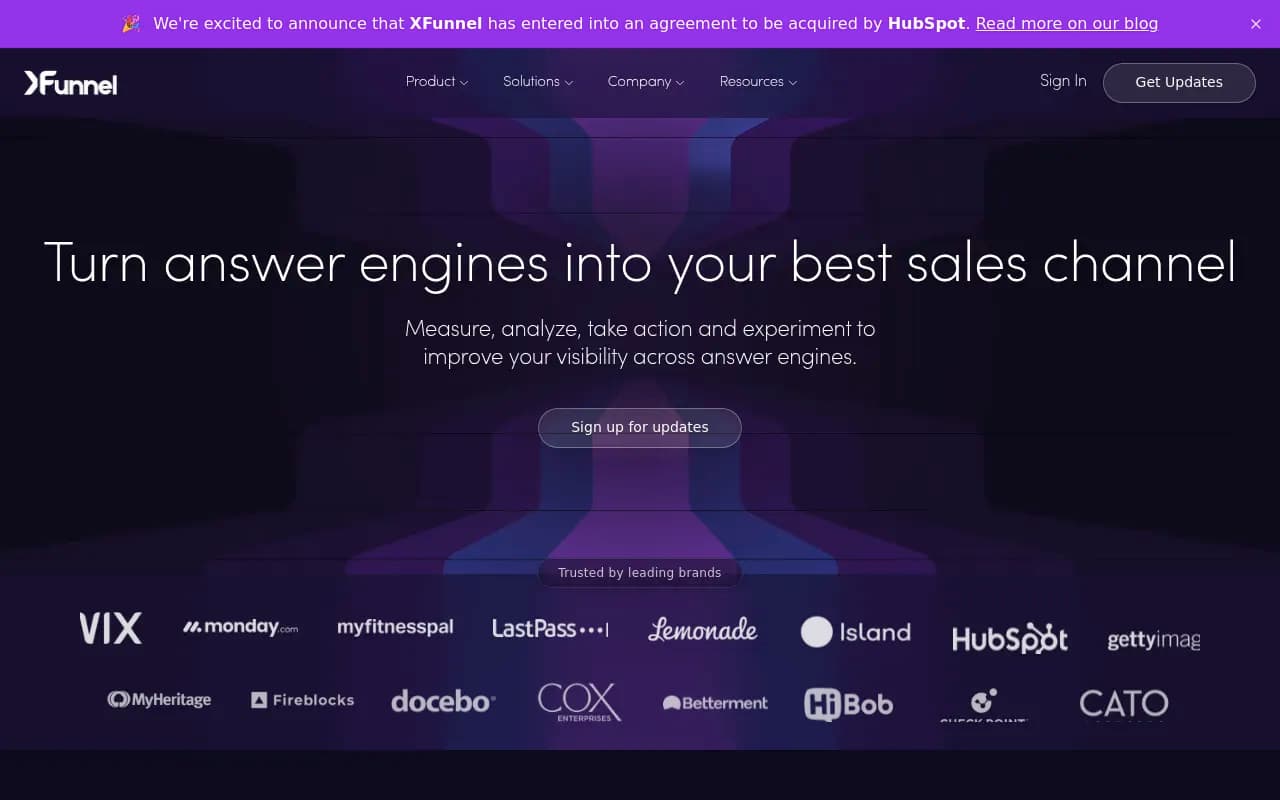
XFunnel built a reputation as an early mover in generative engine optimization, helping marketing teams track brand visibility across AI search platforms. The platform attracted enterprise customers like Wix, Monday.com, MyFitnessPal, and LastPass with its focus on citation tracking and AI-powered search analysis.
In late 2025, HubSpot acquired XFunnel. This changes the game entirely. XFunnel now operates as part of HubSpot's product suite, which means tighter integration with HubSpot's CRM and marketing tools but also means you're buying into the HubSpot ecosystem. Pricing shifted to custom enterprise-only with no public rates.
Cognizo: Independent AEO platform with content creation built in
Cognizo
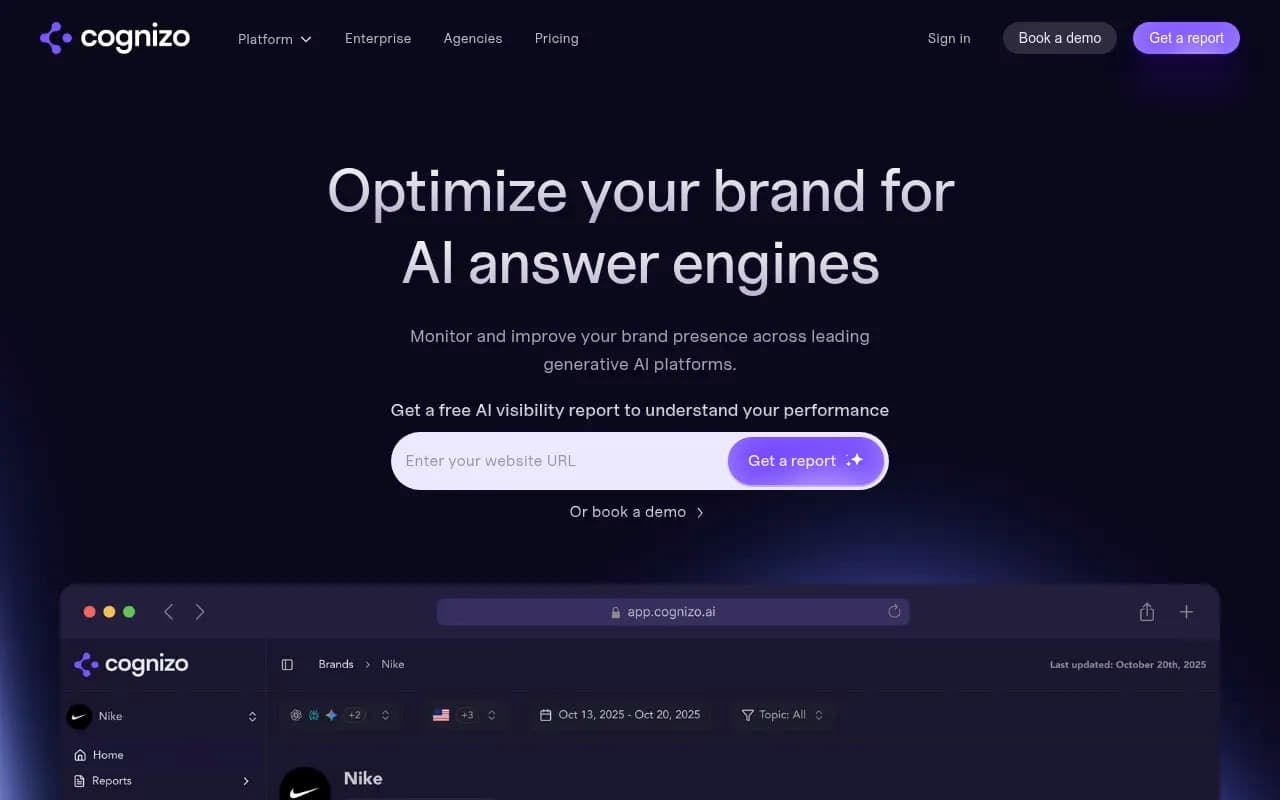
Cognizo positions itself as a complete Answer Engine Optimization platform that goes beyond monitoring. The core pitch: track visibility across AI engines, then use those insights to generate optimized content that actually gets cited.
The platform monitors ChatGPT, Perplexity, Gemini, and Google AI Overviews while providing real-time citation tracking, sentiment analysis, and competitor comparisons. What sets it apart is the built-in content generation engine that turns visibility gaps into publishable articles. Pricing starts at $300/mo for the Starter plan with 350 prompts, making it accessible to mid-market teams.
Side-by-side comparison
| Feature | XFunnel | Cognizo |
|---|---|---|
| Pricing model | Custom enterprise (contact sales) | Transparent: from $300/mo |
| Free trial | Not publicly available | Yes, plus free visibility report |
| AI engines monitored | ChatGPT, Perplexity, Gemini, Google AI Overviews | ChatGPT, Perplexity, Gemini, Google AI Overviews |
| Citation tracking | ✓ | ✓ |
| Sentiment analysis | ✓ | ✓ |
| Competitor monitoring | ✓ | ✓ |
| Built-in content generation | Limited (via HubSpot tools) | ✓ Native AI writer |
| HubSpot integration | Native (owned by HubSpot) | Standard integration |
| Traffic attribution | ✓ | ✓ AI crawler logs + human traffic |
| Prompt volume data | ✓ | ✓ |
| Target audience | Enterprise teams, HubSpot users | Mid-market to enterprise |
| Ownership | HubSpot subsidiary | Independent |
Pricing: Transparency vs enterprise sales
XFunnel pricing
XFunnel moved to custom enterprise pricing after the HubSpot acquisition. There are no public rates. You need to contact sales, go through a demo process, and negotiate a contract. This is standard for HubSpot's enterprise products but creates friction for teams that want to test before committing or need budget approval before engaging sales.
The upside: if you're already a HubSpot customer, bundling XFunnel into your existing contract might make financial sense. The downside: no way to evaluate cost without entering a sales cycle.
Cognizo pricing
Cognizo publishes transparent pricing:
| Plan | Price | Prompts | Key features |
|---|---|---|---|
| Starter | $300/mo | 350 | Basic monitoring, citation tracking, 1 user |
| Professional | Custom | Custom | Advanced analytics, content generation, team access |
| Enterprise | Custom | Custom | Full platform, API access, dedicated support |
The Starter plan gives you a real entry point to test the platform without a massive commitment. Free trial available, plus they offer a free AI visibility report so you can see what you're getting before paying.
Verdict: Cognizo wins on pricing transparency and accessibility. XFunnel requires enterprise budgets and HubSpot alignment.
Monitoring capabilities: Similar coverage, different contexts
Both platforms track the same core AI engines: ChatGPT, Perplexity, Gemini, and Google AI Overviews. Citation tracking, sentiment analysis, and competitor monitoring are table stakes for both.
XFunnel's monitoring dashboard shows where your brand appears in AI-generated answers, tracks citation frequency, and compares your visibility against competitors. The data feeds into HubSpot's reporting infrastructure post-acquisition, which is powerful if you're already using HubSpot's analytics suite.
Cognizo provides similar monitoring with real-time citation tracking and sentiment analysis. The interface emphasizes actionable insights -- showing not just where you're mentioned but where you're missing and what content gaps exist. The platform processes millions of data points daily to surface high-impact opportunities.
Both platforms track prompt volume and difficulty, helping you prioritize which queries to optimize for. Both offer competitor heatmaps showing who's winning for specific prompts.
Verdict: Monitoring capabilities are comparable. XFunnel integrates better with HubSpot's ecosystem; Cognizo's interface is built around turning insights into content actions.
Content optimization: Built-in vs bolt-on
XFunnel's approach
Pre-acquisition, XFunnel focused primarily on monitoring and analytics. Content optimization happened outside the platform. Post-HubSpot acquisition, content creation flows through HubSpot's existing content tools -- the blog editor, SEO recommendations, and AI writing assistants HubSpot already offers.
This works well if you're a HubSpot power user. Your visibility insights from XFunnel can inform content briefs in HubSpot's CMS. But there's no direct "generate optimized content from this visibility gap" workflow within XFunnel itself.
Cognizo's approach
Cognizo built content generation into the platform from the start. The workflow:
- Platform identifies visibility gaps and high-impact prompts
- AI content writer generates optimized articles targeting those gaps
- Content is structured to maximize citation probability in AI responses
- You review, edit, and publish
The content engine uses the same citation data and prompt analysis that powers the monitoring dashboard. It's not a separate tool -- it's the action layer on top of the insights.
Cognizo also provides content briefs, SEO optimization scores, and recommendations for improving existing content to rank better in AI search.
Verdict: Cognizo has a clear advantage if you want an all-in-one platform. XFunnel requires HubSpot's content suite to close the loop.
Integration and ecosystem fit
XFunnel: HubSpot-native
The HubSpot acquisition makes XFunnel a natural fit for teams already using HubSpot for CRM, marketing automation, and content management. Data flows natively into HubSpot's reporting dashboards. Visibility insights can trigger workflows in HubSpot's automation engine.
If you're not using HubSpot, you're now buying into that ecosystem to use XFunnel. That's a bigger decision than just choosing an AEO tool.
Cognizo: Platform-agnostic
Cognizo integrates with standard marketing tools but doesn't lock you into a specific ecosystem. It works alongside whatever CMS, CRM, or analytics stack you're already using. The platform offers API access for custom integrations and can export data to reporting tools.
This flexibility matters if you're using Salesforce, Marketo, WordPress, or any non-HubSpot stack. You're not forced to rip and replace your existing tools.
Verdict: XFunnel wins if you're HubSpot-committed. Cognizo wins for everyone else.
Traffic attribution and AI crawler tracking
Both platforms track AI-driven traffic -- the human visitors who arrive at your site after seeing your brand mentioned in an AI response.
XFunnel provides traffic attribution through its analytics dashboard, showing which AI platforms are driving visitors and which content is getting cited. Post-acquisition, this data integrates with HubSpot's attribution reporting.
Cognizo tracks AI crawler activity (when ChatGPT, Perplexity, etc. crawl your site) plus human traffic that originates from AI search. The platform shows which pages AI engines are reading, how often they return, and which content is driving the most AI-referred visitors.
Both approaches work. The difference is where the data lives -- in HubSpot's unified dashboard for XFunnel, or in Cognizo's standalone platform.
Verdict: Tie. Both provide solid traffic attribution; choose based on where you want the data to live.
User experience and learning curve
XFunnel's interface is clean and focused on visibility metrics. If you're familiar with HubSpot's design language, you'll feel at home. The learning curve is moderate -- understanding citation tracking and prompt analysis takes some time, but the dashboard is intuitive.
Cognizo's interface emphasizes the action loop: see gaps, generate content, track results. The platform guides you from insights to execution. The learning curve is similar to XFunnel, but the workflow is more opinionated about what you should do next.
Both platforms offer demos and onboarding support. XFunnel's enterprise sales process includes implementation assistance. Cognizo provides a free visibility report upfront so you can see the platform's value before committing.
Verdict: Slight edge to Cognizo for the free report and trial, making it easier to evaluate before buying.
Customer base and market positioning
XFunnel attracted major enterprise brands: Wix, Monday.com, MyFitnessPal, LastPass, Lemonade, Getty Images, Fireblocks, and others. The customer logos on their site are impressive. The HubSpot acquisition validates the platform's value but also signals a shift toward serving HubSpot's enterprise customer base.
Cognizo targets mid-market to enterprise marketing teams that want a complete AEO solution without being locked into a specific ecosystem. The customer base is growing but not as publicly visible as XFunnel's roster of household names.
Verdict: XFunnel has stronger brand recognition and enterprise credibility. Cognizo is the challenger with more accessible pricing.
Pros and cons
XFunnel pros
- Proven platform used by major brands
- Native HubSpot integration post-acquisition
- Strong enterprise support and implementation assistance
- Comprehensive citation tracking and competitor analysis
- Backed by HubSpot's resources and roadmap
XFunnel cons
- Enterprise-only pricing with no public rates
- Requires HubSpot ecosystem commitment
- No built-in content generation (relies on HubSpot's tools)
- No free trial or visibility report to evaluate before sales engagement
- Acquisition creates uncertainty about product roadmap independence
Cognizo pros
- Transparent pricing starting at $300/mo
- Built-in AI content generation from visibility insights
- Free trial and visibility report available
- Platform-agnostic -- works with any marketing stack
- Independent roadmap not tied to a larger platform's priorities
Cognizo cons
- Smaller customer base and less brand recognition
- Fewer public case studies and customer testimonials
- May lack some enterprise-grade features HubSpot provides
- Integration with HubSpot is standard, not native
Who should choose which platform
Choose XFunnel if:
- You're already a HubSpot customer and want native integration
- You have an enterprise budget and prefer working with a major platform vendor
- Brand credibility and customer logos matter for internal buy-in
- You're comfortable with custom pricing and enterprise sales cycles
- Your team is already trained on HubSpot's tools and workflows
Choose Cognizo if:
- You want transparent pricing and the ability to start at $300/mo
- Built-in content generation is a priority
- You're not using HubSpot or want platform flexibility
- You need to test before committing to a large contract
- You're a mid-market team that can't justify enterprise-only pricing
- You want a platform focused purely on AEO, not bundled into a larger suite
Alternative to consider
If you're evaluating XFunnel and Cognizo, you might also want to look at Promptwatch, which takes a different approach to AI visibility. Promptwatch goes beyond monitoring to help you actually fix visibility gaps with content gap analysis, AI content generation grounded in 880M+ citations, and real-time AI crawler logs. It's worth comparing if you want a platform that emphasizes taking action on insights rather than just tracking them.

Final verdict
This comparison comes down to ecosystem fit and pricing model.
XFunnel made sense as a standalone AEO platform. Post-HubSpot acquisition, it's now a HubSpot product. If you're already invested in HubSpot's ecosystem and have an enterprise budget, XFunnel is a logical choice. The native integration and HubSpot's backing are real advantages.
Cognizo is the better choice for teams that want pricing transparency, built-in content generation, and platform flexibility. The $300/mo entry point makes it accessible to mid-market teams, and the free trial removes risk. The content generation engine is a clear differentiator -- you're not just monitoring, you're creating optimized content directly from visibility insights.
For most marketing teams evaluating AEO platforms in 2026, Cognizo offers better value and more control. XFunnel is the right call if HubSpot is already your marketing operating system and you're willing to navigate enterprise sales to get native integration.
The market is moving fast. Both platforms will evolve. But right now, Cognizo gives you more flexibility and a clearer path from insights to action without locking you into a single vendor's ecosystem.