D&B Hoovers Review 2026
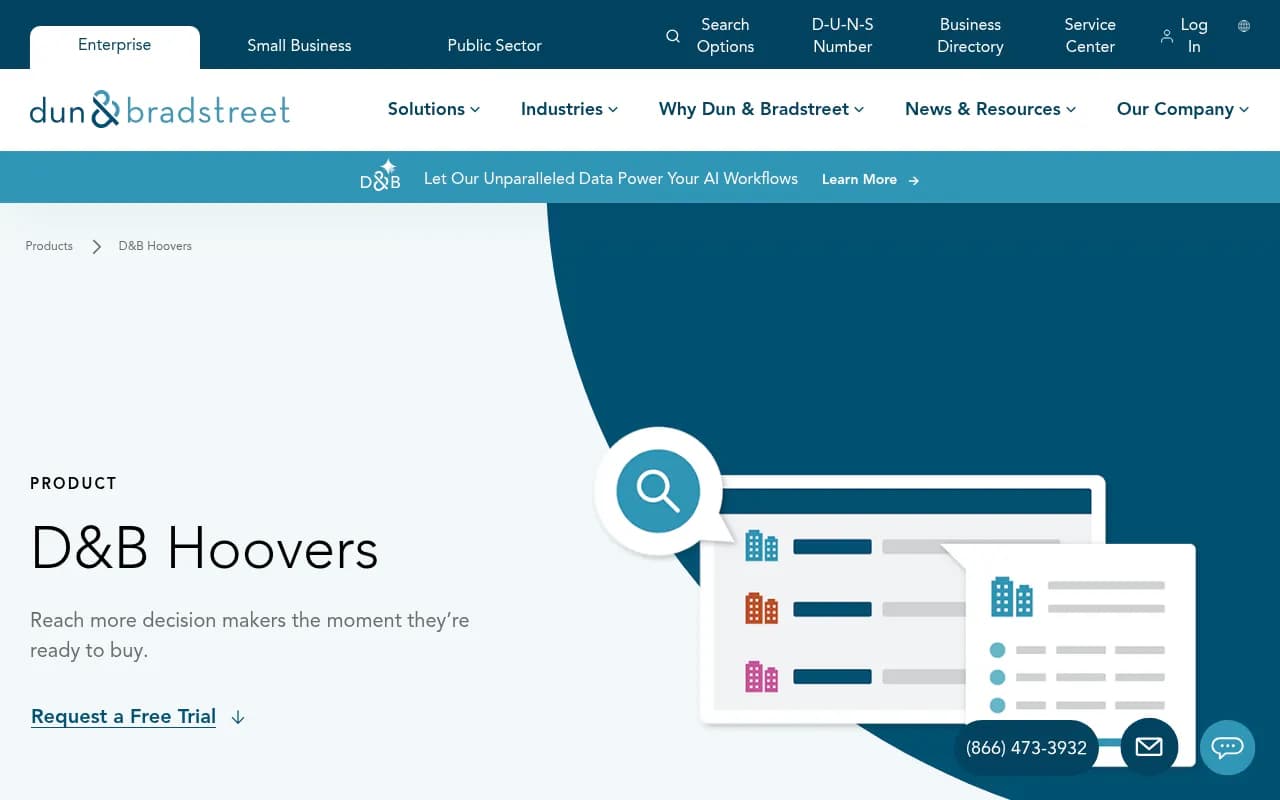
Sales acceleration platform built on Dun & Bradstreet's business data. Covers 500M+ companies globally with financials, contact info, and prospecting tools.
Key takeaways
- D&B Hoovers gives B2B sales teams access to one of the largest commercial databases in the world, with 500M+ company profiles and deep firmographic data sourced from Dun & Bradstreet's proprietary network.
- The platform goes beyond basic contact lookup with buyer intent signals, trigger alerts, and advanced filtering, making it genuinely useful for outbound prospecting rather than just data enrichment.
- Pricing starts at $49/month for the Essentials plan (150 credits), which is accessible for small teams, though the credit model can get expensive at scale.
- The data quality is generally strong for larger enterprises but can be inconsistent for smaller or international companies, and some contact-level data ages quickly.
- Not a Promptwatch competitor -- this tool operates in B2B sales intelligence, not AI search visibility or GEO.
D&B Hoovers is the sales intelligence product from Dun & Bradstreet, one of the oldest and most recognized names in commercial data. The platform sits at the intersection of company research and sales prospecting, giving revenue teams a way to identify target accounts, find decision-maker contacts, and time outreach around buying signals. It's built on D&B's Data Cloud, which the company claims covers over 500 million business entities globally, making it one of the largest commercial databases available to sales teams.
The target audience is squarely B2B: inside sales reps, account executives, SDRs, and sales operations teams at companies that sell to other businesses. It's particularly well-suited for organizations that need to build prospect lists from scratch, research accounts before outreach, or enrich their CRM with firmographic and contact data. The platform has been around in various forms for decades -- Hoovers was originally a standalone business intelligence company founded in 1990, acquired by D&B in 2003, and has since been rebuilt into a modern SaaS prospecting tool under the D&B Hoovers brand.
The competitive landscape here is crowded. ZoomInfo, Apollo.io, Cognism, and LinkedIn Sales Navigator all compete for the same budget. D&B Hoovers differentiates primarily on the depth of its company-level data and the breadth of its global coverage, particularly for firmographic attributes that other tools don't always carry (like D-U-N-S numbers, corporate linkage, and detailed financial data). Whether that differentiation is worth the price depends heavily on your use case.
Key features
Company database and firmographic data
The core of D&B Hoovers is its company database. With 500M+ business profiles, it covers everything from Fortune 500 enterprises to small local businesses. Each profile includes standard firmographic fields (industry, revenue, employee count, location) but also D&B-specific attributes like:
- D-U-N-S Number: D&B's proprietary identifier for business entities, useful for matching records across systems
- Corporate family trees: Shows parent companies, subsidiaries, and affiliates, which is critical for enterprise selling where you need to understand org structure before approaching
- Financial data: Revenue estimates, credit ratings, and payment history for many companies
- Industry classification using both SIC and NAICS codes
The depth here is genuinely impressive for larger companies. For smaller businesses or international companies outside the US and UK, the data can be thinner, and you'll sometimes find outdated revenue figures or missing contacts.
Contact data and decision-maker search
Beyond company profiles, D&B Hoovers provides contact-level data including names, titles, direct phone numbers, and email addresses. The platform lets you filter contacts by job function, seniority level, and department, which is the core workflow for SDRs building outreach lists.
The contact database is solid but not the platform's strongest suit compared to specialists like ZoomInfo or Apollo. Email deliverability and phone number accuracy are generally acceptable, but you'll encounter bounce rates that require validation before large-scale outreach. The platform doesn't include a built-in email verification tool, so you'll want to run exports through a third-party validator.
Advanced search and list building
The prospecting workflow centers on a search interface that lets you combine dozens of filters to build targeted account and contact lists. You can filter by:
- Geography (country, state, city, metro area)
- Industry and sub-industry
- Revenue range and employee count
- Growth signals (companies that have recently hired, expanded, or raised funding)
- Technology usage (what software a company uses)
- Ownership type (public, private, subsidiary)
The saved search and list management features let you build persistent prospect lists that update automatically as new companies match your criteria. This is useful for ongoing prospecting rather than one-time list pulls.
Buyer intent data
D&B Hoovers includes intent signals that indicate when companies are actively researching topics relevant to your product category. This is powered by Bombora's intent data (D&B has a partnership with Bombora), which aggregates B2B content consumption signals across thousands of websites.
In practice, intent data helps prioritize which accounts to contact now versus later. A company showing high intent for "cloud security" is more likely to respond to an outreach about your security product than one with no recent research activity. The quality of intent signals varies by industry and company size, and like all intent data, it's probabilistic rather than definitive.
Trigger alerts and news monitoring
The platform monitors companies for business events that signal buying opportunities: leadership changes, funding rounds, expansions, acquisitions, earnings releases, and more. You can set up alerts for specific accounts in your target list and get notified when a trigger event occurs.
This is one of the more practically useful features for account-based selling. A new CTO joining a target account is often a better time to reach out than a cold Monday morning. The news monitoring pulls from public sources and D&B's own data feeds.
CRM integration and data export
D&B Hoovers integrates with Salesforce and Microsoft Dynamics, allowing you to push company and contact records directly into your CRM without manual data entry. The Salesforce integration in particular is reasonably well-built, supporting both record creation and enrichment of existing accounts.
Data export is available in CSV format for users who want to work outside the platform. The credit system governs how many records you can export or view in detail per month, which is where the cost model gets complicated for high-volume users.
Chrome extension
A browser extension lets you pull D&B data on companies and contacts while browsing LinkedIn or company websites. This is useful for reps who do a lot of research on the fly and want to enrich records without switching between tabs. The extension is functional but not as polished as LinkedIn Sales Navigator's native experience.
Who is it for
D&B Hoovers fits best for mid-market and enterprise B2B sales teams that need reliable company-level data at scale. Think a 20-person sales team at a software company targeting CFOs at manufacturing firms with $50M+ in revenue -- the kind of use case where you need accurate revenue figures, org structure, and the right contact title, not just a name and email. The corporate family tree feature alone is worth the subscription for anyone selling into large enterprises where you need to understand which entity actually controls the budget.
It's also a strong fit for sales operations and RevOps teams responsible for CRM data quality. The D-U-N-S number matching and corporate linkage data make D&B Hoovers useful for deduplication, account hierarchy mapping, and territory planning in ways that contact-focused tools like Apollo can't replicate.
Financial services, professional services, and manufacturing companies tend to get the most value here, partly because D&B's data is strongest in those sectors and partly because those industries rely heavily on the financial and credit data that D&B has been collecting for over 180 years.
Who should probably look elsewhere: early-stage startups with tight budgets who need high-volume email outreach will find Apollo.io or Hunter.io more cost-effective. Teams focused primarily on tech companies or startups will find ZoomInfo or Crunchbase more current. And anyone who needs verified mobile numbers at scale should look at Cognism, which has stronger compliance and mobile data coverage in Europe.
Integrations and ecosystem
D&B Hoovers connects to the major CRM platforms most enterprise sales teams already use:
- Salesforce: Bidirectional sync for accounts and contacts, with the ability to enrich existing records
- Microsoft Dynamics 365: Similar CRM push functionality
- HubSpot: Available through the platform, though less deeply integrated than the Salesforce connector
- Marketo and Eloqua: For marketing automation workflows that need account data
The platform also connects to D&B's broader product suite, including D&B Optimizer (for CRM data enrichment) and D&B Rev.Up (their ABM platform), which matters if you're already a D&B customer and want a unified data layer across sales and marketing.
There's no native Zapier integration listed, which limits workflow automation for smaller teams without dedicated RevOps resources. The API is available for enterprise customers who want to build custom data pipelines, but it's not a self-serve developer experience -- you'll need to go through the sales team to get API access.
CSV export is available across all plans, and the Chrome extension works on LinkedIn and company websites for on-the-fly research.
Pricing and value
D&B Hoovers uses a credit-based pricing model with three main tiers:
- Essentials: $49/month, includes 150 credits per month. Suitable for individual reps or very small teams doing light prospecting.
- Professional and higher tiers: Pricing is quote-based and scales with credit volume, number of users, and feature access. Expect to pay significantly more for team plans with intent data and CRM integrations.
The $49 Essentials plan is genuinely accessible and a reasonable entry point for a solo founder or small sales team that needs occasional company lookups. But 150 credits goes fast if you're building lists regularly -- a single list export of 150 contacts uses your entire monthly allotment.
For comparison, Apollo.io's free tier includes 50 email credits per month, and their paid plans start around $49/month with more generous credit limits. ZoomInfo doesn't publish pricing but typically starts at $10,000+ per year for team plans, making D&B Hoovers more accessible at the entry level. Cognism is also enterprise-priced and targets compliance-heavy markets.
The value proposition for D&B Hoovers is strongest when you specifically need D&B's company-level data quality -- corporate hierarchies, financial data, D-U-N-S matching -- rather than just contact volume. If you're optimizing for contact volume and email deliverability, there are cheaper options.
Strengths and limitations
What it does well:
- The company database depth is hard to match, especially for firmographic data, corporate family trees, and financial attributes. For enterprise account research, it's one of the most thorough options available.
- The D-U-N-S number system and corporate linkage data are genuinely useful for sales ops teams managing complex account hierarchies in their CRM.
- Buyer intent data powered by Bombora is a meaningful addition that helps prioritize outreach timing, not just list building.
- Global coverage at 500M+ companies is broader than most competitors, even if data quality varies by region.
- The trigger alert system for business events (leadership changes, funding, expansions) is well-implemented and practically useful for timing outreach.
Honest limitations:
- Contact data quality, particularly email accuracy and mobile numbers, lags behind specialists like ZoomInfo or Cognism. You'll want to validate emails before large sends.
- The credit model can become expensive quickly for high-volume prospecting teams. The math doesn't work well if you're pulling thousands of contacts per month.
- The UI feels dated compared to newer entrants like Apollo.io, which has invested heavily in a cleaner prospecting workflow. Navigation and list management in D&B Hoovers can feel clunky.
- API access isn't self-serve, which limits the platform's usefulness for technical teams wanting to build custom data workflows without going through a sales process.
- Data freshness for smaller companies and international markets outside the US can be inconsistent. Revenue figures and employee counts are sometimes years out of date.
Bottom line
D&B Hoovers is the right choice for B2B sales teams that prioritize company-level data quality over contact volume -- particularly enterprise sellers who need corporate hierarchy mapping, financial data, and D-U-N-S-based CRM matching. The Essentials plan at $49/month makes it accessible to try, and the Bombora-powered intent data adds real prospecting value at higher tiers.
If your primary need is high-volume contact prospecting with verified emails and mobile numbers, Apollo.io or Cognism will likely serve you better. But for account research depth and firmographic accuracy, D&B Hoovers remains one of the most thorough options in the market.
Tags:
Frequently asked questions
What is D&B Hoovers?
How much does D&B Hoovers cost?
Is there a free trial for D&B Hoovers?
How does D&B Hoovers compare to ZoomInfo or Apollo.io?
What CRMs does D&B Hoovers integrate with?
Who is D&B Hoovers best suited for?
Similar and alternative tools to D&B Hoovers