Kompyte Review 2026
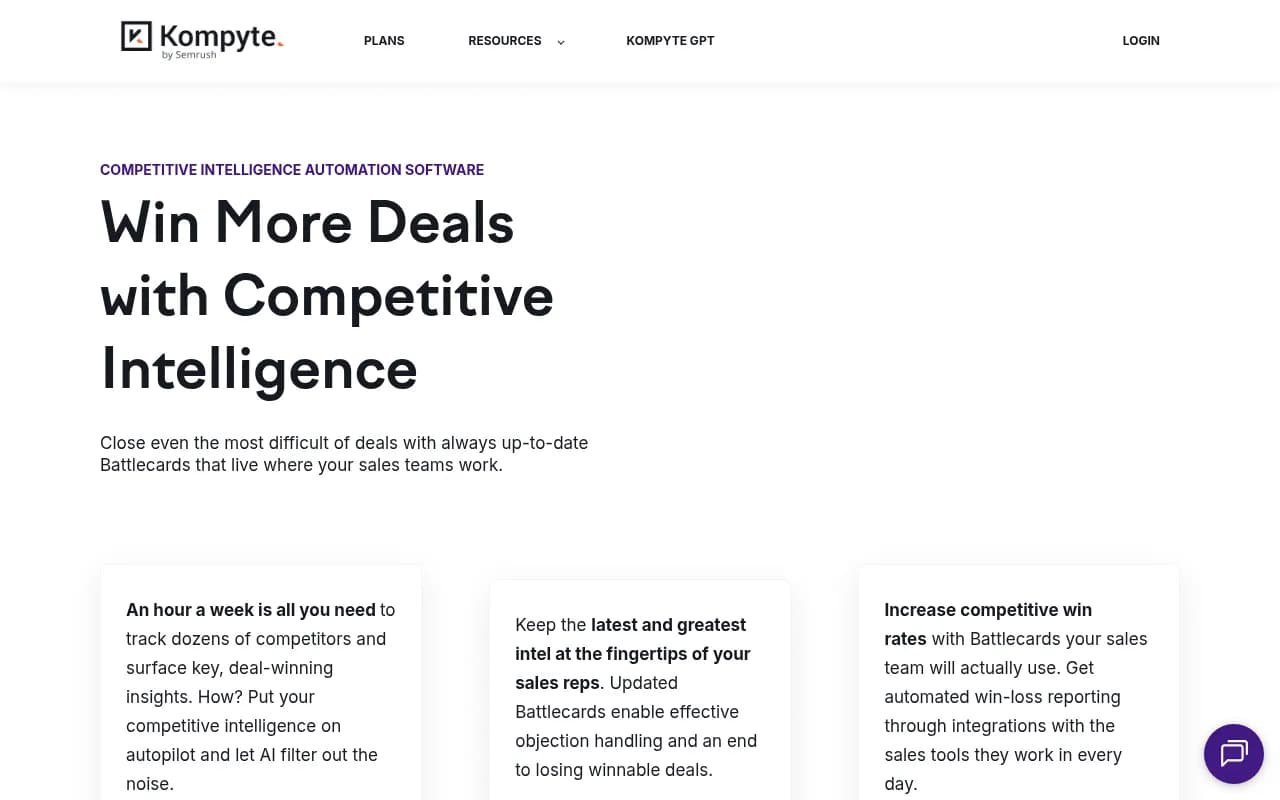
Tracks competitor websites, reviews, and job postings automatically, then syncs battlecards into CRM and sales tools to keep reps informed at every deal stage.
Key takeaways
- Kompyte is a competitive intelligence and sales battlecard platform built for product marketing and sales enablement teams at B2B SaaS companies.
- Tracks competitors across websites, reviews, social, ads, and job postings, then uses AI to filter noise and surface actionable updates.
- Battlecards sync bi-directionally with Salesforce and HubSpot, so reps see competitive intel inside the tools they already use.
- Win/loss analysis is a genuine differentiator -- Kompyte partners with IcebergIQ for qualitative interview-based research alongside automated quantitative data.
- Pricing is not publicly listed; annual contracts are required, and setup takes 7-8 weeks according to third-party comparisons.
- Owned by Semrush since 2021, which adds SEO and traffic data as a potential advantage over standalone competitors like Crayon and Klue.
Kompyte is a competitive intelligence automation platform that tracks what your competitors are doing -- website changes, pricing updates, new job postings, review trends, ad copy shifts -- and turns that raw signal into sales-ready battlecards. The pitch is simple: your product marketing team shouldn't be spending 20 hours a week manually checking competitor sites. Kompyte does that automatically, filters out the irrelevant noise with AI, and delivers the useful stuff to your sales reps inside Salesforce or HubSpot before they walk into a deal.
The target audience is product marketing managers and sales enablement teams at B2B companies, typically mid-market to enterprise, where competitive differentiation actually moves deals. Think a 50-person SaaS company with a dedicated PMM who's tired of building battlecards in Google Docs that go stale the moment they're published, or a 200-person sales org where reps are losing deals to competitors they barely understand.
Kompyte was acquired by Semrush in December 2021, which is worth knowing upfront. The acquisition brought Semrush's SEO and web traffic data into the mix, and Kompyte now markets itself partly on that combined data advantage. Whether that integration is deep or surface-level depends on your plan, but it's a meaningful differentiator on paper against pure-play competitors like Crayon and Klue.
Key features
Automated competitor tracking across multiple sources
Kompyte monitors competitors across six main data types: website changes, review platforms (G2, Capterra, etc.), content and blog updates, social media activity, paid advertising, and job postings. The job posting tracker is particularly useful -- if a competitor suddenly posts 10 engineering roles focused on a specific feature area, that's a signal worth knowing. Website change tracking goes beyond just "the homepage changed" and can surface specific copy updates, pricing page edits, or new feature announcements.
- Tracks "hundreds of sources and millions of data points" per Kompyte's own description
- AI Daily Summaries condense the firehose into a digestible digest
- Filters are available to cut noise and focus on the signal types that matter to your team
AI-powered noise filtering and daily summaries
This is where Kompyte tries to solve the core problem with competitive tracking tools: information overload. Raw competitor monitoring generates a lot of irrelevant updates. Kompyte's AI layer is supposed to distinguish between a competitor changing their footer copyright year (noise) versus updating their pricing page or launching a new product tier (signal). The AI Daily Summaries feature compresses what would otherwise be hours of review into roughly an hour per week, according to Kompyte's marketing. In practice, the quality of filtering depends on how well you've configured your tracking parameters.
Sales battlecards with bi-directional CRM integration
This is Kompyte's clearest differentiator from basic monitoring tools. Battlecards aren't just static documents -- they're living templates that pull in the latest competitive intel automatically. The bi-directional integration with Salesforce and HubSpot means:
- Battlecards surface inside CRM deal records based on which competitor is tagged
- Updates to battlecard content push back to the CRM without manual re-export
- New sales reps get access to current competitive positioning without needing to find the right Google Doc
Templates cover overviews, differentiators, objection handling, and pricing comparisons. You can customize the structure to match how your team actually sells.
Win/loss analysis and reporting
Kompyte goes further than most battlecard tools by connecting competitive intel to actual revenue outcomes. The win/loss module tracks:
- Competitive win rates with and without battlecard usage (so you can prove ROI)
- Competitor frequency in deals
- Revenue influenced by competitive initiatives
The IcebergIQ partnership is a notable addition -- it brings in qualitative win/loss interview data from actual customers and lost prospects, which gets populated back into battlecards and reports. Quantitative data tells you what happened; qualitative data tells you why. Having both in one platform is genuinely useful for PMMs who need to make the case for their competitive program internally.
Battlecard adoption measurement
One of the more practical features: Kompyte tracks whether sales reps are actually using the battlecards. Adoption metrics show which battlecards get opened, how often, and by whom. This matters because the classic failure mode of competitive intelligence programs is building great content that nobody reads. If your Salesforce battlecard for Competitor X has 3% adoption, you know there's a distribution or relevance problem to fix.
Integrations with sales enablement platforms
Beyond CRM, Kompyte integrates with Slack, Microsoft Teams, Google Drive, OneDrive, Highspot, and Showpad. The Slack integration is particularly useful for pushing competitor alerts to relevant channels (e.g., a #competitive-intel channel) without requiring anyone to log into another tool. Highspot and Showpad integrations mean battlecards can live inside existing sales enablement stacks rather than requiring reps to adopt yet another platform.
Semrush data integration
Since the acquisition, Kompyte can pull in Semrush's SEO traffic estimates and keyword data for competitors. This adds a layer of context that pure competitive intelligence tools don't have -- you can see not just that a competitor updated their website, but whether that update correlated with a traffic spike. For companies where organic search is a meaningful acquisition channel, this is a real advantage.
Who is it for
Kompyte fits best at B2B SaaS companies in the 50-500 employee range that have at least one dedicated product marketing manager and a sales team large enough that informal competitive knowledge-sharing has broken down. If you're a 10-person startup where the founder knows every competitor personally, Kompyte is overkill. If you're a 300-person company where sales reps are losing deals to competitors they've never heard of, it starts making sense.
The primary user is a product marketing manager or competitive intelligence analyst who owns the competitive program. They use Kompyte to monitor the landscape, curate the signal, and build battlecards. The secondary users are sales reps who consume battlecards inside Salesforce or HubSpot -- ideally without ever logging into Kompyte directly.
Industries where it works particularly well: B2B SaaS, fintech, legal tech, and any sector with 5-20 meaningful competitors where differentiation is genuinely complex. Kompyte's customer list includes LegalZoom, Podium, BetMGM, and GetResponse -- a mix of verticals that suggests it's not narrowly specialized.
Who should probably look elsewhere: Very small teams without a dedicated PMM will struggle to get value from the setup investment (7-8 weeks per third-party comparisons). Companies in industries with only 2-3 competitors may find the automation overhead isn't worth it. And teams that primarily need SEO-focused competitive analysis rather than sales battlecards would be better served by Semrush or Ahrefs directly.
Integrations and ecosystem
Kompyte's integration story is one of its stronger selling points. The core integrations:
- Salesforce: Bi-directional battlecard sync, deal-level competitive tagging, win/loss data
- HubSpot: Similar CRM integration for HubSpot-native sales teams
- Slack and Microsoft Teams: Competitor alert notifications, daily summaries pushed to channels
- Google Drive and OneDrive: Export and storage for reports and battlecards
- Highspot and Showpad: Sales enablement platform integrations for teams that already use these tools
- Semrush: Traffic and SEO data for competitor websites (via parent company)
There's no publicly documented API for custom integrations, which is a limitation for teams that want to build custom workflows or pull Kompyte data into their own BI tools. The integration set covers the most common sales tech stack configurations, but if your team uses a less common CRM or sales enablement tool, you may be out of luck.
No mobile app is mentioned in available documentation. The platform appears to be web-based with notifications pushed to Slack/Teams for mobile-accessible alerts.
Pricing and value
Kompyte does not publish pricing on its website, which is a common pattern for enterprise-oriented competitive intelligence tools. Based on third-party comparison data:
- Annual contracts are required; shorter periods may be available at a premium
- Pricing varies based on number of competitors tracked, number of users, and boards/battlecards used
- Payment is accepted via wire transfer and check -- no self-serve credit card signup
For context, comparable tools in this space (Crayon, Klue) typically run $15,000-$50,000+ per year for mid-market teams, with enterprise pricing going higher. Kompyte likely sits in a similar range, though the Semrush acquisition may give it some pricing flexibility.
The 7-8 week setup timeline is worth factoring into the total cost of ownership. That's not a tool you spin up in an afternoon -- it requires dedicated onboarding time from your team and Kompyte's implementation staff.
There is no free tier. A demo/tour is available via the website.
Strengths and limitations
What Kompyte does well:
- The bi-directional CRM integration is genuinely well-executed. Battlecards that live inside Salesforce deal records, updated automatically, is a real workflow improvement over static documents.
- Win/loss analysis with both quantitative automation and qualitative IcebergIQ interview data is a more complete picture than most competitors offer.
- Battlecard adoption tracking solves a real problem -- knowing whether your competitive program is actually being used is half the battle for PMMs trying to prove ROI.
- The Semrush data layer adds SEO and traffic context that standalone competitive intelligence tools can't match.
- Broad source coverage (websites, reviews, ads, job postings, social) in a single platform reduces the need for multiple monitoring tools.
Limitations and honest gaps:
- No self-serve pricing or free trial. The sales-led, annual-contract model creates friction for teams that want to evaluate before committing.
- The 7-8 week setup timeline is long. Teams with urgent competitive needs can't move fast with Kompyte.
- No public API documentation limits custom integrations and data portability.
- AI filtering quality is hard to evaluate without hands-on testing -- the "hour a week" claim depends heavily on how well the noise filters are configured, and early setup may require significant tuning.
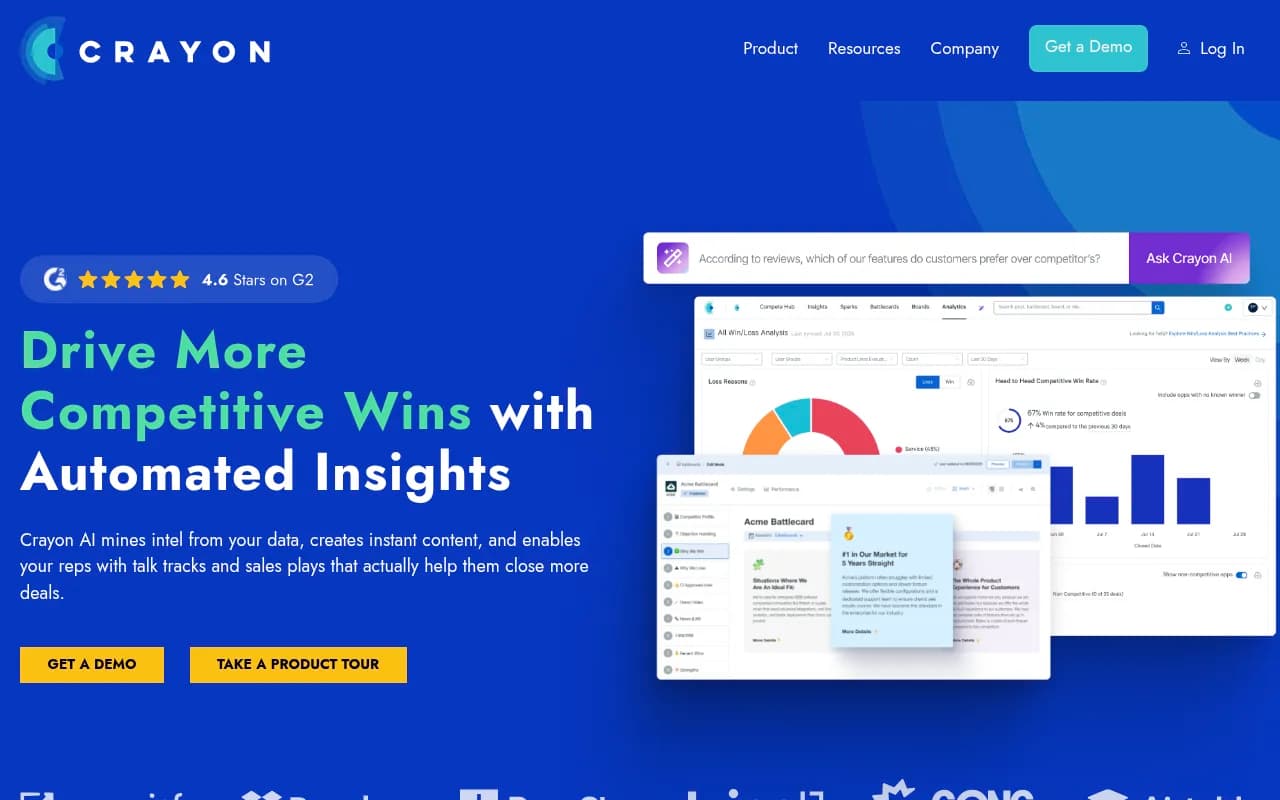
- Compared to Crayon, Kompyte's AI maturity has been noted as "less mature" in third-party comparisons, occasionally missing key updates.
Bottom line
Kompyte is a solid choice for B2B SaaS companies with a dedicated product marketing function that needs to operationalize competitive intelligence at scale -- specifically, teams where the gap between "we have good competitive data" and "our reps actually use it in deals" is the core problem to solve. The CRM-native battlecard delivery and win/loss analytics are the strongest reasons to choose it over simpler monitoring tools.
Best use case in one sentence: A PMM at a 100-300 person SaaS company who needs to automate competitor tracking, build battlecards that reps will actually open in Salesforce, and prove the competitive program's impact on win rates.
Tags:
Frequently asked questions
What is Kompyte?
Who is Kompyte best suited for?
How much does Kompyte cost?
Is there a free trial or free plan?
How does Kompyte compare to Crayon and Klue?
Who owns Kompyte?
Similar and alternative tools to Kompyte