Dealroom Review 2026
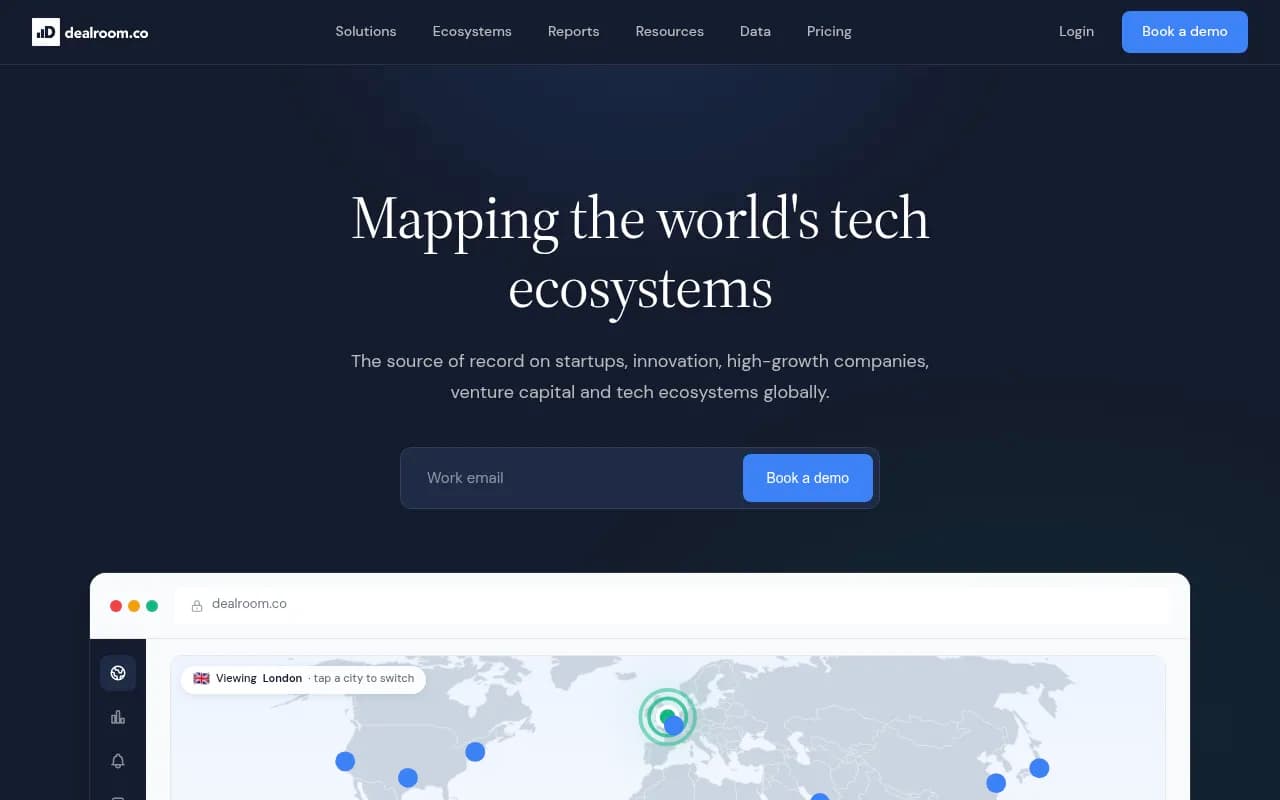
Company intelligence platform focused on startups, venture capital, and tech ecosystems. Strong on European market data, investor tracking, and funding rounds.
Key takeaways
- Dealroom is one of the most comprehensive startup and venture capital intelligence platforms available, with particular depth in European tech ecosystems -- a genuine differentiator versus US-centric competitors like PitchBook and Crunchbase.
- The platform goes well beyond a simple database: real-time signals on stealth founders, patent filings, talent movements, and funding rounds make it genuinely useful for deal sourcing rather than just retrospective research.
- Pricing starts at €12,600/year (3 seats), which puts it firmly in the enterprise tier -- not a tool for solo analysts or early-stage founders on a budget.
- The free "Builders" tier for founders is a smart move, giving startups access to investor-matching features without paying, while the paying customers (VCs, corporates, governments) get the full picture.
- Clients include Accel, Index Ventures, McKinsey, BCG, Microsoft, AWS, and 100+ government ecosystem partners -- the client list alone signals the quality of the data.
Dealroom was founded in Amsterdam and has spent the better part of a decade building what it calls "the source of record" on global tech ecosystems. The platform tracks startups, venture capital activity, high-growth companies, talent movements, patent filings, and ecosystem health metrics across every major tech hub in the world. If you need to know who just came out of stealth in London, which sectors are attracting the most VC money in Southeast Asia, or how Austin's startup ecosystem compares to Berlin's, Dealroom is one of the few places you can actually find that data in one place.
The target audience is broad but specific in its needs: venture capital and private equity firms doing deal sourcing, corporate innovation teams tracking competitive threats, government economic development agencies benchmarking their regions, and management consultancies (McKinsey, BCG) building market maps for clients. Founders get a free tier to find investors, which is a clever acquisition strategy -- it keeps the data fresh and creates a pipeline of future paying customers.
Dealroom has built a network of 100+ ecosystem partners including La French Tech, Tech Nation, British Business Bank, Techleap.nl, and Innovation Norway. These partnerships aren't just logos -- they mean Dealroom often has privileged access to data that competitors simply can't replicate through web scraping alone. That's a meaningful moat.
Key features
Real-time ecosystem signals
The homepage live feed is genuinely impressive. Dealroom tracks stealth founder activity (with names, prior employers, and days in stealth), patent filings, talent movements from major tech companies, funding rounds as they close, and sector-level funding trends -- all updating in near real-time. This isn't just a news aggregator; the platform is pulling structured data from multiple sources and surfacing it as actionable intelligence. For a VC analyst trying to get to a founder before competitors, this kind of early signal matters.
- Stealth founder tracking includes prior employer context (e.g., "Ex-Head of Generative AI at OpenAI") and university affiliation
- Patent filings are tracked with invention descriptions, not just filing numbers
- "Startup mafia" tracking shows which alumni of a given company have gone on to found new startups and how much they've raised
Company profiles with financial depth
Individual company pages go well beyond the basics. The ElevenLabs example shown on the site includes ARR with YoY growth rates, valuation multiples benchmarked against audio AI peers, cap table breakdown by investor, headcount trends, talent background (which companies employees came from), patent portfolio with grant status, and a "startup mafia" view of alumni-founded companies. This level of depth on private companies is genuinely rare and is where Dealroom earns its price tag.
Ecosystem benchmarking and the Global Tech Ecosystem Index
Dealroom's ecosystem tools are probably its most unique capability relative to competitors. The platform lets you compare tech ecosystems by total value, growth rate, sector composition, and investor activity. The Global Tech Ecosystem Index scores cities on a composite metric, and the data is granular enough to track Austin vs. Berlin vs. Singapore in a meaningful way. This is why government agencies and economic development bodies are paying customers -- there's no other tool that does this as well.
Investor intelligence
The platform tracks investor activity with real depth: which firms are most active by deal count, which sectors they're focused on, stage preferences, and portfolio performance. The "matched investors" feature for founders uses this data to surface relevant VCs based on stage, sector, and geography. For VCs themselves, the ability to see competitor deal flow and identify which firms are moving into new sectors is a genuine competitive advantage.
Sector and trend analysis
Dealroom surfaces fastest-growing sectors by YoY funding, with specific deal counts and leading companies. The sector maps (like the AI agents category map shown on the site) give a visual overview of the competitive landscape with valuations attached. These aren't static reports -- they update as new data comes in. For corporate strategy teams trying to understand where disruption is coming from, this is more useful than a quarterly analyst report.
Talent and people intelligence
The platform tracks individual researchers, founders, and executives -- including publication activity (Yann LeCun's papers on world models appear in the feed), job changes, and founding activity. The "12 DeepMind alumni founded new companies" signal is a good example: Dealroom is tracking talent clusters and surfacing them as investment signals, not just individual events.
Founder tools (free tier)
Founders get free access to investor-matching features, which surfaces relevant VCs based on the startup's stage, sector, and geography. This is a smart product decision -- it keeps founder data flowing into the platform and creates goodwill with the startup community, while the actual paying customers (investors, corporates) benefit from having current founder data.
API and data exports
The Premium plan includes 10,000 exports per year, and Dealroom offers API access for teams that want to integrate the data into their own workflows. This is important for larger organizations that want to pull Dealroom data into internal CRMs, dashboards, or proprietary models.
Who is it for
The primary users are venture capital and private equity firms doing deal sourcing and portfolio monitoring. A firm like Index Ventures or Balderton Capital (both listed as clients) needs to track thousands of companies across multiple geographies, identify emerging categories before they become obvious, and monitor talent movements that signal where the next wave of startups will come from. Dealroom's real-time signals and deep company profiles make it genuinely useful for this workflow in a way that a static database like Crunchbase doesn't.
Corporate innovation and strategy teams at companies like Microsoft, AWS, SAP, and Stripe (all listed as clients) use Dealroom to track competitive threats, identify acquisition targets, and understand which startups are gaining traction in their markets. The sector maps and category views are particularly useful here -- a corporate BD team can pull up the AI agents landscape and immediately see which companies are raising, at what valuations, and with which investors.
Government agencies and economic development bodies are a less obvious but significant user group. Organizations like La French Tech, British Business Bank, and Invest Atlanta use Dealroom to benchmark their ecosystems, track the health of local startup communities, and make the case for investment in their regions. No other platform serves this use case as well.
Who should probably look elsewhere: solo analysts or researchers who need occasional data lookups (Crunchbase's free tier or a cheaper subscription is more appropriate), early-stage founders who just need a basic investor list (the free tier covers this, but don't expect the full platform), and teams primarily focused on US-only deal flow (PitchBook has deeper US coverage, particularly for later-stage and PE deals).
Integrations and ecosystem
Dealroom's integrations are primarily data-out rather than two-way syncs. The platform supports:
- API access for pulling company, funding, and ecosystem data into external systems -- useful for VC firms building proprietary deal flow tools or corporates integrating into their CRM
- Data exports (10,000/year on the Premium plan) in standard formats for use in Excel, Tableau, or other analytics tools
- Ecosystem partner network -- 100+ government and development agency partners contribute data and use Dealroom's white-label ecosystem tools
- Looker Studio / BI tool compatibility -- exported data can feed into custom dashboards
There's no native Salesforce or HubSpot integration listed, which is a gap for VC firms that want deal flow data to flow directly into their CRM. Most firms using Dealroom at scale are building custom integrations via the API. The GitHub presence (github.com/dealroom) suggests some developer tooling exists, though the public repos appear to be limited.
Mobile access is available through the web app on mobile browsers, but there's no dedicated iOS or Android app listed -- a minor inconvenience for analysts who want to check signals on the go.
Pricing and value
Dealroom's pricing is enterprise-oriented and not publicly detailed beyond the Premium tier:
- Builders (Free): Founder-focused tier with investor matching and basic company search. No exports, no API.
- Premium: €12,600/year for 3 seats. Includes core data access and 10,000 exports per year. This is the entry point for professional use.
- Higher tiers: Not publicly listed -- require a demo/sales conversation. Presumably cover more seats, higher export limits, API access, and white-label ecosystem tools for government partners.
At €12,600/year ($13,500 at current rates), Dealroom is cheaper than PitchBook (which typically runs $20,000-$30,000+/year for comparable access) but more expensive than Crunchbase Pro ($5,000-$7,000/year). The value proposition versus Crunchbase is real: the depth of European data, real-time signals, ecosystem benchmarking, and talent intelligence are meaningfully better. Versus PitchBook, Dealroom wins on European coverage and ecosystem tools but loses on US PE/late-stage data depth and some financial modeling features.
For a VC firm doing active deal sourcing in Europe, the price is easy to justify. For a US-focused firm with occasional European interest, it's a harder sell. For government agencies and corporates, the ecosystem benchmarking tools alone are probably worth the price.
Strengths and limitations
What Dealroom does well:
- European startup data depth: No other platform comes close for European tech ecosystems. The combination of local partnerships, ecosystem network, and years of data collection creates a genuine advantage that US-centric competitors haven't replicated.
- Real-time signals: The live feed of stealth founders, patent filings, talent movements, and funding rounds is genuinely useful for deal sourcing. This isn't just a database -- it's an intelligence feed.
- Ecosystem benchmarking: The Global Tech Ecosystem Index and city-level comparison tools are unique. Government agencies and economic development bodies have no real alternative.
- Company profile depth: ARR trends, cap table data, talent backgrounds, patent portfolios, and startup mafia tracking on private companies is impressive. The ElevenLabs profile example shows what's possible.
- Founder-friendly free tier: Smart product decision that keeps data fresh and builds goodwill with the startup community.
Honest limitations:
- US late-stage and PE coverage: PitchBook has deeper data on US private equity, growth equity, and later-stage deals. If your focus is US buyouts or growth rounds above $500M, PitchBook is probably still the better tool.
- No native CRM integration: For VC firms that want deal flow data flowing directly into Salesforce or Affinity, the lack of native integrations means custom API work. This is a real friction point for smaller teams without engineering resources.
- Price point excludes smaller teams: €12,600/year is a meaningful commitment. Solo GPs, small family offices, or early-stage analysts who need occasional data access will find the entry price steep relative to Crunchbase or even LinkedIn.
- Data freshness on smaller companies: The real-time signals are impressive for well-tracked companies, but coverage of very early-stage or non-English-language startups outside major hubs can be spottier. This is an inherent challenge for any platform at this scale.
Bottom line
Dealroom is the right tool for VC and PE firms with European exposure, corporate strategy teams tracking tech disruption, and government agencies that need to benchmark and communicate the health of their startup ecosystems. The combination of real-time signals, deep company profiles, and ecosystem benchmarking tools is genuinely differentiated -- particularly for anyone who finds PitchBook too US-centric or Crunchbase too shallow.
Best use case in one sentence: a European VC analyst who needs to find the next Wayve or ElevenLabs before it raises its Series A, using real-time talent signals and stealth founder tracking to get there first.
Tags:
Frequently asked questions
What is Dealroom?
How much does Dealroom cost?
How does Dealroom compare to PitchBook and Crunchbase?
Is there a free plan?
Who are Dealroom's main clients?
Does Dealroom have an API?
Similar and alternative tools to Dealroom