Key takeaways
- Most AI visibility tools are monitoring dashboards -- they show you where you're invisible but don't help you fix it. Only a handful close the loop with content generation and optimization.
- The market average price is around $337/month, but several strong options exist well below that threshold.
- Platform coverage matters: the best tools track ChatGPT, Perplexity, Google AI Overviews, Claude, Gemini, and more -- not just one or two.
- For teams that need to act on data (not just read it), look for tools with answer gap analysis, content generation, and traffic attribution built in.
- Promptwatch is the only platform in this comparison rated as a "Leader" across all evaluation categories in a 2026 review of 12 GEO platforms.
The AI search visibility market has gone from a niche curiosity to a crowded, well-funded category in under two years. Over $31 million has flowed into this space, and new tools are launching constantly. That's great for competition, but it makes choosing genuinely difficult.
The core problem: most tools in this category look similar on the surface. They all track brand mentions in ChatGPT, Perplexity, and Google AI Overviews. They all show you a share-of-voice score. But there's a massive difference between a tool that shows you a problem and a tool that helps you solve it.
This guide ranks the 10 best options by three dimensions: feature depth (what can it actually do?), accuracy (how reliable is the data?), and price (what do you get for the money?). We've also flagged which tools are monitoring-only versus which ones help you take action.
How we evaluated these tools
Before getting into the list, here's what we weighted:
- Model coverage: Does it track ChatGPT, Perplexity, Google AI Overviews, Claude, Gemini, Grok, DeepSeek, and others -- or just two or three?
- Data methodology: Are responses sampled multiple times per prompt to account for LLM variability? Is citation capture reliable?
- Actionability: Can you diagnose gaps and fix them inside the platform, or do you have to export data and figure it out yourself?
- Traffic attribution: Can you connect AI visibility to actual website traffic and revenue?
- Prompt intelligence: Does it give you volume estimates, difficulty scores, and competitive context for each prompt?
- Price-to-value: What do you actually get at each tier?
With that framework in mind, here are the 10 best tools right now.
1. Promptwatch -- best overall for teams that want to act, not just monitor
Promptwatch is the most complete platform in this category. Where most competitors stop at showing you data, Promptwatch is built around a three-step loop: find gaps, create content, track results.

The answer gap analysis is the standout feature. It shows you exactly which prompts your competitors are visible for that you're not -- with the specific content topics and angles AI models want answers to but can't find on your site. That's genuinely useful in a way that a share-of-voice dashboard isn't.
From there, the built-in AI writing agent generates articles, listicles, and comparisons grounded in real citation data (880M+ citations analyzed). This isn't generic content -- it's engineered around what AI models actually cite. Once content is published, page-level tracking shows which pages are being cited, how often, and by which models. Traffic attribution via a code snippet, GSC integration, or server log analysis closes the loop to revenue.
A few other things worth noting: Promptwatch has AI crawler logs that show in real time which AI bots (ChatGPT, Claude, Perplexity) are hitting your site, which pages they read, and any errors they encounter. Most competitors don't have this at all. It also tracks Reddit and YouTube -- two channels that heavily influence AI recommendations but are largely ignored by other tools.
Coverage spans 10 AI models: ChatGPT, Perplexity, Google AI Overviews, Google AI Mode, Claude, Gemini, Meta/Llama, DeepSeek, Grok, Mistral, and Copilot.
Pricing starts at $99/month (Essential: 1 site, 50 prompts, 5 articles), $249/month (Professional: 2 sites, 150 prompts, 15 articles, crawler logs), and $579/month (Business: 5 sites, 350 prompts, 30 articles). A free trial is available.
In a 2026 comparison of 12 GEO platforms, Promptwatch was the only tool rated as a "Leader" across all categories.
Best for: Marketing and SEO teams that need to improve AI visibility, not just measure it.
2. Profound -- best for enterprise teams with dedicated analysts
Profound is a serious platform with strong data depth. It tracks brand mentions across 9+ AI engines and gives enterprise teams the kind of granular reporting their leadership expects. The share-of-voice metrics are reliable, and the competitive benchmarking is solid.
Profound

The catch is price -- Profound starts at $499/month, which puts it out of reach for most small and mid-sized teams. It's also primarily a monitoring and analysis tool. You get excellent data, but the workflow for actually fixing gaps requires taking that data elsewhere. For teams with a dedicated analyst who can translate insights into action, that's fine. For leaner teams, it's a limitation.
Best for: Enterprise brands with budget and dedicated analysis resources.
3. Scrunch AI -- best for brands that prioritize content intelligence
Scrunch AI raised $19 million and has built a genuinely capable platform. Its strength is in understanding how AI models perceive and describe your brand -- not just whether you're mentioned, but how. That sentiment and framing analysis is more sophisticated than most competitors offer.
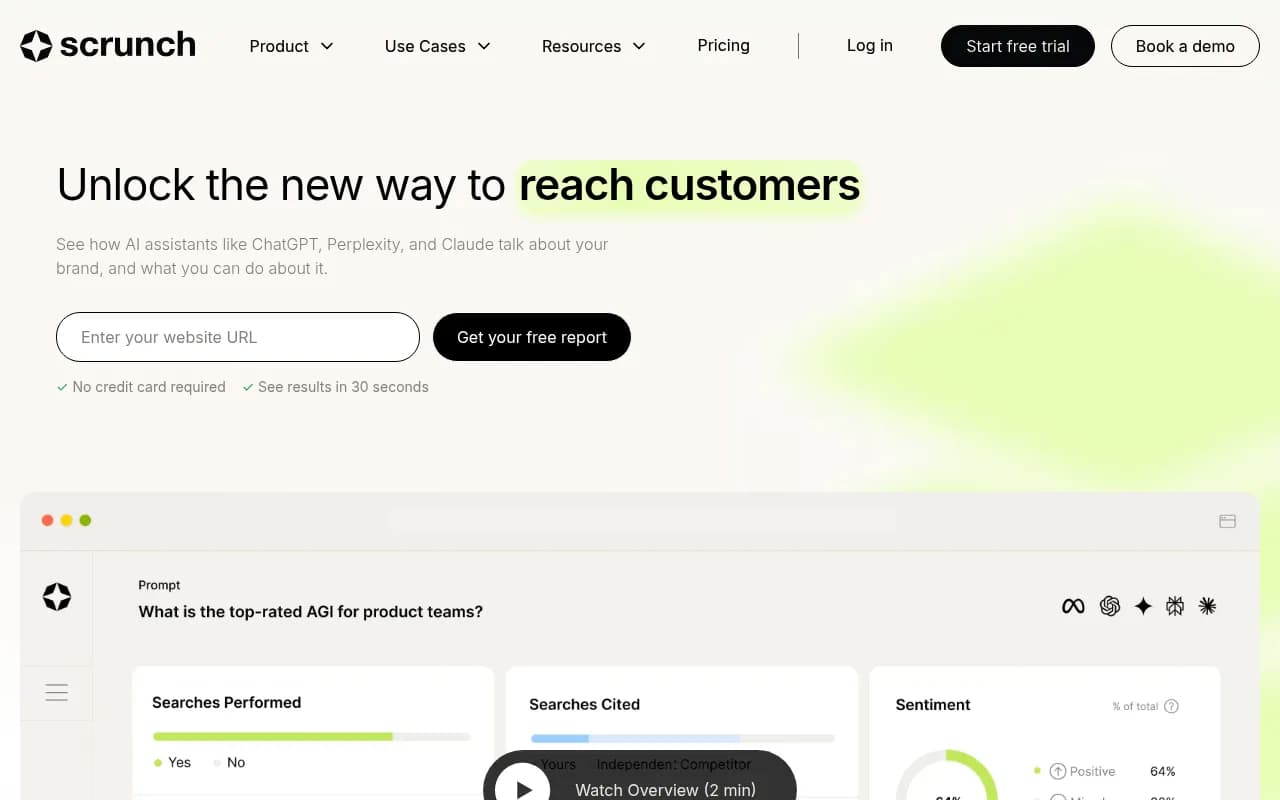
It tracks multiple AI engines and provides competitive heatmaps that show where rivals are winning. The content intelligence features are good. The main limitation is price ($300/month entry point) and the fact that it's still largely a monitoring-first tool -- content optimization requires external workflows.
Best for: Brand teams that care about perception and narrative, not just mention counts.
4. Peec AI -- best budget option with solid fundamentals
Peec AI covers the core bases well at a price that's hard to argue with. For $99/month, you get tracking across ChatGPT, Gemini, Perplexity, Claude, Google AI Overviews, Google AI Mode, and Copilot. The data is reliable, the interface is clean, and the competitive benchmarking is useful.
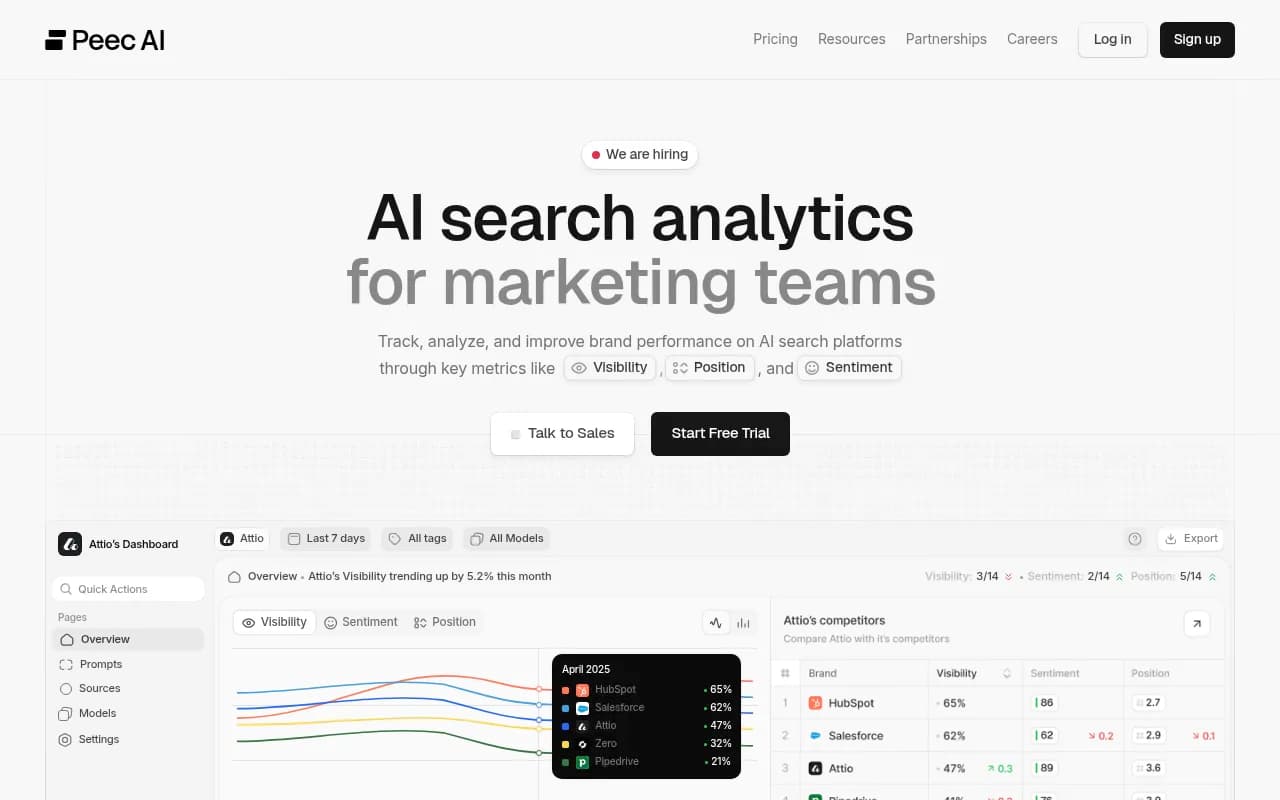
What Peec AI doesn't have is the action layer. There's no content generation, no gap analysis that tells you what to write, and no traffic attribution. It's a monitoring tool, and a good one -- but if you want to move from "I see the problem" to "I fixed the problem," you'll need to supplement it.
Best for: Teams with a tight budget that need reliable monitoring across major AI engines.
5. Otterly.AI -- best for getting started quickly
Otterly.AI is consistently recommended in SEO communities as one of the most accessible entry points into AI visibility tracking. The setup is fast, the interface is intuitive, and the pricing is among the lowest in the market.
Otterly.AI

It tracks brand mentions across ChatGPT, Perplexity, and Google AI Overviews, and gives you share-of-voice metrics and competitor comparisons. For someone who's never tracked AI visibility before, it's a reasonable starting point.
The limitations become apparent as your needs grow. No crawler logs, no visitor analytics, no content generation, and limited prompt intelligence. It's a solid monitoring dashboard, but that's about it.
Best for: Individuals and small teams taking their first steps into AI visibility tracking.
6. AthenaHQ -- best for structured competitive analysis
AthenaHQ takes a methodical approach to AI visibility. It's built around tracking specific prompts over time and comparing your performance against named competitors. The reporting is clean and easy to share with stakeholders.

The platform is monitoring-focused, which means it tells you where you stand but doesn't help you change it. There's no content optimization or generation built in. For teams that already have a strong content operation and just need visibility data to inform it, that's workable. For teams that need end-to-end support, it falls short.
Best for: Teams with existing content workflows that need structured competitive monitoring.
7. LLMrefs -- best for keyword-centric teams transitioning from traditional SEO
LLMrefs has a smart approach: it starts with the keywords you already track and automatically generates realistic conversational prompts around them. That makes it easier for SEO teams to bridge the gap between traditional keyword tracking and AI visibility monitoring.
LLMrefs
The share-of-voice metrics and citation counts are solid. The platform covers ChatGPT, Google AI Overviews, Perplexity, and Gemini. Pricing starts at $79/month, making it one of the more affordable options with decent feature depth.
The gap is on the action side -- like most tools in this list, LLMrefs shows you what's happening but doesn't help you fix it. Still, for SEO teams that want a familiar workflow adapted for AI search, it's a strong option.
Best for: SEO teams that want to extend their existing keyword strategy into AI visibility.
8. Semrush -- best for teams that want AI visibility inside a tool they already use
Semrush has been adding AI search tracking features to its core platform, and for teams already paying for Semrush, it's worth knowing what's there. The AI visibility features are incorporated into Pro, Guru, and Business plans (starting around $129.95/month).
The honest assessment: Semrush's AI visibility features are useful but not deep. The prompts are largely fixed rather than customizable, and there's no AI traffic attribution. If you're already a Semrush customer and want a basic read on AI visibility without adding another tool to your stack, it works. If AI visibility is a serious priority, you'll want a dedicated platform.
Best for: Existing Semrush users who want a basic AI visibility layer without adding a new tool.
9. Ahrefs -- best for teams that want traditional SEO and AI tracking in one place
Ahrefs has been building out its Brand Radar feature for AI search tracking. Like Semrush, it's a useful addition for existing Ahrefs customers rather than a reason to switch from a dedicated AI visibility tool.
The prompts in Brand Radar are fixed, which limits how precisely you can track the specific queries your customers are actually asking. There's also no AI traffic attribution. But the integration with Ahrefs' existing backlink, keyword, and content data is genuinely useful for understanding the full picture of your search presence.
Best for: Existing Ahrefs customers who want to add AI visibility tracking without a separate subscription.
10. SE Ranking -- best all-in-one for mid-market teams
SE Ranking has built a solid all-in-one SEO platform that now includes AI visibility features. The pricing is competitive, the interface is accessible, and the breadth of features (rank tracking, site audits, content optimization, AI monitoring) makes it a reasonable single-tool solution for mid-market teams.
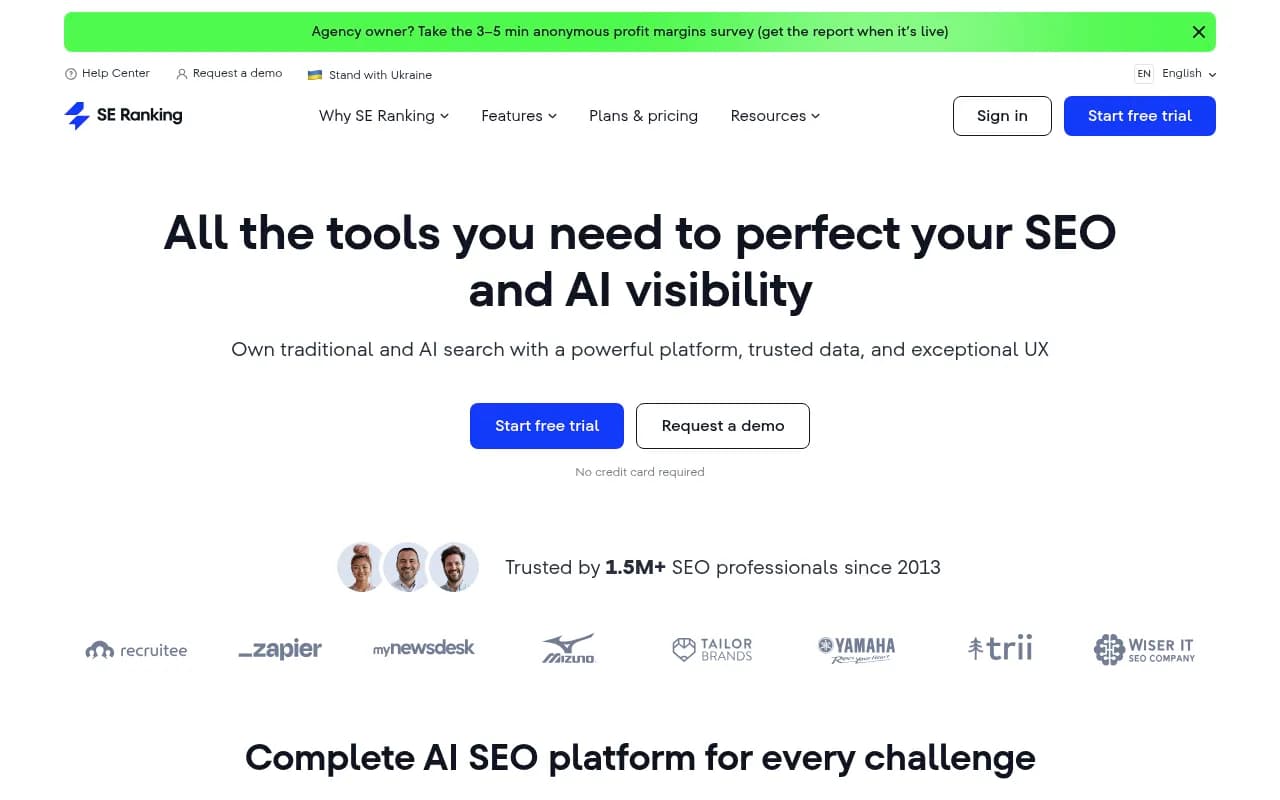
The AI visibility features aren't as deep as dedicated platforms -- you won't get crawler logs, Reddit tracking, or content generation for AI search. But if you're a mid-sized team that wants one platform to handle traditional SEO and basic AI visibility, SE Ranking is worth considering.
Best for: Mid-market teams that want traditional SEO and AI visibility in a single, affordable platform.
Feature comparison
Here's how the 10 tools stack up across the dimensions that matter most:
| Tool | AI models tracked | Content generation | Crawler logs | Traffic attribution | Prompt intelligence | Starting price |
|---|---|---|---|---|---|---|
| Promptwatch | 10+ | Yes | Yes | Yes | Yes (volume + difficulty) | $99/mo |
| Profound | 9+ | No | No | Limited | Basic | $499/mo |
| Scrunch AI | Multiple | No | No | No | Basic | $300/mo |
| Peec AI | 7 | No | No | No | No | $99/mo |
| Otterly.AI | 3 | No | No | No | No | ~$49/mo |
| AthenaHQ | Multiple | No | No | No | Basic | Custom |
| LLMrefs | 4 | No | No | No | Basic | $79/mo |
| Semrush | Limited | No | No | No | No | $129.95/mo |
| Ahrefs | Limited (fixed) | No | No | No | No | Bundled |
| SE Ranking | Multiple | No | No | No | No | ~$65/mo |
The pattern is hard to miss. Most tools in this category are monitoring dashboards. Promptwatch is the only one in this list that covers the full cycle from gap identification to content creation to traffic attribution.
How to choose the right tool for your situation
The right answer depends on what you actually need to do.
If you're just starting out and want to understand whether AI models are mentioning your brand, Otterly.AI or Peec AI will get you there cheaply. Neither will help you fix what you find, but they're low-risk ways to get oriented.
If you're an enterprise team with budget and a dedicated analyst, Profound gives you the data depth and reporting structure that large organizations expect. You'll need to build your own action workflows on top of it.
If you're already deep in the Semrush or Ahrefs ecosystem and AI visibility is a secondary concern, use what you have. The built-in features are basic but functional.
If AI visibility is a real priority -- meaning you want to actually improve where you appear in AI responses, not just measure it -- you need a platform with gap analysis, content generation, and attribution built in. That's a short list, and Promptwatch is at the top of it.
The market average for these tools is around $337/month. Several strong options exist well below that. But the more important question isn't the price -- it's whether the tool helps you close the loop between finding a gap and filling it.
What to watch in the second half of 2026
A few trends worth tracking as this market matures:
The distinction between monitoring tools and optimization platforms will become more important, not less. As more brands start tracking AI visibility, the competitive advantage will shift to those who can act on the data faster. Tools that only show you the problem will become table stakes.
Google AI Mode is becoming a significant channel in its own right, separate from traditional AI Overviews. Tools that treat them as the same thing will give you an incomplete picture.
Reddit and YouTube are increasingly influential in what AI models cite. Most tools still ignore these channels entirely -- which means there's a meaningful gap between what's being tracked and what's actually driving AI recommendations.
Traffic attribution from AI search is still an unsolved problem for most teams. The tools that crack this cleanly will have a significant advantage in proving ROI and justifying budget.
The category is moving fast. The tools that were leading six months ago aren't necessarily leading now. Keep evaluating.