Key takeaways
- Most GEO platforms in 2026 are monitoring dashboards — they tell you where you're invisible but don't help you fix it
- The best platforms for content teams combine visibility tracking with content gap analysis and AI-assisted content creation
- Promptwatch is the only platform rated a "Leader" across all GEO categories in a 2026 comparison of 12 platforms, because it closes the full loop: find gaps, create content, track results
- Platforms like Otterly.AI, Peec.ai, and AthenaHQ are solid for monitoring but stop short of helping you act
- Pricing ranges from free tiers to $500+/month for enterprise-grade platforms with content generation built in
- If your team's job is to create content that ranks in AI search, the tool you pick matters enormously
The GEO tool market has exploded. There are now dozens of platforms claiming to help you rank in ChatGPT, Perplexity, Claude, and Google AI Overviews. Most of them do roughly the same thing: run your brand name through a set of prompts, count how often you appear, and hand you a dashboard.
That's useful. But it's not enough.
Content teams don't just need to know they're invisible. They need to know why, and they need a clear path to doing something about it. That's the gap most GEO tools leave wide open.
This guide focuses specifically on platforms that help content teams act -- not just observe. I've organized them by what they actually do well, so you can pick the right tool for where your team is right now.
What makes a GEO platform useful for content teams?
Before getting into the list, it's worth being clear about what "useful for content teams" actually means.
A monitoring-only tool tells you your brand appears in 12% of relevant AI responses. That's a number. What a content team needs is: which topics are competitors winning that you're not? What specific questions is ChatGPT answering without citing you? What content would change that?
The platforms that earn a spot on this list do at least one of the following beyond basic monitoring:
- Show you specific prompt-level gaps where competitors are visible and you're not
- Help you understand what content AI models want to cite (and why they're not citing yours)
- Generate or assist in creating content specifically engineered to earn AI citations
- Track whether new content you publish actually improves your visibility scores
Not every tool on this list does all four. But all of them do more than just count mentions.
The 10 best GEO platforms for content teams in 2026
1. Promptwatch — best for the full content loop
Promptwatch is the most complete GEO platform available right now for teams that need to go beyond tracking. It's built around what it calls the "action loop": find gaps, create content, track results.

The Answer Gap Analysis is the standout feature for content teams. It shows you exactly which prompts your competitors are appearing in that you're not -- with the specific topics, angles, and questions AI models want answered. You're not guessing at what to write. You're looking at a list of content your website is literally missing.
From there, the built-in AI writing agent generates articles, listicles, and comparison pieces grounded in citation data from over 880 million citations analyzed. This isn't generic AI content -- it's content built around what actually gets cited by ChatGPT, Claude, Perplexity, and other models.
Promptwatch also has AI Crawler Logs (real-time logs of when ChatGPT, Claude, and Perplexity crawl your site), prompt volume and difficulty scoring, Reddit and YouTube insights, ChatGPT Shopping tracking, and page-level citation tracking that shows which specific pages are being cited and by which models.
In a 2026 comparison of 12 GEO platforms, it was the only tool rated a "Leader" across all categories. Most competitors stop at monitoring. Promptwatch is built around fixing the problem.
Pricing starts at $99/month (Essential: 1 site, 50 prompts, 5 articles), $249/month (Professional: 2 sites, 150 prompts, 15 articles, crawler logs), and $579/month (Business: 5 sites, 350 prompts, 30 articles). Free trial available.
2. AirOps — best for content engineering workflows
AirOps sits at the intersection of content operations and AI search optimization. It's less of a monitoring tool and more of a content engineering platform -- you build workflows that research, draft, and optimize content for AI search visibility at scale.
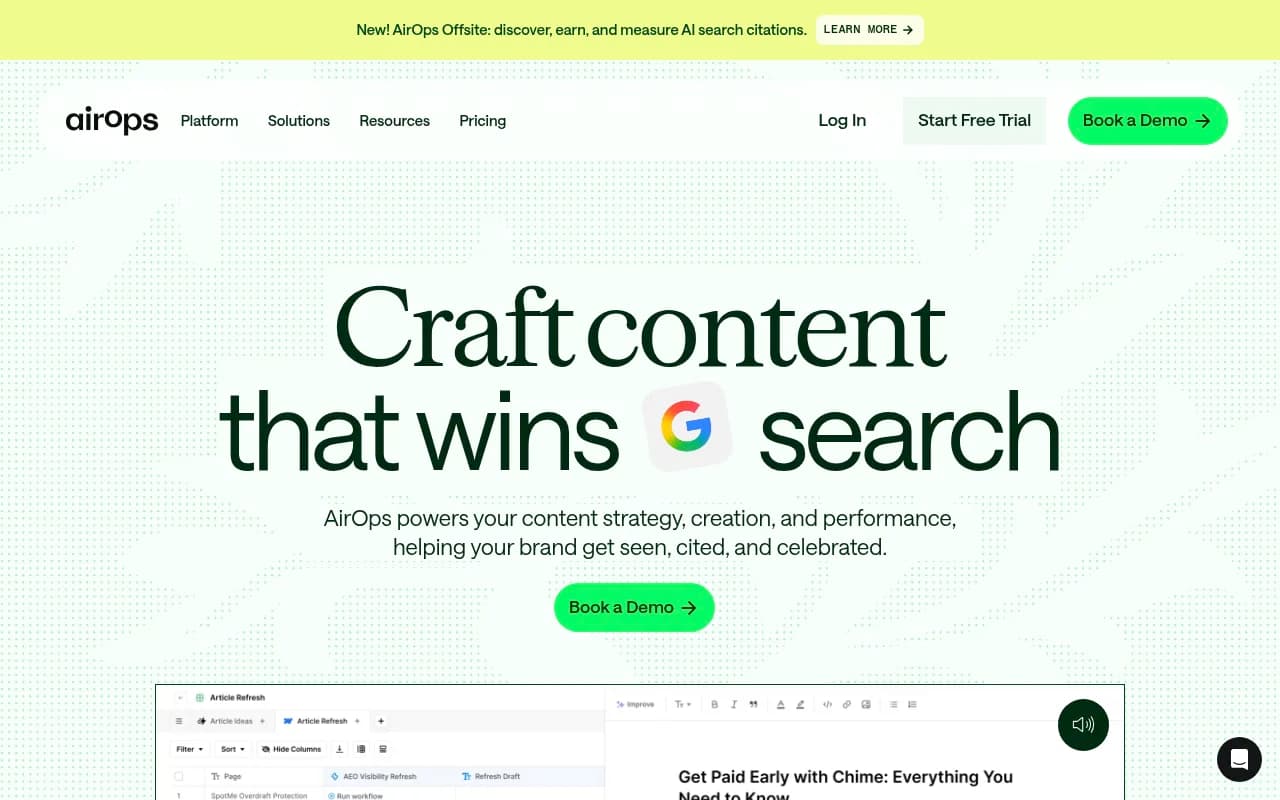
Where it shines is in teams that already have a content operation and want to systematize GEO into it. You can build custom pipelines that pull in competitor data, analyze citation patterns, and generate briefs or full drafts. It's more technical to set up than most tools on this list, but the output quality is high.
The tradeoff: it doesn't have the same depth of AI visibility monitoring as Promptwatch or Profound. You'll likely want to pair it with a dedicated tracking tool.
3. Profound — best for enterprise monitoring depth
Profound has strong brand recognition in the GEO space and genuine depth on the monitoring side. It tracks brand mentions across 9+ AI engines and gives enterprise teams detailed sentiment and positioning analysis.
Profound

For content teams, the most useful feature is its competitive benchmarking -- you can see how your brand is positioned relative to competitors in AI responses, which gives you a directional sense of where to focus content efforts.
The gap: Profound is primarily a monitoring platform. It doesn't generate content or provide the kind of specific prompt-level gap analysis that tells you exactly what to write. You'll get good data, but the "what do we do about it" question is still on you.
Pricing is on the higher end, making it better suited to enterprise marketing teams than smaller content operations.
4. Semrush — best for teams already in the Semrush ecosystem
Semrush has added AI search tracking capabilities to its existing platform, which makes it a convenient option if your team already lives in Semrush for traditional SEO.
The AI Overviews tracking and brand mention monitoring work reasonably well. The content tools (ContentShake AI, the Writing Assistant) are genuinely useful for SEO content creation. And the sheer breadth of keyword and competitive data available in Semrush gives content teams a lot to work with.
The limitation for GEO specifically: Semrush uses fixed prompts for AI monitoring, which means you're tracking a preset list rather than the actual questions your customers are asking. There's no AI traffic attribution either. It's a solid addition to an existing Semrush workflow, but not a purpose-built GEO platform.
5. AthenaHQ — best for narrative and sentiment monitoring
AthenaHQ focuses on how AI models describe and position your brand -- the tone, the narrative, the specific language used. For brands where perception matters as much as presence, this is genuinely valuable.

Content teams can use AthenaHQ to understand the gap between how they want their brand described and how AI models actually describe it. That's a useful brief for content strategy: if ChatGPT consistently positions you as "affordable" when you're trying to own "premium," you know what content needs to change.
The limitation is that AthenaHQ is monitoring-focused. It tells you what the narrative is, but doesn't help you create the content that would shift it.
6. Otterly.AI — best for quick visibility checks
Otterly.AI is a clean, accessible monitoring tool that's good for teams that want to get started with AI visibility tracking without a lot of setup or budget.
Otterly.AI

It tracks brand mentions across ChatGPT, Perplexity, and Google AI Overviews, and the interface is straightforward. For small teams or those just getting started with GEO, it's a reasonable entry point.
The honest assessment: Otterly.AI is monitoring-only. No crawler logs, no visitor analytics, no content generation. It's a good tool for understanding your current visibility, but content teams will quickly hit its ceiling when they want to act on what they find.
7. Surfer SEO — best for on-page content optimization
Surfer SEO isn't a GEO platform in the traditional sense, but it belongs on this list because it solves a real problem for content teams trying to rank in AI search: making sure your content is substantive enough to be cited.
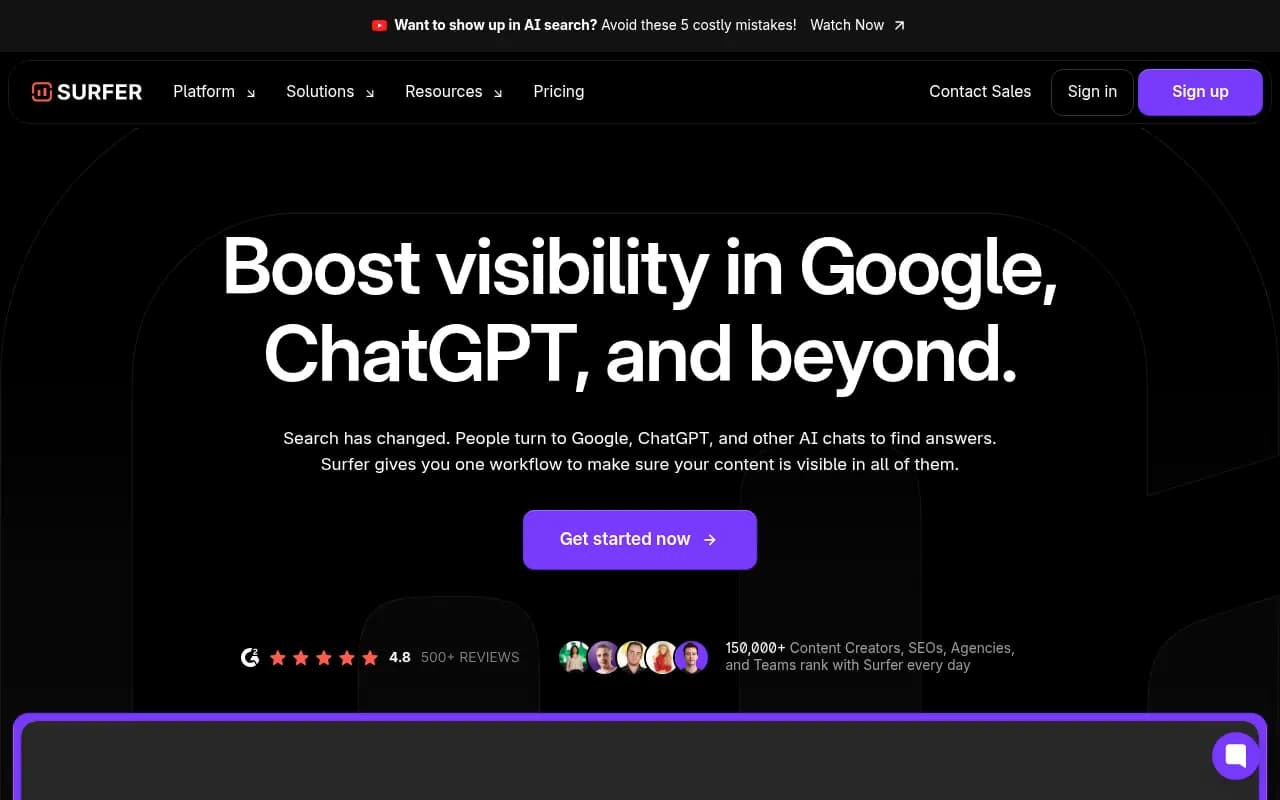
AI models cite content that comprehensively covers a topic. Surfer's content editor and SERP analyzer help you understand what depth and breadth a piece needs to be competitive. The NLP-based optimization has direct relevance to GEO because the signals that make content rank in Google (comprehensiveness, entity coverage, topical authority) also make content more likely to be cited by AI models.
Surfer won't tell you which AI prompts you're missing. But it will help you make the content you do create more citation-worthy.
8. Scrunch AI — best for influencer and source signal analysis
Scrunch AI takes a different angle: it analyzes which sources, influencers, and domains AI models are drawing from when they generate responses in your category.
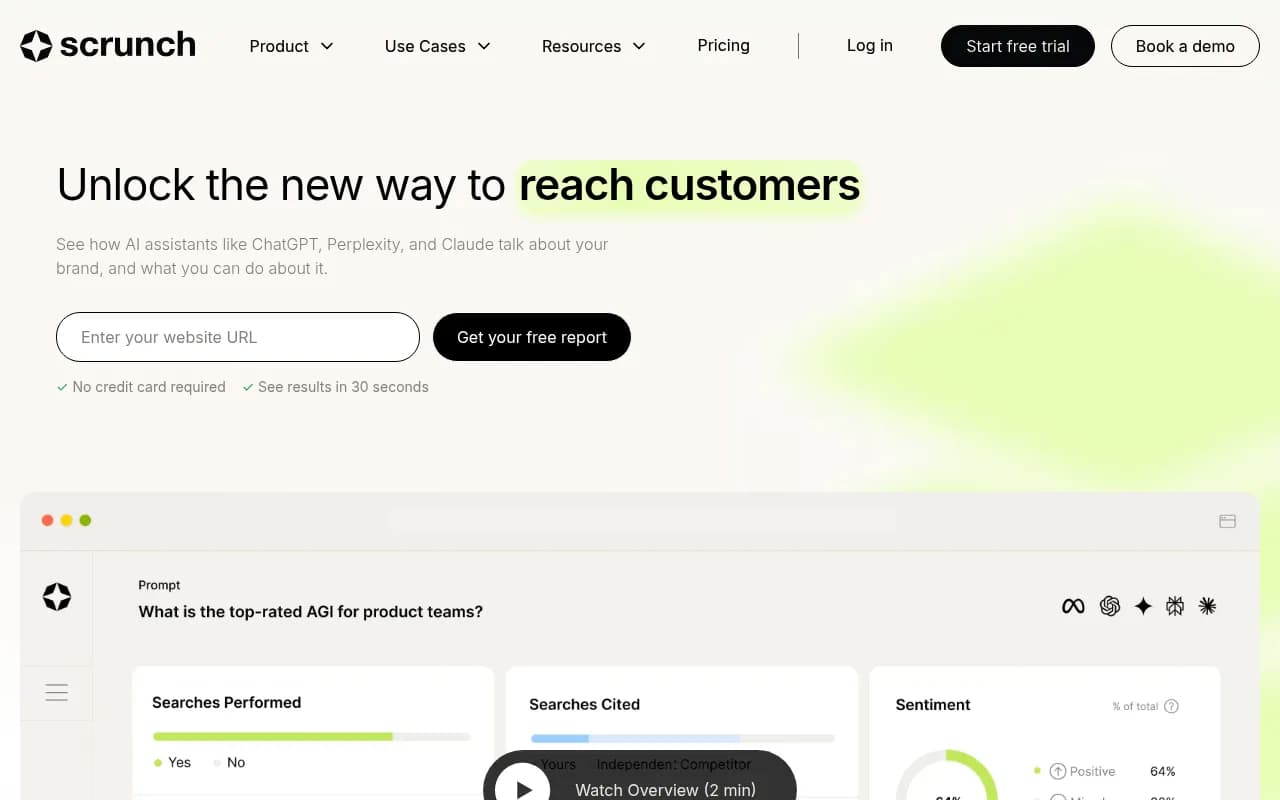
For content teams, this is useful for distribution strategy. If you know that ChatGPT heavily cites a specific set of industry publications when answering questions in your space, you know where to publish or earn coverage. It's a channel most GEO tools ignore entirely.
The tradeoff is that Scrunch is more of a research and intelligence tool than an optimization platform. It informs your strategy but doesn't execute it.
9. Search Atlas — best for teams wanting SEO and GEO in one place
Search Atlas combines traditional SEO automation with AI search optimization, and it's one of the more complete options for teams that don't want to manage separate tools for each.

The platform can fix, optimize, and publish content -- which puts it in a similar category to Promptwatch in terms of being action-oriented rather than monitoring-only. The AI content generation is solid, and the integration between keyword research, content creation, and tracking is tighter than most competitors.
Where it falls short compared to Promptwatch: the AI-specific features (citation tracking, crawler logs, prompt intelligence) aren't as deep. It's a strong all-rounder but not the most specialized GEO tool.
10. Peec AI — best for lightweight multi-model tracking
Peec AI tracks brand visibility across ChatGPT, Perplexity, and Claude, and it does so cleanly and affordably. For teams that need a simple way to monitor whether their brand is appearing across multiple AI models, it gets the job done.

Like Otterly.AI, Peec AI is monitoring-focused. There's no content generation, no gap analysis, no crawler logs. But the multi-model coverage is good, and the pricing is accessible for smaller teams.
Think of it as a pulse check tool -- useful for knowing where you stand, but you'll need other tools to actually improve your standing.
How these platforms compare
| Platform | Monitoring | Gap analysis | Content generation | Crawler logs | AI traffic attribution | Best for |
|---|---|---|---|---|---|---|
| Promptwatch | Yes (10 models) | Yes | Yes (AI writing agent) | Yes | Yes | Full GEO loop |
| AirOps | Limited | Partial | Yes (workflows) | No | No | Content engineering |
| Profound | Yes (9+ models) | Partial | No | No | No | Enterprise monitoring |
| Semrush | Yes (limited) | No | Yes (SEO-focused) | No | No | Existing Semrush users |
| AthenaHQ | Yes | No | No | No | No | Narrative/sentiment |
| Otterly.AI | Yes | No | No | No | No | Quick visibility checks |
| Surfer SEO | No | No | Yes (optimization) | No | No | Content quality |
| Scrunch AI | Yes | Partial | No | No | No | Source intelligence |
| Search Atlas | Yes | Partial | Yes | No | No | SEO + GEO combined |
| Peec AI | Yes (3 models) | No | No | No | No | Lightweight tracking |
The real divide: monitoring vs. optimization
Here's the thing most GEO tool comparisons don't say clearly enough: there's a fundamental split in this market between tools that monitor and tools that optimize.
Monitoring tools (Otterly.AI, Peec.ai, AthenaHQ, most of the lightweight trackers) are valuable. Knowing your visibility score is the starting point. But for a content team, the starting point isn't the destination.
The platforms that actually move the needle are the ones that close the loop -- that take you from "we're invisible for these 40 prompts" to "here's the content we need to create" to "here's proof that creating it improved our visibility."
That's a much shorter list. Promptwatch is the most complete version of it right now. AirOps and Search Atlas get partway there. Most others don't.
How to choose the right tool for your team
A few honest questions to help you decide:
Are you just getting started with GEO? Start with a monitoring tool to understand your baseline. Otterly.AI or Peec AI are fine entry points. Once you have data, you'll quickly realize you need something that helps you act on it.
Does your team already live in Semrush? Add the AI monitoring features and ContentShake AI. It won't be the most specialized GEO setup, but it's the lowest-friction path if you're already paying for Semrush.
Do you have a content team that needs to produce AI-optimized content at scale? Promptwatch is the most purpose-built option. The Answer Gap Analysis tells you what to write, the AI writing agent helps you write it, and the tracking closes the loop. AirOps is worth looking at if you want more workflow customization.
Are you an enterprise brand focused on narrative and positioning? Profound or AthenaHQ give you the monitoring depth you need. Just plan for the fact that you'll need a separate content process to act on what you find.
Do you want one tool that does both SEO and GEO reasonably well? Search Atlas is the most complete option in that category.
A note on the market in 2026
The GEO tool landscape is moving fast. New platforms are launching every few months, and existing ones are adding features quickly. A few things worth keeping in mind:
ChatGPT reached 900 million weekly users by February 2026. Google AI Overviews now appear on over 13% of all searches. The traffic implications are real and growing. Semrush research suggests LLM traffic will overtake traditional Google search by late 2028 -- which means the window for getting ahead of this is now, not later.
The brands that will win in AI search are the ones building content strategies around it today. The tools on this list are the best available right now for doing that. But the most important thing isn't which tool you pick -- it's whether you're actually using it to create content, not just to generate reports.
Data without action is just expensive anxiety.