Key takeaways
- National AI visibility scores hide the problem. A brand can look fine overall while half its locations never get named when someone asks ChatGPT for "a dentist near me".
- Only a few tools report per location. Yext Scout and BrightLocal's Local AI Visibility are built for it. Promptwatch handles it through local GEO/SEO targeting at exact coordinates.
- Cadence and prompt caps matter at scale. BrightLocal checks each location twice a month with up to 20 prompts, which is a real limit for big fleets.
- Listings and reviews feed AI answers, so reputation platforms like Birdeye, Uberall and SOCi belong in the stack even though they are not pure trackers.
- Pricing for the enterprise-grade options is mostly unpublished. Confirm everything on vendor sites before you budget.
Why multi-location brands need a different kind of tracker
Most AI visibility tools were built to answer one question: is my brand mentioned in ChatGPT? That works for a SaaS company with one website. It falls apart when you run 80 clinics, 300 franchise units or 1,200 retail stores.
The issue is that AI answers change with place. Ask Google AI Mode for a plumber and you get different businesses in Leeds than in Leicester. A brand-level score averages all of that into mush. You can't tell which locations are invisible, which competitors beat you in which city, or whether the problem is the location's listing, its reviews, or its landing page.
A second wrinkle: a location is almost never alone in an answer. Promptwatch Data found that 47.6% of ChatGPT responses with citations cite 10 or more domains (Sep 28 to Oct 4, 2026), and only 6% cite three or fewer. So tracking whether you were mentioned is the weakest metric. Position, sentiment and who gets co-cited matter more, and you need enough prompts per location to see a pattern, because one prompt tells you very little.
There is also a content angle. In the same period, Promptwatch's content type data shows product pages at 22.4% of ChatGPT citations and landing pages at 16.8%. For branded prompts, reviews climb to 5.6% and social posts to 3.0%. For a local brand, that points at location landing pages, FAQs and reviews as the assets that get read.
What to look for before you buy
Skip the feature checklist for a second and ask these questions:
- Does it report per location, or just per brand with a country filter?
- Can it simulate the query from a real place, not just add a city name to the prompt?
- Which engines does it cover? Some tools skip Gemini, Perplexity or Copilot.
- How often are locations checked, and how many prompts per location?
- Does it show which sources the AI cited, so you know whether to fix a listing, a review profile or a page?
- What happens after the report? Some tools only measure. Others send work to agents or teams.
Comparison table
| Tool | Best for | Per-location reporting | Engines | Pricing |
|---|---|---|---|---|
| Promptwatch | Measuring and fixing local AI visibility | Exact-coordinate monitors | ChatGPT, AI Overviews, AI Mode, Gemini, Perplexity, Copilot and more | From $95/mo, local targeting on Business ($579/mo) |
| Yext Scout | Enterprise location networks | Yes, location by location | Google, Maps, AI Overviews, ChatGPT, Gemini, Claude, Perplexity | Not published |
| BrightLocal | Local SEO teams who want a built-in tracker | Yes, 0-100 score per location | ChatGPT, AI Mode, AI Overviews | From $31/mo annual |
| Birdeye | Reviews and listings that AI reads | Indirect | Indirect | Custom |
| Uberall | Listings and local search at scale | Location-level listings | Limited AI coverage | Custom |
| SOCi | Franchise marketing automation | Location-level marketing | Varies | Custom |
| Chatmeter | Multi-location reputation and search | Yes | Varies | Custom |
| Semrush Local | Local SEO automation | Listings and local rank | Add-on AI toolkit | Custom |
| Local Falcon | Geo-grid map rankings | Grid-based | Maps-focused | Subscription |
| Whitespark | Citations and local rankings | Listings and local rank | Limited | Subscription |
Pricing and coverage change fast. Confirm each vendor's current numbers before committing.
The 10 tools
1. Promptwatch
Promptwatch is the one on this list that goes from measurement to fixing, and it is the pick we would start with if local AI visibility is a revenue question rather than a reporting one. Its local GEO/SEO targeting lets you pin a monitor to exact coordinates (accuracy radius from 20 m to 5 km), so ChatGPT, Google AI Overviews and Google AI Mode answer as if asked from that spot. That suits "near me" queries for stores, offices, franchises and multi-location brands. State and city tracking comes with Business, and it is also in the REST API and MCP.

What separates it from a pure tracker: IP-verified AI crawler logs show whether bots can even read your location pages, the Action Board lists what to fix, and the Content Agent can draft and publish pages to WordPress, Webflow or Framer. Agency plans (Kick-off $199/mo up to Scale $799/mo) include local targeting on Scale and unlimited projects, which helps if you manage many brands. Local targeting at exact coordinates is on Business, Agency Scale and Enterprise, so check pricing at promptwatch.com/pricing.
Honest caveat: it is not a listings manager. You still need something to push accurate NAP data to directories.
2. Yext Scout
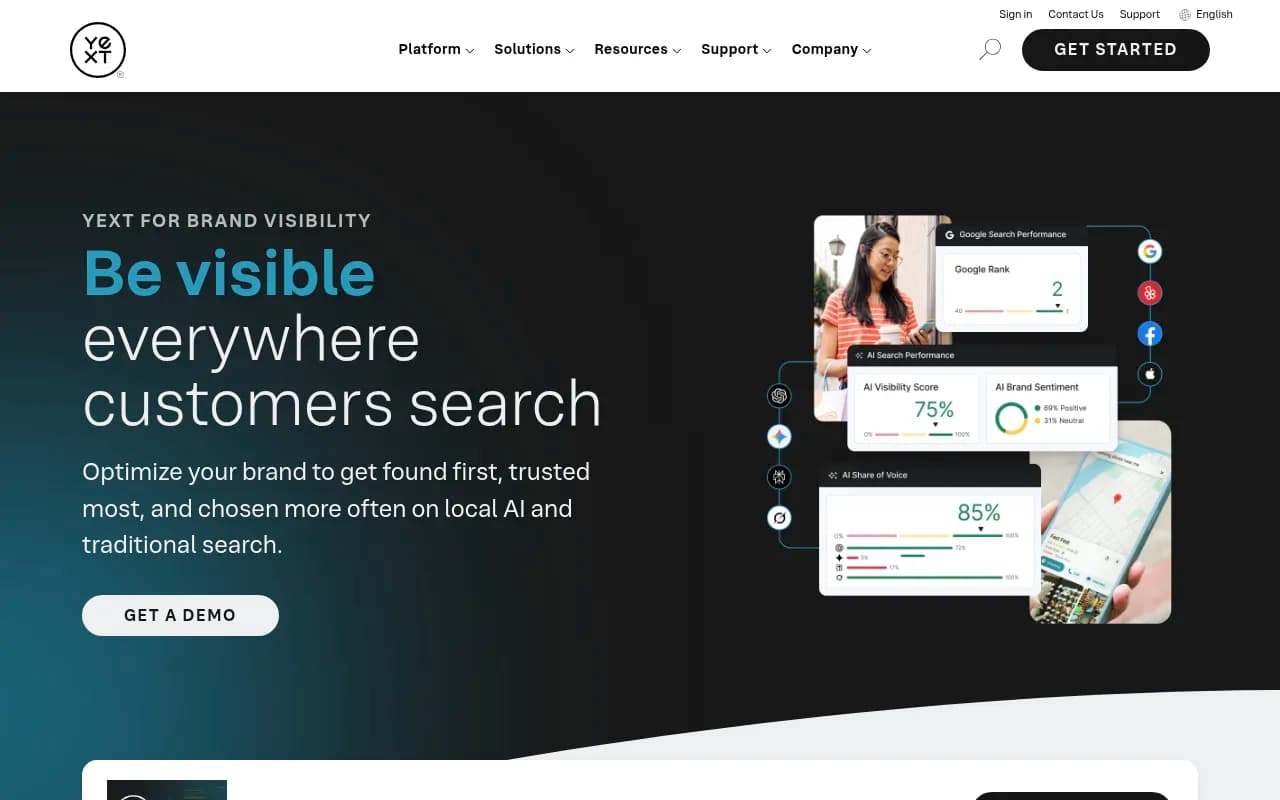
Scout is the most purpose-built option for big location networks. Per Zapier's review, it breaks AI brand monitoring down by location, includes a map of how much visibility each location has in high-intent searches, and benchmarks you against your 20 closest competitors per scan. It also does sentiment analysis and citation tracking.
Two things to know. First, the action agents need the rest of the Yext platform, so it is an all-in decision. Second, pricing is by request. Zapier cites third-party information suggesting at least $199 a month, but that is unconfirmed, so treat it as a rough floor. Yext also opened Scout data to partners with an MCP and API launch on May 18, 2026. A DigiJaws review rates it 3.5/5.
If you run a handful of sites, Scout is probably more than you need.
3. BrightLocal Local AI Visibility
BrightLocal announced its Local AI Visibility tracker on September 10, 2026. It covers ChatGPT, Google AI Mode and Google AI Overviews, and gives each location a 0-100 score, broken down by platform and by prompt. Metrics include mentions, sources, share of voice, average position and recommended actions.
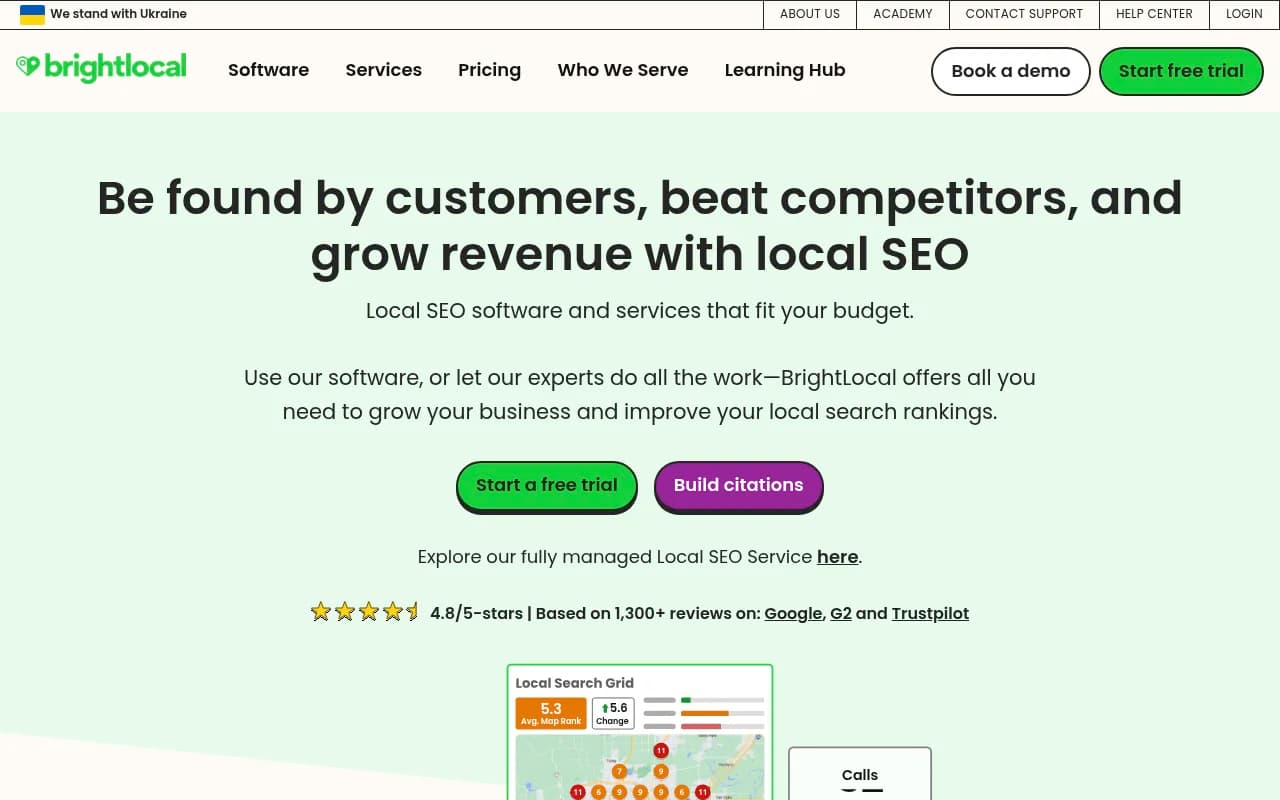
It is included at no extra cost on Track, Manage and Grow plans, with plans starting from $31 a month billed annually. That makes it by far the cheapest way into per-location tracking. The tradeoffs are real though: up to 20 prompts per location, checked twice a month, and no Gemini, Perplexity, Copilot or Grok. It is also only on the new BrightLocal platform. For a 15-location regional chain it is great value. For 500 locations that need weekly movement data, you will feel the cap.
4. Birdeye
Birdeye is not a tracker first. Data-mania picks it as best for multi-location brands because it cleans up the reviews and listings AI systems read for local and service answers. Its AI visibility coverage is indirect.
Use it when your diagnosis is "our review profile is thin" rather than "we can't see where we stand". Pricing is custom.
5. Uberall
Uberall is a multi-location marketing platform for listings and local search visibility, now pitched around AI search too. Treat it as the foundation layer: accurate listings across maps, directories and apps give AI engines consistent facts to pull.
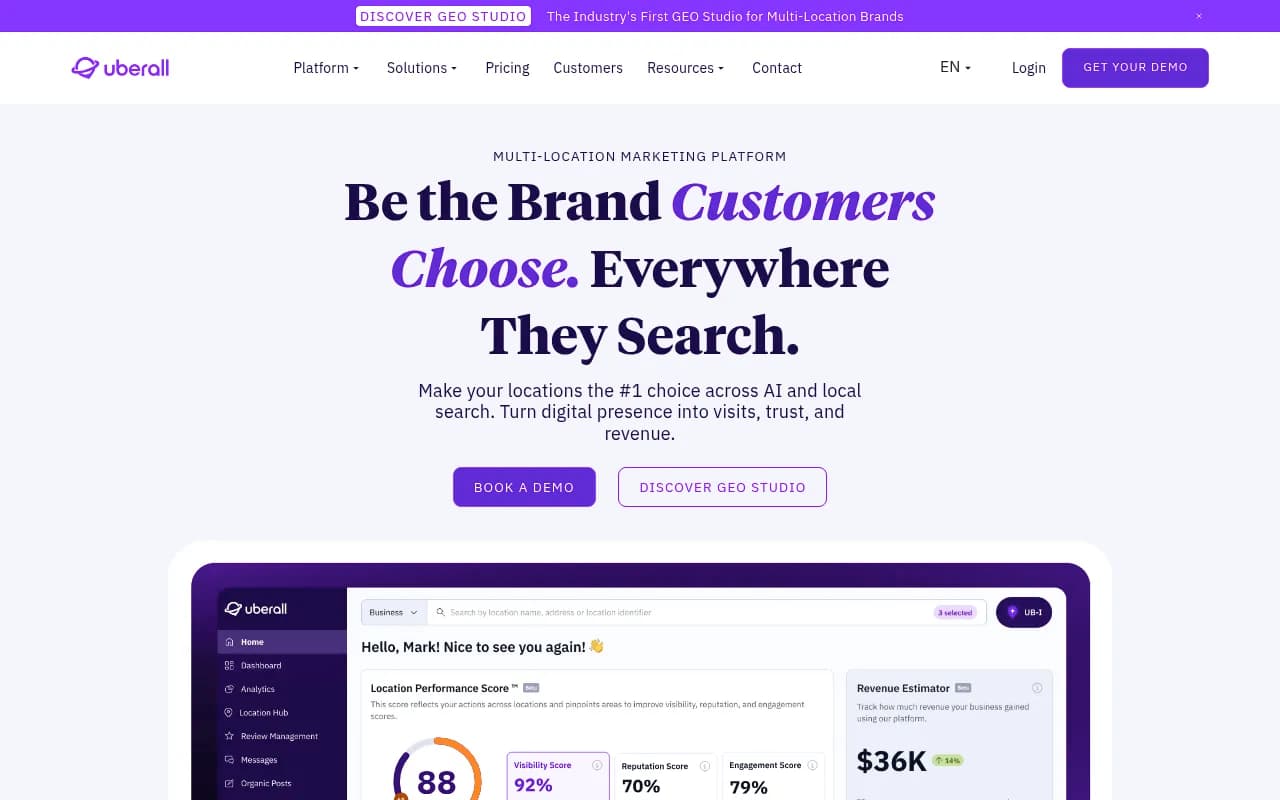
Pair it with a dedicated tracker if you want proof that listing fixes change AI answers.
6. SOCi
SOCi focuses on AI-powered local marketing automation for franchises and multi-location brands. It suits organizations where corporate sets strategy and local operators execute, since it handles listings, reviews and social in one place.
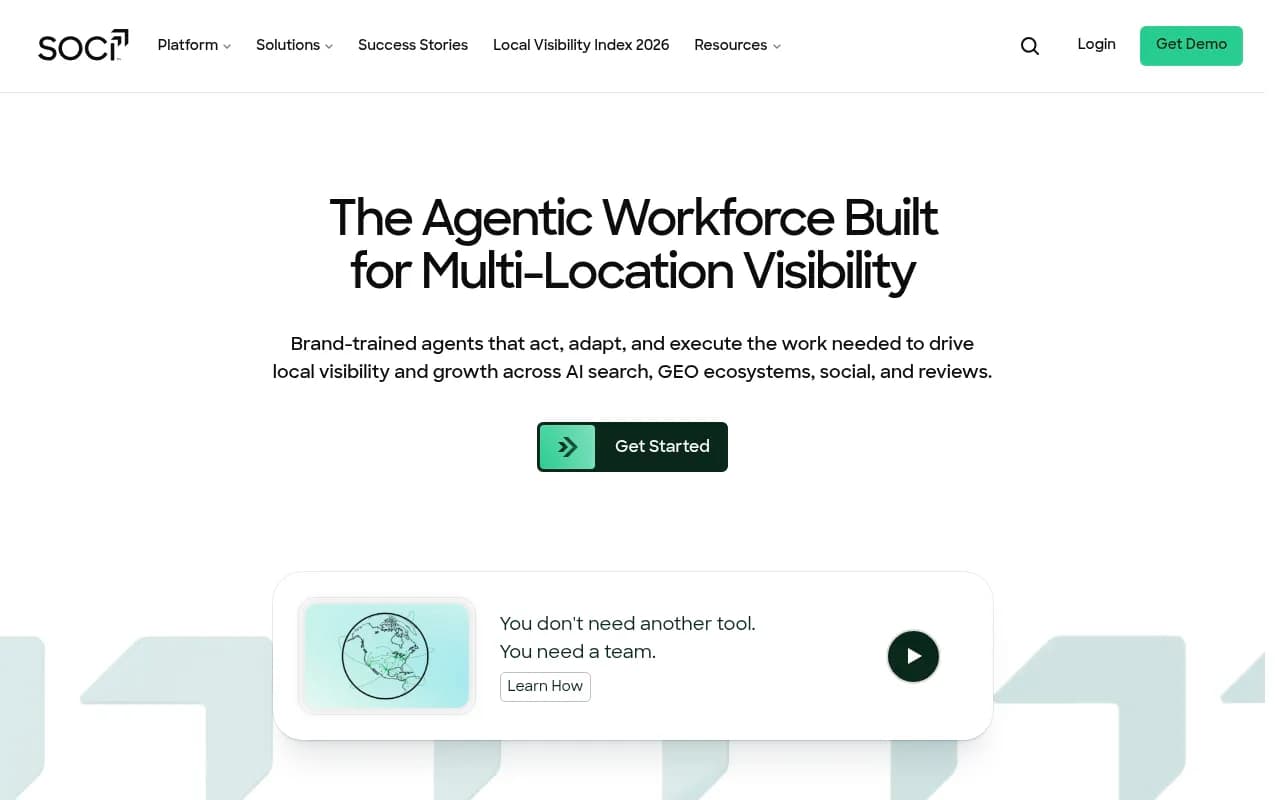
We did not verify its AI tracking depth or pricing, so ask for a demo that shows per-location AI answers specifically.
7. Chatmeter
Chatmeter positions itself as multi-location reputation and search visibility AI. Its strength is rolling reviews, rankings and local search data up and down a location hierarchy, which matches how franchise brands actually report.
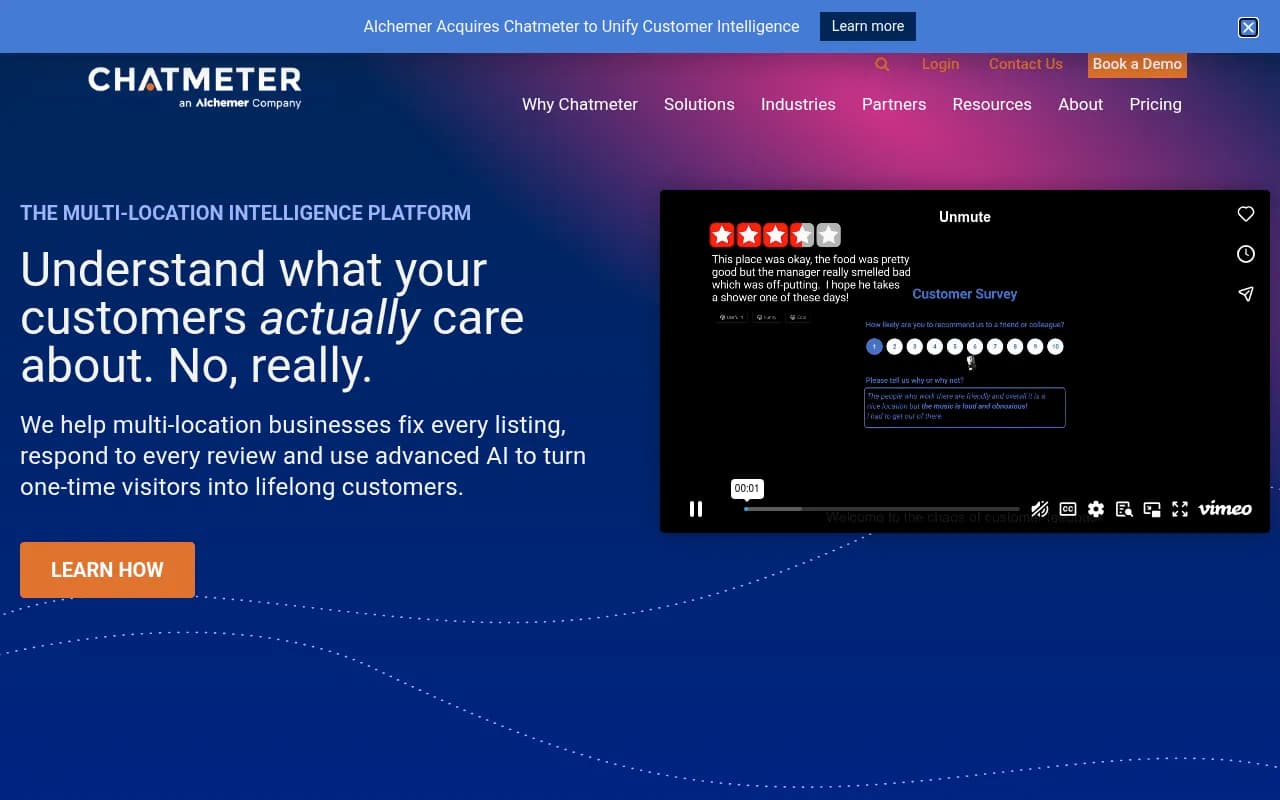
Again, verify how deep its generative engine coverage goes before assuming it replaces a dedicated AI tracker.
8. Semrush Local
Semrush Local automates local SEO for businesses and agencies, and Semrush sells a separate AI Visibility Toolkit at $99 a month standalone. Data-mania ranks the toolkit best overall for engine coverage and prompt research, but local awareness is not listed for it.
If your team already lives in Semrush, it is a natural add-on. Just don't assume the AI toolkit reports by location.
9. Local Falcon
Local Falcon gives you visual geo-grid rank tracking, the classic map view of where a business ranks across a city. It is Maps-focused rather than a generative engine tracker, but the grid view is useful context because Google Maps rankings and Google's AI answers often draw on the same business signals.
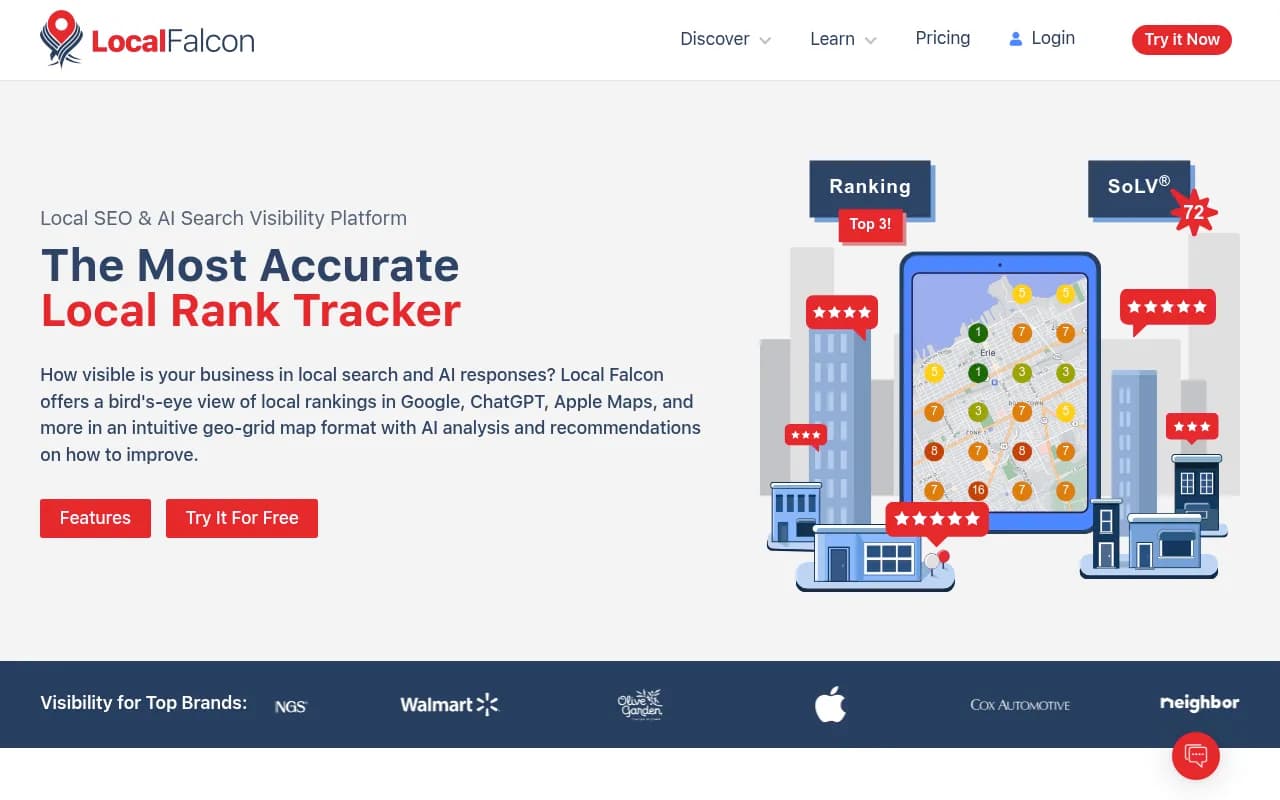
Think of it as the old-school local layer that sits next to your AI tracking.
10. Whitespark
Whitespark is a long-standing local SEO toolkit for citations and local rankings. It earns a slot because citation consistency is still one of the cheaper wins for local visibility, and AI answers lean on the same directories.
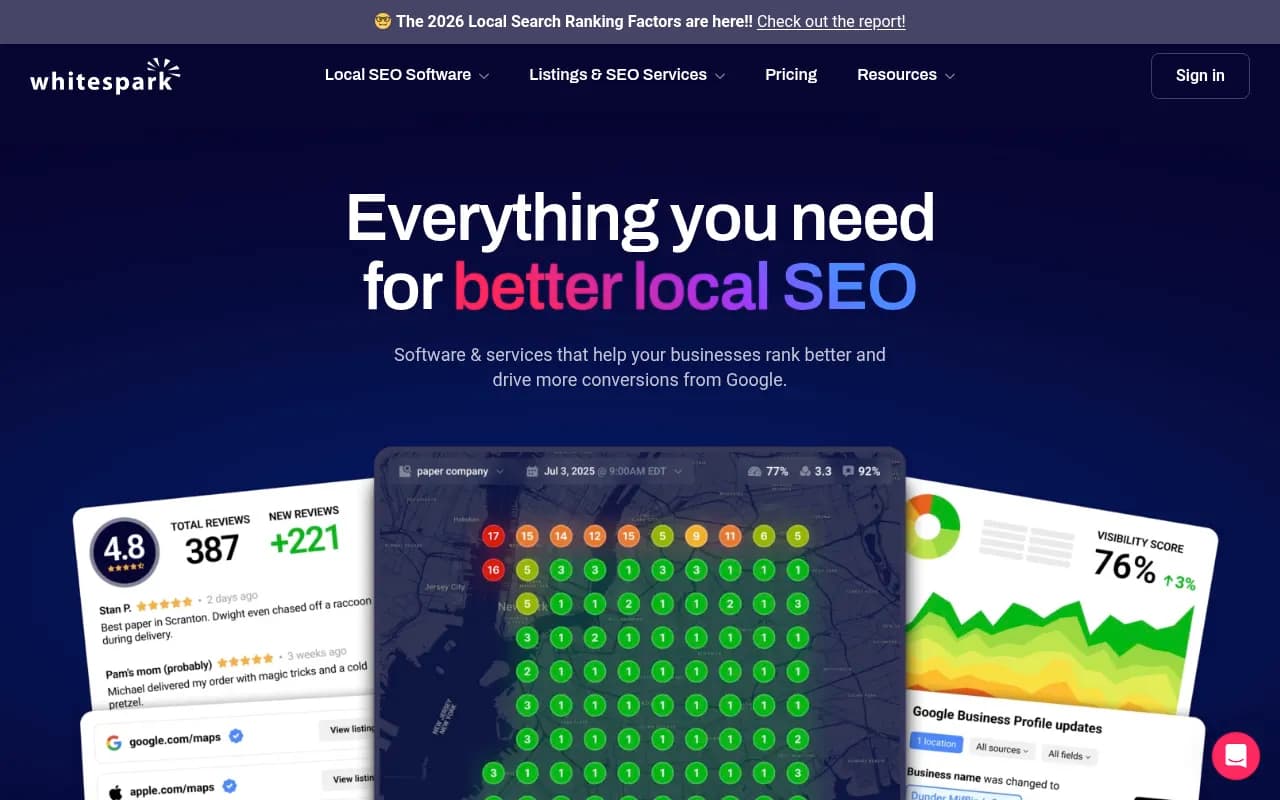
It will not tell you what ChatGPT says about a location, so use it for the fix, not the measurement.
Which one fits which situation
Here is the honest version of a decision tree.
- You want to measure and act, across ChatGPT, AI Overviews and AI Mode at exact locations: start with Promptwatch.
- You have hundreds or thousands of locations and already use Yext: Scout.
- You are a local SEO team with under about 50 locations and a tight budget: BrightLocal.
- Your AI answers cite thin reviews or wrong listings: Birdeye, Uberall, SOCi, Whitespark.
- You want a map-style view of local rankings alongside AI data: Local Falcon.
One generic option worth a mention: if you only need a rough national read first, HubSpot's free AI Search Grader gives a one-time snapshot with no account, though it has no local awareness. Lighthouse Local's own comparison also lists LLMrefs and Nightwatch with country and language or local rank tracking, which may be enough for smaller brands. Browse more options in the GEO software directory at bestgeosoftware.com.
How to run a local AI visibility test
- Pick 10 to 20 representative locations: some strong, some weak, some in competitive metros.
- Write 15 to 20 prompts per location in the phrasing people use: "best urgent care in [city]", "service + city", plus branded prompts like "is [brand] in [neighborhood] any good".
- Track from the actual place, not only the city name in the prompt. Coordinates or per-location reporting beat text tricks.
- Record position, sentiment and which competitors and sources are co-cited, not just yes or no mentions.
- Compare against listing accuracy, review count and the location landing page. The gap usually shows up there.
- Re-run on a schedule. AI answers drift, so one snapshot is a trap.
A caveat on query behavior: Promptwatch Data's ChatGPT query fanout report shows average query length falling from about 117 characters in December to about 53 characters in April, with searches per response varying across the period. The practical read: short, keyword-like headings that put the service and city up front are a safe bet for location pages. Check the report's dates before leaning on any single figure.
BrightLocal's own consumer research found that 75% of consumers used more than one channel in their most recent local search and 23% used AI during it. That is the vendor's data, but it matches the direction: AI is one channel among several, not a replacement for Maps and listings.
Common mistakes
- Averaging everything into one brand score and calling it done.
- Tracking too few prompts per location, so noise looks like signal.
- Ignoring crawlability. If AI bots hit errors on location pages, no tracker will fix that for you.
- Treating listing tools and AI trackers as interchangeable. They solve different halves of the problem.
- Trusting unverified pricing. Several tools here quote on request, so get written numbers for your location count.
Wrapping up
Start by deciding whether your gap is visibility data, content, or listings and reviews. For most multi-location brands the answer is some of each, which means two tools: one tracker that reports per location, and one platform keeping the underlying business data clean. Promptwatch and BrightLocal cover the tracking side at very different scales, Yext Scout covers the enterprise end, and the rest handle the foundations AI engines read. Pilot on 10 locations before you roll out to the fleet.