Summary
- Optimize money pages first: Revenue-driving pages (product pages, service descriptions, pricing) get cited more often than blog posts in AI responses
- Build structured, citation-worthy content: AI models prefer clear, factual content with specific data points, comparisons, and technical details
- Track what's working: Use visibility tracking tools to see which prompts mention your brand, which competitors dominate, and where gaps exist
- Fix technical barriers: AI crawlers need clean HTML, fast load times, and proper rendering—JavaScript-heavy sites often get skipped
- Create content for AI intent: Write for how people actually prompt AI assistants, not just how they search Google
Your brand is being discussed in ChatGPT conversations right now. Someone just asked "What's the best project management software for remote teams?" or "Which CRM should I choose for my startup?" The question is: does your brand show up in those responses?
According to recent data, shoppers complete purchases 47% faster when assisted by AI. If your brand isn't mentioned in ChatGPT, Claude, Gemini, or Perplexity for relevant searches, you're missing a massive channel. This isn't about vanity metrics—it's about being present when buying decisions happen, often before potential customers ever visit your website.
The frustrating part? You might be doing everything "right" in traditional SEO. You have a solid website, you're producing content, you're optimizing for search. But your competitors keep showing up in AI responses while you don't.
The truth is that AI visibility requires a different playbook. Here are 15 ways to get your brand mentioned more often in ChatGPT and other AI assistants.
1. Prioritize your money pages over blog content
Most brands make a critical mistake: they focus all their optimization efforts on blog posts and informational content, while neglecting the pages that actually drive revenue.

AI models cite product pages, service descriptions, pricing pages, and comparison pages more frequently than generic blog posts when answering buying-intent prompts. Why? Because these pages contain the specific, factual information AI assistants need to make recommendations.
If someone asks ChatGPT "What's the best email marketing platform for small businesses?", the model wants to cite pages that clearly explain features, pricing, use cases, and differentiators—not a 2,000-word blog post about email marketing trends.
Start by auditing your money pages:
- Do they clearly explain what you do and who it's for?
- Are features and benefits listed in scannable formats (bullet points, tables)?
- Is pricing transparent and easy to find?
- Do you include specific use cases and customer types?
- Are technical specifications documented?
These pages need to be citation-worthy: clear, factual, and structured in a way that AI models can extract and reference.
2. Write content that answers specific prompts
Google search and AI prompts are fundamentally different. Someone searching Google might type "project management software". That same person asking ChatGPT will say "I need project management software for a 15-person design team that integrates with Figma and doesn't require a lot of setup. What should I use?"
AI prompts are conversational, specific, and intent-rich. Your content needs to match that specificity.
Create content that directly answers these detailed questions:
- "Best [your category] for [specific use case]"
- "[Your product] vs [competitor] for [specific scenario]"
- "How to [accomplish goal] using [your product]"
- "[Your product] pricing and features explained"
Don't write generic "ultimate guides". Write targeted content that addresses the exact questions your potential customers ask AI assistants. Tools like Promptwatch can show you which prompts competitors rank for but you don't—those are your content gaps.

3. Build comparison and alternative pages
When someone asks ChatGPT "What are alternatives to [competitor]?", you want your brand in that response. Comparison content is one of the highest-intent content types for AI visibility.
Create dedicated pages comparing your product to competitors:
- "[Your brand] vs [Competitor A]"
- "Best alternatives to [major competitor]"
- "[Competitor] alternatives for [specific use case]"
Be honest and specific. AI models favor balanced comparisons that acknowledge trade-offs. Don't just say you're better—explain why and for whom. Include concrete details: pricing differences, feature comparisons, ideal customer profiles, integration capabilities.
| Comparison element | What to include |
|---|---|
| Pricing | Exact tier prices, what's included at each level |
| Features | Side-by-side feature matrix with checkmarks |
| Use cases | Specific scenarios where each tool excels |
| Integrations | List of supported platforms and APIs |
| Limitations | Honest assessment of what each tool doesn't do well |
This structured, factual approach makes your content citation-worthy.
4. Make your site crawlable by AI bots
AI models can't cite content they can't read. If your site is built with heavy JavaScript frameworks and doesn't render properly for crawlers, you're invisible.
Check if AI crawlers can access your content:
- Monitor your server logs for ChatGPT-User, Claude-Web, PerplexityBot, and GoogleOther (AI Overviews crawler)
- Use tools that track AI crawler activity and identify pages they're hitting—or missing
- Test your pages in text-only browsers to see what crawlers actually see
Common technical barriers:
- JavaScript-rendered content that doesn't have server-side rendering or pre-rendering
- Slow load times (AI crawlers have limited patience)
- Broken internal links or redirect chains
- Content hidden behind login walls or paywalls
- Robots.txt rules that block AI crawlers
If you're running a modern JavaScript framework (React, Vue, Next.js), make sure you have proper server-side rendering or use a pre-rendering service. AI crawlers need clean HTML, not JavaScript that needs to execute.
[tool:promptwatch] includes AI crawler log monitoring so you can see exactly which pages AI models are reading—and which they're skipping.
5. Add structured data and schema markup
AI models love structured data. Schema markup helps them understand what your content is about and extract specific facts more easily.
Prioritize these schema types:
- Product schema: Name, description, price, availability, reviews, ratings
- Organization schema: Company name, logo, contact info, social profiles
- FAQ schema: Questions and answers in a machine-readable format
- HowTo schema: Step-by-step instructions for processes
- Review schema: Customer reviews and ratings
Structured data doesn't guarantee citations, but it makes your content easier for AI models to parse and reference. It's the difference between a model having to interpret your prose versus pulling clean, labeled data.
Test your schema implementation with Google's Rich Results Test and Schema.org validators.
6. Create detailed FAQ sections
FAQ content is perfect for AI citations because it's already in question-and-answer format—exactly how people prompt AI assistants.
Build comprehensive FAQ pages that answer:
- Common objections ("Is [your product] worth the price?")
- Feature questions ("Does [your product] integrate with [popular tool]?")
- Use case questions ("Can I use [your product] for [specific scenario]?")
- Comparison questions ("How is [your product] different from [competitor]?")
- Technical questions ("What are the system requirements for [your product]?")
Keep answers concise but complete. AI models prefer responses that directly answer the question in 2-3 sentences, then optionally provide more detail.
Use FAQ schema markup to make these questions and answers machine-readable.
7. Publish case studies with specific metrics
AI models cite case studies when answering prompts about results and ROI. But generic case studies don't cut it—you need specific, quantifiable outcomes.
Strong case studies include:
- Exact metrics ("increased conversion rate by 34%", not "significantly improved conversions")
- Timeline ("within 3 months of implementation")
- Starting point and ending point ("from 2% to 2.68% conversion rate")
- Specific use case ("for a B2B SaaS company selling to mid-market enterprises")
- Challenges faced and how your product solved them
When someone asks ChatGPT "What results can I expect from [your category]?", case studies with hard numbers are what get cited.
8. Build topical authority in your niche
AI models favor brands that demonstrate deep expertise in a specific domain. Publishing one great article isn't enough—you need a cluster of related content that establishes you as an authority.
Create content clusters around your core topics:
- Main pillar page covering the broad topic
- 8-12 supporting articles diving deep into subtopics
- Internal links connecting related content
- Consistent terminology and definitions across all content
For example, if you're a CRM platform, your cluster might include:
- Main: "Complete Guide to CRM for Small Businesses"
- Supporting: "CRM Implementation Checklist", "How to Migrate from Spreadsheets to CRM", "CRM Integrations Explained", "CRM Pricing Models Compared", etc.
This depth signals to AI models that you're a credible source worth citing.
9. Track your AI visibility systematically
You can't improve what you don't measure. Set up systematic tracking of how often your brand appears in AI responses.
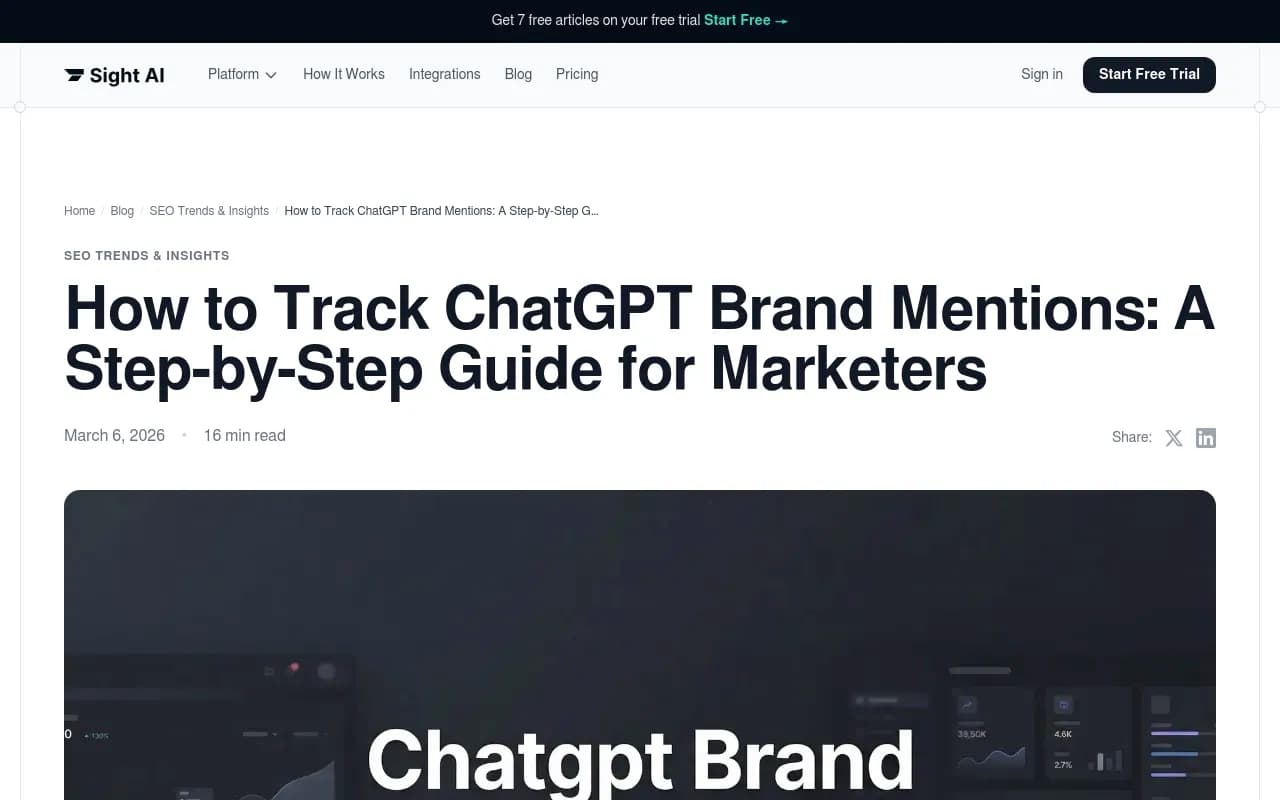
Start by defining your tracking parameters:
- List all brand name variations (official name, abbreviations, common misspellings)
- Document your product names separately
- Identify 5-7 direct competitors to track alongside your brand
- Create a list of 20-50 core prompts relevant to your business
Then track:
- Which prompts mention your brand vs competitors
- Position in the response (first mention, middle, or end)
- Context of mentions (positive recommendation, alternative option, or neutral reference)
- Which AI models cite you most often
Tools like Promptwatch automate this tracking across ChatGPT, Claude, Gemini, Perplexity, and other AI models. You can see exactly which prompts you're visible for, where competitors beat you, and which content gaps to fill.

Otterly.AI

10. Optimize for Reddit and community discussions
AI models frequently cite Reddit threads, Quora answers, and other community discussions when answering questions. If your brand is mentioned positively in these spaces, those mentions can flow through to AI responses.
Strategies that work:
- Participate authentically in relevant subreddits (don't spam)
- Answer questions on Quora with detailed, helpful responses that naturally mention your product
- Engage in industry forums and communities
- Encourage satisfied customers to share their experiences in relevant communities
The key word is authentic. AI models (and community moderators) can spot promotional spam. Focus on being genuinely helpful, and mentions of your brand will follow naturally.
Some visibility tracking platforms monitor Reddit and YouTube discussions that influence AI recommendations—a channel most brands completely ignore.
11. Make your pricing transparent and easy to find
One of the most common prompts to AI assistants is "How much does [product] cost?" If your pricing isn't clearly documented on your website, AI models will either skip you or cite outdated information.
Create a dedicated pricing page that includes:
- Exact prices for each tier (not "contact us for pricing")
- What's included at each price point
- Annual vs monthly pricing
- Any additional fees or add-on costs
- Free trial details if applicable
- Comparison of tiers in a table format
If you have complex or custom pricing, at least provide starting prices and typical ranges. "Enterprise pricing available upon request" is fine for your highest tier, but don't hide all pricing behind forms.
12. Build backlinks from authoritative sources
AI models consider the authority and credibility of sources they cite. Backlinks from high-authority domains signal that your content is trustworthy.
Focus on:
- Industry publications and trade journals
- Educational institutions (.edu domains)
- Government resources (.gov domains)
- Well-established industry blogs and news sites
- Research papers and whitepapers that cite your data
Quality matters far more than quantity. One link from a respected industry publication is worth more than 100 links from random blogs.
Create linkable assets:
- Original research and data
- Industry reports and surveys
- Interactive tools and calculators
- Comprehensive guides that become go-to resources
When authoritative sites link to you, AI models take notice.
13. Update and maintain your content regularly
AI models favor fresh, up-to-date content. A comprehensive guide from 2022 will lose visibility to a recently updated guide from 2026.
Set up a content maintenance schedule:
- Review top-performing content quarterly
- Update statistics, examples, and screenshots
- Add new sections covering recent developments
- Remove outdated information and broken links
- Update publication dates to reflect the refresh
This is especially important for comparison content, pricing information, and feature lists—areas that change frequently.
AI crawlers notice when content is updated. Regular refreshes signal that your information is current and reliable.
14. Create content in multiple formats
AI models pull from diverse sources: text articles, videos, podcasts, PDFs, presentations. Repurposing your content into multiple formats increases your chances of being cited.
From one core piece of content, create:
- Written article or guide
- YouTube video covering the same topic
- Podcast episode or audio version
- SlideShare or PDF presentation
- Infographic summarizing key points
- Social media posts highlighting specific insights
Each format reaches different AI training data and citation sources. A YouTube video might get cited when someone asks ChatGPT for video recommendations. A PDF guide might get referenced when someone needs downloadable resources.
15. Monitor and respond to how AI describes your brand
Once you start appearing in AI responses, pay attention to how you're being described. Are the descriptions accurate? Are there misconceptions? Is outdated information being repeated?
Set up monitoring to track:
- How AI models describe your product or service
- Which features they emphasize
- How they position you vs competitors
- Any factual errors or outdated information
If you notice consistent inaccuracies, the issue is likely on your website. AI models are pulling incorrect information from somewhere—often from outdated pages, unclear descriptions, or conflicting information across different pages.
Fix these issues at the source:
- Update your website content to be clear and consistent
- Remove or redirect outdated pages
- Ensure your most important pages are easily crawlable
- Use structured data to provide authoritative information
Tools that track AI visibility can show you exactly what AI models are saying about your brand, making it easier to spot and fix issues.
Comparison: AI visibility tracking tools
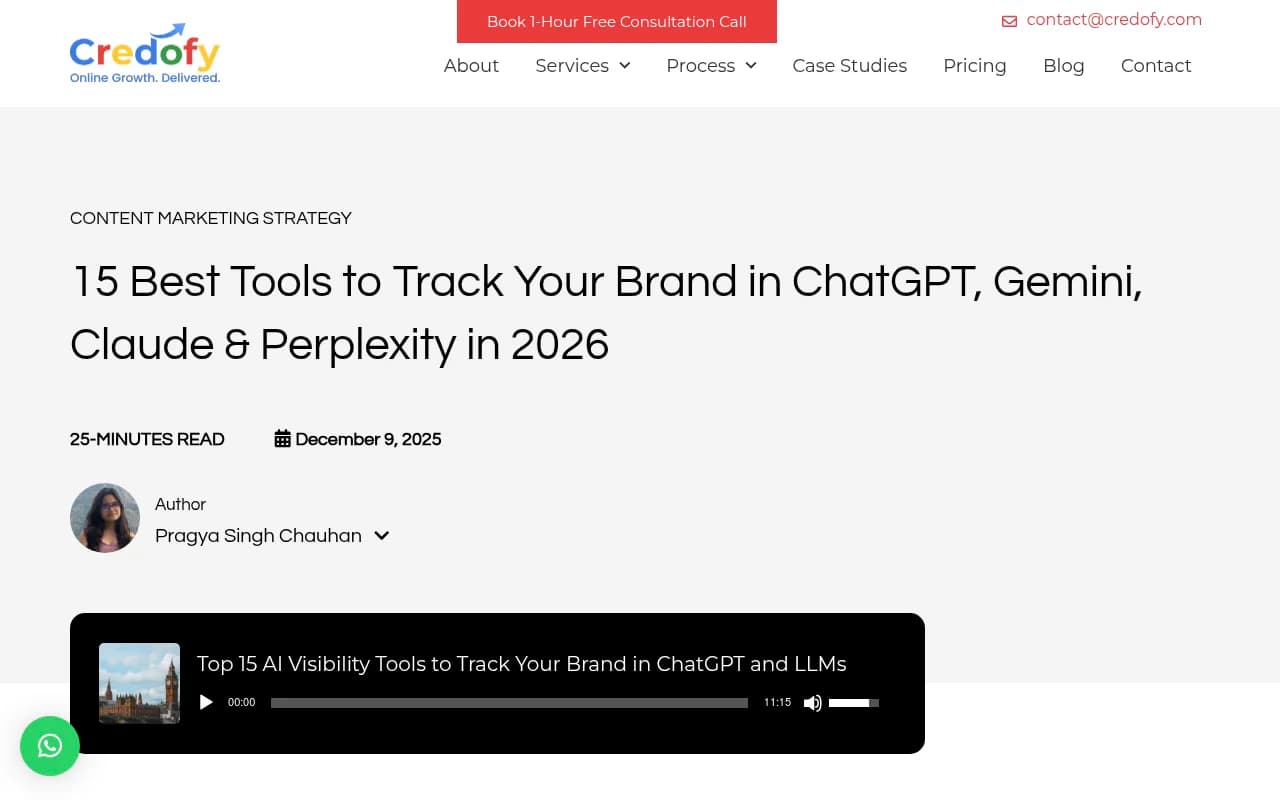
If you're serious about improving your brand's presence in AI responses, you need systematic tracking. Here's how the main approaches compare:
| Approach | Pros | Cons | Best for |
|---|---|---|---|
| Manual tracking | Free, full control | Time-consuming, inconsistent, limited scale | Testing the concept |
| Monitoring-only tools | Shows you the data | No actionable insights, no content creation help | Basic awareness |
| Full optimization platforms | Tracks visibility, identifies gaps, helps create content | Higher cost | Brands serious about AI visibility |
Promptwatch falls into the third category—it's built around the action loop of finding gaps, creating content that ranks in AI, and tracking results. Most competitors stop at monitoring.
The bottom line
Getting your brand mentioned in ChatGPT responses isn't about gaming the system or tricking AI models. It's about creating the kind of clear, factual, well-structured content that AI assistants want to cite when answering user questions.
Start with your money pages—the product pages, service descriptions, and pricing pages that drive revenue. Make them citation-worthy. Then build out comparison content, FAQs, case studies, and topical authority clusters.
Fix the technical barriers that prevent AI crawlers from reading your content. Add structured data. Keep content fresh and up-to-date.
Most importantly, track what's working. You can't optimize for AI visibility if you don't know which prompts mention your brand, which competitors dominate, and where your content gaps are.
The brands that win in AI search are the ones that treat it as a systematic optimization challenge, not a mystery. Build citation-worthy content, make it crawlable, and measure your progress.