Key takeaways
- Peec AI is a solid starting point for AI search visibility, but it has real gaps: no crawler log monitoring, single-domain limits, and no built-in content optimization.
- Crawler log monitoring is increasingly important in 2026 because it tells you which AI bots are reading your pages, how often, and where they hit errors.
- The best alternatives don't just track visibility — they help you act on it by identifying content gaps, generating optimized content, and attributing AI traffic to revenue.
- Promptwatch is the only platform in this comparison rated as a "Leader" across all GEO categories, and the only one with both crawler logs and built-in content generation.
- Most tools on this list offer free trials, so you can test before committing.
Peec AI caught on fast. When AI search started reshaping how people find information in 2024 and 2025, it was one of the first tools to give marketers a clear view of how their brands appeared in ChatGPT, Perplexity, and Google AI Overviews. For a lot of teams, it was the first time they could even see the problem.
But "seeing the problem" is only the beginning. And that's where Peec AI starts to show its limits.
Teams managing multiple domains hit the single-domain-per-plan wall quickly. Agencies trying to build workflows around the data found limited export options. And anyone who wanted to know why their visibility changed — which AI crawlers were hitting which pages, what errors they encountered, whether new content was actually getting picked up — found themselves looking elsewhere.
The feature that's become the biggest differentiator in 2026 is real-time crawler log monitoring. It sounds technical, but the idea is simple: AI engines like ChatGPT and Perplexity send bots to crawl your website before they decide what to cite. If you can see those crawl logs, you know exactly which pages are being read, which are being ignored, and where errors are blocking discovery. Without that, you're optimizing blind.
This guide covers five alternatives that address these gaps — with particular attention to which ones actually include crawler log monitoring.
What to look for beyond basic tracking
Before getting into the tools, it's worth being clear about what separates a monitoring dashboard from a genuine optimization platform.
Most AI visibility tools do the same core thing: they run prompts against AI engines and report back whether your brand was mentioned. That's useful, but it's table stakes in 2026.
The questions that actually matter are:
- Are AI crawlers finding and reading your pages?
- Which prompts are your competitors ranking for that you're not?
- What content do you need to create to close those gaps?
- Is your AI visibility actually driving traffic and revenue?
Tools that answer all four of those questions are rare. Most stop at the first one.
The 5 best Peec AI alternatives in 2026
1. Promptwatch — best overall for the full optimization loop
Promptwatch is the most complete platform on this list. It monitors 10 AI models (ChatGPT, Perplexity, Claude, Gemini, Google AI Overviews, Google AI Mode, Grok, DeepSeek, Copilot, and Mistral), but the real differentiator is what happens after the monitoring.
The crawler log feature is one of the few genuine implementations of this in the market. You get real-time logs of AI bots hitting your site — GPTBot, ClaudeBot, PerplexityBot — showing which pages they read, how often they return, and any errors they encounter. If a key product page is returning a 404 to GPTBot, you'll know. If Perplexity is crawling your blog but ignoring your case studies, you'll see that too.
Beyond crawler logs, Promptwatch runs an Answer Gap Analysis that shows exactly which prompts your competitors are visible for but you're not. It then uses a built-in AI writing agent to generate content specifically engineered to get cited — articles, listicles, and comparisons grounded in citation data from over 880 million citations analyzed. That's the loop: find the gap, create the content, track whether it works.
Traffic attribution closes the circle. You can connect AI visibility to actual revenue through a code snippet, Google Search Console integration, or server log analysis.
Pricing starts at $99/month for the Essential plan (1 site, 50 prompts, 5 articles). Crawler logs are available on the Professional plan at $249/month. There's a free trial available.

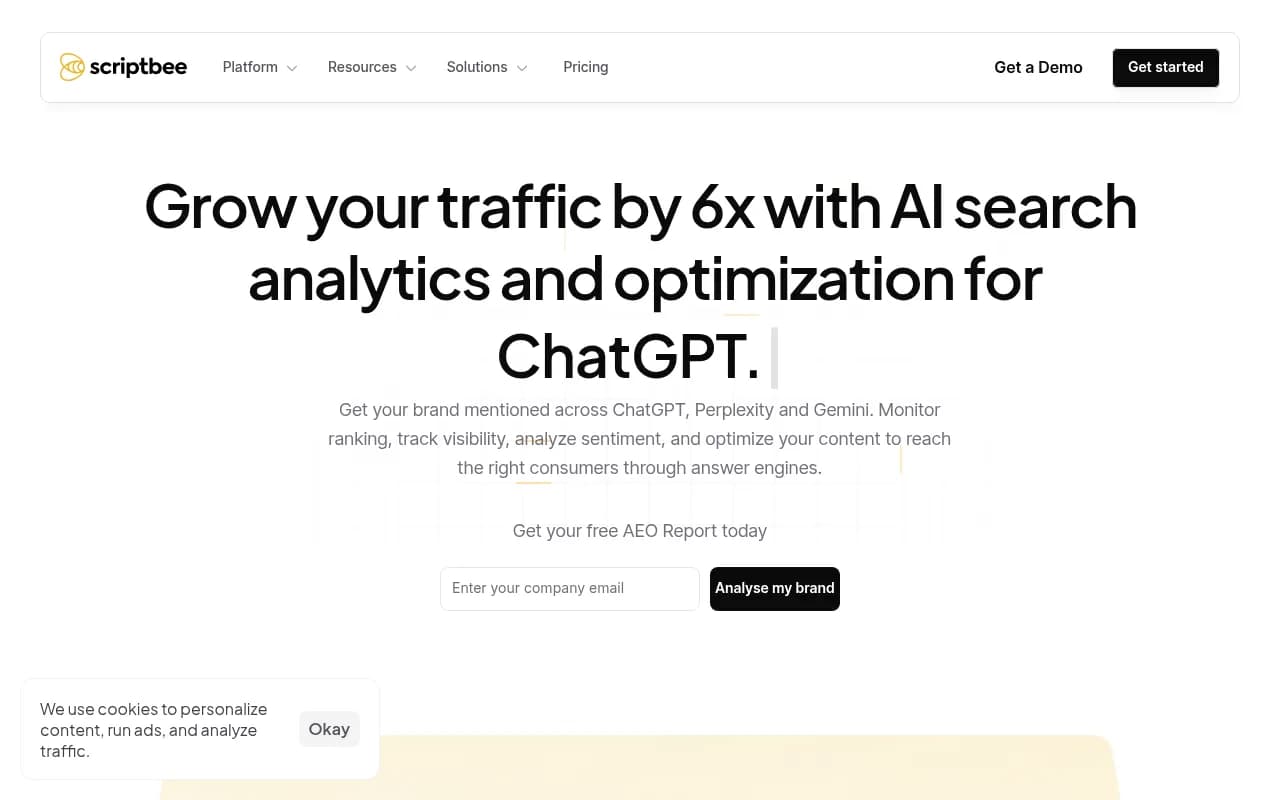
2. Scriptbee — best for agencies managing multiple domains
Scriptbee was built by founders who ran into the same wall many agencies hit with Peec AI: paying for multiple single-domain plans gets expensive fast. Scriptbee supports unlimited domains on a single account, which changes the economics entirely for agencies.
It also includes real-time AI crawler logs, which puts it in a small group of tools that actually show you how AI bots interact with your site. The platform covers ChatGPT, Claude, Perplexity, Gemini, and Google AI Overviews, and integrates natively with Semrush, Ahrefs, and Google Analytics — so you're not copying data between tools.
The prompt-level insights are solid, and the reporting is clean enough to share with clients. If you're an agency managing 10+ sites and need crawler visibility without paying per domain, Scriptbee is worth a close look.
3. Omnia — best for share-of-voice and competitive benchmarking
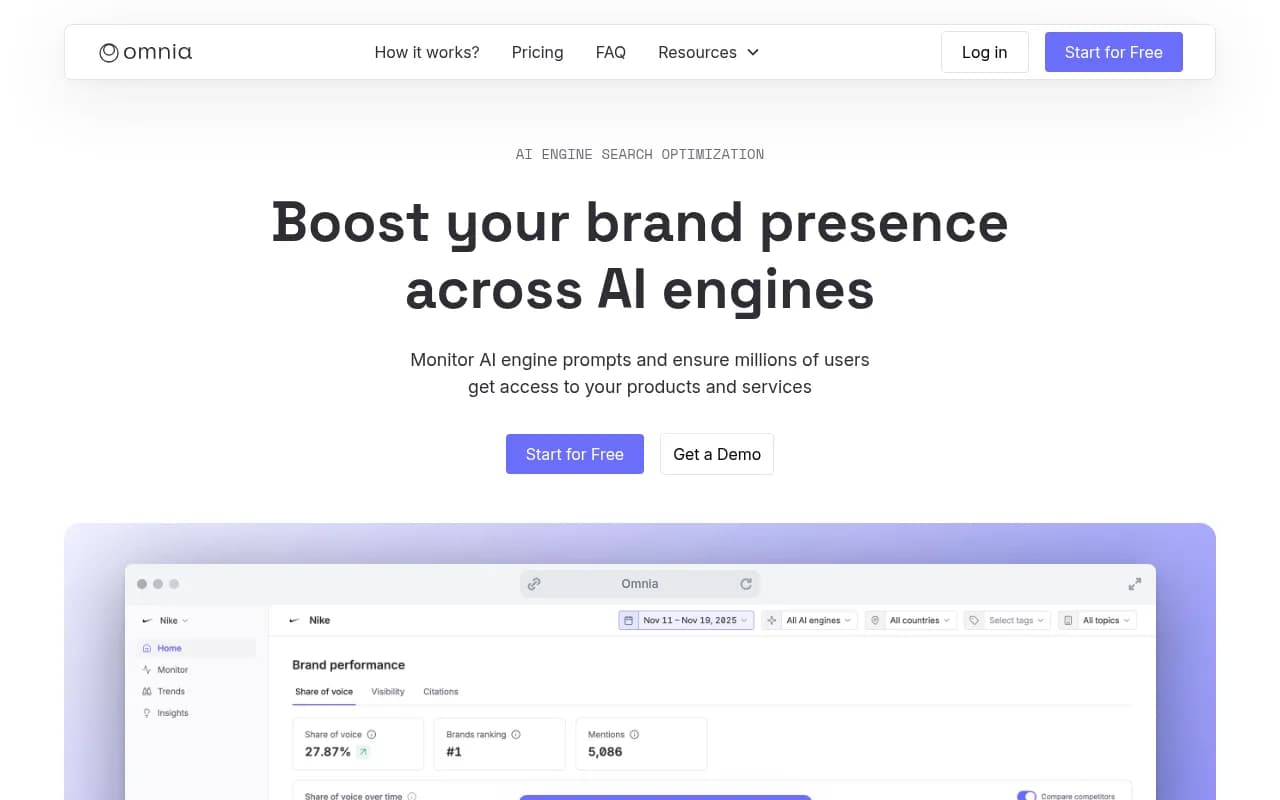
Omnia takes a different angle. Where most tools focus on whether your brand was mentioned, Omnia focuses on how much of the AI conversation you own relative to competitors. Its share-of-voice analytics are more developed than most tools in this space.
It's particularly useful for brand teams and agencies that need to present competitive positioning data to stakeholders. The automated insights surface patterns across AI responses — not just raw mention counts — and the benchmarking features let you track how your position shifts over time.
Omnia offers a free tier and free trial, which makes it accessible for teams that want to test before committing. It's not the deepest technical tool on this list, but for competitive intelligence and brand narrative analysis, it's strong.
4. Scrunch AI — best for enterprise-scale monitoring
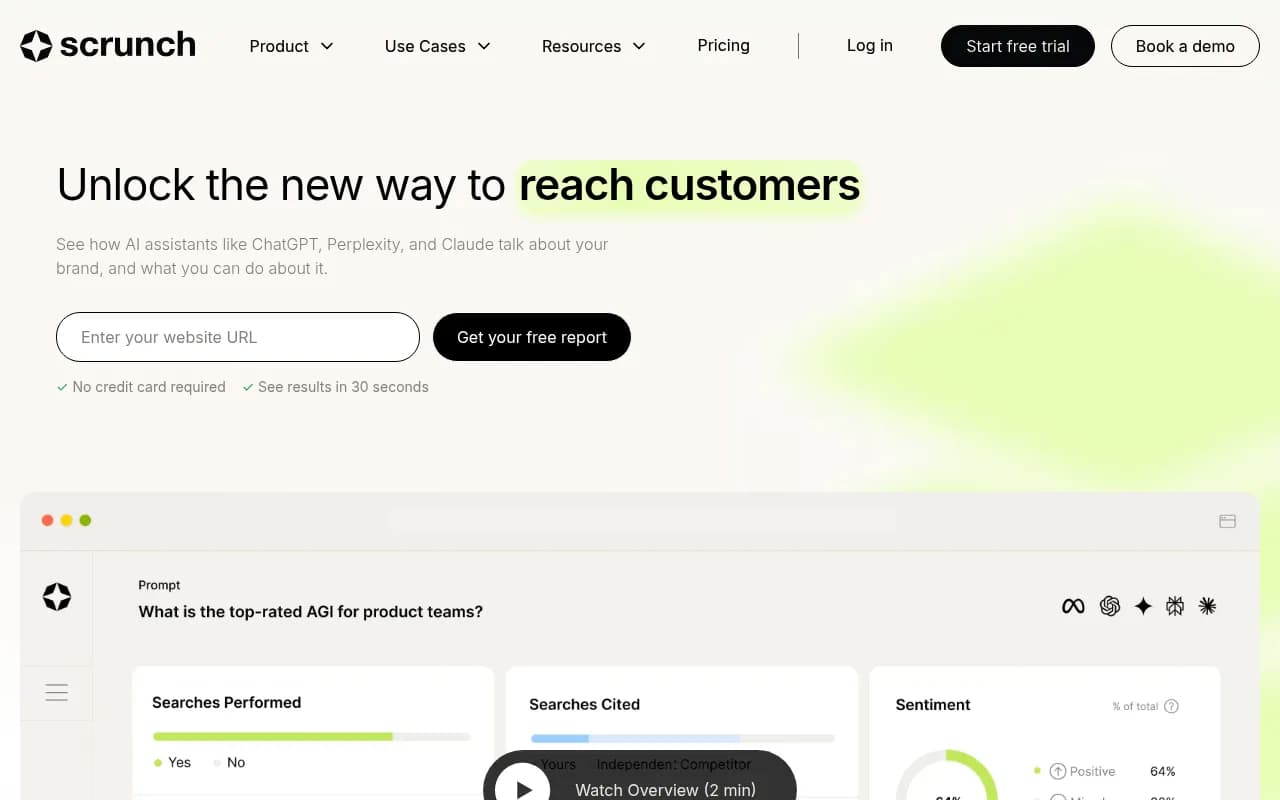
Scrunch AI is built for larger organizations that need to monitor AI visibility across a wide range of brand signals, not just direct mentions. It tracks how AI models describe your brand, what language they use, and how that narrative compares to competitors.
The platform is particularly strong for enterprise teams that care about brand safety and narrative control — situations where it matters not just whether you're mentioned but how you're described. If an AI model is consistently associating your brand with outdated information or a competitor's positioning, Scrunch surfaces that.
It sits at a higher price point than most tools on this list, and it's more monitoring-focused than optimization-focused. But for enterprise brand teams, that depth of narrative analysis is genuinely useful.
5. Otterly.AI — best for teams on a budget
Otterly.AI is the most accessible entry point on this list. It covers the core use case — tracking brand mentions across ChatGPT, Perplexity, and Google AI Overviews — at a price point that works for smaller teams and solo practitioners.
It doesn't have crawler logs, content generation, or deep competitive analysis. But if your primary need is knowing whether your brand is showing up in AI responses and getting basic visibility data, Otterly does that cleanly without overwhelming you with features you won't use.
The trade-off is clear: you get monitoring without optimization. For teams just starting to think about AI visibility, that's a reasonable starting point. For teams that need to act on the data, you'll outgrow it.
Otterly.AI

Feature comparison
| Tool | Crawler log monitoring | Content generation | Multi-domain | Competitive gap analysis | Starting price |
|---|---|---|---|---|---|
| Promptwatch | Yes | Yes (AI writing agent) | Yes (multi-site plans) | Yes (Answer Gap Analysis) | $99/mo |
| Scriptbee | Yes | No | Unlimited | Limited | Custom |
| Omnia | No | No | Yes | Yes (share of voice) | Free tier available |
| Scrunch AI | No | No | Yes | Yes (narrative analysis) | Higher tier |
| Otterly.AI | No | No | Limited | No | Lower tier |
| Peec AI | No | No | Single domain | No | Varies |
Why crawler logs matter more than most teams realize
Here's something that doesn't get talked about enough: AI models don't just generate responses from thin air. They crawl the web, index content, and draw on what they've read. The crawl is the first step in the citation chain.
If GPTBot can't access your page — because it's blocked in robots.txt, returns an error, or loads too slowly — your content won't be cited no matter how good it is. You could have the perfect answer to a high-volume prompt and still be invisible because a bot never read it.
Crawler log monitoring lets you see this in real time. You can spot:
- Pages that AI bots are ignoring entirely
- Crawl errors that block discovery
- Pages being crawled frequently (a signal they're being considered for citation)
- New content that hasn't been discovered yet
Most AI visibility tools don't show you any of this. They show you the output (was your brand mentioned?) without the input (did the bot even read your page?). That's a significant blind spot.
Of the tools on this list, only Promptwatch and Scriptbee include real crawler log monitoring. That's the honest answer.
How to choose the right tool
The right choice depends on what you're actually trying to accomplish.
If you're an agency managing multiple client sites and need to justify AI visibility work with concrete data, Promptwatch or Scriptbee are the serious options. Promptwatch has the edge if you also need content generation and traffic attribution. Scriptbee has the edge if unlimited domains at a flat rate is the priority.
If you're a brand team focused on competitive positioning and share of voice, Omnia is worth a look. The free tier lets you test it without commitment.
If you're at an enterprise with brand safety concerns and need to monitor how AI models describe your brand (not just whether they mention it), Scrunch AI is built for that.
If you're just starting out and want to understand the basics without a big investment, Otterly.AI is a reasonable first step — just know you'll likely need to upgrade as your needs grow.
The bigger picture
The AI search visibility space has matured fast. In early 2025, just knowing whether your brand appeared in an AI response felt like a win. In 2026, that's the baseline. The teams pulling ahead are the ones who understand why they appear, can identify the gaps, create content to fill them, and track whether it's working.
Peec AI helped a lot of teams get started. But the tools that will matter going forward are the ones that close the loop between visibility data and business outcomes. Crawler logs are part of that story. Content generation is part of it. Traffic attribution is part of it.
None of those are optional anymore — they're just how this works now.