Key takeaways
- Most GEO platforms stop at monitoring -- they show you where you're invisible but don't help you fix it. Only a handful go further.
- Promptwatch is the only platform in this comparison rated as a "Leader" across all evaluation categories in 2026, largely because it closes the loop between tracking and content creation.
- AthenaHQ and Scrunch AI are strong monitoring tools but lack built-in content generation and optimization workflows.
- Relixir is purpose-built for enterprise brands and goes deep on content, but comes at a higher price point.
- Search Party is agency-oriented and workflow-heavy, but light on prompt intelligence and gap analysis.
- Pricing ranges from ~$99/month (Promptwatch Essential) to custom enterprise contracts (Relixir, Profound).
- If you want to track AND improve your AI visibility, the platform choice matters a lot -- most tools only do one of those things.
The GEO platform market has exploded. Two years ago, you could count the serious players on one hand. Now there are 200+ tools claiming to help you rank in ChatGPT, Perplexity, Claude, and Google AI Overviews. Most of them are dashboards dressed up as strategy tools.
This guide cuts through the noise. We looked at seven platforms that are actually worth your time in 2026 -- comparing them on AI model coverage, monitoring depth, content optimization capabilities, pricing, and the thing that matters most: whether they help you actually improve your visibility or just measure how bad it is.
Why GEO platforms aren't all the same
The core job of a GEO platform sounds simple: tell you when AI engines mention your brand and when they don't. But what you do with that information is where platforms diverge dramatically.
Some tools are pure trackers. They run prompts, log responses, and show you a dashboard. That's useful, but it's also where most teams get stuck. You know you're invisible for "best project management software" in ChatGPT -- now what?
The better platforms answer that question. They identify which content is missing, help you create it, and then track whether the new content actually gets cited. That's a fundamentally different product category, even if both tools call themselves "GEO platforms."
Keep that distinction in mind as you read through these seven options.
The 7 platforms compared
1. Promptwatch
Promptwatch is the platform this site is built on, so I'll be upfront about that. But the reason it's listed first isn't bias -- it's that in a 2026 comparison of 12 GEO platforms, it's the only one rated as a "Leader" across every evaluation category. That's a meaningful data point.
What makes Promptwatch different from every other tool in this list is the action loop it's built around. Most platforms show you the gap. Promptwatch shows you the gap and then helps you close it.
The workflow goes like this: Answer Gap Analysis surfaces the specific prompts where competitors appear but you don't. You see exactly which topics, questions, and angles AI models want to answer but can't find on your site. Then the built-in AI writing agent generates content -- articles, listicles, comparisons -- grounded in real citation data from over 880 million citations analyzed. Not generic SEO filler. Content engineered to get cited by ChatGPT, Claude, Perplexity, and others. Then you track the results at the page level and connect visibility to actual traffic through GSC integration, a code snippet, or server log analysis.
A few other things worth knowing: Promptwatch has AI crawler logs (real-time logs of ChatGPT, Claude, and Perplexity crawlers hitting your site), ChatGPT Shopping tracking, Reddit and YouTube insights, and competitor heatmaps. It monitors 10 AI models including Google AI Mode, DeepSeek, Grok, and Mistral -- not just the obvious three.
Pricing starts at $99/month for the Essential plan (1 site, 50 prompts, 5 articles). Professional is $249/month (2 sites, 150 prompts, 15 articles, crawler logs). Business is $579/month. Agency and enterprise pricing is custom.

2. AthenaHQ
AthenaHQ is a solid monitoring platform with good AI model coverage. It tracks ChatGPT, Claude, Gemini, Perplexity, and several others, and the interface is clean and well-organized. Teams that want a reliable dashboard to track brand mentions and share of voice across AI engines will find it capable.
The limitation is that AthenaHQ is primarily a monitoring tool. It shows you where you stand but doesn't have the content generation or optimization layer that turns that data into action. There's no built-in writing agent, no answer gap analysis that connects to a content workflow, and no crawler logs. If your team has the capacity to take monitoring data and independently produce content based on it, AthenaHQ works fine. If you want the platform to help you do that work, you'll hit a wall.
API access is available, which is useful for teams building custom reporting. Pricing is on the higher end for what's offered relative to platforms that include content tools.

3. Scrunch AI
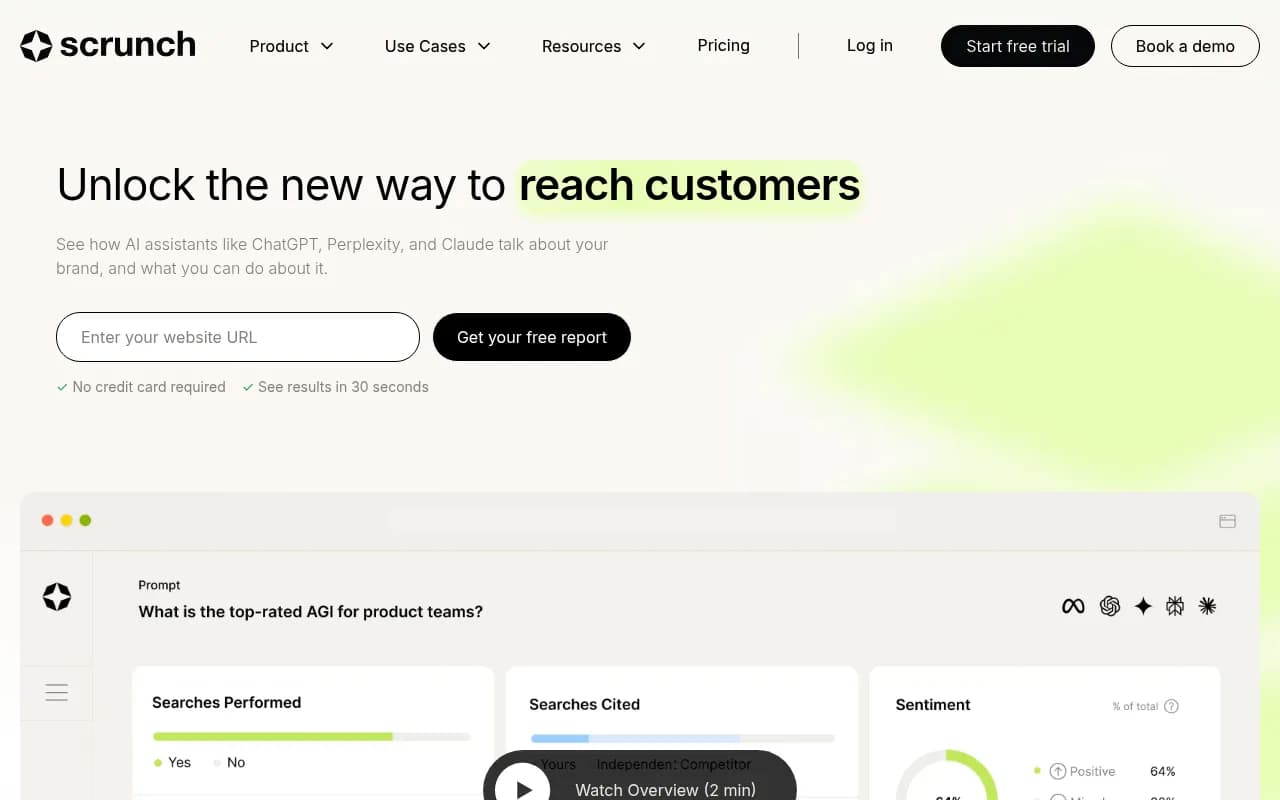
Scrunch AI positions itself as an enterprise-grade AI visibility platform, and it has some genuine strengths. The monitoring depth is good, it covers most major AI engines, and it has decent competitive analysis features. Google AI Mode is available on enterprise plans, which is a differentiator.
Like AthenaHQ, though, Scrunch is fundamentally a monitoring tool. There's no content generation built in, no answer gap analysis tied to a content workflow, and no crawler logs. The platform is strong at telling you what's happening but doesn't have the infrastructure to help you change it.
For large enterprise teams with dedicated content resources who just need reliable visibility data, Scrunch is a reasonable choice. For teams that need the full loop -- track, identify gaps, create content, measure results -- it's only half the solution.
4. Relixir
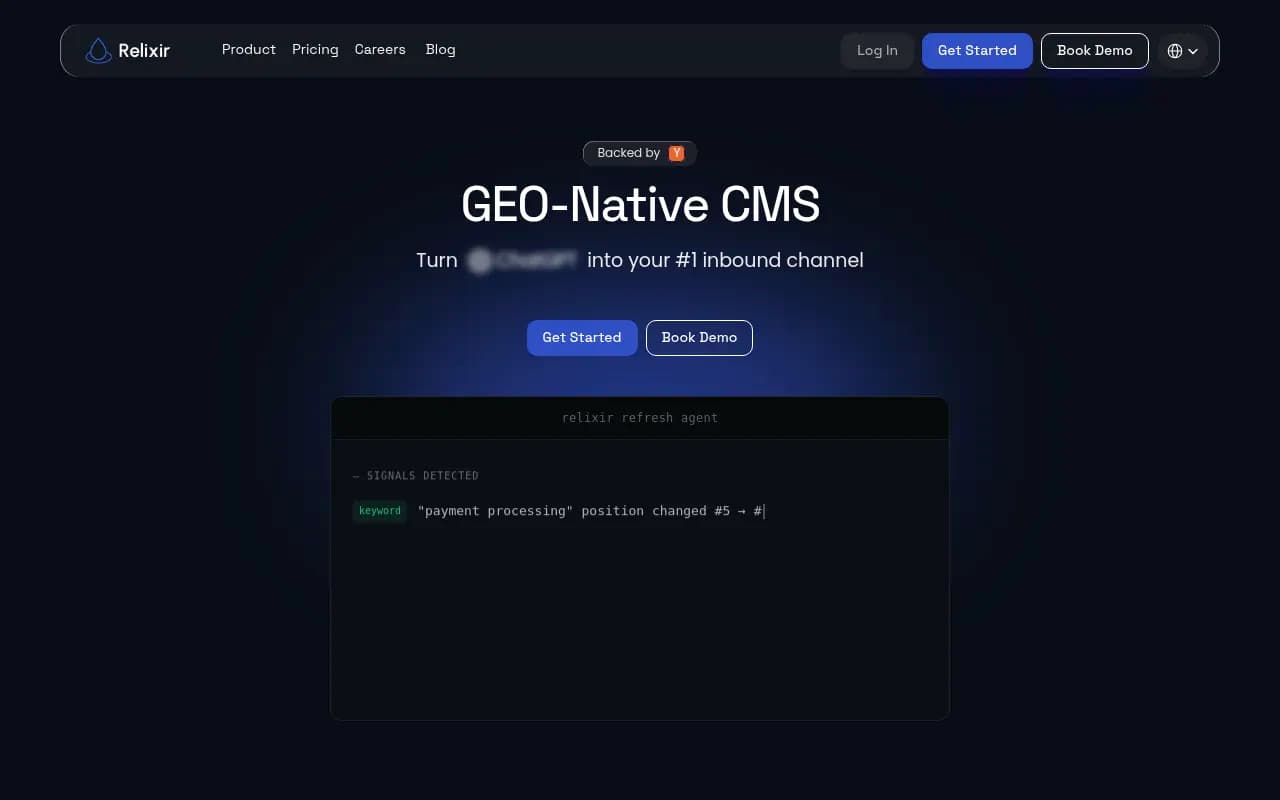
Relixir is built specifically for enterprise brands that want an end-to-end GEO engine, not just a tracker. It goes deep on content strategy, competitive intelligence, and optimization workflows. If Promptwatch is the platform for marketing teams and agencies, Relixir is aimed squarely at enterprise brands with dedicated GEO programs.
The platform includes content generation capabilities, competitive gap analysis, and multi-model tracking. It's one of the few tools that genuinely competes with Promptwatch on the "action" side of the equation rather than just the monitoring side.
The trade-off is price and complexity. Relixir is custom-priced for enterprise, which means it's not accessible for smaller teams or agencies managing multiple clients on a budget. The onboarding is also more involved. For a Fortune 500 brand with a real GEO budget, that's probably fine. For a mid-market company or agency, the cost-to-value ratio may not work.
5. Search Party
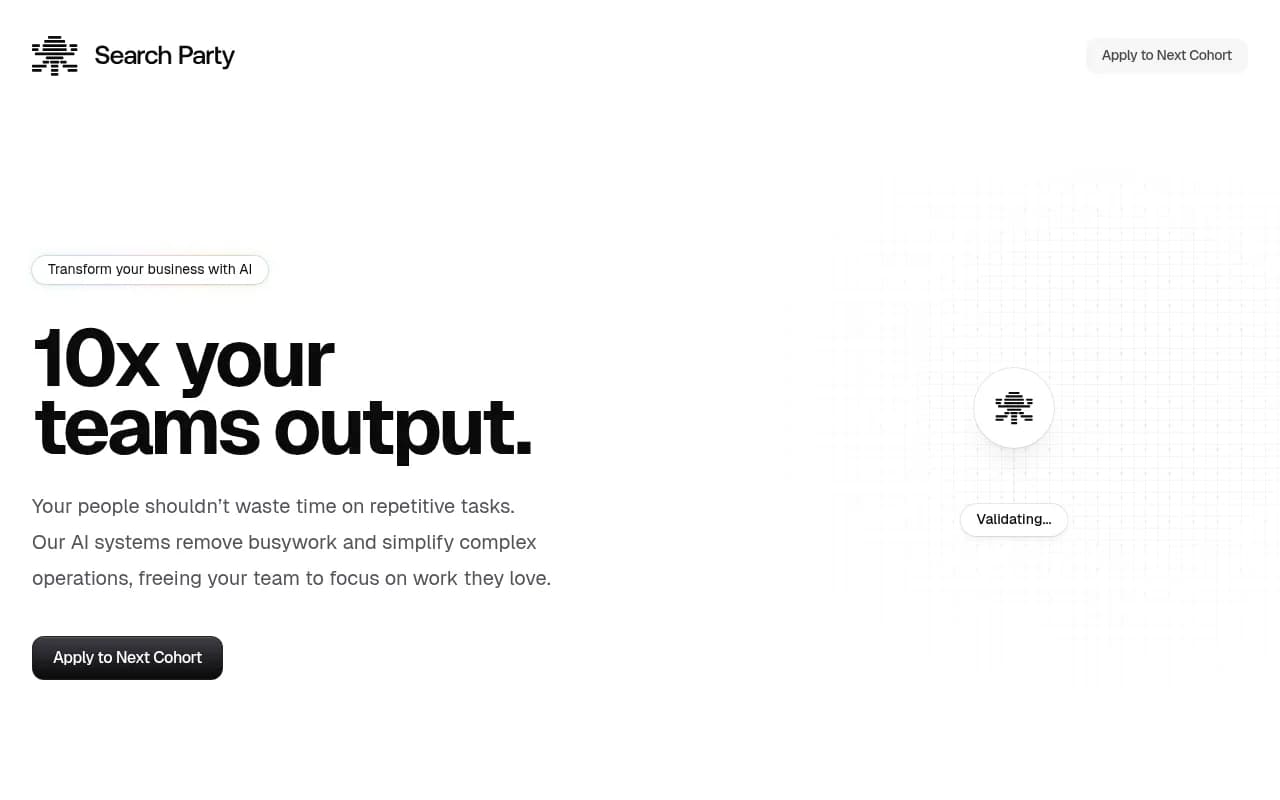
Search Party takes a different approach. It's more of an AI automation consultancy that builds custom workflows than a self-serve SaaS platform. If you need bespoke AI search monitoring integrated into your existing marketing stack, Search Party can build that. It's agency-oriented and workflow-heavy.
The downside is that it's light on the things that matter most for GEO: prompt intelligence, difficulty scoring, query fan-outs, and content gap analysis. You're not getting a platform with 880 million citations analyzed and a built-in writing agent. You're getting custom automation work, which is valuable in certain contexts but not the same thing.
Search Party
6. Profound
Profound is one of the more established enterprise AI visibility platforms. It covers 9+ AI search engines, has solid monitoring depth, and is used by larger marketing teams that need reliable data at scale. The feature set is strong and the data quality is generally good.
Where Profound falls short is on the action side. It doesn't have Reddit or YouTube tracking (which are increasingly important since AI models cite those sources heavily), no ChatGPT Shopping monitoring, and no built-in content generation. It's also on the pricier end of the market, which makes the monitoring-only positioning harder to justify when platforms like Promptwatch include content tools at lower price points.
Profound

7. Otterly.AI
Otterly.AI is a monitoring-focused platform that covers the core AI engines -- ChatGPT, Perplexity, Google AI Overviews -- and is reasonably priced for what it offers. Gemini and Google AI Mode are available as add-ons, which adds friction if you need full coverage.
It's a good entry-level option for teams that are just starting to track AI visibility and don't yet need optimization capabilities. The interface is straightforward and the setup is fast. But it's firmly in the "monitoring only" category -- no content generation, no crawler logs, no answer gap analysis, no Reddit/YouTube insights. Teams that outgrow basic monitoring will need to switch platforms.
Otterly.AI

Feature comparison table
| Platform | AI models covered | Answer gap analysis | Built-in content generation | Crawler logs | Reddit/YouTube tracking | ChatGPT Shopping | Starting price |
|---|---|---|---|---|---|---|---|
| Promptwatch | 10 (incl. DeepSeek, Grok, Mistral) | Yes | Yes (AI writing agent) | Yes | Yes | Yes | $99/mo |
| AthenaHQ | 8+ | Limited | No | No | No | No | Custom |
| Scrunch AI | 8+ (AI Mode: Enterprise only) | No | No | No | No | No | Custom |
| Relixir | 8+ | Yes | Yes | No | No | No | Custom (enterprise) |
| Search Party | Variable | No | No | No | No | No | Custom |
| Profound | 9+ | No | No | No | No | No | Custom |
| Otterly.AI | 3 core + add-ons | No | No | No | No | No | ~$49/mo |
How to choose
The right platform depends on what you actually need to do.
If you want to track AND improve your AI visibility, and you're a marketing team, SEO team, or agency managing multiple clients, Promptwatch is the most complete option at a price point that makes sense. The combination of monitoring, gap analysis, content generation, and traffic attribution is unique in the market.
If you're a large enterprise with a dedicated GEO team and a real budget, Relixir is worth evaluating alongside Promptwatch. It's built for that context and goes deep on content strategy.
If you genuinely only need monitoring -- you have a content team that will take the data and run with it independently -- AthenaHQ or Scrunch AI are solid choices. Both have good data quality and clean interfaces.
If you're just starting out and want to dip your toes in before committing to a serious platform, Otterly.AI is a reasonable starting point. Just know you'll likely outgrow it.
Profound is harder to recommend at its price point given what's missing. The monitoring is good, but you're paying enterprise prices for a monitoring-only tool when alternatives include content generation at lower cost.
Search Party is a different product category entirely -- it's services and custom automation, not a self-serve platform. Useful in specific contexts, but not directly comparable to the others.
The monitoring-vs-optimization gap
One thing worth saying plainly: the GEO market has a monitoring-vs-optimization split, and it matters more than most buyers realize.
Monitoring tells you your brand appears in 12% of relevant ChatGPT responses. Optimization tells you which specific content gaps are causing that, generates the content to fill them, and tracks whether it worked. Those are very different products, and the price difference between them is often smaller than you'd expect.
The platforms that only monitor are useful, but they leave the hardest part of the job to you. In a category where the playbook is still being written, having a platform that helps you execute -- not just observe -- is a meaningful advantage.
Tools like Promptwatch, with its crawler logs showing exactly how AI engines discover your content, its prompt volume and difficulty scoring, and its query fan-out analysis, are designed around that execution layer. Most competitors built the dashboard first and are still figuring out the rest.
What to look for beyond the feature list
A few things that don't show up in comparison tables but matter in practice:
Data freshness matters a lot. AI models update their knowledge and citation patterns constantly. A platform that runs prompts weekly gives you a very different picture than one running them daily or more frequently.
Prompt design affects everything. Some platforms let you write your own prompts; others generate them automatically based on real user query data. The latter tends to be more accurate because it reflects how people actually ask questions, not how you think they do.
Traffic attribution is the missing piece for most teams. Knowing your AI visibility score is interesting. Knowing that your AI visibility drove 340 sessions last month that converted at 4.2% is actionable. Look for platforms that connect visibility data to actual traffic -- through GSC integration, a tracking snippet, or server log analysis.
Reddit and YouTube are underrated. AI models cite these sources constantly, and most GEO platforms ignore them entirely. If you want to understand why a competitor keeps getting cited and you don't, you often need to look at what's being said about each brand in those channels.
Final take
The GEO platform market is maturing fast, but there's still a wide gap between tools that monitor and tools that optimize. For most teams, that gap is the difference between having interesting data and actually improving their AI visibility.
If you're evaluating platforms in 2026, start by being honest about which category you need. If you just need a reliable monitoring dashboard, several options in this list will serve you well. If you need to move the needle -- find gaps, create content, track results -- the list gets much shorter.