Key takeaways
- Traditional social listening tools don't monitor what AI models say about your brand — you need a dedicated AI visibility tracker
- The best tools query ChatGPT, Claude, Perplexity, Gemini, and other LLMs simultaneously, not one at a time
- Most tools in this category are monitoring-only; a small number also help you act on what you find by identifying content gaps and generating optimized content
- Pricing ranges from free tiers to $500+/month for enterprise plans — the right choice depends on how many prompts, sites, and AI models you need to cover
- This category is moving fast; features and pricing have changed significantly even since early 2025
Someone just asked ChatGPT "what's the best project management tool for remote teams?" Your competitor got mentioned. You didn't.
That's the new reality of brand visibility. Gartner projected that traditional search volume would drop 25% by 2026 as users shift to AI assistants for product research, and that shift is well underway. When someone asks an AI assistant for a recommendation, the model draws on its training data and real-time retrieval to construct an answer — and if your brand isn't in that answer, you've effectively lost a potential customer before they ever visited your site.
The problem is that traditional brand monitoring tools weren't built for this. Google Alerts won't tell you what Claude said about you. Brand24 won't show you whether Perplexity is recommending your competitor. You need tools that actually query these AI models and report back what they say.
Here are 7 tools that do exactly that.
How AI brand mention tracking actually works
Before getting into the tools, it's worth understanding what's happening under the hood. These platforms work by running a set of prompts — questions your target customers might ask — against one or more AI models, then parsing the responses to detect brand mentions, sentiment, and citation sources.
The better tools do this at scale: hundreds of prompts, across 5-10 AI models, refreshed regularly. They also go beyond simple mention detection to show you things like:
- Which competitors are being mentioned when you're not
- What sources the AI is citing (and whether those sources are yours)
- Whether the information being surfaced about you is accurate
- How your visibility changes over time
That last point matters. A single snapshot tells you where you stand today. Trend data tells you whether your content efforts are actually working.
The 7 tools
1. Promptwatch
Promptwatch is the most complete platform in this category. It monitors brand mentions across 10 AI models — ChatGPT, Claude, Perplexity, Gemini, Google AI Overviews, Google AI Mode, Meta/Llama, DeepSeek, Grok, Mistral, and Copilot — and pairs that monitoring with tools to actually improve your visibility.

The distinction that matters: most tools in this space show you a dashboard of where you're visible and where you're not, then leave you to figure out what to do next. Promptwatch closes that loop. Its Answer Gap Analysis identifies the specific prompts where competitors are showing up but you aren't, then a built-in AI writing agent generates content designed to get cited by those models. Page-level tracking then shows whether the new content is actually moving the needle.
A few capabilities worth calling out specifically:
- AI Crawler Logs show you in real time which AI crawlers (GPTBot, ClaudeBot, PerplexityBot) are visiting your site, which pages they're reading, and what errors they're hitting. Most competitors don't offer this at all.
- Prompt Intelligence includes volume estimates and difficulty scores for each prompt, so you can prioritize high-value, winnable queries instead of guessing.
- Reddit and YouTube tracking surfaces discussions that directly influence AI recommendations — a channel most platforms ignore.
- ChatGPT Shopping tracking monitors when your brand appears in ChatGPT's product recommendation carousels.
Pricing starts at $99/month (Essential: 1 site, 50 prompts, 5 articles), $249/month (Professional: 2 sites, 150 prompts, crawler logs), and $579/month (Business: 5 sites, 350 prompts). Free trial available.
2. Otterly.AI
Otterly is one of the more established names in AI search monitoring. It tracks brand mentions across ChatGPT, Perplexity, Google AI Overviews, Google AI Mode, and a handful of other platforms, with competitive benchmarking and a GEO audit feature that attempts to explain why you rank (or don't) for specific prompts.
Otterly.AI

The platform is solid for monitoring. Where it falls short is on the action side — there's no built-in content generation, no crawler log analysis, and no traffic attribution to connect AI visibility to actual revenue. It's a good choice if you want a clean monitoring dashboard and don't need the full optimization workflow.
3. Profound
Profound is positioned at the enterprise end of the market. It tracks AI visibility across ChatGPT, Perplexity, Gemini, Claude, Copilot, Meta, and Grok, with strong analytics and reporting features suited to larger teams.
Profound

The starter plan ($99/month) covers ChatGPT only with 50 prompts, which is limiting. The platform gets more interesting at higher tiers where you get multi-model coverage and deeper competitive analysis. Like Otterly, Profound is primarily a monitoring and analytics tool — it doesn't include Reddit tracking or ChatGPT Shopping visibility.
4. Peec AI
Peec AI focuses on daily tracking across ChatGPT, Perplexity, and Claude, with a clean interface and straightforward setup. It's a good fit for teams that want reliable, frequent data refreshes without a lot of configuration overhead.

Starting at around €85/month, it's priced in the mid-range. The platform covers the core use case well — tracking whether your brand appears in AI responses over time — but doesn't extend into content optimization or crawler monitoring.
5. SE Ranking AI Visibility
SE Ranking is primarily an SEO platform, but its AI Visibility module adds meaningful LLM tracking on top of traditional rank tracking. If your team is already using SE Ranking for SEO, this is an efficient way to add AI brand monitoring without switching tools.
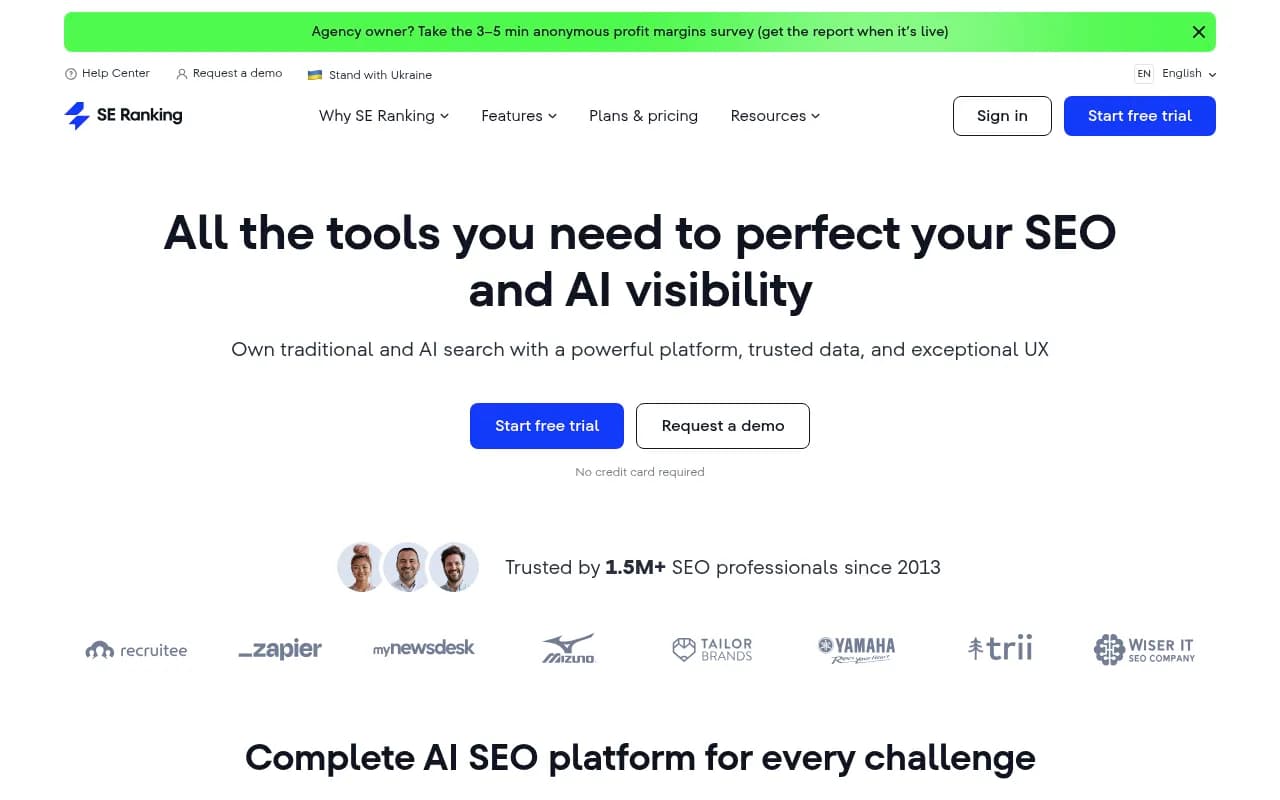
The integration with SE Ranking's existing keyword and content tools is the main draw here. The AI visibility features cover the major models (ChatGPT, Perplexity, Gemini, Claude) and include sentiment analysis and share-of-voice metrics. It's not as deep as a dedicated AI visibility platform, but it's a reasonable option for teams that want everything in one place.
6. AthenaHQ
AthenaHQ is a monitoring-focused platform with solid coverage across the major AI models and a clean competitive analysis interface. It's particularly good at showing share-of-voice comparisons — how often your brand appears versus competitors across different prompt categories.

The platform is well-designed and the data quality is generally reliable. The limitation is that it stops at monitoring. There's no content gap analysis, no content generation, and no traffic attribution. For teams that just want visibility data and plan to act on it elsewhere, that's fine. For teams that want a complete workflow, it's a starting point rather than an endpoint.
7. LLM Pulse
LLM Pulse is a newer entrant that tracks brand visibility across ChatGPT, Perplexity, and several other AI search engines. It's lighter-weight than some of the platforms above, which makes it faster to set up and easier to use for smaller teams or individual marketers.
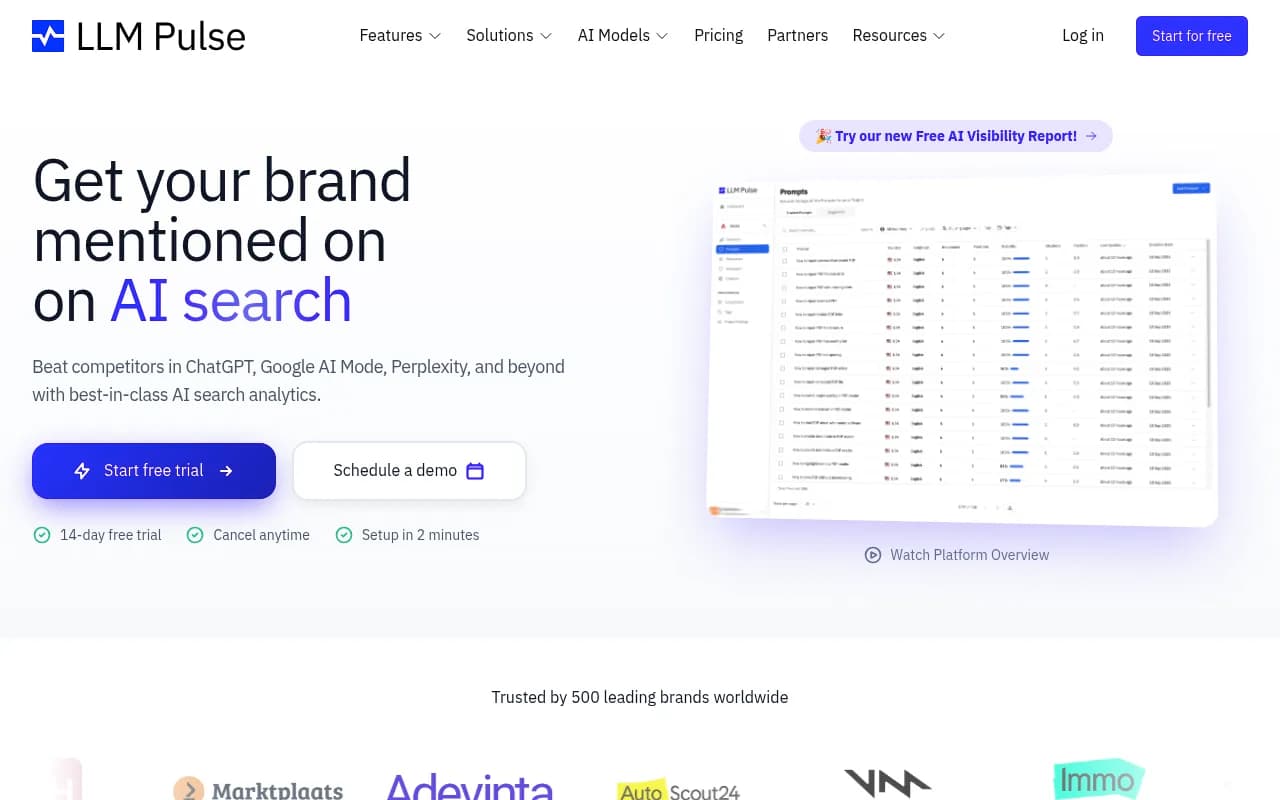
The platform covers the basics well: prompt tracking, mention detection, sentiment analysis, and basic competitive comparison. It doesn't have the depth of Promptwatch or Profound, but it's a reasonable entry point for brands that are just starting to think about AI visibility.
Side-by-side comparison
| Tool | AI models covered | Content generation | Crawler logs | Reddit/YouTube tracking | ChatGPT Shopping | Starting price |
|---|---|---|---|---|---|---|
| Promptwatch | 10 (ChatGPT, Claude, Perplexity, Gemini, Grok, DeepSeek, Copilot, Meta, Mistral, Google AI) | Yes | Yes | Yes | Yes | $99/mo |
| Otterly.AI | 6 | No | No | No | No | $29/mo |
| Profound | 7+ | No | No | No | No | $99/mo |
| Peec AI | 3+ | No | No | No | No | ~€85/mo |
| SE Ranking AI Visibility | 4+ | Limited | No | No | No | Bundled with SE Ranking |
| AthenaHQ | 5+ | No | No | No | No | Custom |
| LLM Pulse | 4+ | No | No | No | No | Varies |
What to look for when choosing
Model coverage. The obvious question: does the tool actually monitor the AI models your customers use? ChatGPT and Perplexity are the most common starting points, but Claude and Gemini are growing fast. Google AI Overviews is already generating enormous traffic. A tool that only covers one or two models is giving you a partial picture.
Prompt customization. Generic prompts like "what is [brand]?" aren't how real customers search. You want to track prompts like "best [category] tool for [use case]" — the actual questions your customers ask. Check whether the platform lets you define your own prompts or locks you into a fixed set.
Data freshness. AI models update their responses, and your content changes. A tool that refreshes weekly is less useful than one that refreshes daily, especially if you're actively publishing content to improve your visibility.
The action layer. This is where most tools fall short. Knowing you're invisible in Perplexity for a high-value prompt is useful. Knowing exactly what content you need to create to fix that — and having a tool that helps you create it — is far more valuable. Only a handful of platforms in this category offer that full loop.
Traffic attribution. Can the tool connect AI visibility to actual website traffic and revenue? This is still an emerging capability, but it's the difference between a vanity metric and a business metric. Look for platforms that offer a tracking snippet, Google Search Console integration, or server log analysis.
The monitoring-only trap
Here's something worth saying plainly: most tools in this category will show you a dashboard full of red and orange indicators telling you that your competitors are more visible than you in AI search. That's useful to know. But then what?
If the tool stops there, you're left with a problem and no clear path to solving it. You know you're invisible for "best [your category] tool for startups" in ChatGPT — but you don't know which specific content gaps are causing that, what you'd need to write to fix it, or whether the content you've already published is being crawled by AI bots at all.
The platforms that go beyond monitoring — that identify specific content gaps, help you create content engineered to get cited, and then track whether it worked — are meaningfully different from the ones that just show you data. That's the distinction that matters most when you're evaluating this category.
A note on this market's pace
Every tool on this list launched between 2023 and 2025. The category didn't exist three years ago. That means pricing, features, and model coverage are changing fast — tools that were monitoring-only six months ago are adding content features, and new entrants are appearing regularly.
The practical implication: whatever you read about specific features or pricing (including here) should be verified directly with the vendor before you commit. The core question to ask any of these tools is: "What happens after you show me I'm invisible? What do you actually help me do about it?"
The answer to that question will tell you more than any feature comparison table.