Key takeaways
- Click-based metrics miss the majority of AI-driven brand exposure -- you need visibility-specific KPIs to see the full picture
- AI Share of Voice, mention rate, and sentiment score are the three metrics every brand should start with before anything else
- Context accuracy matters as much as mention frequency -- being cited wrongly can hurt more than not being cited at all
- Traffic attribution from AI search is now measurable; connecting visibility to revenue is no longer optional
- Most monitoring tools stop at data collection -- the brands gaining ground are the ones using that data to create content that actually gets cited
Something changed quietly over the last couple of years. Buyers started getting their answers from ChatGPT before they ever typed a query into Google. They asked Perplexity which software to use, and it gave them a ranked list. They asked Claude to compare two vendors, and it picked one.
Your brand either showed up in those answers or it didn't. And if you were only watching your Google Analytics dashboard, you had no idea either way.
That's the core problem with applying traditional KPIs to AI search. Clicks, impressions, bounce rate -- these metrics assume someone visited your website. But in a world where AI models synthesize answers and deliver them directly, a huge portion of brand influence happens before anyone clicks anything. According to Exposure Ninja, AI search traffic converts at 14.2% compared to Google's 2.8% -- which means the traffic that does come through is high-intent. But you're only seeing a fraction of the actual brand exposure.
So what should you be measuring? Here are the 9 metrics that actually tell you whether your AI brand visibility strategy is working.
1. AI share of voice
This is the foundational metric. AI Share of Voice (AI SOV) measures what percentage of AI-generated answers across relevant prompts mention your brand compared to your competitors.
Think of it like traditional share of voice, but instead of counting media mentions or ad impressions, you're counting how often ChatGPT, Perplexity, Gemini, Claude, and other models include your brand when someone asks a relevant question.
If you're in project management software and a user asks "what's the best project management tool for remote teams?", did your brand appear? What about your top three competitors? AI SOV gives you that competitive snapshot across hundreds of prompts at once.
The number itself matters less than the trend. Are you gaining or losing ground week over week? Which AI models favor you, and which ones don't? Which competitors are eating into your share?
Promptwatch tracks this across 10 AI models simultaneously, with competitor heatmaps that show exactly who's winning for which prompts and why.

2. AI mention rate
AI SOV tells you your relative position. Mention rate tells you your absolute position -- how often your brand appears in AI responses across the total set of prompts you're tracking.
A brand with a 30% mention rate is cited in roughly 3 out of every 10 relevant AI responses. That's a meaningful number on its own, separate from what competitors are doing.
Track this at the model level too. You might have a 45% mention rate on Perplexity but only 12% on ChatGPT. That gap is a signal -- it suggests your content is being indexed and cited differently across platforms, and there's a specific optimization opportunity on the underperforming model.
Mention rate is also the metric most directly tied to content gaps. When your rate drops on a specific topic cluster, it usually means a competitor published something that's now getting cited instead of you.
Otterly.AI


3. AI mention sentiment score
Not all mentions are good mentions. This is a point that gets glossed over in a lot of AI visibility frameworks, but it matters enormously.
An AI model might mention your brand in a response that says "some users report that [Brand X] has a steep learning curve and limited customer support." That's a mention. It's also damaging. A raw mention count would count it the same as a glowing recommendation.
Sentiment scoring analyzes the tone and framing of AI-generated mentions: positive, neutral, or negative. More sophisticated implementations also flag accuracy issues -- cases where the AI is describing your product incorrectly, citing outdated pricing, or attributing features you don't have.
The practical use of this metric is in content strategy. If AI models consistently describe you in neutral or negative terms around a specific topic, that's a signal to create clearer, more authoritative content on that topic so the models have better source material to draw from.
4. Context accuracy and topic ownership
This one is underrated. Context accuracy measures whether AI models are describing your brand correctly -- in the right category, with accurate product details, and in the right competitive context.
Topic ownership goes a step further: it measures whether AI models recognize your brand as the definitive source on specific topics or questions. If someone asks about "zero-trust data security for mid-market companies," does your brand come up as the authority? Or does a competitor own that conversation?
These two metrics together tell you something clicks and rankings can't: whether AI models actually understand what your brand does and who it's for. A brand can have a high mention rate but terrible context accuracy -- showing up in answers where it doesn't belong, described in ways that confuse buyers rather than convert them.
Fixing context accuracy problems requires publishing clear, structured content that gives AI models unambiguous signals about your positioning. Schema markup, clear product descriptions, and authoritative topic pages all help.
5. Source citation rate
When an AI model cites a source in its response, which pages on your website are getting cited? How often? And by which models?
Source citation rate tracks exactly this. It's the AI-era equivalent of backlinks -- being cited by an AI model is a signal of authority, and the pages that get cited most are the ones doing the most work for your brand.
This metric is useful in two directions. First, it shows you which content is already performing well in AI search so you can double down on that format, topic, or structure. Second, it shows you which pages are never cited despite being important to your business -- those are optimization targets.
Citation patterns also vary by model. Perplexity cites sources more explicitly than ChatGPT. Google AI Overviews pulls from a different content mix than Claude. Understanding which of your pages get cited where helps you tailor your content strategy by platform.
Profound

LLMrefs
6. Prompt coverage and answer gap rate
This metric asks a simple question: for the prompts that matter to your business, how many are you actually showing up for?
Prompt coverage is the percentage of your tracked prompts where your brand appears at least once. Answer gap rate is the inverse -- the percentage of prompts where competitors appear but you don't.
Answer gap rate is particularly powerful because it's directly actionable. Each gap represents a specific question or topic where AI models have decided your competitors are more authoritative than you. That's not abstract -- it points to specific content you need to create.
If you're tracking 200 prompts and you're absent from 80 of them while a competitor shows up in 60 of those same 80, you have a concrete list of 60 topics to address. That's a content roadmap, not just a metric.
Promptwatch's Answer Gap Analysis does exactly this -- it surfaces the specific prompts competitors rank for that you don't, so you know precisely what to write.
7. AI crawler activity and indexing health
This one sits at the technical layer, but it has a direct impact on every other metric on this list. If AI crawlers can't access your content, they can't cite it.
AI crawler monitoring tracks when bots from ChatGPT (GPTBot), Perplexity (PerplexityBot), Claude (ClaudeBot), and other models visit your website -- which pages they read, how often they return, and what errors they encounter.
Low crawler frequency on important pages is a red flag. It might mean your robots.txt is blocking AI crawlers, your JavaScript rendering is preventing content from being parsed, or your page load times are causing crawlers to abandon before indexing completes.
Most traditional SEO tools don't track AI crawler activity at all. It's one of the more meaningful gaps between legacy platforms and purpose-built AI visibility tools.
8. AI-attributed traffic and conversion rate
This is where visibility connects to revenue. AI-attributed traffic measures how many website visitors arrived via an AI search engine -- and what they did when they got there.
The challenge is that AI traffic often shows up as "direct" in Google Analytics because there's no referral header. Getting accurate attribution requires either a tracking snippet on your site, server log analysis, or a Google Search Console integration that can isolate AI-driven sessions.
Once you have clean attribution, the conversion rate metric becomes critical. AI-referred visitors tend to arrive with more context -- they've already read an AI-generated summary that mentioned your brand favorably. That pre-qualification shows up in conversion rates. Tracking this separately from organic or paid traffic gives you a truer picture of AI search ROI.
9. Prompt volume and difficulty score
Not all prompts are worth tracking. Prompt volume estimates how often a specific question or query is asked across AI platforms -- the AI-era equivalent of search volume. Difficulty score estimates how hard it is to break into the AI responses for that prompt given current competition.
These two metrics together let you prioritize. A high-volume, low-difficulty prompt where you're currently absent is a high-value, winnable opportunity. A low-volume, high-difficulty prompt where you're already present might not be worth additional investment.
Without these signals, most brands end up tracking prompts that feel important but have little actual impact on visibility or pipeline. Prompt volume and difficulty scoring turn a list of prompts into a prioritized roadmap.
How these metrics work together
The nine metrics above aren't independent. They form a diagnostic loop.
Start with AI SOV and mention rate to understand your current position. Use sentiment score and context accuracy to assess the quality of that visibility. Dig into source citation rate and answer gap rate to find the specific content gaps driving your underperformance. Check crawler activity to rule out technical blockers. Then use prompt volume and difficulty to prioritize what to fix first. Finally, close the loop with AI-attributed traffic and conversion data to connect all of it to actual business outcomes.
Most brands are only doing the first step -- tracking mentions -- and stopping there. The ones pulling ahead are running the full loop.
Comparing tools for AI brand monitoring
The market for AI visibility tools has grown fast, and the quality varies significantly. Here's how the main options stack up across the metrics covered in this guide:
| Tool | AI SOV | Sentiment | Crawler logs | Answer gap analysis | Traffic attribution | Content generation |
|---|---|---|---|---|---|---|
| Promptwatch | Yes | Yes | Yes | Yes | Yes | Yes |
| Profound | Yes | Yes | No | Limited | No | No |
| Otterly.AI | Yes | Basic | No | No | No | No |
| Peec.ai | Yes | Basic | No | No | No | No |
| AthenaHQ | Yes | Yes | No | No | No | No |
| LLMrefs | Yes | No | No | No | No | No |
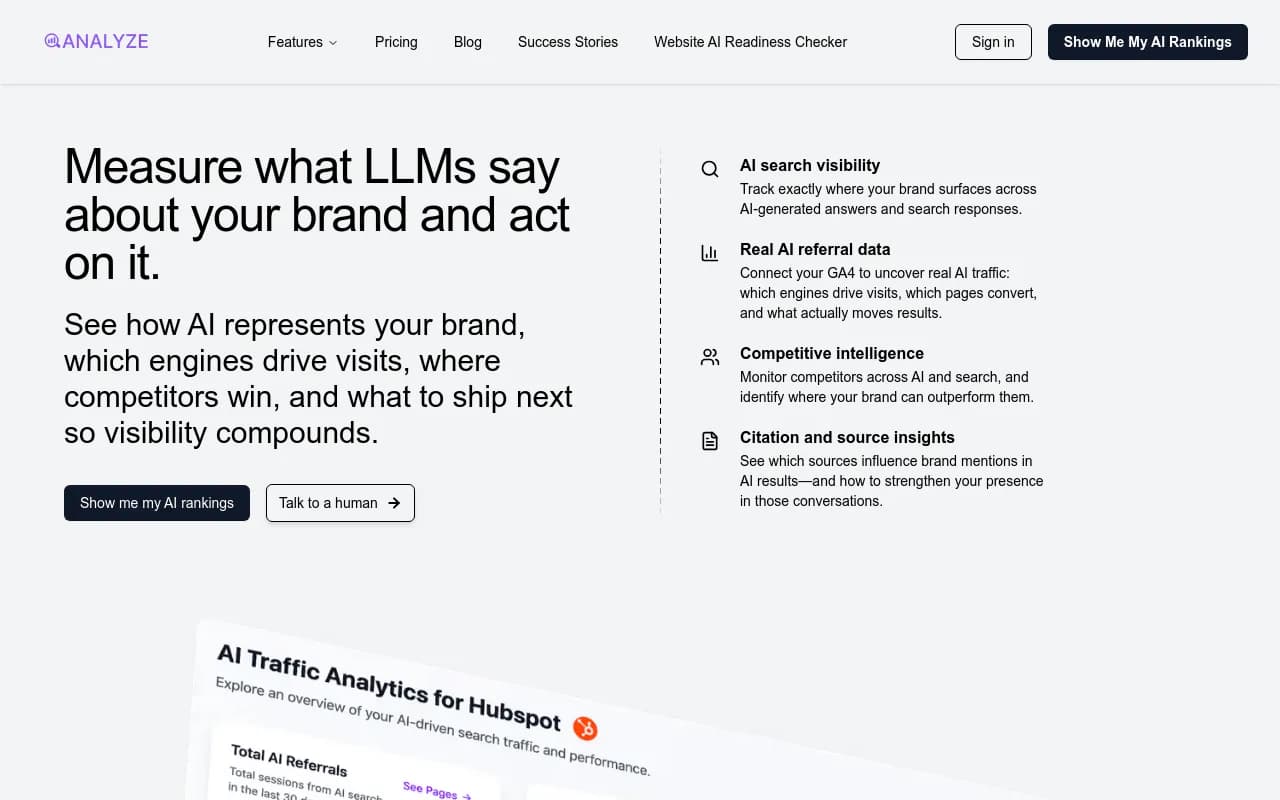
| Analyze AI | Yes | No | No | No | Yes | No |
The pattern is consistent: most tools handle the monitoring side reasonably well but stop there. Promptwatch is the only platform in this comparison that covers the full loop from gap identification through content creation to traffic attribution.

A note on measurement cadence
One mistake brands make when setting up AI visibility tracking is treating it like a monthly report. AI models update their training data and citation patterns more frequently than that, and competitive positions can shift meaningfully in a week.
Weekly tracking of your core prompts is a reasonable baseline. Daily monitoring makes sense for brands in fast-moving categories or those actively publishing new content to close visibility gaps. The key is having enough frequency to detect changes before they compound.
The other thing worth noting: these metrics are most useful when you have a baseline. If you're starting from scratch, the first 30 days of data are mostly about establishing where you stand. The second month is where the trends start to tell you something.
Where to start
If you're new to AI brand monitoring and feeling overwhelmed by nine metrics, here's a practical starting point: pick three prompts that represent your core buying scenarios, run them across ChatGPT, Perplexity, and Google AI Overviews, and note whether your brand appears and how it's described.
That manual exercise takes 20 minutes and will immediately tell you whether you have a visibility problem worth investing in. If your brand is absent from all three responses, or described inaccurately, you have a concrete problem to solve.
From there, a platform like Promptwatch can automate the tracking across hundreds of prompts and all major AI models, surface the specific content gaps driving your underperformance, and help you create the content needed to close those gaps.
The brands that will win in AI search aren't the ones with the biggest budgets. They're the ones that understand exactly where they're invisible, know why, and have a system for fixing it.