Key takeaways
- Classic media and social listening tools watch the web. They do not watch what ChatGPT, Gemini, Perplexity and AI Overviews say about you, and that is where a growing share of brand questions get answered.
- A damaging AI claim usually traces back to a handful of cited pages. ChatGPT cites about 5 sources per web-search answer, so one bad source can dominate the response.
- A proper AI crisis workflow has four steps: monitor claims, trace sources, correct the source, verify the fix.
- Fact-level tools (extracting individual claims and checking them against your own site) are more useful for comms than a single visibility score.
- Keep your existing listening stack (Meltwater, Brandwatch, Talkwalker) for press and social. Add an AI answer layer on top, do not swap one for the other.
Why comms teams now need AI answer monitoring
A journalist calls about a rumor. You check Google, Reddit, X, and the news wires. All clear. Then a prospect screenshots ChatGPT confidently saying your company was fined last year, or that your product was recalled, or that your CEO left. Nothing in your dashboard fired.
This is the gap. Media monitoring tools index published content and social posts. They do not query AI assistants the way a customer would, and they do not capture the synthesized answer that comes back. The answer is its own artifact, and it can be wrong even when every individual source is fine.
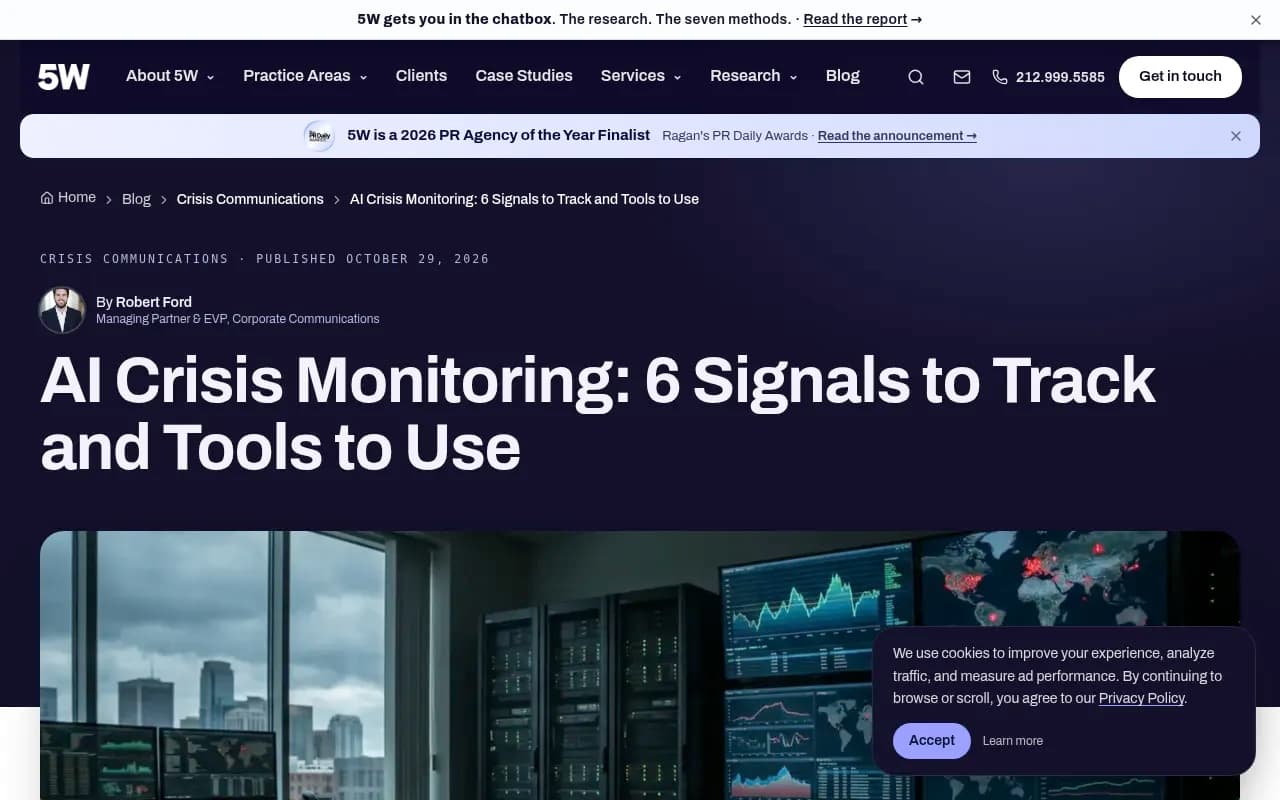
The 5WPR guide on AI crisis monitoring lists AI answers as its own signal category, alongside social and news, with a sample alert trigger of "a wrong or damaging claim about the brand" across ChatGPT, Gemini, Perplexity, Claude and Google AI Overviews. That framing is right. AI answers are a channel, and channels need monitoring.
PRSA's May 2025 piece by Jon Goldberg makes the broader argument that AI helps communicators spot weak signals early, before a problem becomes a full crisis. Worth reading, though most of it covers detection on the input side (news, social, internal data). The output side, what the models say once the story is out, gets less attention.
What counts as a damaging AI claim
Not every inaccuracy is a crisis. Triage matters, otherwise the team drowns in alerts. I would sort claims into four buckets:
- Factual errors: wrong pricing, wrong founding date, a feature you do not have, a lawsuit that never happened.
- Outdated claims: a resolved incident, an old leadership team, a discontinued product still described as current.
- Reputation claims: "known for poor support", "customers report data breaches". These are often true-ish summaries of real complaints, which makes them harder to correct.
- Competitor-framed claims: a comparison page written by a rival that the model repeats as neutral fact.
Factual errors and outdated claims are fixable with content. Reputation claims need a sentiment and substance response. Know which one you are looking at before you assign it.
How AI answers get built, and why that matters for crises
Two data points shape the response playbook.
First, source concentration. According to Promptwatch Data on average sources per response, ChatGPT cites about 5 sources per web-search answer, while Google AI Overviews and Perplexity cite roughly 10. With about five slots, a single hostile or stale page can shape the whole answer.
Second, whose pages get cited. In Promptwatch's content type data (Sep 28 to Oct 4, 2026), product pages made up 22.4% of ChatGPT citations. For branded prompts, meaning prompts that name your company, product pages were 23.3% and landing pages 22.8%, while reviews rose to 5.6% and social posts to 3.0%. Your own pages are the main source of what AI says about you. Third-party reviews and social posts carry roughly three to four times more weight on branded prompts than on prompts in general.
That is mostly good news. If your own pages are clear, current, and crawlable, you have real control. It also means a stale FAQ or an old press release is a liability.
Third, persistence. Promptwatch's content half-life report found news pages lose half their citations in about 36 days, while landing pages and docs stay cited for months. A news-driven false narrative tends to fade. A false claim sitting on an evergreen page does not.
Platforms also differ. In the October 2026 social media citations report, social platforms supplied 12.2% of Google AI Overviews citations but only 0.46% of ChatGPT's. So a viral thread is a bigger risk in AI Overviews than in ChatGPT. And Reddit's share of ChatGPT citations dropped from about 4% to 0.5% on August 14, 2026, which changes where you look for the origin of a ChatGPT claim.
The four-step AI crisis monitoring workflow
1. Monitor the claims, not just mentions
Build a prompt set that mirrors how people ask about you. Include branded prompts ("Is [Company] safe?"), executive prompts, product prompts, and competitor comparisons. Run them across ChatGPT, Gemini, Perplexity, Claude and AI Overviews, in each market and language you operate in.
A few practical notes:
- Use the real consumer interfaces where you can. API outputs and user-facing answers can differ.
- Run on a daily cadence at minimum. During an active incident, hourly is worth it if your tool supports it.
- Add persona variations. A journalist, an investor, and a customer may get different answers.
2. Trace the source
A wrong claim without a source is a mystery. A wrong claim with a cited URL is a to-do item. You need the citation list for every response that contains the claim, plus the type of page (your site, review site, forum, news, competitor).
3. Correct at the source
There is no edit button on ChatGPT. You fix AI answers by fixing what the models read. That means updating your own pages, requesting corrections on third-party pages, publishing a clear primary-source statement, and making sure AI crawlers can actually reach it. A plain-language FAQ about the brand is cheap and effective, and it matches Promptwatch's own advice from the content type data.
4. Verify the fix
Re-run the same prompts after the change is crawled. If the claim persists, check whether the bot visited the corrected page at all. Many "AI is ignoring our correction" cases turn out to be crawl access problems.
Tools worth considering
There are three layers here, and most teams need two of them.
Layer 1: media and social listening
These are your existing early-warning systems for press and social. They do not read AI answers, but they catch the stories that feed them.
Meltwater covers news, broadcast and social at scale, and is a common choice for comms teams that need volume and alerting.
Brandwatch is enterprise social intelligence, strong for conversation analysis and spike detection.
Talkwalker does social listening with alerting that suits crisis watch rooms.
Brand24 is a lighter option for smaller teams that want mention tracking and sentiment without an enterprise contract.
I have not verified current pricing for any of these, so check with each vendor.
Layer 2: AI answer monitoring with claim-level analysis
This is the new layer. Promptwatch is the one I would put first for crisis work, because it goes past "was my brand mentioned" into what AI actually claims.

Its Brand Narrative feature pulls individual claims out of every tracked response (for example "affordable for small teams" or "its mobile app lacks features"), groups repeated claims, and shows which models say each one. Fact Check then lets you mark a claim accurate or inaccurate and reads the pages crawled from your own site to find which ones state it or its opposite, with quotes and a recommended next step. In the product's illustrative demo, a claim about pricing starting at $99 a month gets flagged as conflicting because the site says $199 per seat. That demo is sample data, not a benchmark, but it shows the logic: the claim, the evidence, and the page to fix.
For tracing, it shows citations and where your pages land in the source list, plus Reddit, YouTube and LinkedIn citation reports. For verification, IP-verified AI crawler logs show whether GPTBot, ClaudeBot or PerplexityBot actually read the corrected page. Prompts run daily on every plan, and on Business and above a monitor can run every 12, 6 or 1 hours, which is the setting you want during an incident. Fact Check is on Business, Agency Scale and Enterprise. Business is $579/month, and you should confirm current plans at promptwatch.com/pricing. A free AI visibility report and a 7-day trial on monthly billing are the low-risk ways to test it.
Other AI visibility trackers in our catalog cover parts of this:
Profound

Profound is an enterprise AI visibility platform. See Promptwatch vs Profound for a head-to-head.

Peec AI is a simpler tracker for marketing teams that mainly answers whether you appear.
LLMClicks lists hallucination detection as a feature, which is directly relevant to this topic. I have not tested how deep it goes.
Otterly.AI

Otterly.AI tracks mentions across ChatGPT, Perplexity and AI Overviews.
TrackMyBusiness checks what ChatGPT, Gemini and Perplexity say about a brand.
Most of these report that something was said. Fewer connect the claim to the page that caused it and to a fix. For more options, the directories at bestgeosoftware.com and ai-rank-tools.com list the category in more depth.
Layer 3: fix and publish
Once you know which page is wrong, someone has to rewrite it. Promptwatch's Fact Check includes a "Fix with content agent" step that rewrites the conflicting sentences on affected pages, lets you review them, and publishes through a connected CMS such as Webflow. For comms teams that route copy through legal, the review inbox matters more than speed. If you use another stack, your CMS and an editor like Grammarly work fine for manual fixes.
Comparison table
| Layer | Example tools | Watches | Flags false AI claims | Traces to source pages |
|---|---|---|---|---|
| Media and social listening | Meltwater, Brandwatch, Talkwalker, Brand24 | News, social, forums | No | No |
| AI visibility trackers | Peec AI, Otterly.AI, TrackMyBusiness | AI answers | Mentions and position, varies by tool | Citations, varies |
| Claim-level AI monitoring | Promptwatch, Profound, LLMClicks | AI answers | Yes, claim extraction or hallucination checks | Yes, with citations |
| Source fix and verification | Promptwatch (Content Agent, crawler logs), your CMS | Your own pages and AI crawlers | Not applicable | Confirms crawl and re-citation |
Treat the table as a starting map. Feature depth changes fast, so run a trial against your own worst-case prompts before you buy.
Setting alert thresholds that people will not ignore
Alerts that fire daily get muted by week two. A few rules that work:
- Alert on claim categories, not volume. Legal, safety, financial and executive claims go to the crisis channel. Pricing and feature errors go to the content owner.
- Alert on spread. One response with an odd claim is noise. The same claim across three models in 24 hours is a signal.
- Alert on new claims. A weekly "new this week" view of claims about your brand is more useful than a total count.
- Keep a named owner per claim type. Legal for allegations, product for feature errors, comms for tone.
Agent-style assistants can help here, since a data analyst you can query in plain language ("which new claims about us appeared across Gemini and ChatGPT this week?") saves a lot of dashboard digging. Promptwatch's Agent Chat and scheduled Slack briefings do this, and other platforms are adding similar features.
A short playbook for the first 24 hours
- Capture the evidence. Screenshot the answers with date, model, location and prompt. You will need it for legal and for before/after comparisons.
- Identify the claim and its cited sources. Which of the 5 to 10 sources carries it?
- Decide who owns the source. Your site, a partner, a publisher, a forum, a competitor.
- Publish a clear primary-source answer on your own domain. A dated statement or FAQ, written in plain sentences a model can quote.
- Check crawler access. Make sure AI bots are not blocked by robots.txt or your CDN. Promptwatch's Agentic Readiness Check is free and quick for this.
- Request corrections on third-party pages, with the evidence.
- Re-run your prompts after a few days and again after two weeks. Log what changed.
Expect this to take longer than a press correction. Models update on their own schedules, and an evergreen source can keep a claim alive for months.
Voice and audio are a separate risk
Text is not the only surface. NewsGuard's special report found that ChatGPT Voice and Gemini Live produced false claims with realistic radio-style audio 45 percent of the time for ChatGPT in its testing, per the NewsGuard report. That research is about the models generating misinformation on request, not about brand answers specifically, but it is a reminder that fabricated audio about your executives is plausible. Few tools monitor voice output today, so treat that as a manual spot-check and a deepfake response plan item.
Human judgment still decides what to say
FGS Global's argument that AI can draft the statement and simulate backlash, but humans protect reputation, holds up. Tools find claims and propose fixes. They do not decide whether to respond publicly, acknowledge a real issue, or stay quiet. Spin Sucks makes a similar point in its crisis planning guidance: speed and transparency matter, and neither is automatic.
Should you hire help?
Small comms teams often lack the SEO and technical depth to fix crawl access, restructure pages, and run content programs quickly. If that is you, an agency that does GEO work can cover it. 1001 SEO Media, which publishes this site, offers AI search and GEO services and uses Promptwatch as its AI visibility platform. Whether you outsource or not, the workflow above stays the same.
Bottom line
Keep your press and social listening. Add a layer that reads AI answers claim by claim, ties each claim to the pages behind it, and tells you whether your fix landed. Start with a free scan of your brand, write down the five worst things an AI could plausibly say about you, and set up prompts for exactly those. If one of them already shows up, you have your first incident, and your first test of the tooling.