Key takeaways
- AirOps, Narrato, Jasper AI, and Writer are all strong content creation platforms, but none were built with GEO (Generative Engine Optimization) as a primary output goal.
- Promptwatch is the only platform in this comparison that closes the full loop: tracking AI visibility gaps, generating content engineered to fill them, and measuring whether that content actually gets cited.
- If your goal is brand-safe, on-brand content at scale, Jasper or Writer are solid picks. If your goal is getting cited by ChatGPT, Perplexity, or Google AI Overviews, you need a different approach.
- GEO output quality isn't just about writing quality -- it's about whether the content answers the specific prompts AI models are already fielding, and whether you can track the results.
The question sounds simple: which AI content platform produces the best output for GEO? But it immediately runs into a definitional problem. "GEO output quality" means different things depending on who you ask.
For a content marketer, it might mean well-structured articles that look like they could get cited. For an SEO team, it might mean content that targets the right prompts and entities. For a growth team, it means content that actually shows up in AI-generated answers and drives traffic.
These five platforms -- AirOps, Narrato, Jasper AI, Writer, and Promptwatch -- approach that question from very different angles. Some are content creation tools that have added GEO features. Some are GEO platforms that have added content creation. And one is something else entirely.
Here's how they actually compare.
What "GEO output quality" actually means
Before ranking anything, it's worth being precise about what we're measuring. Traditional SEO content quality is relatively easy to assess: keyword density, readability, internal linking, structured data. GEO is harder.
For content to perform well in AI search, it needs to:
- Answer the specific prompts that AI models are fielding from real users
- Be structured in a way that AI models can extract and cite cleanly
- Cover the entities, topics, and angles that AI models associate with a given subject
- Be published on a domain that AI crawlers trust and return to frequently
Most AI writing tools optimize for the first two points at best. The last two require data that most content platforms simply don't have access to -- real prompt data, citation data, and crawler behavior.
That's the core tension in this comparison.
The five platforms
AirOps
AirOps positions itself as a "growth platform for AI search and AEO." It launched its Quill agent in May 2026, which is designed to automate content workflows for AI search visibility. The pitch is that it goes beyond generic content generation to offer workflow automation, SEO integrations, and templates built for content teams.
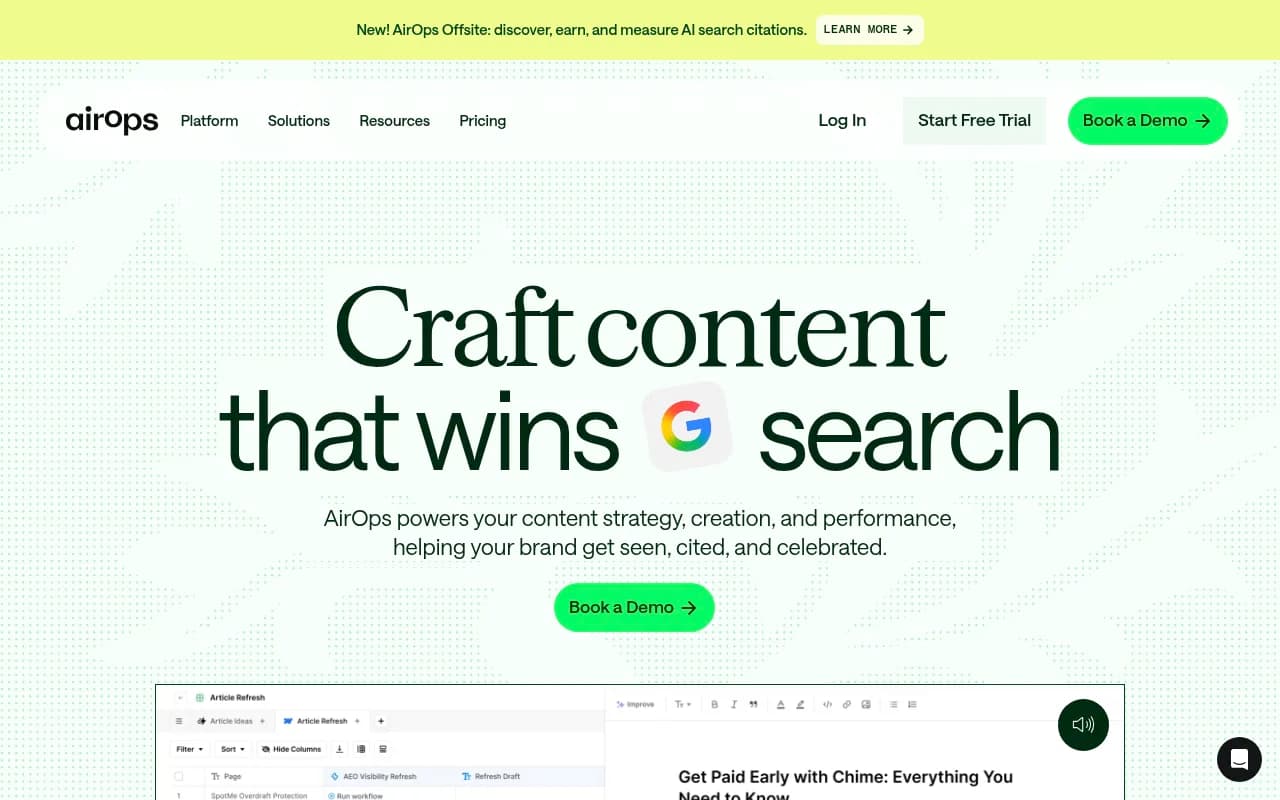
In practice, AirOps is strongest as a content operations platform. It's good at scaling content production and maintaining consistency across large volumes of output. The Quill agent adds some AEO-specific capability, but AirOps is fundamentally a workflow tool that has moved toward GEO -- not a GEO platform that built content generation on top of real visibility data.
Where it shines: teams that need to produce a lot of content quickly, with some SEO structure baked in. Where it falls short: it doesn't show you which prompts you're missing, which AI models are citing your competitors, or whether your new content is actually getting picked up.
Narrato
Narrato is a content workflow and creation platform aimed at content teams and agencies. It covers the full content lifecycle -- briefs, writing, editing, approval workflows, publishing -- with AI assistance throughout.

Narrato's strength is project management for content. If you're running a content operation with multiple writers, editors, and clients, it handles the coordination layer well. The AI writing features are competent but not differentiated -- you get solid output, but there's no GEO-specific intelligence driving what gets written or how it's structured.
For GEO purposes, Narrato is essentially a well-organized writing environment. It doesn't track AI citations, doesn't analyze prompt gaps, and doesn't tell you whether your content is being seen by AI crawlers. It's a production tool, not an optimization tool.
Jasper AI
Jasper has been through a significant evolution. It started as a copywriting tool, expanded into brand voice and templates, and has now repositioned as a marketing platform with agents and content pipelines.

The brand voice and consistency features are genuinely good. Jasper is probably the strongest of the five for keeping AI-generated content on-brand at scale -- which matters if you're a large organization with strict guidelines. The templates cover a wide range of marketing formats, and the agent features can automate multi-step content workflows.
On GEO specifically, Jasper has made some moves. But the core product is still built around content creation, not visibility optimization. You can produce content that looks like it should rank in AI search, but Jasper doesn't tell you which prompts to target, which competitors are winning those prompts, or whether your content is actually being cited. According to ColdIQ's 2026 comparison, "AirOps leads on sustained AI visibility and automation. Jasper leads on keeping that AI-targeted content on-brand."
That's a fair summary. Jasper is the brand consistency choice. It's not the GEO optimization choice.

Writer
Writer is an enterprise AI platform focused on deploying AI agents to automate work across an organization. It's less focused on content marketing specifically and more on enterprise-wide AI deployment -- think knowledge management, internal communications, and business process automation alongside content.

For GEO purposes, Writer is the most tangential of the five. Its content quality is high, and its enterprise governance features (security, compliance, brand controls) are strong. But it's not built for AI search optimization. There's no prompt tracking, no citation analysis, no crawler monitoring. It's an enterprise AI platform that happens to produce content -- not a GEO tool.
If you're a large enterprise that needs AI-generated content with strict governance requirements, Writer is worth evaluating. If your goal is specifically GEO performance, it's not the right fit.
Promptwatch
Promptwatch is a different kind of platform. Where the other four are primarily content creation tools (with varying degrees of GEO awareness), Promptwatch is built around the optimization loop: find the gaps, create content to fill them, track the results.

The distinction matters because GEO output quality isn't just about writing quality -- it's about whether the content answers the right prompts. Promptwatch's Content Agents generate articles, listicles, comparisons, and briefs grounded in real prompt data, citation data, prompt volumes, persona targeting, and competitor analysis. The content is engineered to answer the specific gaps AI models are already exposing, not just to be well-written.
What makes this different from the other four: you can see which prompts your competitors are visible for but you're not, generate content specifically targeting those gaps, and then track whether that content gets cited -- down to the page level, by which AI model, and on what timeline from publish to crawl to citation.
That's a fundamentally different value proposition from "generate good content and hope for the best."
Feature comparison
| Feature | AirOps | Narrato | Jasper AI | Writer | Promptwatch |
|---|---|---|---|---|---|
| AI content generation | Yes | Yes | Yes | Yes | Yes |
| Brand voice / style controls | Partial | Partial | Strong | Strong | Yes |
| GEO-specific content briefs | Partial | No | Partial | No | Yes |
| Prompt gap analysis | No | No | No | No | Yes |
| AI citation tracking | No | No | No | No | Yes |
| Crawler log monitoring | No | No | No | No | Yes |
| Competitor visibility heatmaps | No | No | No | No | Yes |
| Reddit / YouTube insights | No | No | No | No | Yes |
| ChatGPT Shopping tracking | No | No | No | No | Yes |
| Traffic attribution from AI | No | No | No | No | Yes |
| Content workflow management | Yes | Strong | Yes | Yes | Partial |
| Enterprise governance | Partial | Partial | Yes | Strong | Partial |
| Multi-model monitoring (10 AI engines) | No | No | No | No | Yes |
| Free trial | Yes | Yes | Yes | No | Yes |
How each platform approaches GEO content
The table above shows the feature gap clearly, but it's worth explaining the underlying logic.
AirOps, Narrato, Jasper, and Writer all approach GEO content the same way: produce high-quality, well-structured content and trust that good writing will get cited. That's not wrong -- content quality matters. But it's incomplete.
AI models don't cite content randomly. They cite content that answers specific prompts, covers specific entities, and comes from domains they trust and crawl regularly. Without knowing which prompts you're missing, which domains are being cited, and whether your pages are even being crawled, you're optimizing blind.
Promptwatch's approach is different because it starts with data. The Answer Gap Analysis shows exactly which prompts competitors are visible for but you're not. The Content Agents then generate content specifically targeting those gaps -- not generic articles, but content engineered around the specific questions AI models are already answering from competitor sources. And the crawler logs show whether AI agents are actually reading your new pages and when they start citing them.
This is why the GEO output quality comparison isn't really about writing quality. All five platforms can produce readable, well-structured content. The question is whether that content is answering the right questions, and whether you can tell if it's working.
Who should use what
This depends heavily on what problem you're actually trying to solve.
If you need to scale content production with strong brand consistency and your primary concern is traditional marketing content (ads, social, email, blog posts), Jasper is probably the most mature option. The brand voice controls are the best in this group, and the agent features handle multi-step workflows reasonably well.
If you're running a content operation with multiple contributors and need project management baked in, Narrato handles the coordination layer better than the others. It's not a GEO tool, but it's a solid content ops platform.
If you're a large enterprise deploying AI across multiple business functions -- not just content marketing -- Writer's governance and security features make it worth evaluating. Just don't expect GEO-specific capabilities.
If you need workflow automation for AI search content at scale, AirOps is the most GEO-aware of the content-first platforms. The Quill agent shows they're moving in the right direction.
If your actual goal is improving how your brand appears in AI-generated answers -- tracking which prompts you're missing, generating content to fill those gaps, and measuring whether it's working -- none of the first four platforms are built for that. Promptwatch is.
A note on pricing
Pricing varies significantly across these platforms, and direct comparison is tricky because they're solving different problems.
Promptwatch's plans start at $99/month (Essential: 1 site, 50 prompts, 5 articles), $249/month (Professional: 2 sites, 150 prompts, 15 articles, crawler logs), and $579/month (Business: 5 sites, 350 prompts, 30 articles). A free trial is available.
Jasper's pricing is in a similar range for teams, though enterprise plans get expensive quickly. AirOps, Narrato, and Writer all have tiered pricing that scales with usage and team size.
The more useful question isn't which is cheapest -- it's what you're paying for. If you're paying for content generation without visibility data, you're flying blind on GEO. If you're paying for visibility data without content generation, you know what to fix but can't act on it efficiently.
The honest verdict
Ranking these five platforms by "GEO output quality" requires being honest about what that phrase means.
If it means "quality of the writing produced," all five are competent. Jasper and Writer have the edge on brand consistency. AirOps has the edge on workflow automation.
If it means "quality of the content's ability to actually rank in AI search" -- which requires targeting the right prompts, covering the right entities, being crawled by AI agents, and getting cited -- then Promptwatch is in a different category from the other four. It's the only platform that connects content generation to real visibility data and lets you measure whether your content is actually working.
The other four are good tools for different jobs. They're just not GEO optimization platforms. Calling them that would be generous.
If you're serious about AI search visibility in 2026, the workflow that actually works looks like this: track which prompts you're missing, generate content that answers them, and measure whether AI models start citing you. That loop requires data that most content platforms don't have. It's worth knowing that before you commit to a tool.