Key takeaways
- AirOps is a content engineering platform built around AI search visibility, with strong workflow automation and its Quill agent for content production.
- Searchable combines AI visibility monitoring with built-in content generation, but lacks the depth of tracking and optimization features found in more specialized platforms.
- Promptwatch is the only platform that closes the full loop: it finds gaps in your AI visibility, generates content to fill them, and tracks the results down to page-level citations and actual revenue.
- If your goal is just content production, AirOps is a serious option. If you want to understand and improve how AI search engines actually cite your brand, Promptwatch is the more complete choice.
- All three tools are meaningfully different -- picking the wrong one means paying for capabilities you don't need while missing the ones you do.
The AI content generation space has gotten genuinely confusing. A year ago, "AI content tool" meant something like Jasper or Copy.ai -- write faster, publish more. Now the same phrase covers platforms that track your brand across ChatGPT, generate articles engineered to appear in AI search results, analyze crawler logs, and tie visibility back to pipeline. The category has split into at least three distinct approaches, and AirOps, Searchable, and Promptwatch represent three of the clearest examples.
This guide breaks down what each platform actually does, where the real differences lie, and which one makes sense depending on what you're trying to accomplish.
What problem are these tools solving?
Before comparing features, it's worth being clear about the underlying problem each tool is designed to fix.
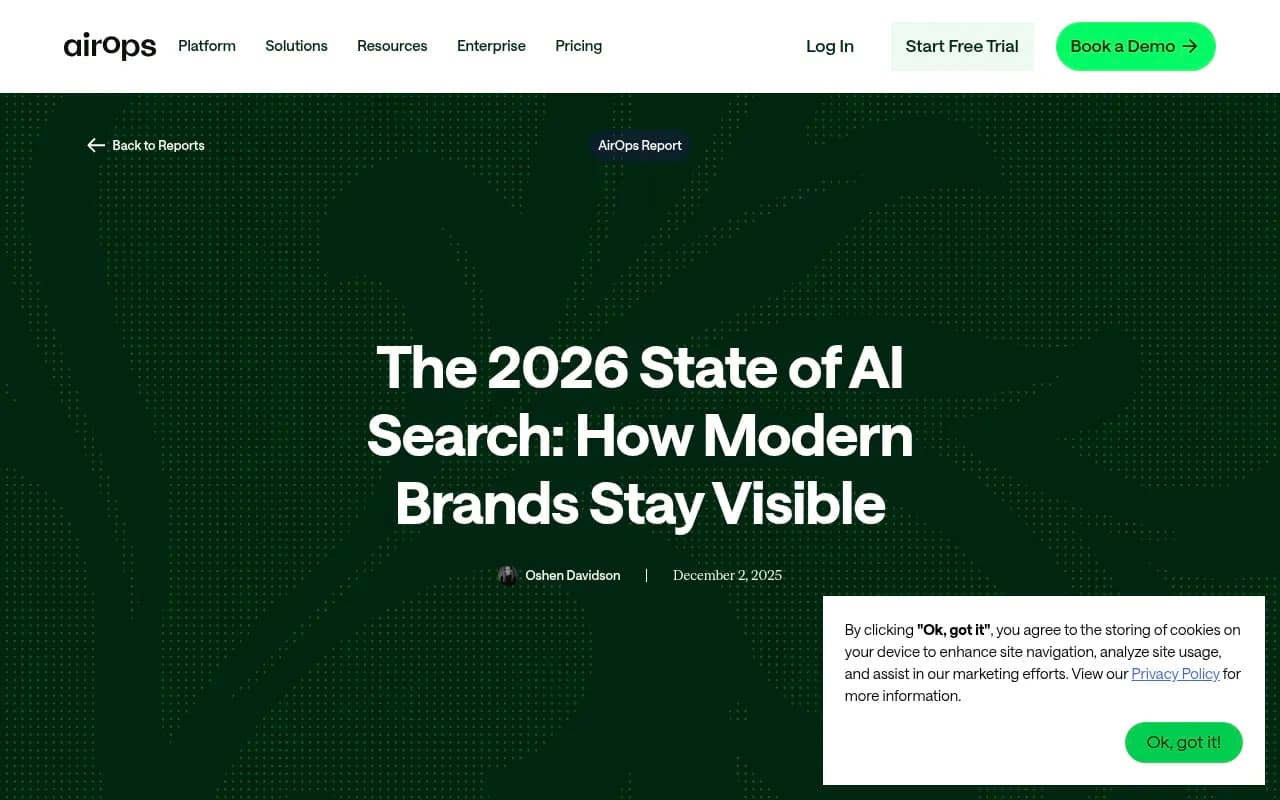
AI search engines -- ChatGPT, Perplexity, Google AI Overviews, Claude, Gemini -- don't rank pages the way Google does. They synthesize answers from sources they've crawled and deemed credible. If your content isn't being cited, you're invisible to a growing share of search traffic. AirOps research from their 2026 State of AI Search report found that only 30% of brands stay visible from one AI answer to the next, and roughly 60% of AI Overview citations come from URLs not ranking in the top 20 organic results.
That last stat is the crux of the problem: traditional SEO rankings don't predict AI visibility. You need a different strategy, different content, and different measurement.
AirOps, Searchable, and Promptwatch all claim to address this. But they do it in very different ways.
AirOps: content engineering at scale
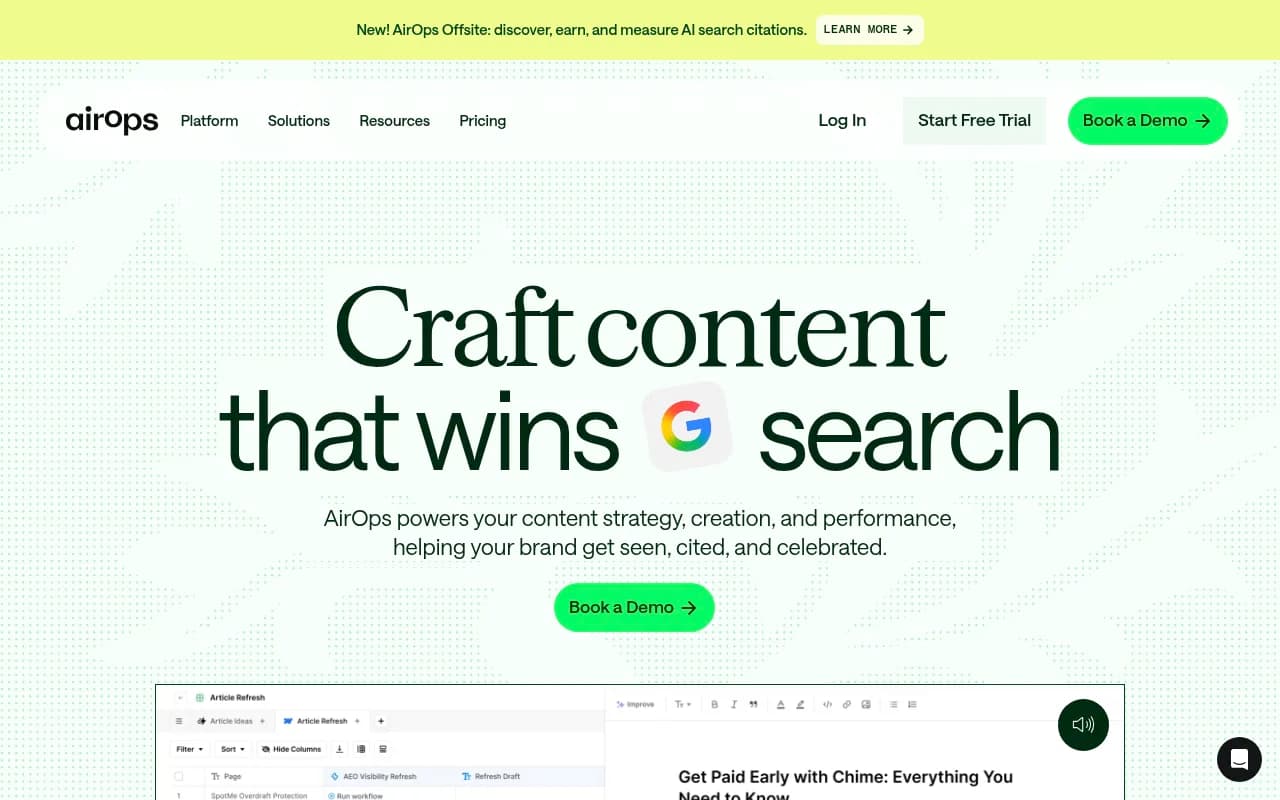
AirOps positions itself as a content engineering platform for AI search visibility. The core idea is that winning in AI search requires producing content at scale that's specifically structured to be cited -- not just SEO-optimized blog posts, but pages that answer the exact questions AI models are already synthesizing answers for.
The platform launched its Quill agent in May 2026, which automates a significant portion of the content production workflow. Quill can research topics, generate drafts, and publish content based on templates and brand guidelines. For growth teams running high-volume content operations, this is genuinely useful.
AirOps also covers owned and third-party placements -- meaning it tracks not just whether your own pages are being cited, but whether your brand appears in external sources that AI models pull from. That's a meaningful distinction. AirOps' own research shows that 85% of brand mentions in AI answers originate from third-party pages rather than owned domains, so tracking only your own site misses most of the picture.
Where AirOps is strong:
- High-volume content production with AI agents
- Workflow automation for content teams
- Research-backed content strategy (their 2026 State of AI Search report is genuinely good)
- Third-party placement tracking
Where it's weaker:
- Less depth on prompt-level tracking and citation analytics compared to dedicated GEO platforms
- No AI crawler log analysis (understanding why AI engines are or aren't crawling your pages)
- Content generation is the primary focus -- the monitoring side is less developed
- Pricing isn't publicly listed, which makes it harder to evaluate for smaller teams
AirOps makes the most sense for content-heavy teams that need to produce a lot of AI-optimized content quickly and have some existing infrastructure for tracking results.
Searchable: monitoring with content generation built in
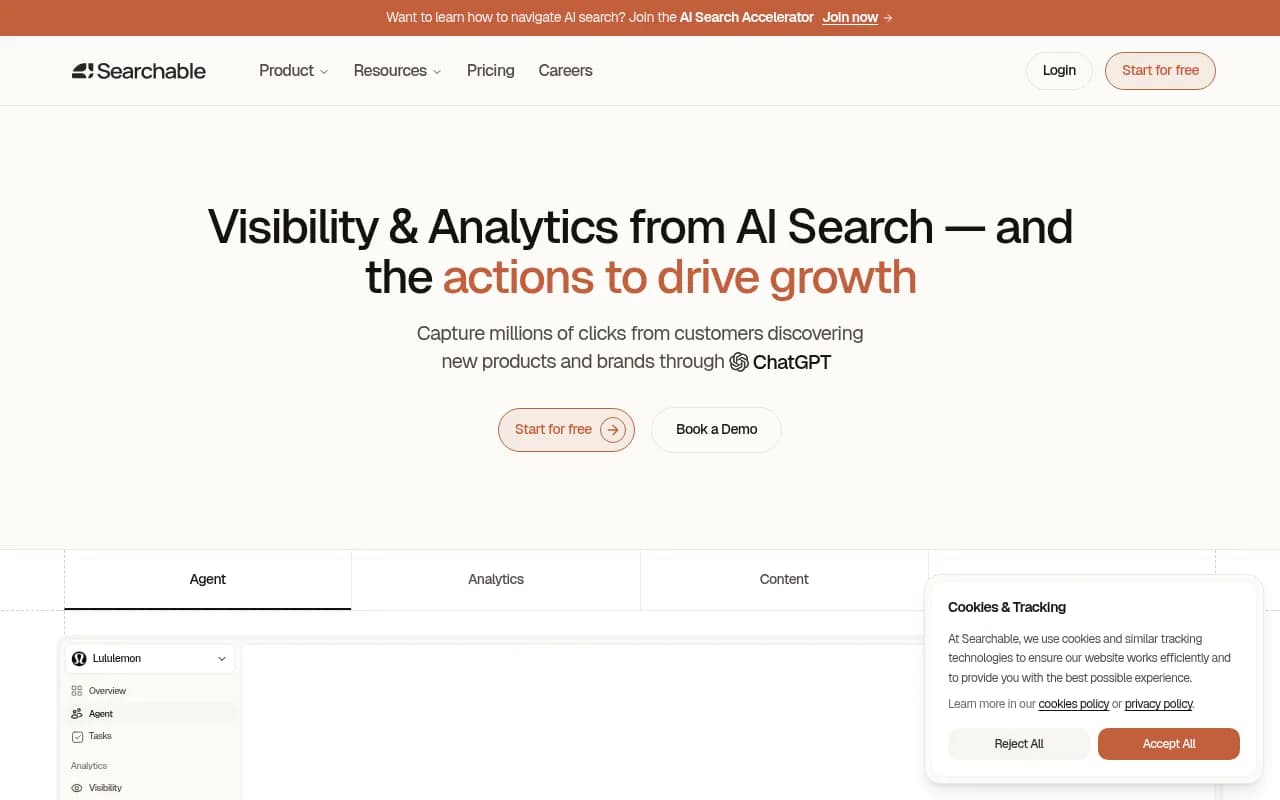
Searchable takes a different angle. It's an AI search visibility platform that includes content generation as part of its feature set -- the pitch being that you can monitor where you're missing and then generate content to fill those gaps, all in one place.
The monitoring side covers brand mentions across major AI engines, citation tracking, and some competitor comparison. The content generation side lets you create articles and pages based on visibility data.
In practice, Searchable sits somewhere between a pure monitoring tool and a full content platform. It's more capable than basic trackers like Otterly.AI or Peec.ai, but it doesn't go as deep as either AirOps (on the content side) or Promptwatch (on the monitoring and optimization side).
Where Searchable is reasonable:
- Combines monitoring and content generation in one interface
- Lower complexity than enterprise-focused platforms
- Decent for teams that want a single tool rather than stitching multiple products together
Where it falls short:
- Content generation is more generic than platforms built specifically around prompt data and citation analysis
- Missing AI crawler logs, which means you can't diagnose why AI engines aren't crawling or citing your pages
- No Reddit or YouTube insights, which matter because AirOps' own data shows 48% of AI citations come from community platforms
- Less granular prompt intelligence -- no volume estimates, difficulty scores, or query fan-outs
- Page-level citation tracking is limited compared to more specialized platforms
Searchable is a reasonable starting point for teams that want to dip into AI visibility without committing to a more complex platform. But teams that get serious about GEO tend to outgrow it.
Promptwatch: the full optimization loop
Promptwatch takes the most comprehensive approach of the three. The core difference isn't just more features -- it's a fundamentally different philosophy about what the tool should do.
Most AI visibility platforms are monitoring dashboards. They show you data: where you appear, where you don't, how you compare to competitors. That's useful, but it leaves you stuck. You know you have a problem; you still have to figure out how to fix it.
Promptwatch is built around what it calls the action loop: find the gaps, create content that fills them, track the results.

The gap-finding starts with Answer Gap Analysis, which shows exactly which prompts competitors are visible for that you're not -- and more specifically, what content your site is missing that AI models want to cite. This isn't a vague "you should write more about X" suggestion. It's a map of specific topics, angles, and questions where AI models are already synthesizing answers but not finding your content.
The content creation side uses Content Agents that generate articles, listicles, comparisons, and briefs grounded in real prompt data, citation data, prompt volumes, persona targeting, and competitor analysis. The output is engineered to answer the specific gaps AI models are already exposing -- not generic SEO filler.
The tracking side goes deeper than most platforms. Page-level visibility tracking shows exactly which pages are being cited, how often, and by which AI model. AI Crawler Logs (available on Professional and above) show in real time which AI crawlers are hitting your site, which pages they're reading, what errors they encounter, and how often they return. This is how you diagnose why you're not being cited -- not just that you're not.
A few other things Promptwatch does that neither AirOps nor Searchable match:
- Reddit and YouTube insights that surface discussions influencing AI recommendations
- ChatGPT Shopping tracking for brands that appear in product carousels
- Offsite citation analysis tracking which external pages and third-party sources are driving your AI visibility
- Prompt Intelligence with volume estimates, difficulty scores, and query fan-outs
- Multi-language and multi-region monitoring with customizable personas
- Traffic attribution that connects AI visibility to actual revenue
Promptwatch monitors 10 AI models: ChatGPT, Perplexity, Google AI Overviews, Google AI Mode, Claude, Gemini, Meta/Llama, DeepSeek, Grok, Mistral, and Copilot. That's broader coverage than most competitors.
Pricing starts at $99/month for the Essential plan (1 site, 50 prompts, 5 articles), $249/month for Professional (2 sites, 150 prompts, 15 articles, crawler logs), and $579/month for Business (5 sites, 350 prompts, 30 articles). A free trial is available.
Feature comparison
| Feature | AirOps | Searchable | Promptwatch |
|---|---|---|---|
| AI visibility monitoring | Yes | Yes | Yes |
| Content generation | Yes (Quill agent) | Yes (basic) | Yes (Content Agents) |
| Prompt-level tracking | Limited | Limited | Yes, with volume + difficulty |
| Answer Gap Analysis | No | Partial | Yes |
| AI Crawler Logs | No | No | Yes (Professional+) |
| Page-level citation tracking | No | No | Yes |
| Reddit & YouTube insights | No | No | Yes |
| ChatGPT Shopping tracking | No | No | Yes |
| Offsite citation analysis | Partial | No | Yes |
| Traffic attribution | No | No | Yes |
| Multi-language / multi-region | Limited | No | Yes |
| Number of AI models tracked | Not specified | Limited | 10 |
| Pricing transparency | No | Limited | Yes ($99-$579/mo) |
| Free trial | Yes | Yes | Yes |
Which tool is right for you?
The honest answer depends on what stage you're at and what you actually need.
If you're a content team running high-volume production and your primary goal is generating AI-optimized content at scale, AirOps is worth evaluating seriously. The Quill agent is a real capability, and their research on AI search behavior is some of the better public work in the space. Just know that the monitoring and optimization depth isn't there yet.
If you want a simple, single-tool entry point into AI visibility with some content generation included, Searchable is a reasonable starting point. It's less overwhelming than enterprise platforms. But be realistic about its ceiling -- you'll likely want more granular data as your GEO program matures.
If you want to actually move your AI visibility numbers -- not just measure them -- Promptwatch is the most complete option. The combination of gap analysis, content generation grounded in real prompt data, AI crawler logs, and page-level tracking means you can run a proper optimization cycle rather than just watching a dashboard. For marketing teams, SEO teams, and agencies that are serious about AI search, that full loop matters.
The GEO market is still young enough that most tools are still figuring out what they are. AirOps is primarily a content platform that added visibility features. Searchable is a monitoring tool that added content generation. Promptwatch was built from the start around the idea that monitoring without action is just expensive reporting. That difference in philosophy shows up in the product.
One more thing worth knowing
AirOps' own 2026 State of AI Search data found that pages not updated quarterly are 3x more likely to lose citations, and that sequential headings with rich schema correlate with 2.8x higher citation rates. That's useful regardless of which tool you use -- AI search rewards freshness and structure in ways that traditional SEO didn't require.
The implication is that AI visibility isn't a one-time project. It's an ongoing program. Which means the tool you choose needs to support not just an initial audit but a continuous cycle of finding gaps, creating content, and tracking what works. That's the lens to use when evaluating any platform in this space.