Key takeaways
- AI search engines like ChatGPT, Perplexity, and Google AI Overviews now influence millions of purchase decisions daily -- and most consumer brands have no idea whether they're being mentioned or not.
- For B2C brands, the stakes are different from B2B: you need product-level tracking, shopping recommendation monitoring, and fast content turnaround -- not just share-of-voice dashboards.
- Most platforms stop at monitoring. The ones worth paying for also help you close the gaps they find.
- Promptwatch is the only platform in 2026 rated as a "Leader" across all GEO categories -- and the only one that connects monitoring to content generation to traffic attribution in a single workflow.
- Free or cheap tools can get you started, but they won't scale with a serious consumer brand.
Why B2C brands have a different AI visibility problem
If you run marketing for a consumer brand -- fashion, beauty, food, travel, home goods, consumer electronics -- the AI search shift hits you differently than it hits a B2B SaaS company.
B2B buyers are doing research over weeks. B2C consumers ask ChatGPT "what's the best moisturizer for dry skin" and buy something within the hour. The window is short. The stakes per query are lower, but the volume is enormous. And unlike B2B, your brand might be competing not just for a mention but for a spot in a ChatGPT shopping carousel or a Perplexity product recommendation.
That changes what you need from an AI visibility platform. You're not just tracking whether your brand name appears in some generic industry prompt. You need to know:
- Which product categories are AI models recommending you for?
- Are competitors getting cited in "best X for Y" queries that you should own?
- When ChatGPT shows a shopping list, does your product appear?
- Which of your product pages are actually being crawled and cited by AI engines?
Most platforms weren't built with these questions in mind. They were built for B2B brand monitoring. So let's look at what actually matters for consumer brands, then walk through the tools.
What to look for in an AI visibility platform (B2C lens)
Multi-model coverage that includes shopping surfaces
ChatGPT, Perplexity, Google AI Overviews, Google AI Mode, Gemini, Grok, Claude -- these are the models your customers are actually using. A platform that only monitors one or two of them is giving you a partial picture. For B2C specifically, you also want a platform that tracks shopping recommendations and product carousels, not just text citations.
Prompt tracking at the product and category level
Generic brand monitoring tells you whether your company name appears in AI responses. That's a start. But consumer brands need prompt tracking at the category level: "best running shoes under $150," "top-rated coffee makers 2026," "moisturizer for sensitive skin." These are the prompts your customers are actually typing. If you're not tracking them, you don't know where you're winning or losing.
Content gap analysis and generation
Finding out you're invisible is only useful if you can do something about it. The best platforms don't just show you the gap -- they help you create the content that closes it. For B2C brands with large product catalogs and fast-moving trends, this matters a lot.
AI crawler logs
Which of your pages are AI engines actually reading? Which ones are returning errors? Which ones get crawled but never cited? This is technical intelligence that most monitoring tools completely ignore, and it's often the difference between a page that gets cited and one that doesn't.
Traffic attribution
Ultimately, you need to know whether AI visibility is driving actual revenue. Platforms that connect AI citations to website traffic and conversions give you something you can take to a CFO.
The platforms worth considering in 2026
Promptwatch -- best overall for B2C brands
Promptwatch is the platform I'd recommend first for any serious consumer brand. It's used by 1,480+ brands and agencies including Booking.com and Center Parcs, and it's the only platform in a 2026 comparison of 12 GEO tools rated as a "Leader" across every category.
What makes it different for B2C is the full action loop: it finds the gaps, helps you create content to close them, and then tracks whether that content actually gets cited. Most competitors stop at step one.
Specific features that matter for consumer brands:
- ChatGPT Shopping tracking -- monitors when your products appear in ChatGPT's shopping carousels and product recommendations, which is genuinely unique
- AI Crawler Logs -- real-time data on which pages AI engines are crawling, what errors they're hitting, and when pages move from crawled to cited
- Answer Gap Analysis -- shows you the exact prompts competitors are visible for that you're not, at the product and category level
- Content Agents -- generate articles, listicles, and comparison content grounded in real prompt data and competitor analysis, not generic SEO filler
- Reddit and YouTube tracking -- surfaces the discussions and videos that AI models are actually citing, which is a channel most platforms ignore entirely
- Monitors 10 AI models including Google AI Mode, Grok, DeepSeek, and Mistral -- not just the obvious three
Pricing starts at $99/month for the Essential plan (1 site, 50 prompts, 5 articles). The Professional plan at $249/month adds crawler logs, state/city tracking, and 15 articles per month. For multi-brand consumer companies, the Business plan at $579/month covers 5 sites.

Profound -- strong for enterprise consumer brands
Profound is a well-regarded enterprise platform with solid multi-model coverage and good competitive benchmarking. It's used by large brands and handles scale well. The gap compared to Promptwatch is on the action side -- Profound is primarily a monitoring and analytics tool. It'll tell you where you stand, but it won't help you generate the content to improve your position. For a brand with a large in-house content team that just needs data, that's fine. For a lean marketing team that needs the whole workflow, it's a limitation.
Profound

Otterly.AI -- good starting point, limited depth
Otterly.AI is one of the more accessible entry points for AI visibility monitoring. It tracks brand mentions across ChatGPT, Perplexity, and Google AI Overviews, and the interface is clean. For a small consumer brand just getting started with GEO, it's a reasonable first step.
The limitations show up quickly though. No crawler logs, no content generation, no shopping tracking, no Reddit or YouTube insights. It's a monitoring dashboard, not an optimization platform. Fine for awareness, not for action.
Otterly.AI

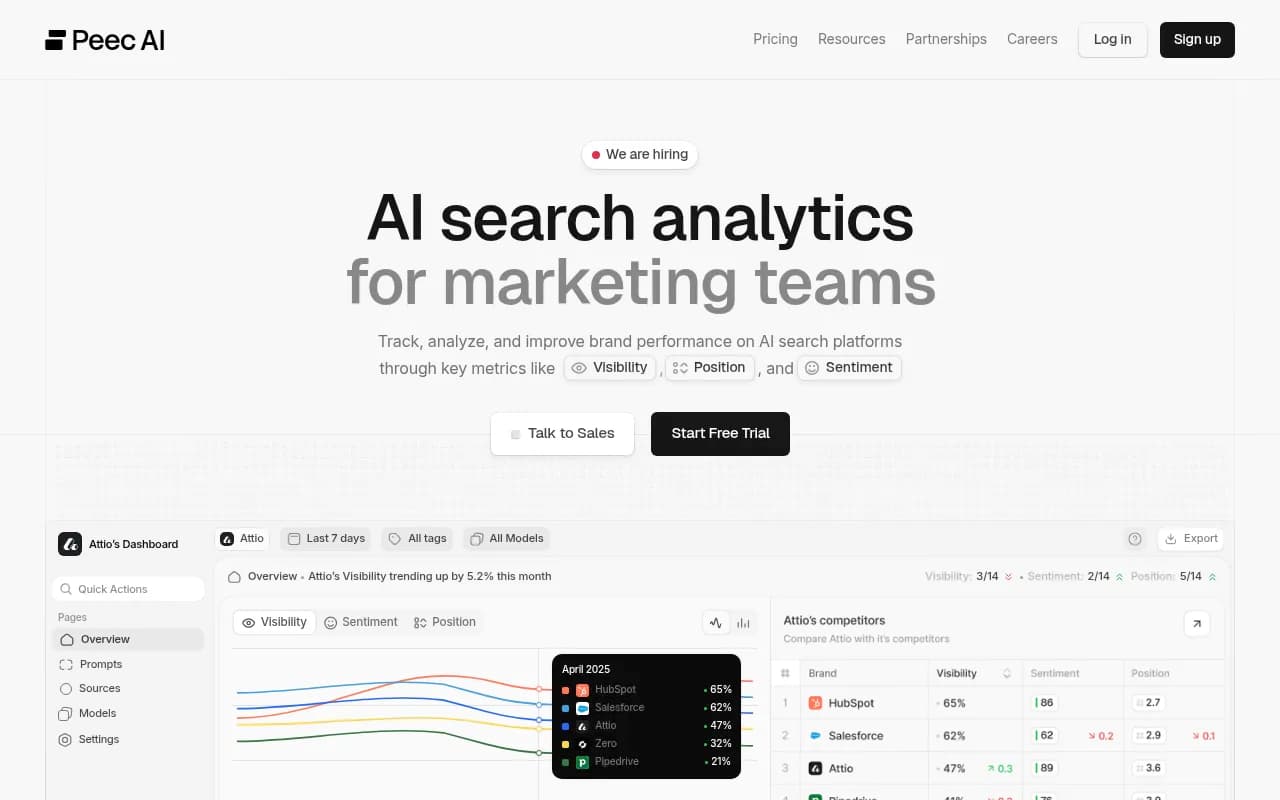
Peec AI -- solid monitoring for mid-market brands
Peec AI sits in a similar space to Otterly -- monitoring-focused, reasonably priced, decent multi-model coverage. It's a common shortlist choice for mid-market marketing teams. Like Otterly, it doesn't offer much on the content or optimization side, but the tracking data is solid and the interface is easy to use.
Semrush -- familiar but limited on AI search depth
Semrush added AI visibility features to its platform and released a 2026 AI Visibility Index analyzing 126 million AI search prompts. If your team is already in Semrush daily, the convenience of having AI monitoring in the same tool has real value. The limitation is that Semrush uses fixed prompts rather than letting you track the specific queries your customers are actually using, and there's no AI traffic attribution. It's a bolt-on, not a purpose-built solution.
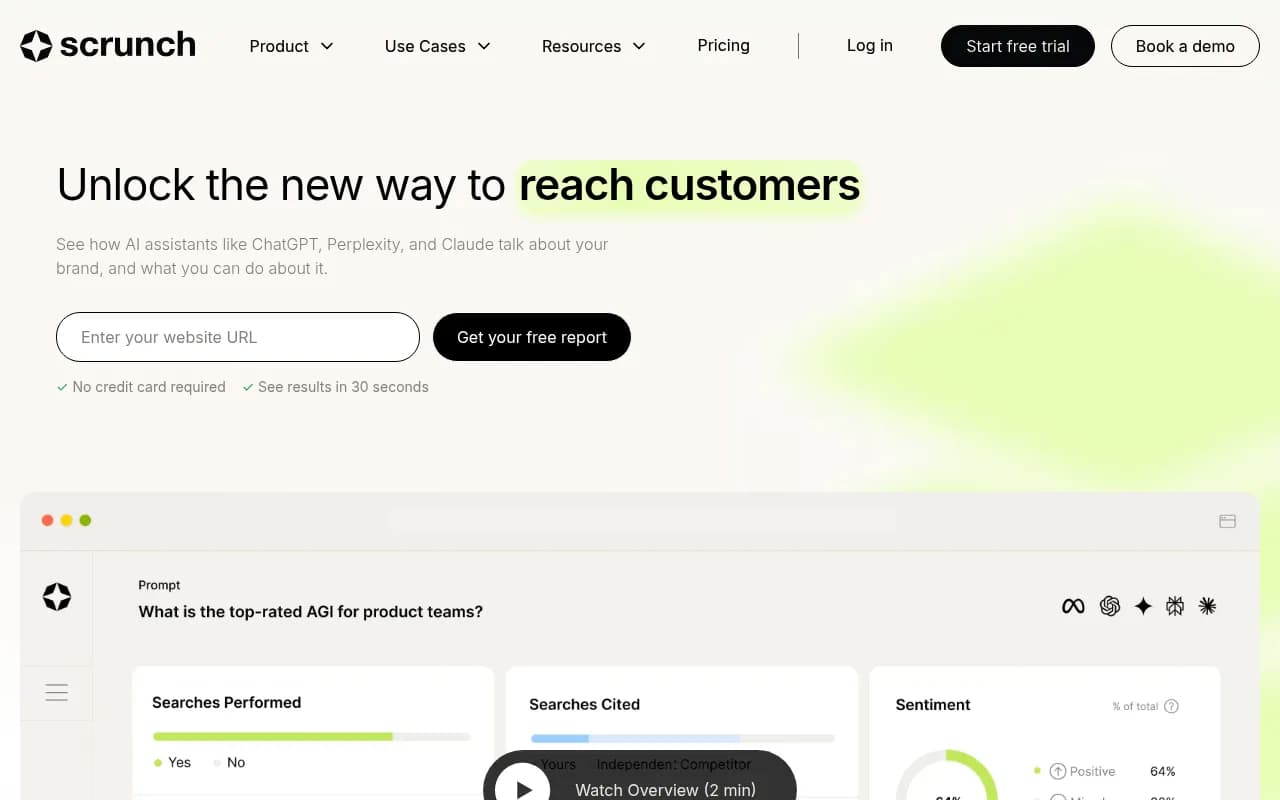
Scrunch AI -- worth a look for content-heavy brands
Scrunch AI has been building out its GEO feature set and is worth evaluating if you're specifically focused on content optimization for AI search. It has reasonable tracking capabilities and some content tooling. The gap is in the breadth of AI model coverage and the depth of analytics compared to Promptwatch.
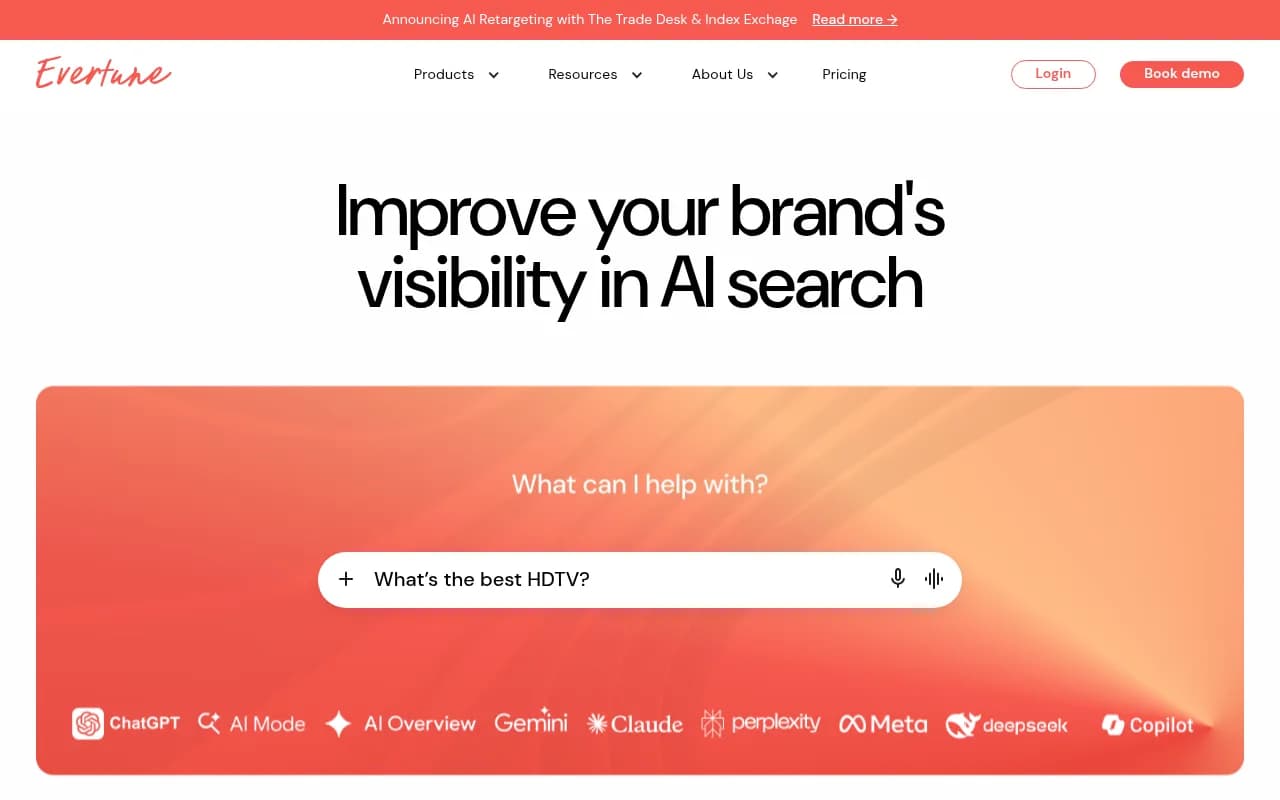
Evertune -- enterprise GEO with strong Fortune 500 focus
Evertune positions itself at the Fortune 500 end of the market with a strong emphasis on GEO insights and brand monitoring at scale. If you're a large consumer brand with complex multi-brand portfolios and need enterprise-grade reporting, it's worth evaluating. The pricing and complexity may be overkill for mid-market brands.
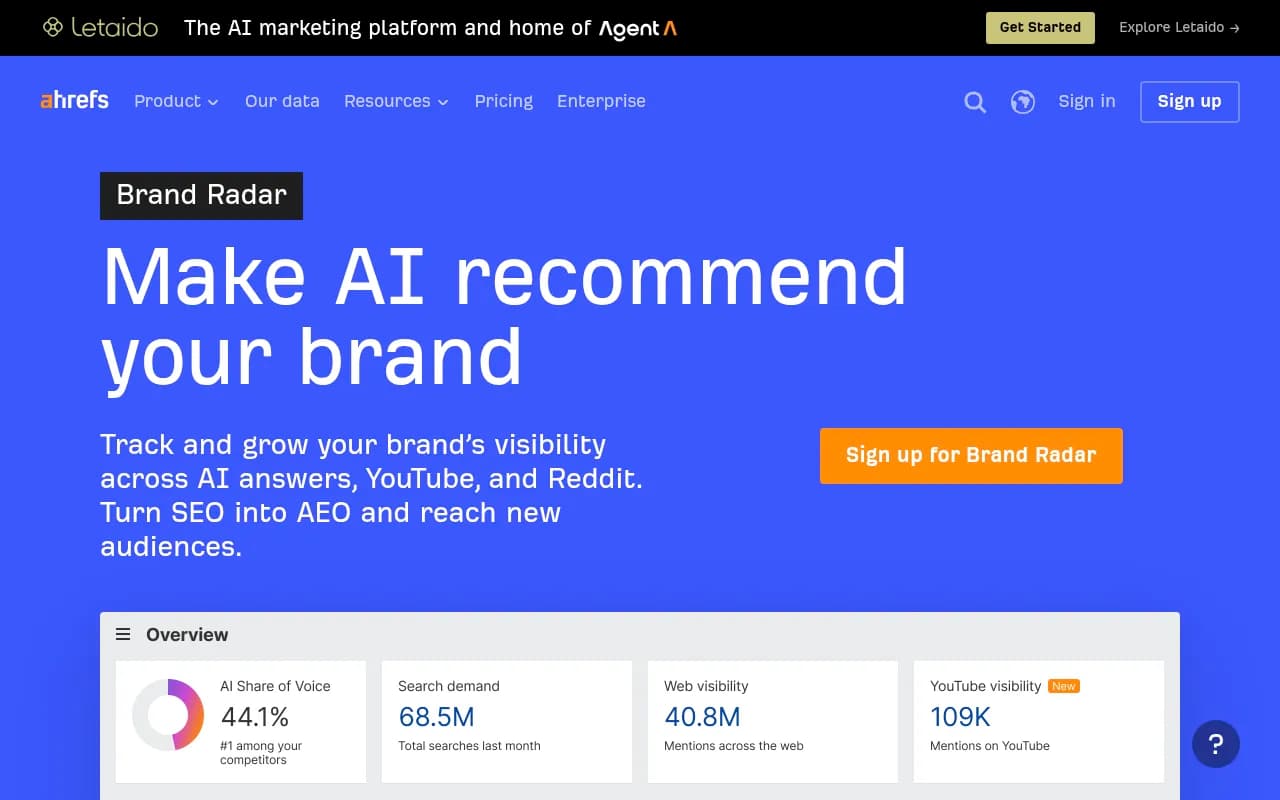
Ahrefs Brand Radar -- useful if you're already in Ahrefs
Similar to Semrush, Ahrefs Brand Radar is a useful addition if you're already paying for Ahrefs. It gives you brand visibility in AI search without switching platforms. The fixed prompt structure and lack of AI traffic attribution are the same limitations as Semrush. Think of it as a starting point, not a complete solution.
Platform comparison table
| Platform | AI models covered | Shopping tracking | Crawler logs | Content generation | Reddit/YouTube | Traffic attribution | Starting price |
|---|---|---|---|---|---|---|---|
| Promptwatch | 10 | Yes | Yes | Yes | Yes | Yes | $99/mo |
| Profound | 9+ | No | No | No | No | No | Custom |
| Otterly.AI | 3 | No | No | No | No | No | ~$49/mo |
| Peec AI | 4+ | No | No | No | No | No | ~$79/mo |
| Semrush | 3-4 | No | No | No | No | No | $139/mo+ |
| Scrunch AI | 5+ | No | No | Partial | No | No | Custom |
| Evertune | 6+ | No | No | No | No | No | Custom |
| Ahrefs Brand Radar | 3 | No | No | No | No | No | $129/mo+ |
The B2C-specific use cases that separate good platforms from great ones
ChatGPT shopping recommendations
This is genuinely new territory. When a user asks ChatGPT "what's the best wireless headphone under $200," the model sometimes returns a shopping carousel with product images, prices, and links. If your product isn't in that carousel, you've lost a purchase decision. Tracking this requires monitoring the actual user-facing interface of ChatGPT, not just API outputs -- because the shopping layer often differs from what the API returns. Promptwatch is the only platform in this comparison that explicitly tracks this surface.
"Best of" and comparison prompts
Consumer purchase decisions are heavily driven by "best X for Y" queries. "Best protein powder for beginners," "most comfortable running shoe for flat feet," "top-rated air fryer 2026." These are high-intent, high-volume prompts. A good AI visibility platform lets you track exactly which of these your brand appears in, which competitors are winning, and what content is driving those citations.
Multi-location and regional visibility
Consumer brands with physical retail presence -- restaurants, retail chains, hotels -- need to know how AI models respond to location-specific queries. "Best coffee shop near me" or "top hotel in Amsterdam" require regional prompt tracking. Promptwatch's Professional plan includes state/city tracking for this reason.
Trend-responsive content
Consumer trends move fast. A beauty brand needs to respond to a trending ingredient before competitors do. Platforms that surface prompt volume data and difficulty scores let you prioritize which gaps to close first -- the ones with high search volume and low competition. That's a meaningful advantage in fast-moving consumer categories.
How to build an AI visibility workflow for a consumer brand
Getting started doesn't require a massive investment. Here's a practical sequence:
-
Pick 20-30 prompts that represent how your customers actually search for products in your category. Not your brand name -- the category-level queries. "Best [product type] for [use case]."
-
Run those prompts across the major AI models and see where you appear, where competitors appear, and what content is being cited. This is your baseline.
-
Identify the gaps -- prompts where competitors are visible and you're not. These are your highest-priority targets.
-
Look at what content is being cited for those prompts. Is it a comparison article? A Reddit thread? A YouTube review? A brand's own product page? That tells you what format to create.
-
Create content specifically designed to answer those prompts. Not generic blog posts -- content that directly addresses the question the AI model is trying to answer.
-
Track whether AI crawlers pick up your new content and whether it starts appearing in responses.
-
Repeat. This is a continuous cycle, not a one-time project.
Tools like Promptwatch automate most of this workflow. The Answer Gap Analysis handles step 3, Content Agents handle step 5, and the crawler logs and page-level tracking handle step 6. For teams without dedicated GEO resources, that automation is what makes the difference between a strategy that gets executed and one that stays in a slide deck.
What most platforms get wrong for B2C
The majority of AI visibility tools were designed with B2B SaaS in mind. They track brand name mentions in industry-level prompts, show share-of-voice dashboards, and call it done. That's useful for a software company. It's incomplete for a consumer brand.
Consumer brands need product-level tracking, not just brand-level. They need to know whether their specific SKUs are being recommended, not just whether their company name appears somewhere in an AI response. They need shopping surface monitoring. They need fast content turnaround to respond to trends. And they need attribution that connects AI visibility to actual purchase behavior.
The platforms that understand this -- and build features around it -- are the ones worth evaluating seriously. The ones that don't are monitoring dashboards dressed up as GEO platforms.
Bottom line
AI search is already influencing consumer purchase decisions at scale. Semrush's 2026 AI Visibility Index analyzed 126 million AI search prompts -- that's not a niche phenomenon, that's a mainstream shift in how people discover products.
For B2C brands, the question isn't whether to invest in AI visibility. It's which platform gives you the full picture and the tools to act on it. Monitoring-only tools will tell you you're invisible. What you need is a platform that also helps you fix it.
Promptwatch is the clearest choice for brands that want the complete workflow -- from gap identification to content creation to citation tracking to revenue attribution. For brands just getting started with smaller budgets, Otterly.AI or Peec AI can provide a baseline. But plan to outgrow them quickly.
The brands that figure this out in 2026 will have a meaningful head start on the ones that treat AI search as a future problem.