Key takeaways
- Most AI visibility platforms in 2026 are monitoring dashboards — they show you where you're invisible but don't help you do anything about it.
- A small number of platforms have moved beyond tracking into what you might call the "action loop": find gaps, generate content, track results.
- The platforms worth paying for in 2026 are the ones that close that loop — connecting prompt data to content creation to measurable visibility improvement.
- Crawler logs, prompt volume data, and content gap analysis are the features that separate action-oriented platforms from pure trackers.
- Price alone is a poor guide here. A $29/month tracker that only shows you data is less useful than a $249/month platform that helps you act on it.
The real problem with most AI visibility tools
AI-referred traffic to websites grew roughly 393% year over year in Q1 2026, according to Adobe. Visitors arriving from ChatGPT, Perplexity, and Google AI Overviews convert better and spend more per visit than traffic from paid search or email. The math is obvious: if your brand isn't appearing in AI-generated answers, you're losing high-intent buyers.
That's why the AI visibility tool category exploded from a handful of options in 2024 to more than 15 serious platforms by mid-2026. Every week there's a new tracker, a new dashboard, a new share-of-voice score.
Here's the problem: most of them stop at the dashboard.
They'll show you that your competitor appears in 67% of relevant AI responses and you appear in 23%. They'll show you sentiment scores, citation rates, and a heatmap of which LLMs mention you. That's genuinely useful data. But then what? The tool has no answer. You're left staring at a gap with no clear path to closing it.
The platforms worth serious attention in 2026 are the ones that actually help you fix the problem — not just describe it.
What "action tools" actually means
Before comparing platforms, it's worth being precise about what separates a monitoring tool from an action-oriented one.
A monitoring tool tracks your AI visibility and reports it. That's table stakes now.
An action-oriented platform does at least some of the following:
- Shows you the specific prompts where competitors appear but you don't (answer gap analysis)
- Tells you what content your site is missing that would close those gaps
- Helps you create that content — articles, briefs, comparisons — grounded in real prompt data
- Tracks AI crawler activity on your site so you can fix indexing issues
- Connects new content back to visibility improvements over time
The distinction matters because the goal isn't a better dashboard. The goal is more citations, more traffic, more revenue from AI search. A tool that only monitors is like a fitness tracker that shows your heart rate but can't tell you how to get healthier.
The platforms that go beyond monitoring
Promptwatch
Promptwatch is the most complete action loop available in 2026. It's used by 1,480+ brands and agencies including Booking.com and Center Parcs, and it's the only platform in a recent 12-tool comparison rated as a "Leader" across all evaluation categories.

What makes it different from monitoring-only tools is the full cycle it supports. The Answer Gap Analysis shows you exactly which prompts competitors rank for that you don't — not as a vague "content gap" but as specific questions and topics AI models are already answering from competitor content. From there, Content Agents generate articles, listicles, and briefs grounded in that same prompt data, with brand guidance, competitor analysis, and real citation data baked in. Then page-level tracking shows you which new pages are being cited, by which models, and how often.
The crawler log feature is genuinely rare. Promptwatch shows you real-time logs of AI crawlers (ChatGPT, Claude, Perplexity, and others) hitting your site — which pages they read, errors they hit, how often they return. Most competitors don't have this at all. It's the difference between knowing you're invisible and knowing why you're invisible.
It also tracks 10 AI models (ChatGPT, Perplexity, Google AI Overviews, Google AI Mode, Claude, Gemini, Meta/Llama, DeepSeek, Grok, Mistral, Copilot), monitors Reddit and YouTube for discussions influencing AI recommendations, and includes ChatGPT Shopping tracking for brands with products.
Pricing starts at $99/month (Essential: 1 site, 50 prompts, 5 articles), $249/month (Professional: 2 sites, 150 prompts, 15 articles, crawler logs), and $579/month (Business: 5 sites, 350 prompts, 30 articles). A free trial is available.
AirOps
AirOps sits at the content operations end of the spectrum. It's built for teams that need to produce AI-optimized content at scale, with workflows that connect research to writing to publishing.
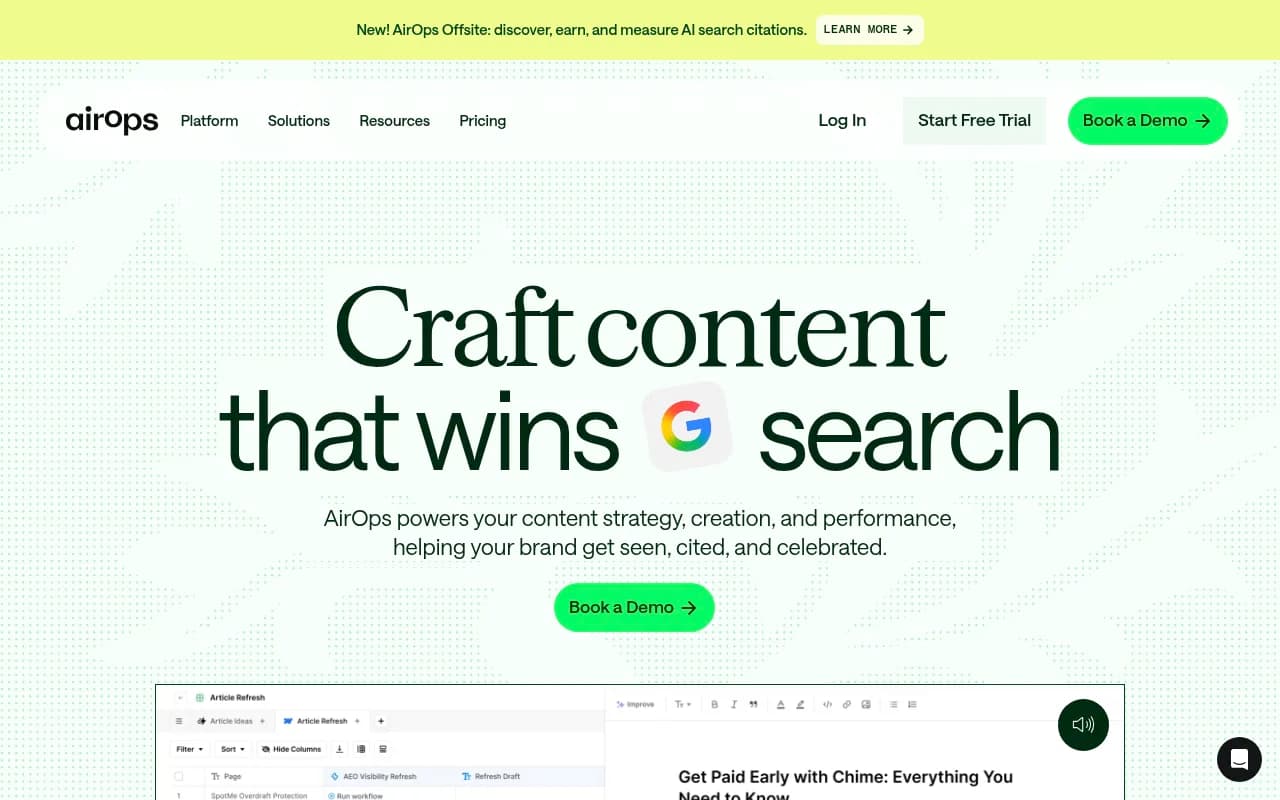
It tracks up to 4 AI models and has a free tier, which makes it accessible for smaller teams. The strength is in content engineering — building structured workflows that generate content grounded in search and AI data. It's less of a visibility tracker and more of a production system, which means it works best alongside a dedicated monitoring tool rather than as a standalone solution.
Searchable
Searchable sits in an interesting middle ground: it monitors AI visibility across up to 7 models and has built-in content generation features, starting at $50/month.
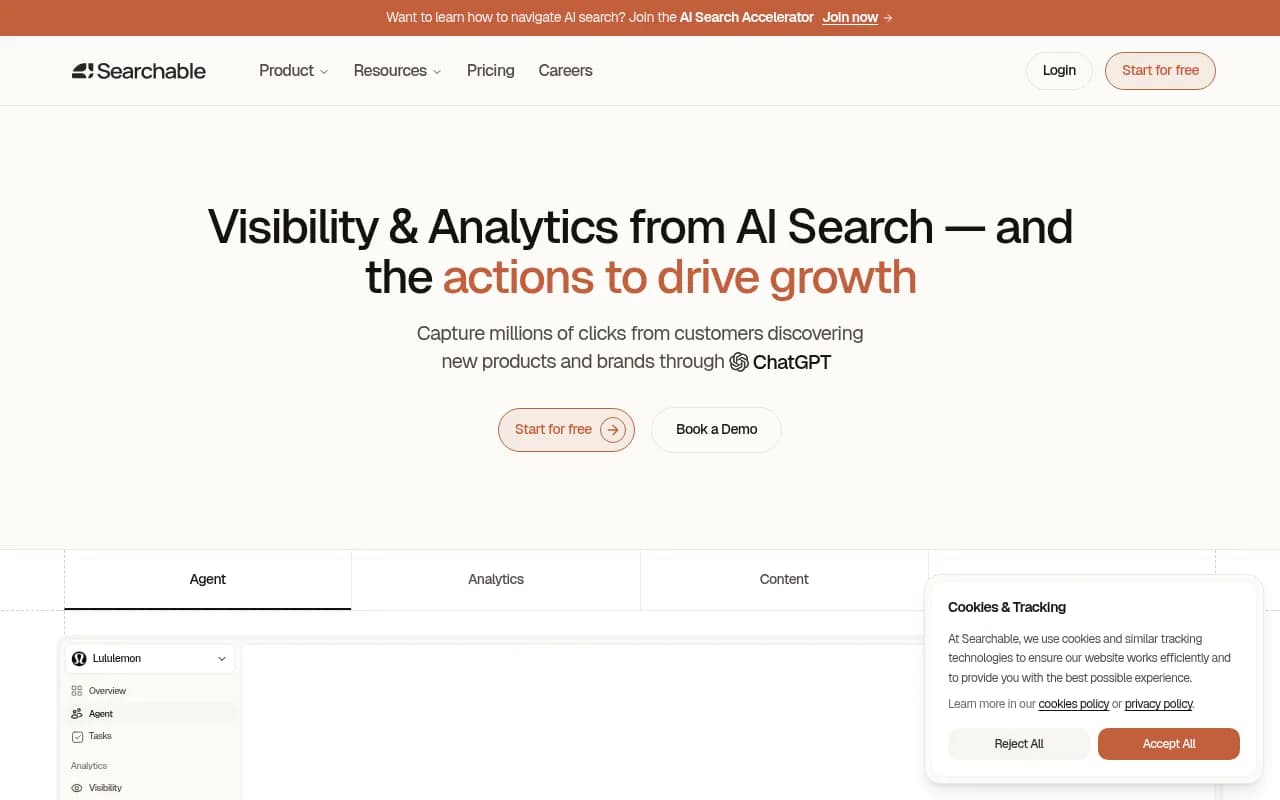
It's one of the few lower-cost options that tries to close the monitoring-to-action gap. The content generation is less sophisticated than what you'd get from a platform like Promptwatch, but for smaller teams or solo marketers who want both monitoring and basic content tools without a large budget, it's worth evaluating.
Profound
Profound is strong on the enterprise research side. It tracks up to 10 AI models at the Enterprise tier and has solid prompt research capabilities, starting at $99/month.
Profound

Where it falls short is in the action loop. Profound is primarily a monitoring and research platform. It's good at telling you what's happening in AI search — which prompts matter, how your brand appears, how competitors compare. But it doesn't generate content or provide the crawler-level insights that help you understand why AI models aren't citing your pages. For enterprise teams with dedicated content teams who just need the data layer, it's a strong choice. For teams that want the full loop, it leaves a gap.
Semrush
Semrush added AI visibility tracking to its platform through the AI Toolkit, which makes it genuinely useful for teams already paying for Semrush's traditional SEO features.
It tracks 5 AI models and uses fixed prompts, which limits flexibility. The AI visibility data is bundled with Semrush plans rather than priced separately, so if you're already a Semrush customer, it's worth turning on. The limitation is that Semrush's AI tracking doesn't include AI traffic attribution — you can see visibility data but can't connect it directly to traffic or revenue. For teams that need a dedicated AI search platform, it's a complement rather than a replacement.
Otterly.AI
Otterly.AI is the entry-level option in this space, starting at $29/month. It tracks 4 AI models at the base tier and covers the monitoring fundamentals: brand mentions, share of voice, competitor comparisons.
Otterly.AI

It's honest about what it is. There's no content generation, no crawler logs, no gap analysis that tells you what to create. For teams that are just getting started with AI visibility and want to understand the basics without a large investment, it's a reasonable starting point. But if you're serious about improving your AI search presence rather than just measuring it, you'll outgrow it quickly.
Peec AI
Peec AI offers flexible model selection — up to 10 models — starting at €85/month, which gives it good coverage at a mid-range price.

Like Otterly.AI, it's primarily a monitoring platform. The model flexibility is a genuine advantage for teams that need to track visibility across a wide range of LLMs, but there's no built-in path from the data to action. It's a solid tracker for teams that have separate content workflows.
SE Visible
SE Visible (from SE Ranking) tracks 5 AI models and is positioned for multi-brand, multi-country monitoring at $99/month.
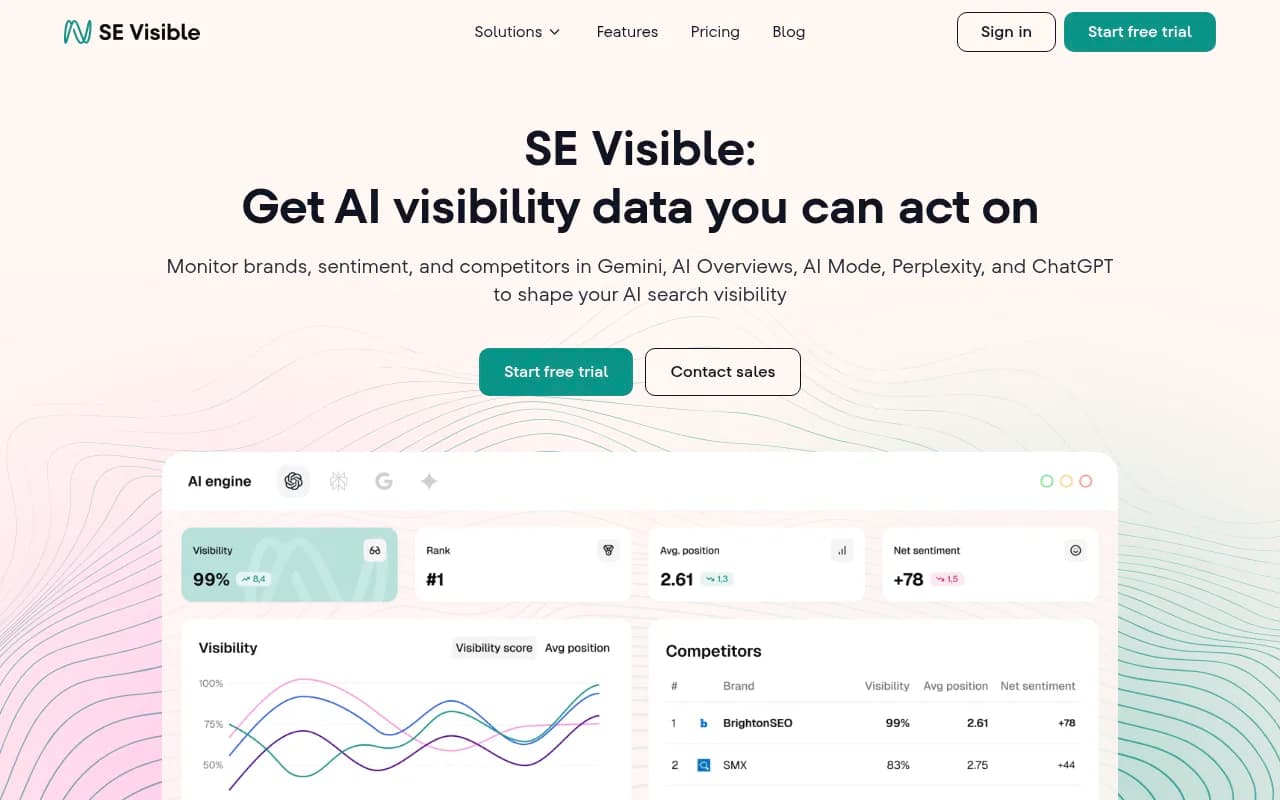
The multi-location and multi-brand capabilities are its strongest differentiator. For agencies managing multiple clients or brands operating across different markets, the ability to track AI visibility across regions and languages in one place is valuable. Like most monitoring-focused tools, it doesn't offer content generation or crawler insights.
Nightwatch
Nightwatch combines traditional SEO rank tracking with AI search monitoring, starting at $32/month with a $99 AI add-on.
The appeal is consolidation: if you're paying for rank tracking anyway, adding AI visibility to the same platform reduces tool sprawl. It tracks 4 AI models. The AI features are an add-on rather than a core product, which means the depth of AI-specific features is limited compared to dedicated platforms.
How the platforms compare
| Platform | AI models tracked | Content generation | Crawler logs | Prompt volume data | Starting price | Best for |
|---|---|---|---|---|---|---|
| Promptwatch | 10 | Yes (Content Agents) | Yes | Yes | $99/mo | Full action loop: monitor, create, optimize |
| AirOps | 4 | Yes (workflows) | No | Limited | Free tier | Content operations teams |
| Searchable | 7 | Basic | No | No | $50/mo | Small teams wanting monitor + create |
| Profound | 10 (Enterprise) | No | No | Yes | $99/mo | Enterprise prompt research |
| Semrush | 5 | No (SEO tools only) | No | No | Bundled | Existing Semrush users |
| Otterly.AI | 4 | No | No | No | $29/mo | Entry-level monitoring |
| Peec AI | 10 | No | No | No | €85/mo | Flexible model coverage |
| SE Visible | 5 | No | No | No | $99/mo | Multi-brand, multi-country |
| Nightwatch | 4 | No | No | No | $32/mo + $99 add-on | SEO + AI in one tool |
What to look for when choosing
If you want to actually improve your AI visibility (not just measure it): You need a platform with answer gap analysis and content generation. Promptwatch is the only one in this comparison that does both at depth, with the crawler logs to understand why AI models aren't citing your pages.
If you're an agency managing multiple clients: Multi-brand support and white-label reporting matter. Promptwatch has agency and enterprise pricing with custom configurations. SE Visible is worth looking at for multi-country monitoring specifically.
If you're just starting out and want to understand the basics: Otterly.AI at $29/month or Searchable at $50/month are low-risk ways to get familiar with AI visibility data before committing to a more capable platform.
If you're already a Semrush customer: Turn on the AI Toolkit. It's not a replacement for a dedicated platform, but it gives you a baseline view of AI visibility without adding another tool to your stack.
If content production is your bottleneck: AirOps is worth evaluating as a content operations layer, ideally alongside a dedicated visibility tracker.
The ecommerce angle
For ecommerce brands specifically, the stakes are higher. AI-referred visitors convert 42% better than paid search traffic and spend 37% more per visit, according to Adobe's Q1 2026 data. When ChatGPT recommends a product by name, there's no "page 2" — you're either in the answer or you're not.
This makes the action loop even more critical for ecommerce. Knowing your competitor's product appears in "best running shoes under $150" responses is useful. Knowing exactly what content gap is causing that, and being able to generate the page that closes it, is what actually changes the outcome.
ChatGPT Shopping tracking is a feature that matters specifically here — monitoring when your brand appears in product recommendation carousels and shopping responses. Promptwatch includes this; most other platforms don't.
The monitoring-only trap
There's a real risk in the current market: teams invest in a visibility tracker, get a dashboard full of data, and then... don't know what to do with it. The data shows gaps but doesn't explain how to close them. Content teams don't have a clear brief. Six months later, visibility scores haven't moved.
This isn't a failure of the data. It's a structural problem with monitoring-only tools. They're built to answer "where are we?" not "what do we do next?"
The platforms that answer both questions are worth the higher price point. The cost of not improving your AI search visibility — losing high-converting traffic to competitors who are actively optimizing — is almost certainly higher than the difference in subscription cost between a tracker and a full optimization platform.
Bottom line
The AI visibility tool market in 2026 has two distinct tiers: platforms that monitor, and platforms that help you act. Most tools fall into the first category. They're useful for understanding your current position, but they don't move the needle on their own.
If your goal is to actually appear more often in AI-generated answers — to get cited by ChatGPT, Perplexity, and Google AI Overviews for the prompts your customers are using — you need a platform that closes the loop from gap identification to content creation to visibility tracking. That's a short list in 2026, and Promptwatch sits at the top of it.
The monitoring-only tools have their place, particularly for teams just getting started or those with tight budgets. But if you're serious about AI search as a channel, the question isn't whether to invest in an action-oriented platform. It's how long you can afford to wait.