Key takeaways
- Google AI Mode shows brands in roughly 90% of responses, compared to just 43% in AI Overviews -- making it a high-stakes visibility channel most teams aren't tracking yet
- Most AI visibility tools monitor several LLMs at once, but only a handful have specific Google AI Mode tracking with meaningful data depth
- The biggest split in the market is between tools that show you data and tools that help you act on it -- most stop at the dashboard
- For teams that want to track Google AI Mode and fix the gaps they find, Promptwatch is the only platform rated "Leader" across all GEO categories in 2026
- If you're already on Semrush, its AI Toolkit is a reasonable starting point; if you want dedicated tracking without the SEO bundle, tools like Profound, Otterly.AI, or Peec AI are worth evaluating
Why Google AI Mode deserves its own tracking strategy
Google AI Mode is not the same as AI Overviews, and treating them as interchangeable is a mistake that's costing brands visibility they don't even know they're missing.
AI Overviews appear at the top of standard search results for certain queries. AI Mode is a separate, conversational search experience where users ask follow-up questions, explore topics in depth, and get synthesized answers with cited sources. According to research cited by SE Ranking's Visible blog, brands appear in roughly 90% of AI Mode responses -- compared to 43% in traditional AI Overviews. That gap matters. It means AI Mode is more brand-inclusive, but it also means the competition for a citation is intense.
The other thing worth knowing: AI Mode responses can differ meaningfully from what you'd see if you queried the same model through an API. The user-facing interface, the conversational context, and Google's own ranking signals all influence which sources get cited. Tools that only query APIs may miss this entirely.
So if you're serious about Google AI Mode visibility, you need a tool that actually simulates the real user experience -- not just an API wrapper dressed up as a tracker.
What to look for in a Google AI Mode tracking tool
Before diving into specific tools, here's what separates a useful tracker from a dashboard that looks impressive but doesn't move the needle:
Real UI monitoring, not just API queries. Google AI Mode behaves differently in the actual interface. A tool that fires API calls and calls it "AI Mode tracking" is giving you incomplete data.
Prompt customization. Generic prompts like "best [category] tools" will tell you almost nothing useful. You need to track the specific questions your customers are actually asking -- and the tool needs to let you define those.
Competitor benchmarking. Knowing you appear in 40% of relevant AI Mode responses means nothing without knowing your competitors appear in 70%. The gap is what matters.
Content gap analysis. When you're not being cited, you need to know why. Is it a missing page? A topic you haven't covered? A competitor's content that's more comprehensive? The best tools tell you what to fix, not just that something is broken.
Traffic attribution. AI Mode citations should eventually translate to clicks and conversions. If your tool can't connect visibility to actual traffic, you're flying blind on ROI.
The best tools for tracking Google AI Mode visibility in 2026
Promptwatch
Promptwatch is the most complete option for teams that want to track Google AI Mode and actually improve their visibility -- not just watch the numbers.

It monitors 10 AI models including Google AI Mode, Google AI Overviews, ChatGPT, Perplexity, Claude, Gemini, Grok, DeepSeek, Copilot, and Meta AI. Critically, it tracks how these models behave in real user interfaces, not just through API calls -- which matters a lot for Google AI Mode specifically, where the conversational context changes what gets cited.
What makes Promptwatch different from most tools in this list is what happens after you see the data. The Answer Gap Analysis shows you exactly which prompts competitors are being cited for that you're not. Then Content Agents generate articles, comparisons, and briefs grounded in that real prompt data -- content engineered to close the specific gaps AI Mode is exposing. Most competitors stop at the monitoring step. Promptwatch is built around the full loop: find the gap, create content to fill it, track the improvement.
The AI Crawler Logs are also worth calling out. You can see in real time which pages Google's AI crawlers are reading, how often they return, and when a crawled page moves to an actual citation. That's the kind of operational detail that helps you fix indexing issues before they cost you visibility.
Pricing starts at $99/month for the Essential plan (1 site, 50 prompts, 5 articles), with Professional at $249/month and Business at $579/month.
Profound
Profound is the strongest dedicated enterprise tracker if your primary need is deep monitoring and reporting rather than content creation.
Profound

It covers 9+ AI search engines including Google AI Mode, with strong prompt customization and competitor benchmarking. The read/write AI model lets you automate some content operations, and the reporting is genuinely enterprise-grade. It's a good fit for large brands with dedicated SEO teams who want comprehensive data and can handle the content execution side themselves.
The tradeoff: Profound is monitoring-focused. It will tell you where you're invisible, but it won't help you write the content that fixes it. Starting price is around $99/month, though enterprise plans scale significantly higher.
Semrush AI Toolkit
If your team is already standardized on Semrush, the AI Toolkit is the natural way to add AI Mode tracking without adopting a new platform.
It covers Google AI Mode alongside other major AI search engines, and the integration with Semrush's existing keyword research, content tools, and competitive data is genuinely useful. You can move from "I'm not appearing in AI Mode for this query" to "here's the keyword data and content brief to fix it" without leaving the platform.
The limitation is that Semrush uses fixed prompt templates rather than fully customizable prompts, and it doesn't have the depth of AI-specific features (crawler logs, query fan-outs, Reddit/YouTube citation tracking) that purpose-built GEO platforms offer. For teams that want AI Mode tracking as one piece of a broader SEO workflow, it works well. For teams where AI visibility is the primary focus, it may feel shallow.
SE Visible
SE Visible (by SE Ranking) is a strong mid-market option, particularly for agencies managing multiple clients.
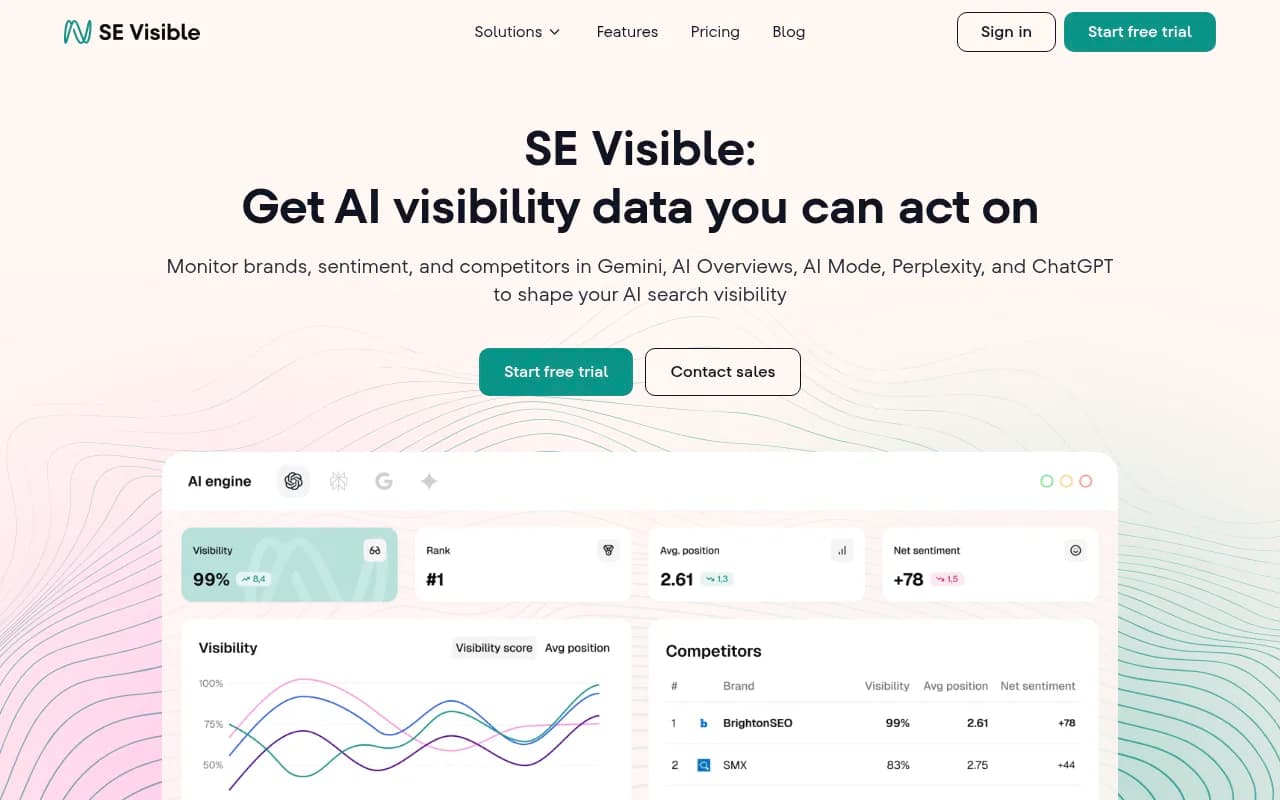
It focuses specifically on AI visibility tracking and has solid Google AI Mode coverage. The interface is clean, the data is actionable, and the pricing is reasonable at $189/month. It's a good choice for agencies that need to show clients clear AI visibility reports without the complexity of an enterprise platform.
The gap: SE Visible is primarily a monitoring tool. It shows you where you stand, but the path from "I'm not being cited" to "here's what to do about it" requires you to bring your own content strategy.
Otterly.AI
Otterly.AI is one of the more accessible entry points for teams just getting started with AI visibility tracking.
Otterly.AI

It covers Google AI Overviews and several other AI engines, with automated prompt testing and basic GEO audit features. The $29/month starting price makes it approachable for smaller teams or those who want to experiment before committing to a larger platform.
The honest assessment: Otterly.AI is a monitoring tool. It lacks crawler logs, visitor analytics, and content generation capabilities. It's useful for getting a baseline picture of your AI visibility, but you'll hit its ceiling quickly if you're trying to actively improve your rankings.
Peec AI
Peec AI targets SaaS companies and B2B brands with a clean dashboard and solid competitor benchmarking.
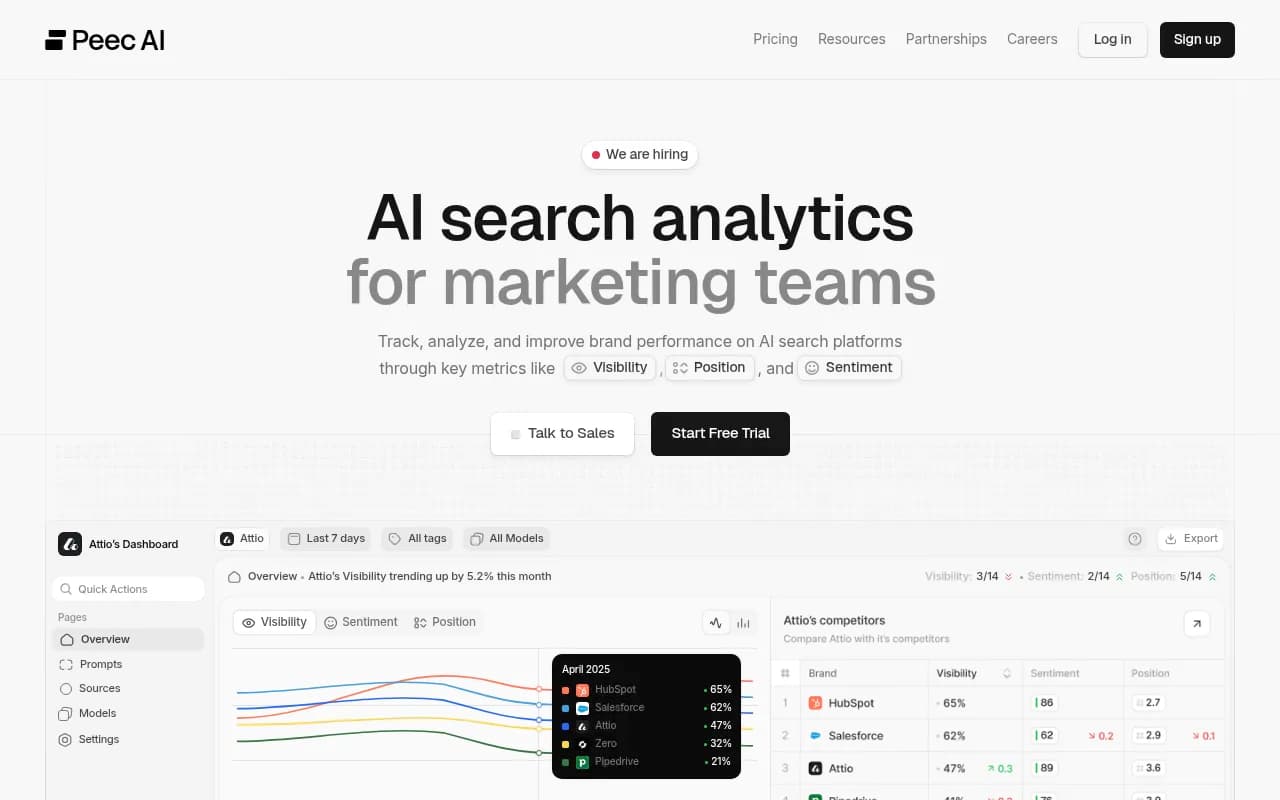
It covers conversational AI visibility across multiple engines including Google AI Mode, and the interface is genuinely easy to use. Starting at €89/month, it's positioned as a straightforward tracker for teams that don't need enterprise complexity.
Like Otterly.AI, Peec AI is monitoring-focused. The competitor benchmarks are useful for understanding where you stand, but the platform doesn't offer content gap analysis or generation tools to help you close the gaps it identifies.
Nightwatch
Nightwatch is worth mentioning for teams that want AI tracking alongside traditional rank tracking, particularly for local SEO.
It has an AI search monitoring add-on that covers Google AI Mode, and the geo-level data is more granular than most competitors. Starting at $39/month with the AI add-on, it's one of the more affordable options for combining traditional and AI search tracking.
The depth of AI Mode tracking is lighter than dedicated platforms, but for local businesses or agencies doing local SEO work, the combination of traditional rankings and AI visibility in one tool has real practical value.
LLM Pulse
LLM Pulse focuses on brand recommendations and sentiment across AI engines, which is a slightly different angle from pure visibility tracking.
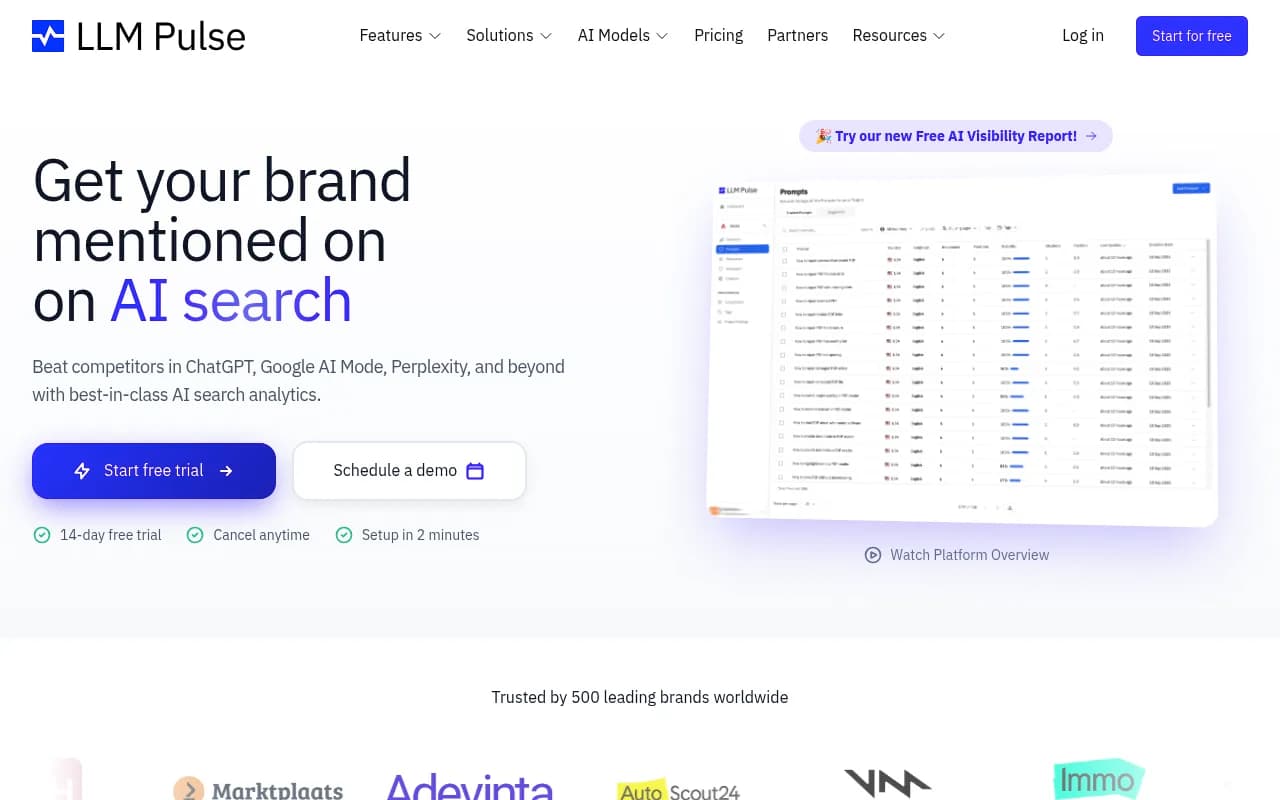
If you care not just about whether AI Mode mentions your brand, but about what it says -- the sentiment, the framing, the context -- LLM Pulse has more depth here than most tools. Starting at €49/month, it's accessible for smaller teams.
It's not the right tool if you need comprehensive prompt customization or content optimization features, but for PR teams and CMOs focused on brand perception in AI responses, it fills a specific gap.
Comparison table
| Tool | Google AI Mode tracking | Prompt customization | Content generation | Crawler logs | Best for | Starting price |
|---|---|---|---|---|---|---|
| Promptwatch | Yes (real UI) | Full | Yes (Content Agents) | Yes | Full GEO optimization loop | $99/mo |
| Profound | Yes | High | Limited | No | Enterprise monitoring | $99/mo |
| Semrush AI Toolkit | Yes | Fixed templates | Via Semrush tools | No | Teams already on Semrush | Bundled |
| SE Visible | Yes | Moderate | No | No | Agencies, reporting | $189/mo |
| Otterly.AI | Yes | Basic | No | No | Entry-level monitoring | $29/mo |
| Peec AI | Yes | Moderate | No | No | SaaS, B2B brands | €89/mo |
| Nightwatch | Yes (add-on) | Basic | No | No | Local SEO + AI tracking | $39/mo+ |
| LLM Pulse | Yes | Moderate | No | No | Brand sentiment tracking | €49/mo |
How to actually improve your Google AI Mode visibility
Tracking is the starting point, not the finish line. Here's how teams that are winning in Google AI Mode are using these tools:
Map the prompts that matter to your business. Don't start with generic category queries. Think about what your customers actually ask when they're in buying mode -- "best [product type] for [specific use case]" or "how does [your brand] compare to [competitor]". These are the prompts worth tracking.
Identify the citation gap. Once you're tracking the right prompts, look at which ones your competitors appear in that you don't. That's your priority list. A tool like Promptwatch's Answer Gap Analysis does this automatically, but you can also do it manually by reviewing AI Mode responses for your target prompts.
Audit what AI Mode is actually citing. When a competitor gets cited, look at the specific page. Is it a comparison article? A detailed how-to? A listicle? AI Mode tends to favor content that directly answers the question being asked, with clear structure and specific details. If you're missing citations, it's often because your content is too general or doesn't match the conversational framing of the query.
Create content that fills the gaps. This is where most teams stall. Identifying the gap is relatively easy; writing the content that fills it is the actual work. Tools with content generation features (Promptwatch's Content Agents, or Frase's writing tools) can accelerate this, but the content still needs to be accurate, specific, and genuinely useful.
Track the crawl-to-citation pipeline. After publishing new content, monitor whether AI crawlers are picking it up and how long it takes to move from crawl to citation. Promptwatch's crawler logs show this timeline explicitly. If pages aren't being crawled, that's a technical issue to fix before worrying about content quality.
Don't ignore offsite citations. Google AI Mode doesn't only cite your own website. It cites Reddit threads, YouTube videos, industry publications, and third-party review sites. Building a presence on these channels -- getting mentioned in relevant Reddit discussions, appearing in comparison articles on authoritative sites -- is part of the AI Mode visibility picture.
The monitoring-only trap
One pattern worth naming directly: a lot of teams invest in an AI visibility tracker, spend a few weeks looking at dashboards, and then... nothing changes. The tool shows them they're invisible for certain prompts, but there's no clear path from that data to actual improvement.
This is the monitoring-only trap. It's not a failure of the team -- it's a product design problem. Most AI visibility tools are built to show you data, not to help you act on it. The dashboard looks impressive, the charts show competitor gaps, and then you're on your own to figure out what to do.
The tools that break this pattern are the ones that connect monitoring to action: content gap analysis that tells you specifically what's missing, content generation tools that help you create it, and tracking that shows you when the new content starts getting cited. That full loop is what separates a GEO platform from a GEO dashboard.
Which tool should you choose?
The honest answer depends on where you are and what you need:
If you're just starting out and want to understand your current AI Mode visibility without a big investment, Otterly.AI or Peec AI will give you a baseline picture at a reasonable price.
If you're on Semrush and want to add AI Mode tracking to your existing workflow without adopting a new tool, the Semrush AI Toolkit is the path of least resistance.
If you're an agency managing multiple clients and need clean reporting with solid Google AI Mode data, SE Visible is worth a look.
If you're a larger brand or an enterprise team that needs deep monitoring and reporting, Profound is the strongest dedicated tracker.
If you want to track Google AI Mode and actually improve your visibility -- not just watch the numbers -- Promptwatch is the only platform that closes the full loop from gap identification to content creation to citation tracking. That's the difference between knowing you have a problem and fixing it.