Key takeaways
- Most AI visibility tools stop at monitoring -- they show you where you're invisible but don't help you fix it. Content marketing teams need platforms that close the loop.
- Promptwatch is the only platform in this comparison that combines AI search tracking, content gap analysis, and built-in content generation in one workflow.
- AirOps is a strong content engineering tool but lacks native AI visibility monitoring; it works best as a content production layer.
- Searchable includes content generation features but has a narrower model coverage and less granular prompt intelligence than Promptwatch.
- Junia AI is a capable SEO content writer but isn't an AI visibility platform -- it doesn't track how your brand appears in ChatGPT, Perplexity, or Google AI Overviews.
Why content marketing teams need AI visibility tools now
Something shifted in 2025. AI search engines stopped being a novelty and became a real acquisition channel. Adobe reported that AI-driven traffic to U.S. retail sites grew 1,100% year over year, and those visitors showed 12% higher engagement than organic search visitors. Meanwhile, Pew Research found that when Google shows an AI summary, click-through rates on traditional results drop from 15% to 8%.
The practical implication: if your brand isn't being cited in AI-generated answers, you're losing traffic that used to be yours by default.
For content marketing teams, this creates a new problem. You're no longer just writing for Google's crawler. You're writing for AI models that synthesize information, pick sources, and decide whose content gets surfaced in a response. The question is no longer just "do we rank on page one?" It's "does ChatGPT recommend us when someone asks about our category?"
That's where AI visibility platforms come in. But they vary wildly in what they actually do. Some just monitor. Some help you act. And a few are content tools that have been loosely rebranded as "AI visibility" platforms without actually tracking anything.
This guide breaks down four tools that content marketing teams are evaluating in 2026: Promptwatch, AirOps, Searchable, and Junia AI. We'll cover what each one does well, where each falls short, and how to decide which fits your workflow.
What to look for in an AI visibility platform
Before comparing tools, it helps to be clear about what the category actually requires. A genuine AI visibility platform should do at least three things:
- Monitor how your brand appears across major AI engines (ChatGPT, Perplexity, Claude, Gemini, Google AI Overviews, etc.)
- Identify gaps -- the prompts and topics where competitors are being cited but you're not
- Help you act on those gaps, either through content recommendations or built-in content creation
Most platforms handle the first point reasonably well. The second and third are where the field thins out fast.
Content marketing teams specifically need the action layer. Knowing you're invisible in Perplexity is only useful if you know what to write to fix it.
Promptwatch
Promptwatch is the most complete option in this comparison for content marketing teams that want to track AI visibility and actually improve it.

The core workflow is built around three steps: find gaps, create content, track results. The Answer Gap Analysis shows you exactly which prompts your competitors are appearing for that you're not. You see the specific topics and questions AI models are answering using competitor content -- not yours. That's the brief for your content team.
From there, Promptwatch's built-in AI writing agent generates articles, listicles, and comparison pages grounded in real citation data. It's not generic content generation -- the output is calibrated to what AI models actually cite, based on analysis of over 880 million citations. The difference matters. You're not writing for a keyword; you're writing to be cited in a specific type of AI response.
The tracking layer closes the loop. Page-level visibility scores show which of your pages are being cited, by which models, and how often. Traffic attribution (via code snippet, Google Search Console integration, or server log analysis) connects those citations to actual sessions and revenue.
A few features that stand out for content teams specifically:
- Prompt Intelligence: Volume estimates and difficulty scores for each prompt, plus query fan-outs that show how a single search branches into related sub-queries. This helps prioritize which content to write first.
- AI Crawler Logs: Real-time logs of AI crawlers (ChatGPT, Claude, Perplexity) hitting your site -- which pages they read, how often they return, and any errors they hit. Most competitors don't have this.
- Reddit and YouTube Insights: Surfaces discussions that directly influence AI recommendations. If a Reddit thread is shaping what Perplexity says about your category, you need to know about it.
- Competitor Heatmaps: Visual comparison of your AI visibility vs competitors across models. Useful for identifying which LLMs you're winning and which you're losing.
Promptwatch monitors 10 AI models: ChatGPT, Perplexity, Google AI Overviews, Google AI Mode, Claude, Gemini, Meta/Llama, DeepSeek, Grok, Mistral, and Copilot. Multi-language and multi-region support is included, with customizable personas.
Pricing starts at $99/month (Essential: 1 site, 50 prompts, 5 articles), $249/month (Professional: 2 sites, 150 prompts, 15 articles, crawler logs), and $579/month (Business: 5 sites, 350 prompts, 30 articles). A free trial is available.
For content marketing teams that need to justify AI visibility work in terms of traffic and revenue, Promptwatch is the only tool in this comparison that provides the full chain from gap identification to content creation to attribution.
AirOps
AirOps takes a different angle. It's primarily a content engineering platform -- built around the idea that content teams should be able to run structured, repeatable workflows for producing AI-optimized content at scale.
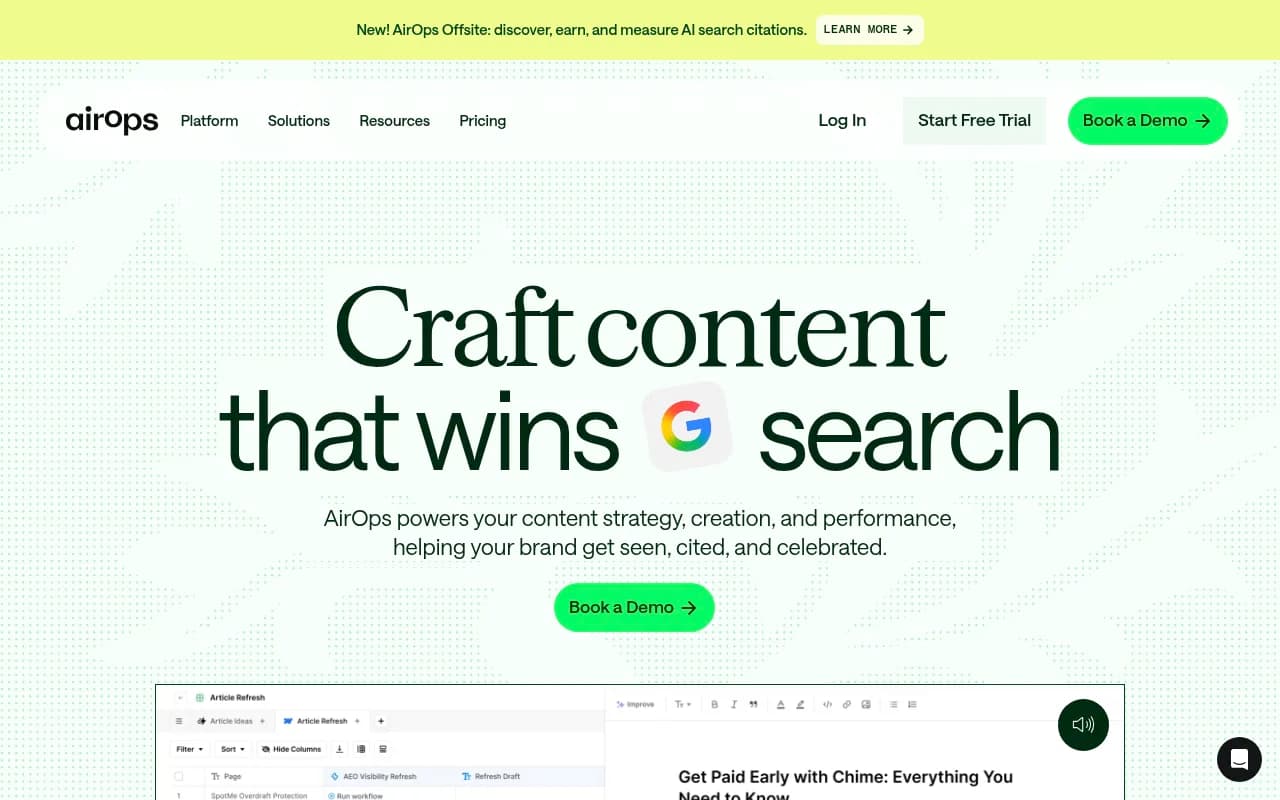
The platform lets you build "content recipes": templated workflows that pull in research, competitor data, and SEO signals to generate content briefs or full drafts. It's well-suited for teams that already know what they want to write and need a scalable production system to do it faster.
Where AirOps gets interesting for AI search is its focus on content structure and entity coverage. The platform helps ensure that articles include the right entities, answer the right questions, and follow the structural patterns that AI models tend to cite. That's genuinely useful.
The limitation for content marketing teams focused on AI visibility: AirOps doesn't monitor how your brand appears in AI engines. There's no dashboard showing your citation share in ChatGPT or your visibility score in Perplexity. You can produce content optimized for AI search, but you can't measure whether it's working from within the platform.
AirOps works best as a content production layer inside a larger stack -- paired with a monitoring tool like Promptwatch to identify what to write, then used to produce it at scale. As a standalone AI visibility platform, it's incomplete.
Searchable
Searchable positions itself as an AI search visibility platform with built-in content generation -- which puts it closer to Promptwatch in scope than AirOps or Junia.
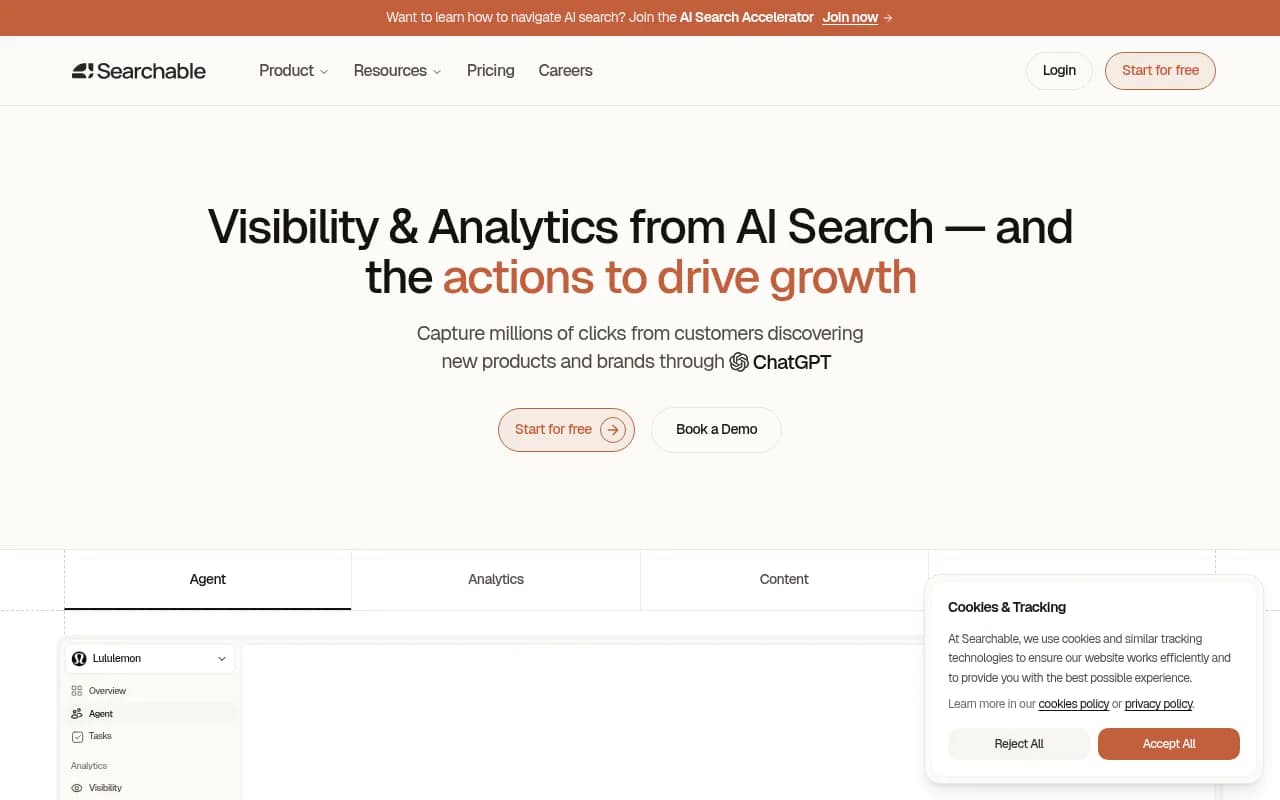
The platform tracks brand mentions across AI engines and includes tools for identifying content gaps and generating content to fill them. For teams looking for an all-in-one solution, it covers the basic loop.
A few areas where it falls short compared to Promptwatch:
- Model coverage is narrower. Searchable doesn't match Promptwatch's 10-model coverage, which matters if your audience uses a mix of AI tools.
- Prompt intelligence is less developed. There's no equivalent to Promptwatch's volume estimates, difficulty scoring, or query fan-out analysis. You know you have a gap, but you have less data to prioritize which gap to address first.
- No AI crawler logs. Understanding how AI bots are actually crawling your site -- which pages they visit, how often, what errors they hit -- is a meaningful diagnostic tool that Searchable doesn't offer.
- Traffic attribution is limited. Connecting AI visibility to actual revenue is harder without the attribution layer Promptwatch provides.
Searchable is a reasonable option for smaller teams that want a single tool covering monitoring and content creation without the complexity of a more feature-rich platform. But for teams that need to prioritize content investment based on prompt volume data, or that want to understand the crawl behavior of AI bots on their site, it leaves gaps.
Junia AI
Junia AI is an AI-powered SEO content platform. It writes, optimizes, and publishes articles -- and it does that well.
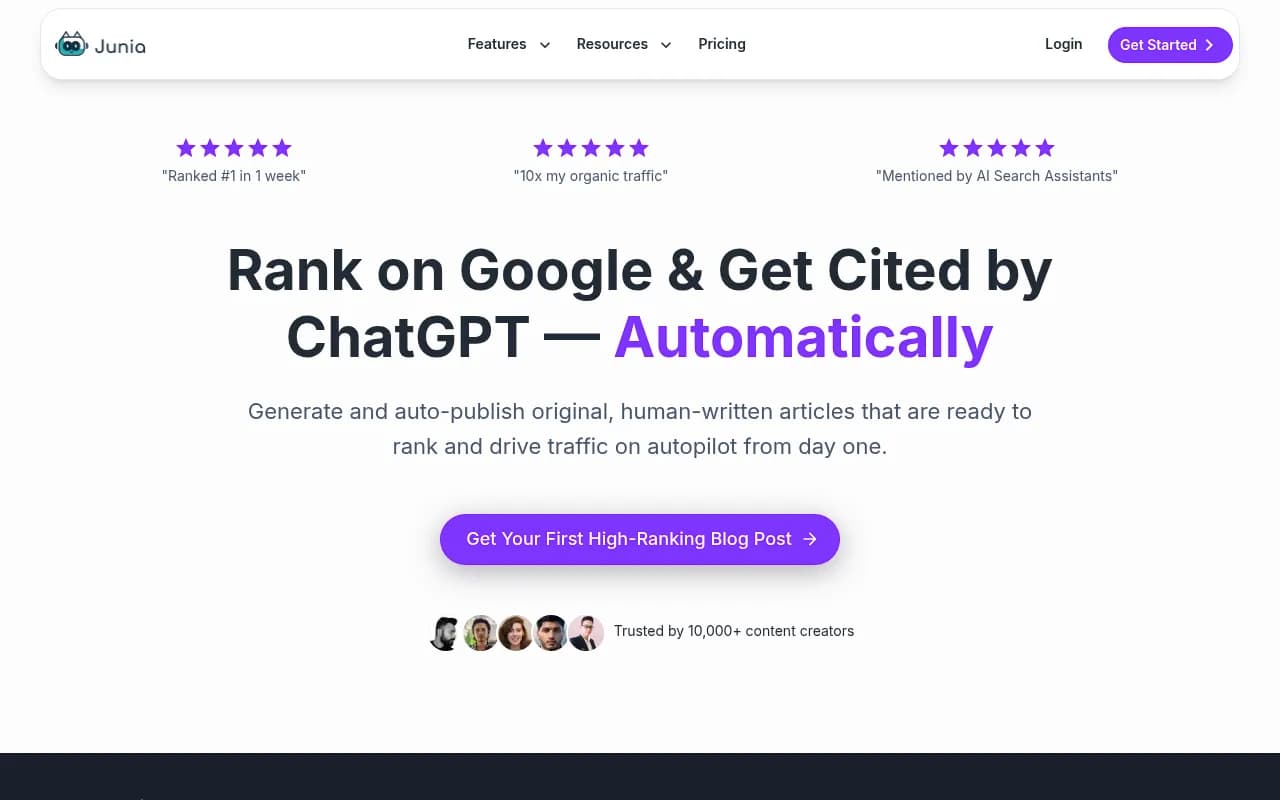
The platform generates long-form SEO content with solid structure, internal linking suggestions, and optimization for traditional search. It's a legitimate content production tool that many marketing teams use effectively.
But it's not an AI visibility platform. Junia doesn't track how your brand appears in ChatGPT, Perplexity, or Google AI Overviews. There's no monitoring dashboard, no citation analysis, no prompt intelligence, no gap analysis against competitors in AI search. The "AI" in Junia AI refers to the writing technology, not the search channel being optimized for.
Including Junia in a comparison of AI visibility platforms is a category error that's easy to make when evaluating tools quickly. If your goal is to produce more SEO content faster, Junia is worth considering. If your goal is to understand and improve how your brand appears in AI-generated answers, Junia doesn't address that problem.
Side-by-side comparison
| Feature | Promptwatch | AirOps | Searchable | Junia AI |
|---|---|---|---|---|
| AI engine monitoring | 10 models | None | Partial | None |
| Brand citation tracking | Yes | No | Yes | No |
| Answer gap analysis | Yes | No | Basic | No |
| Prompt volume/difficulty scoring | Yes | No | No | No |
| Query fan-out analysis | Yes | No | No | No |
| Built-in content generation | Yes | Yes | Yes | Yes |
| Content grounded in citation data | Yes | Partial | Partial | No |
| AI crawler logs | Yes | No | No | No |
| Reddit/YouTube insights | Yes | No | No | No |
| Traffic attribution | Yes | No | Limited | No |
| ChatGPT Shopping tracking | Yes | No | No | No |
| Multi-language/region | Yes | Partial | Limited | Yes |
| Pricing (entry) | $99/mo | Custom | Custom | ~$69/mo |
Which tool fits which team
The right choice depends on what problem you're actually trying to solve.
If you need to understand and improve your brand's visibility across AI search engines -- and connect that work to traffic and revenue -- Promptwatch is the most complete option. The combination of gap analysis, citation-grounded content generation, crawler logs, and attribution makes it the only platform in this comparison that covers the full workflow.
If you already have an AI visibility monitoring tool and need a scalable content production system, AirOps is worth evaluating as a complementary layer. It's not a replacement for monitoring, but it's a capable production engine.
If you want a simpler all-in-one tool and don't need deep prompt intelligence or crawler diagnostics, Searchable covers the basics. It's a reasonable starting point for smaller teams.
If your primary need is producing SEO content at volume and AI search visibility is a secondary concern, Junia AI is a solid content tool -- just don't expect it to tell you how your brand is performing in ChatGPT.
A note on the broader market
The AI visibility platform space has expanded fast. A 2026 comparison by Omnia catalogued 27 tools in the category, and the number keeps growing. Most of them are monitoring dashboards -- they show you data, but the work of acting on it falls entirely on your team.
The distinction that matters for content marketing teams is whether a platform helps you close the loop. Tracking your visibility score is only useful if you know what content to create next and can measure whether it worked. That's the gap most tools leave open.
For teams that want to move beyond dashboards and actually improve their AI search presence, the action layer -- gap analysis, content generation, attribution -- is what separates a useful platform from an interesting one.
Promptwatch is the only platform in this comparison that provides all three. The others are useful for specific parts of the workflow, but none covers the full cycle from identifying gaps to creating content to tracking results.