Key takeaways
- ChatGPT and other AI models are increasingly used for product discovery, making AI visibility a real revenue issue for e-commerce brands -- not just a vanity metric
- Most AI visibility tools only monitor brand mentions; very few help you actually improve your rankings or fix what's wrong
- E-commerce brands need tools that track ChatGPT Shopping carousels, product-specific prompts, and citation sources -- not just generic brand mentions
- The gap between monitoring-only tools and full optimization platforms is significant; the best tools close the loop from "where am I invisible?" to "here's the content that fixes it"
- Promptwatch is one of the few platforms that covers the full cycle: gap analysis, content generation, and traffic attribution -- including ChatGPT Shopping tracking
Why ChatGPT product queries matter for e-commerce in 2026
Something shifted in the past 18 months. Shoppers who used to type "best running shoes under $150" into Google are now asking ChatGPT the same question -- and expecting a direct answer with recommendations, not a list of blue links to sort through.
This isn't a small trend. OpenAI's shopping features have expanded significantly, and ChatGPT now surfaces product carousels, brand comparisons, and direct recommendations in response to commercial queries. If your brand isn't in those responses, you're not just missing a click -- you're missing the consideration entirely.
The problem is that most e-commerce teams haven't caught up. They're still measuring success by Google rankings and organic traffic, while a growing slice of their potential customers is getting product recommendations from AI models that have never crawled their product pages properly, or that have outdated or just plain wrong information about their catalog.
One founder I came across while researching this guide described showing up to demo calls where prospects cited ChatGPT pricing for their product that was $30 higher than actual. Being visible with wrong information can cost more than not being visible at all. That's a problem specific to AI search that traditional SEO tools simply weren't built to detect.
So what do e-commerce brands actually need from an AI visibility tool in 2026?
What e-commerce brands specifically need (vs. generic AI visibility)
Generic AI visibility tools track brand mentions across ChatGPT, Perplexity, Claude, and similar platforms. That's useful baseline data. But e-commerce has specific requirements that most tools don't address:
Product-level tracking, not just brand-level. You need to know whether ChatGPT recommends your specific products -- not just whether your brand name appears somewhere in a response. "Nike" appearing in a ChatGPT response about marathon training is very different from "Nike Vomero 18" being recommended in response to "best cushioned running shoes for heavy runners."
ChatGPT Shopping carousel monitoring. OpenAI has built out shopping features that surface product cards with images, prices, and links. Appearing in these carousels is a distinct visibility goal from appearing in text responses. Very few tools track this separately.
Citation source analysis. When ChatGPT recommends a product, it's pulling from somewhere -- review sites, Reddit threads, YouTube videos, comparison articles. Knowing which sources influence AI recommendations tells you where to publish and what to optimize.
Competitor benchmarking at the product category level. You don't just want to know if you appear -- you want to know who appears instead of you, and for which specific product queries.
Traffic attribution. If AI visibility drives actual sessions and purchases, you need to connect the dots. Otherwise you're optimizing for a metric that may or may not correlate with revenue.
The tools worth considering
Here's an honest breakdown of the tools that are most relevant for e-commerce brands focused on ChatGPT product query visibility.
Promptwatch
Promptwatch is the most complete option for e-commerce brands that want to go beyond monitoring. The platform covers 10 AI models including ChatGPT, Perplexity, Claude, Gemini, and Google AI Overviews -- but what makes it relevant for e-commerce specifically is the combination of ChatGPT Shopping tracking, citation source analysis (Reddit, YouTube, and web sources), and a built-in content generation tool that creates articles grounded in real citation data.
The Answer Gap Analysis is particularly useful: it shows you which product-related prompts your competitors are appearing in but you're not, and tells you specifically what content is missing from your site. That's actionable in a way that a simple "you appeared in 12% of responses" dashboard isn't.
Pricing starts at $99/month for the Essential plan (1 site, 50 prompts). The Professional plan at $249/month adds crawler logs, which show you exactly which pages AI crawlers are reading on your site -- useful for diagnosing why certain products aren't getting cited.

Profound
Profound is a strong enterprise option with deep analytics. It covers 9+ AI search engines and gives detailed breakdowns of how your brand appears in AI responses. The reporting is thorough, and it's well-suited to larger teams that need to share data across marketing and SEO functions.
The limitation for e-commerce is that Profound is primarily a monitoring and analytics platform. It shows you the data clearly, but the path from "here's where you're invisible" to "here's how to fix it" requires you to take that data elsewhere. No Reddit or YouTube citation tracking either, which matters for product categories where community discussions heavily influence AI recommendations.
Profound

Otterly.AI
Otterly.AI is a clean, accessible monitoring tool that tracks brand mentions across ChatGPT, Perplexity, and Google AI Overviews. It's easy to set up and the interface is straightforward -- good for teams that want a quick read on AI visibility without a steep learning curve.
For e-commerce brands with serious optimization goals, though, it runs out of runway quickly. No content generation, no crawler logs, no ChatGPT Shopping tracking, and no traffic attribution. It tells you what's happening but not why, and definitely not what to do about it.
Otterly.AI

Peec AI
Peec AI focuses on brand visibility tracking across ChatGPT, Perplexity, and Claude. It's a monitoring tool with a clean UI and reasonable pricing for smaller teams. Like Otterly.AI, it's better suited to brands that want awareness of their AI presence than brands actively trying to improve it.

LLMClicks
LLMClicks is interesting because it was built specifically to detect hallucinations -- cases where AI models mention your brand but get the details wrong (wrong pricing, wrong features, wrong use cases). For e-commerce brands selling products with specific specs, prices, and availability, this is a real problem. A tool that flags inaccurate AI mentions is more useful than one that just counts mentions.
The platform is earlier-stage and less comprehensive than Promptwatch or Profound, but the hallucination detection angle is genuinely differentiated.
Evertune AI
Evertune positions itself as an enterprise GEO platform with strong brand visibility tracking and competitive benchmarking. It covers the major AI models and provides sentiment analysis alongside visibility data. It's a solid choice for larger brands with dedicated analytics teams.
SE Ranking (AI visibility features)
SE Ranking has been building out AI visibility tracking as an extension of its traditional SEO platform. If your team already uses SE Ranking for Google rank tracking, the AI visibility features are a natural add-on. The coverage isn't as deep as dedicated GEO platforms, but the integration with existing SEO workflows is convenient.
AIclicks
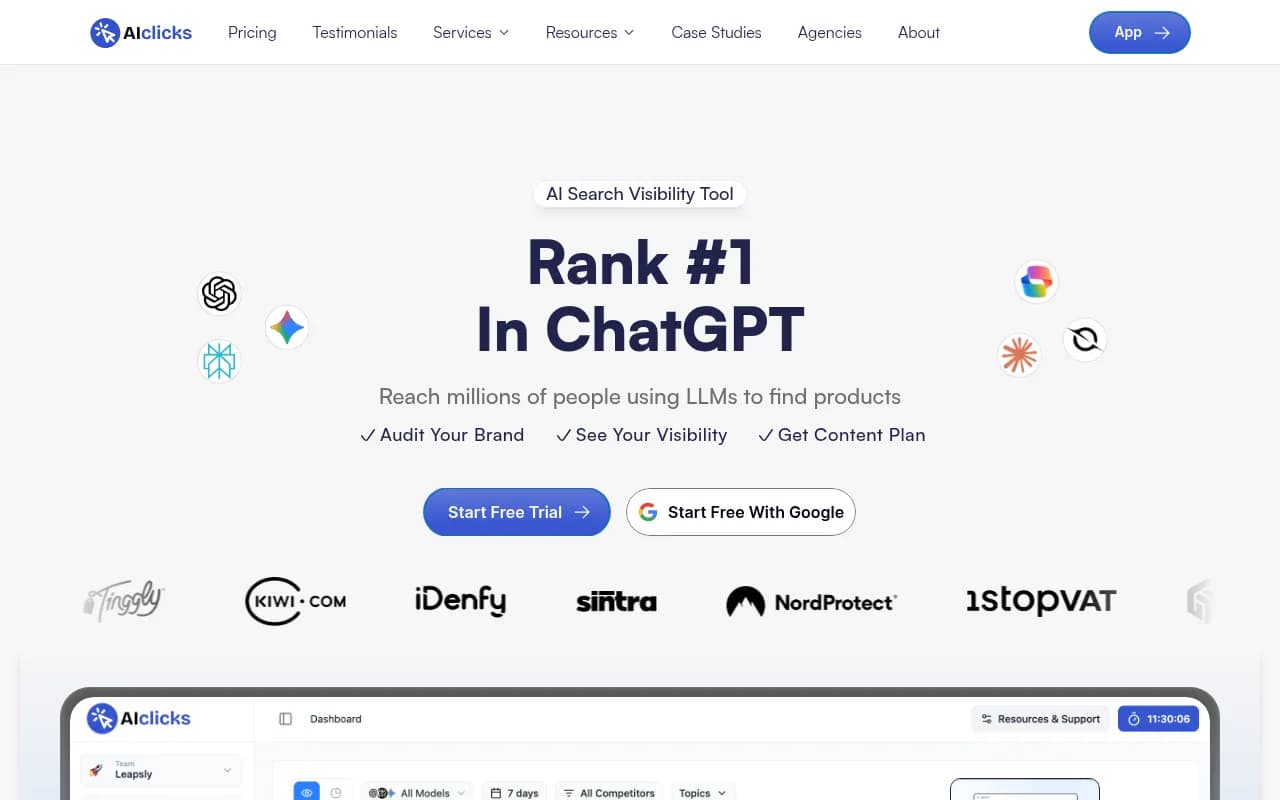
AIclicks is a ChatGPT rank tracking tool with a focus on prompt-level visibility. It tracks how your brand appears in response to specific prompts and benchmarks you against competitors. Useful for e-commerce teams that want to track a defined set of product queries over time.
Tool comparison
| Tool | ChatGPT Shopping tracking | Content generation | Crawler logs | Citation source analysis | Traffic attribution | Starting price |
|---|---|---|---|---|---|---|
| Promptwatch | Yes | Yes (built-in AI writer) | Yes (Professional+) | Yes (Reddit, YouTube, web) | Yes | $99/mo |
| Profound | No | No | No | Partial | No | Enterprise |
| Otterly.AI | No | No | No | No | No | ~$49/mo |
| Peec AI | No | No | No | No | No | ~$49/mo |
| LLMClicks | No | No | No | No | No | Freemium |
| Evertune AI | No | No | No | No | No | Enterprise |
| SE Ranking | No | No | No | No | No | ~$65/mo |
| AIclicks | No | No | No | No | No | Freemium |
The table makes the gap pretty clear. Most tools in this space are monitoring dashboards. Promptwatch is the only one in this list that covers the full cycle from gap identification through content creation to traffic attribution, with ChatGPT Shopping tracking on top.
How to actually improve your visibility in ChatGPT product queries
Tracking is the starting point, not the finish line. Here's the practical workflow for e-commerce brands trying to improve their position in AI product recommendations.
Step 1: Map the prompts that matter
Start by identifying the actual queries your customers are asking AI models. These aren't the same as your Google keyword targets. AI queries tend to be more conversational and comparison-focused: "what's the best [product category] for [specific use case]?" or "compare [Brand A] vs [Brand B] for [scenario]."
Tools like Promptwatch show you prompt volumes and difficulty scores, which helps you prioritize which queries to target first. Go after prompts where you have a realistic chance of appearing -- not the ones dominated by major players with years of AI citation history.
Step 2: Understand who's getting cited and why
When ChatGPT recommends a competitor's product instead of yours, it's pulling that recommendation from somewhere. Citation source analysis tells you whether it's a review site, a Reddit thread, a YouTube comparison video, or a specific article. That tells you exactly where to focus your content efforts.
If Reddit discussions in your product category are heavily influencing AI recommendations, publishing content there (or getting mentioned in existing discussions) is more valuable than writing another blog post. Most brands don't think this way because traditional SEO didn't require it.
Step 3: Fill the content gaps
The Answer Gap Analysis approach -- finding specific prompts where competitors appear but you don't -- gives you a concrete content brief. You know the question, you know what the AI currently says, and you know what's missing from your site.
The content you create needs to be genuinely useful and specific. Generic product descriptions don't get cited. Detailed comparison guides, use-case-specific recommendations, and content that directly answers the questions AI models are being asked -- that's what gets pulled into responses.
Step 4: Fix your technical crawlability
AI crawlers behave differently from Googlebot. They may read your pages more or less frequently, encounter different rendering issues, and prioritize different content signals. Crawler log analysis (available in Promptwatch's Professional plan and a few other tools) shows you which pages AI crawlers are actually reading, how often, and what errors they're hitting.
If your product pages are rendering JavaScript that AI crawlers can't parse, or if your most important category pages are being crawled infrequently, that's a fixable technical problem -- but you need the data to know it exists.
Step 5: Track the results and connect them to revenue
Visibility scores going up is nice. Revenue going up is better. The connection between the two requires traffic attribution -- knowing when a session on your site came from an AI referral, and whether that session converted.
This is harder than it sounds because AI models don't always pass referral data cleanly. Server log analysis, GSC integration, and dedicated tracking snippets each capture different parts of the picture. The goal is closing the loop: you created content, your AI visibility improved, here's the traffic and revenue that followed.
A note on ChatGPT Shopping specifically
ChatGPT's shopping features deserve separate attention because they work differently from text recommendations. Product carousels in ChatGPT pull from structured data sources, and appearing in them requires a different optimization approach than appearing in conversational responses.
The signals that influence ChatGPT Shopping recommendations include product review volume and recency, structured data markup on your product pages, presence in the data sources ChatGPT's shopping features draw from, and brand authority signals across the web.
Tracking whether your products appear in ChatGPT Shopping carousels -- and for which queries -- is a capability that very few tools currently offer. Promptwatch is one of them. If ChatGPT Shopping is a priority channel for your brand (and for many e-commerce categories it's becoming one), that tracking capability is worth factoring into your tool selection.
Which tool should you actually use?
For most e-commerce brands that are serious about AI visibility, the honest answer is that you need a platform that does more than monitor. Monitoring without action is just an expensive anxiety dashboard.
If you're a mid-size e-commerce brand with a dedicated marketing or SEO team, Promptwatch gives you the most complete toolkit: visibility tracking across 10 AI models, ChatGPT Shopping monitoring, citation source analysis including Reddit and YouTube, content gap identification, built-in content generation, and traffic attribution. The $249/month Professional plan is where the most useful features unlock.
If you're earlier-stage and just want to understand your current AI visibility before committing to a full optimization workflow, Otterly.AI or Peec AI are reasonable starting points. They're cheaper and simpler, and they'll give you a baseline read on where you stand.
If hallucination detection is a specific concern -- your products have precise specs, pricing, or compatibility requirements that AI models frequently get wrong -- LLMClicks is worth testing alongside whatever primary tool you use.
For enterprise brands with complex reporting needs and multiple product lines, Profound or Evertune AI offer the depth of analytics that larger teams need, though you'll need to bring your own content strategy to act on the data.
The category is moving fast. Tools that were monitoring-only six months ago are adding optimization features. The gap between the leaders and the rest is narrowing, but it's still real. Pick a tool that matches where you want to be in six months, not just where you are today.