Key takeaways
- Traditional SEO rank tracking and AI visibility (GEO) are converging, but most tools still do one well and the other poorly
- Semrush and Ahrefs have added AI tracking features, but both use fixed prompt sets and lack AI traffic attribution -- you can monitor but not optimize
- seoClarity is the strongest enterprise option if you're already deep in that ecosystem, but it's expensive and still monitoring-heavy
- Promptwatch is the only platform in this comparison that closes the full loop: find gaps, generate content, track results across both AI and traditional search
- If you're running a serious GEO program alongside SEO, you need a platform that does more than show you a dashboard
Why you suddenly need both
For most of the last decade, SEO rank tracking was straightforward. You picked a tool, fed it your keywords, watched your positions move up or down, and adjusted your content strategy accordingly. The feedback loop was slow but legible.
That's changed. ChatGPT, Perplexity, Google AI Overviews, Claude, Gemini -- these systems now answer millions of queries that used to send users to a search results page. Gartner projected a 25% decline in traditional search volume by 2026 as AI chatbots absorb more of that traffic. Whether or not that number lands exactly right, the directional shift is real and already showing up in analytics for a lot of brands.
The problem is that your existing rank tracker has no idea any of this is happening. It can tell you you're ranking #3 for "best project management software" on Google. It cannot tell you whether ChatGPT recommends you when someone asks the same question, or whether Perplexity cites your pricing page, or whether Claude even knows your product exists.
So now marketing and SEO teams are managing two parallel visibility problems. And the tools landscape is scrambling to catch up.
This guide looks specifically at tools that try to bridge both worlds -- traditional rank tracking and AI/GEO visibility -- and gives you a clear picture of what each one actually does well, where it falls short, and who it's best suited for.
What "combining GEO and SEO tracking" actually means
Before comparing tools, it's worth being precise about what we're evaluating. A tool that "combines" GEO and SEO tracking could mean several different things:
- A traditional SEO platform that bolted on some AI monitoring features
- A pure-play GEO platform that also pulls in Google Search Console data
- A platform built from scratch to handle both natively
The distinction matters because the depth of each capability varies wildly. Semrush adding an "AI Visibility Toolkit" is not the same as a platform that was designed around AI search from day one. Similarly, a GEO tool that shows you a GSC integration isn't really doing traditional rank tracking.
The four platforms in this comparison represent different points on that spectrum.
The four platforms compared
Promptwatch
Promptwatch is a purpose-built AI visibility platform that has grown into the most complete GEO solution available. It monitors 10 AI models (ChatGPT, Perplexity, Claude, Gemini, Google AI Overviews, Google AI Mode, Grok, DeepSeek, Copilot, and Meta/Llama), tracks citations at the page level, and -- this is the part that separates it from most competitors -- actually helps you do something about what you find.

The core workflow is built around three stages: finding gaps (which prompts are your competitors visible for that you're not?), creating content to fill those gaps (using a built-in AI writing agent trained on 880M+ real citations), and tracking whether that content actually gets cited. It also includes AI crawler logs that show you in real time which AI bots are visiting your site, which pages they're reading, and what errors they're hitting.
On the traditional SEO side, Promptwatch integrates with Google Search Console and supports server log analysis for traffic attribution. It's not a full-featured rank tracker in the traditional sense -- you won't get keyword position history going back years or a full backlink index -- but it connects AI visibility to actual organic traffic in a way that most pure-play GEO tools don't.
Pricing runs from $99/month (Essential) to $579/month (Business), with agency and enterprise tiers available.
Semrush
Semrush is the incumbent. It's been the default SEO platform for agencies and in-house teams for years, and it has the deepest traditional SEO feature set of anything in this comparison: keyword research, rank tracking, site audits, backlink analysis, competitive intelligence, and more.
The AI Visibility Toolkit is Semrush's answer to GEO. It monitors brand mentions across AI search engines and tracks how often your brand appears in AI-generated responses. The coverage is decent, and the integration with the rest of the Semrush platform is genuinely useful -- you can look at your traditional rankings and your AI visibility in the same interface.
The limitations are real, though. Semrush uses fixed prompt sets, which means you're tracking a predefined list of queries rather than the full range of prompts your actual customers might use. There's no AI traffic attribution, so you can't connect AI visibility to revenue. And there's no content generation or gap analysis -- you can see where you're invisible, but the tool doesn't help you fix it.
For teams already paying for Semrush, the AI Toolkit is a reasonable add-on. As a standalone GEO solution, it's not deep enough.
Ahrefs
Ahrefs built its reputation on backlink analysis and has expanded into a solid all-around SEO platform. Its traditional SEO capabilities -- keyword research, rank tracking, site explorer, content gap analysis -- are genuinely excellent and in some areas better than Semrush.
Brand Radar is Ahrefs' AI visibility feature. Like Semrush, it uses fixed prompts, which caps how useful it is for brands with niche or long-tail AI search exposure. There's no AI traffic attribution, no content generation, and no crawler log monitoring. The feature feels like it was added to check a box rather than built as a core capability.
Where Ahrefs shines is in the traditional SEO workflow. If your primary need is keyword research, backlink analysis, and rank tracking -- with AI visibility as a secondary concern -- Ahrefs is hard to beat on value. But if GEO is a real priority, Brand Radar won't get you far.
seoClarity
seoClarity is an enterprise SEO platform that has been building out AI search tracking more seriously than most traditional SEO tools. It covers AI visibility monitoring across major LLMs, integrates with traditional rank tracking, and has some content optimization features.
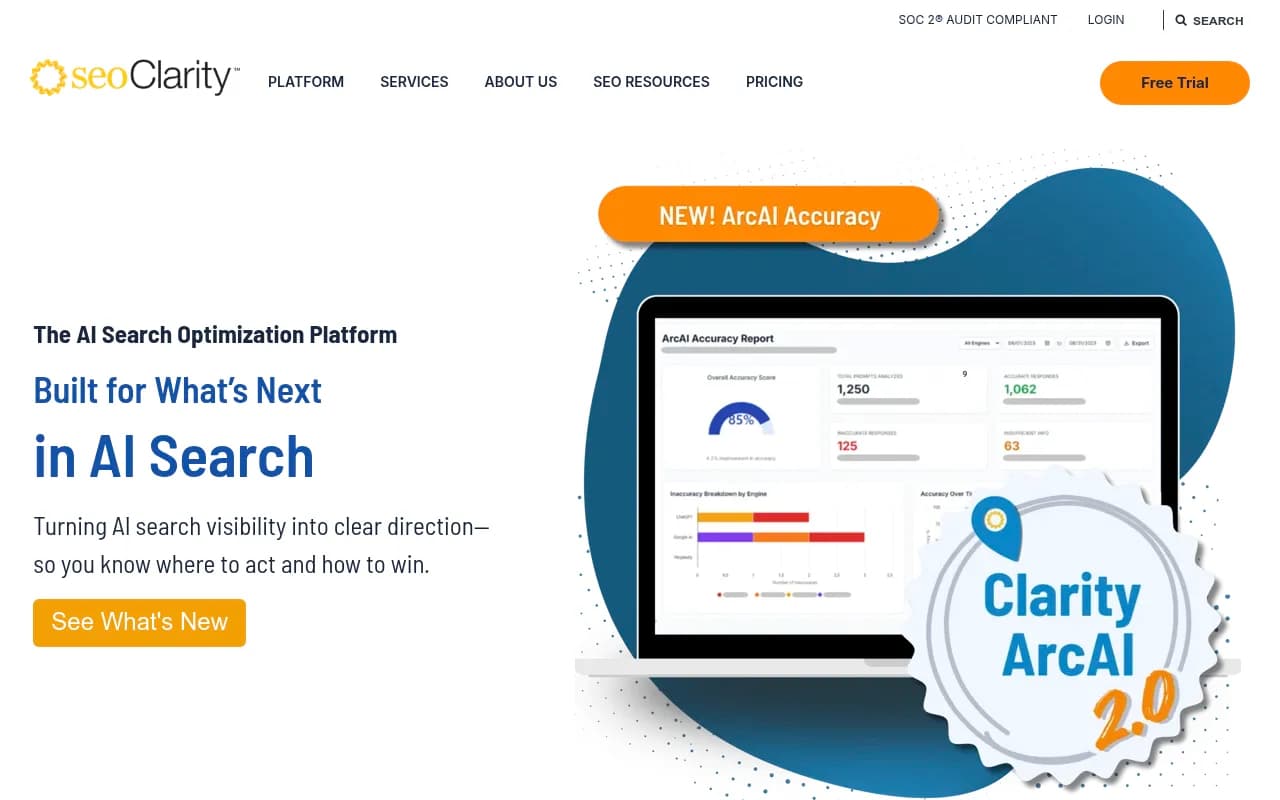
The platform is genuinely more capable on the GEO side than either Semrush or Ahrefs -- it goes beyond fixed prompts and has more flexibility in how you configure monitoring. The enterprise focus means it's built for large teams with complex needs: multi-site management, custom reporting, and integration with enterprise data stacks.
The downsides are cost (enterprise pricing puts it out of reach for most SMBs and mid-market teams) and the fact that it's still primarily a monitoring platform. Like the others, it shows you data but doesn't generate content or close the optimization loop in the way Promptwatch does.
Feature comparison table
| Feature | Promptwatch | Semrush | Ahrefs | seoClarity |
|---|---|---|---|---|
| AI model coverage | 10 models | ~5 models | ~3 models | ~5 models |
| Traditional rank tracking | Via GSC integration | Full native | Full native | Full native |
| Backlink analysis | No | Yes | Yes (best-in-class) | Yes |
| Fixed vs. custom prompts | Custom | Fixed | Fixed | Custom (enterprise) |
| Answer gap analysis | Yes | No | No | Limited |
| AI content generation | Yes (built-in agent) | No | No | No |
| AI crawler logs | Yes | No | No | No |
| Reddit/YouTube tracking | Yes | No | No | No |
| ChatGPT Shopping tracking | Yes | No | No | No |
| AI traffic attribution | Yes (GSC, server logs) | No | No | Limited |
| Prompt volume/difficulty | Yes | No | No | No |
| Page-level citation tracking | Yes | No | No | Limited |
| Pricing (entry) | $99/mo | ~$139/mo (+ AI add-on) | ~$129/mo | Enterprise only |
| Best for | GEO-first teams, agencies | SEO teams adding AI monitoring | SEO-first teams | Enterprise SEO + AI |
How each tool handles the "action gap"
This is the most important distinction and the one that gets glossed over in most comparisons.
Every tool in this list can show you that your brand appears (or doesn't appear) in AI search responses. That's the easy part. The hard part is: what do you do about it?
Semrush and Ahrefs essentially stop at the data layer. You can see your AI visibility score, compare it to competitors, and then... go figure out what to do. There's no structured way to identify which specific content gaps are causing you to miss citations, no tooling to create content that addresses those gaps, and no way to close the loop by attributing AI visibility improvements to traffic or revenue.
seoClarity gets closer. It has some content optimization features and more flexibility in how you configure monitoring. But it's still fundamentally a reporting platform.
Promptwatch is the only one in this group that treats the whole thing as a workflow. The Answer Gap Analysis shows you exactly which prompts competitors are getting cited for that you're not -- not just "you have low visibility" but "here are the specific questions ChatGPT is answering where your competitors show up and you don't." The built-in writing agent then generates content designed to fill those gaps, grounded in real citation data. And the page-level tracking lets you see whether that content actually starts getting cited after you publish it.
That's a fundamentally different product philosophy, and it matters a lot if GEO is something you're trying to actively improve rather than just monitor.
Who should use what
The honest answer is that the right choice depends on where you are in your GEO journey and what your existing stack looks like.
If you're an SEO team that has been using Semrush or Ahrefs for years and just wants to add a layer of AI visibility monitoring without changing your workflow, the built-in AI features in those platforms are a reasonable starting point. You'll get basic coverage without adding another tool or another invoice.
If AI visibility is a real strategic priority -- if you're actively trying to improve how often your brand gets cited by ChatGPT or Perplexity, if you want to understand which content gaps are costing you citations, if you want to connect AI visibility to actual traffic and revenue -- then neither Semrush nor Ahrefs is going to cut it. You need a platform built for that problem.
seoClarity is worth evaluating if you're an enterprise team with a large existing SEO operation and need AI visibility to integrate into a complex reporting stack. The price point rules it out for most teams.
Promptwatch is the right choice if you want to run a real GEO program: track visibility across 10 AI models, find the content gaps, generate content to fill them, and measure whether it works. The $99/month entry point makes it accessible to teams of all sizes, and the agency tier covers multi-client workflows.
A note on the broader landscape
These four tools aren't the only options. The GEO tracking space has exploded -- there are now 20+ platforms competing for this market, ranging from lightweight monitoring tools to enterprise platforms.
Tools like Peec AI, LLMrefs, and Otterly.AI offer solid monitoring at lower price points and are worth considering if your needs are simpler. Profound and AthenaHQ are more capable but lean monitoring-heavy. SE Ranking has added AI visibility features that integrate well with its traditional rank tracking.

Otterly.AI

Profound

The pattern across almost all of them is the same: strong on monitoring, weak on optimization. Promptwatch is the clearest exception to that pattern, which is why it stands out in a comparison specifically about combining tracking with action.
The practical question: do you need one tool or two?
A lot of teams end up running Semrush or Ahrefs for traditional SEO alongside a dedicated GEO platform for AI visibility. That's not a bad approach -- you get best-in-class capabilities for each problem rather than a mediocre hybrid.
The cost adds up, but the alternative (using a traditional SEO tool's AI features and accepting their limitations) means you're flying partially blind on a channel that's growing fast.
If you go the two-tool route, Ahrefs for traditional SEO and Promptwatch for GEO is a strong combination. Ahrefs has the best backlink analysis and keyword research in the business. Promptwatch has the most complete GEO workflow. Together they cover both worlds without significant overlap.
If you want a single platform that does both reasonably well, Semrush is the most defensible choice -- it has the broadest traditional SEO feature set and the AI Toolkit is at least a starting point. Just go in knowing the AI monitoring is shallow compared to a dedicated platform.
Bottom line
The tools that genuinely bridge GEO and traditional SEO are still rare. Most platforms do one or the other, and the ones that claim to do both usually do one well and one as an afterthought.
Of the four platforms compared here, Promptwatch is the most complete solution for teams that take AI visibility seriously. Semrush and Ahrefs are excellent traditional SEO tools with limited GEO depth. seoClarity is the best enterprise option if budget isn't a constraint.
The market is moving fast. Gartner's prediction about search volume decline is already showing up in traffic data for brands in competitive categories. Teams that build a real GEO practice now -- not just monitoring, but actual optimization -- will have a meaningful head start on the ones that treat it as a future problem.