Key takeaways
- Brandlight is strong on compliance, audit trails and multi-brand narrative analytics, but teams leave it over price, complexity, and a weak path from monitoring to action.
- The best Brandlight alternative depends on what you need: execution (Promptwatch), enterprise monitoring depth (Profound, Scrunch, Evertune), suite integration (BrightEdge, Semrush) or a lower price (LLM Pulse, AthenaHQ).
- Judge platforms on four things: engine coverage from real interfaces, citation intelligence, whether the tool helps you act, and security and procurement fit.
- Every public 'Brandlight alternatives' list is written by a vendor with a stake in the ranking, including this one's sources. Verify pricing on vendor sites before you buy.
Why enterprise teams look beyond Brandlight
Brandlight is a serious product. Even competitors that write comparison pages concede its compliance features, audit trails and multi-channel narrative analytics suit regulated industries and multi-brand organizations. So this is not a 'Brandlight is bad' article.
But the reasons teams switch are consistent across the comparison pages we reviewed:
- Price for mid-market and divisional budgets. One competitor's page puts Brandlight's entry pricing around $199/month, with enterprise tiers custom.
- Monitoring without a clear path to action. You see the problem, then you open a ticket for the content team.
- Complexity for teams that are not running a dozen brands.
- No engagement layer for sources like Reddit and YouTube.
- An existing SEO suite already covers the basics.
A disclosure up front: every source we found ranking Brandlight alternatives is vendor-written, including Brandlight's own blog, LLM Pulse, Mentionova and Amadora. I have treated their claims as leads, not facts. 1001 SEO Media publishes this site and uses Promptwatch for its own GEO work, so weigh that too. Where I list prices, they come from third-party comparison pages and need checking on each vendor's pricing page.
How to evaluate an enterprise AI visibility platform
Brandlight's own blog frames the comparison on engine coverage, citation intelligence, action and fit. That is a reasonable framework, so I will borrow it and add a fifth, security.
Engine coverage that matches the real user experience
Engines behave differently. According to Promptwatch Data's sources-per-response report, ChatGPT cites about 5 sources per web-search answer, Google AI Overviews about 10, and Perplexity almost exactly 10 every day. Copilot's average swung from under 2 to nearly 17 within a few weeks. A platform that blends these into one number hides the differences. Ask for per-engine reporting and ask whether data comes from the real interfaces or only from APIs, because user-facing answers and citations can differ from API outputs.
Citation intelligence
Brandlight claims roughly 85% of sources AI cites for category questions are third-party or social. That is its own unverified analysis, and the social share in particular looks too high against first-party data. In Promptwatch's social media citations report for Sep 28 to Oct 4, 2026, all social platforms together were 0.46% of ChatGPT citations, 12.2% of Google AI Overviews citations and 2.7% of Perplexity citations. Reddit was about 0.09% of ChatGPT citations that week, after falling from roughly 4% to 0.5% on August 14, 2026. Any vendor telling you Reddit drives 40% of AI citations is not looking at current data. The takeaway: citation mix varies hugely by engine and shifts month to month, so you need a tool that tracks it continuously.
Action, not just dashboards
A dashboard that reports a score is easy to build. The harder part is closing the loop: finding the content gap, producing the page, publishing it, and checking whether AI crawled and cited it. Ask each vendor to show that loop end to end.
Fit and procurement
Check for SSO, audit logs, SOC 2 or ISO 27001, GDPR posture, API access and multi-brand or multi-region support. These are the features Brandlight is good at, so they are the bar to clear.
Quick comparison table
Pricing below comes from third-party comparison pages or vendor pages and may be out of date. Treat it as a starting point.
| Platform | Best for | Strength | Watch out for |
|---|---|---|---|
| Promptwatch | Teams that want monitoring plus execution | Content Agent, crawler logs, visitor analytics, Action Board | Content Agent starts at Business plan |
| Profound | Enterprise monitoring depth | Large engine menu, strong enterprise reputation | Custom pricing, monitoring-led |
| Scrunch AI | Agencies and mid-market | Solid monitoring, strong review scores | Reported from $250/mo, less execution |
| Evertune | Fortune 500 brand research | Large-scale statistical sampling approach | Enterprise-only buying motion |
| AthenaHQ | Mid-size teams wanting recommendations | Guided optimization | Narrower data stack |
| LLM Pulse | Cost-conscious enterprise-style tracking | Lower price point | Fewer execution features |
| BrightEdge | Existing enterprise SEO suite users | Combines SEO and AI visibility | AI tracking is part of a larger suite |
| Semrush AI Toolkit | Existing Semrush users | Add-on convenience | Reported 3 engines, fixed depth |
The 8 platforms compared
1. Promptwatch
Promptwatch is the one on this list built around the full loop rather than the dashboard. It monitors ChatGPT, Gemini, Claude, Perplexity, Google AI Overviews, Google AI Mode, Copilot, Meta AI and others through their real interfaces, in whichever countries and languages you choose. Then it traces where answers come from, and acts on the gaps.

The action side is what separates it from Brandlight and most monitoring-first rivals. The Action Board produces a prioritized GEO to-do list. The Content Agent plans, writes and publishes pages to WordPress, Webflow or Framer on a schedule you control, with an approval inbox or fully hands-off. Then IP-verified AI crawler logs show whether bots read the page, Page Tracker shows whether AI cites it, and visitor analytics show whether it sent traffic. Crisp reported 2x higher conversion rates from AI traffic than from traditional channels, and TreeHouse (the company behind Pararius) grew AI search to roughly 25% of its organic conversions.
For enterprise procurement, it is ISO/IEC 27001 certified and GDPR compliant, with audit logs, scoped API keys and SSO on Enterprise. It also covers things many alternatives skip: Brand Narrative and Fact Check (marking claims AI makes about you as accurate or inaccurate, then finding the page it learned them from), Reddit, YouTube, LinkedIn and Instagram citation tracking, ChatGPT Shopping and Ads Radar, and local targeting at exact coordinates.
Pricing from promptwatch.com/pricing: Essential $95/mo, Professional $245/mo, Business $579/mo, with Enterprise custom and agency plans from $199/mo. The Content Agent and faster-than-daily tracking start on Business. Start with the free AI visibility report or the 7-day trial. Read the Promptwatch vs Brandlight head-to-head only if that page is live for you; otherwise the GEO platform comparison covers it.
Best for: teams that want one product to monitor, fix and measure.
2. Profound
Profound is the name most enterprise buyers already know. Mentionova cites it at 4.6/5 from 322 reviews, though it does not say where the score comes from, and lists a start price of $82.50/month on annual billing. Treat that number carefully: enterprise plans are custom-priced, so it looks like an entry figure.
Profound

It tracks a broad engine menu and is a credible choice for regulated industries. The trade-off is that it is mostly a monitoring product. There is no ChatGPT Shopping coverage or Reddit tracking in the comparison we reviewed, and no agent that writes and publishes the fix. See Promptwatch vs Profound for a detailed look.
Best for: enterprises that mainly need monitoring depth and a recognized vendor.
3. Scrunch AI
Scrunch AI scores 4.7/5 from 63 reviews on the same unverified source and starts around $250/month according to Mentionova. It is positioned for agencies and mid-market brands, with six engines tracked.

It is a solid monitoring product with good reviews, and it sits above most budget trackers on price. Like Profound, it leaves the content work to you. Compare directly at Promptwatch vs Scrunch.
Best for: agencies and mid-market teams that want a polished monitoring layer.
4. Evertune
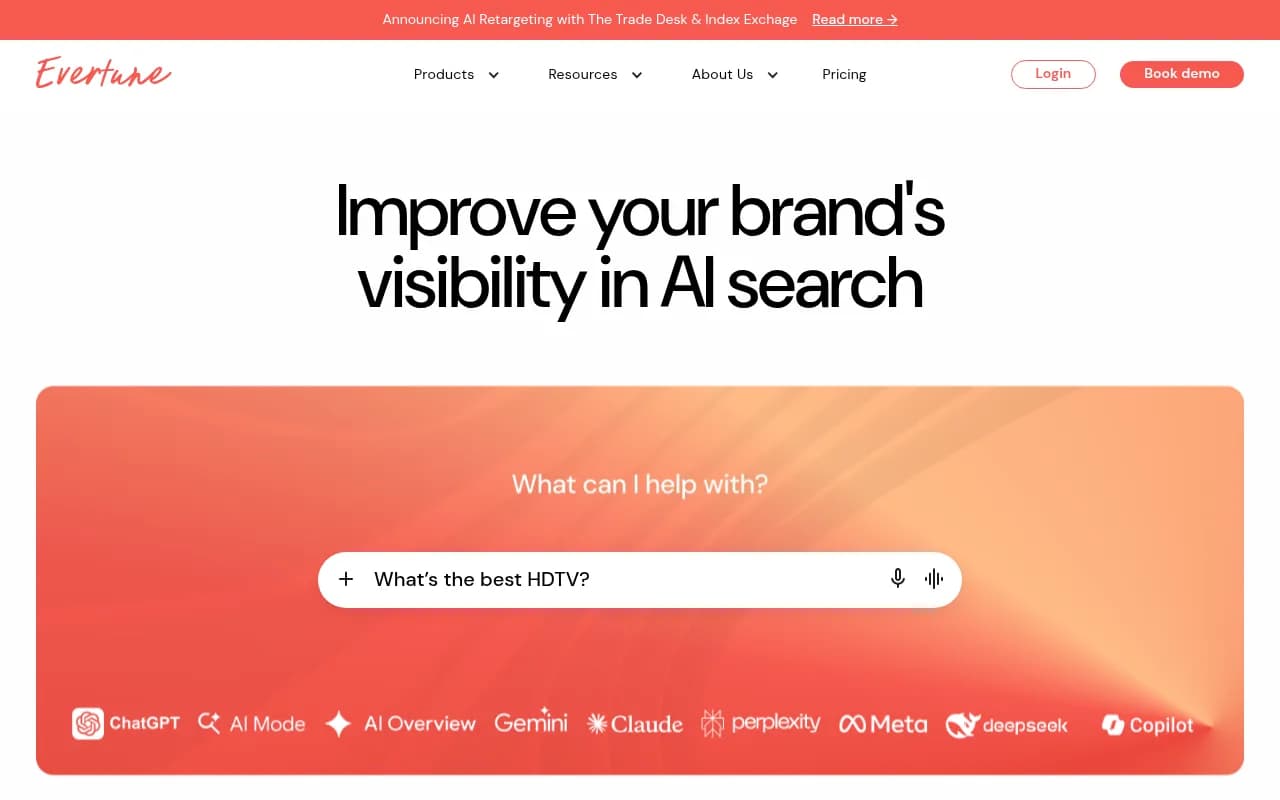
Evertune pitches itself as an enterprise GEO platform for Fortune 500 brands, leaning on research-style analysis of how models represent brands at scale. It is a different flavor from prompt-by-prompt trackers, closer to brand-perception measurement.
That suits a CMO or insights team presenting to a board. It suits an SEO team that needs to ship content on Tuesday less well. Pricing is sales-led.
Best for: large brands that treat AI visibility as a brand measurement problem.
5. AthenaHQ
AthenaHQ gets named alongside Profound in most enterprise shortlists. It focuses on tracking plus recommendations for what to change, which narrows the gap between insight and action a little.

It is a monitoring-first tool without crawler logs or CMS publishing in the stack we compared. Good for teams that want guidance but have their own content operation. See Promptwatch vs AthenaHQ.
Best for: mid-size teams that want recommendations without a full execution platform.
6. LLM Pulse
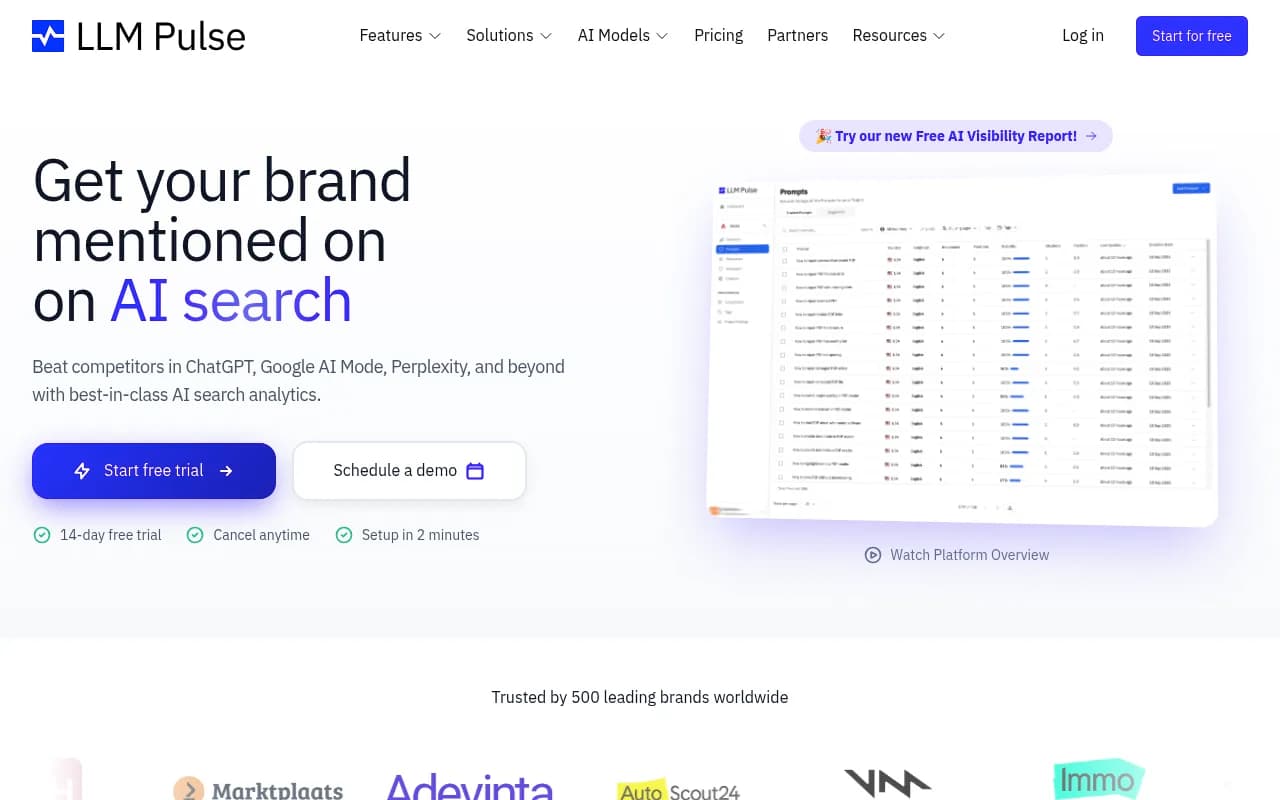
LLM Pulse's pitch is enterprise-grade tracking without enterprise-only pricing, and it publishes a Brandlight cost comparison and migration guide. That makes it easy to evaluate as a swap.
Expect a tracker, not a content engine. If Brandlight's price is the main complaint and your team already has a content workflow, it is worth a trial. Remember the source of the claim: LLM Pulse wrote the comparison ranking itself first. Head-to-head: Promptwatch vs LLM Pulse.
Best for: price-sensitive teams replacing Brandlight with comparable monitoring.
7. BrightEdge
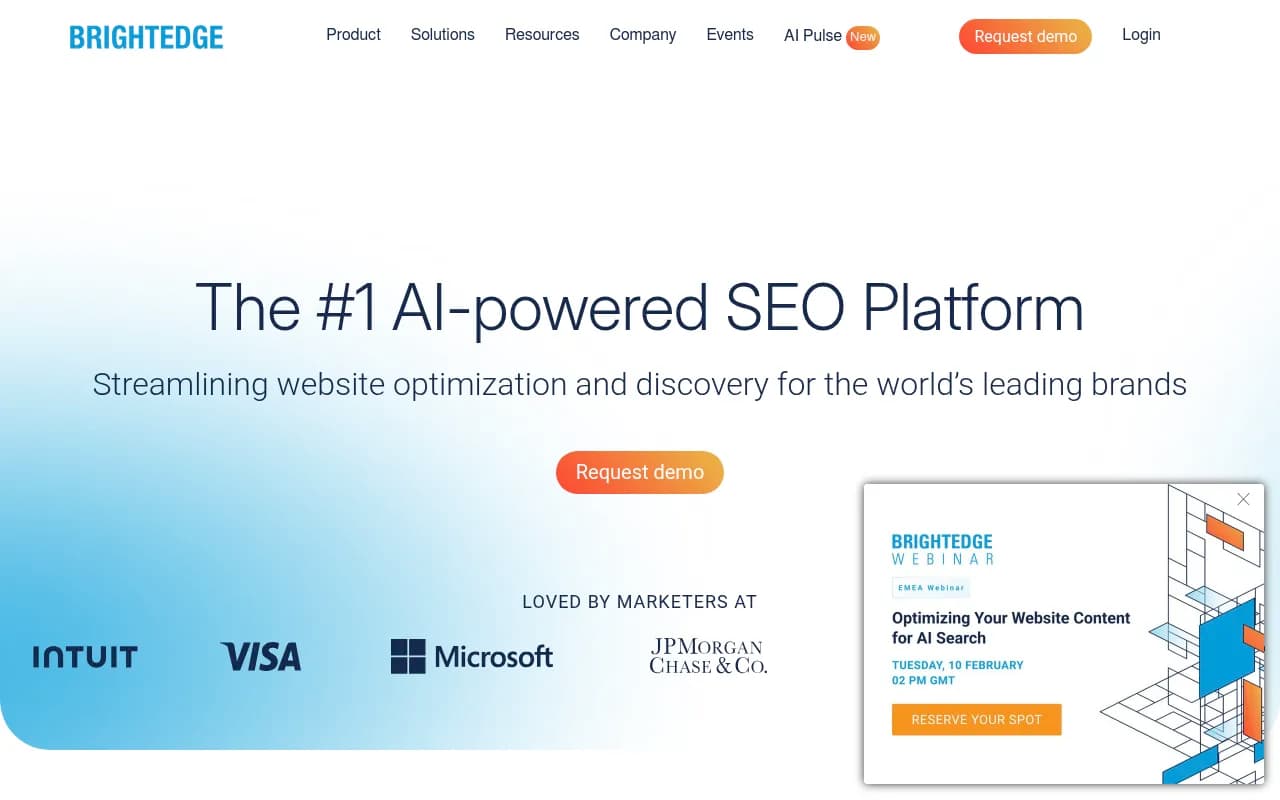
BrightEdge is the pick if you already live in an enterprise SEO suite and want AI visibility inside it rather than another login.
Suites bolt AI tracking onto a product built for classic SEO, so expect less AI-specific depth, such as crawler logs or citation-type analysis. In exchange you get one vendor, one contract and existing SEO reporting.
Best for: enterprises with an established BrightEdge relationship.
8. Semrush AI Toolkit
Semrush's AI Toolkit is an add-on to a suite many teams already pay for. Mentionova lists it at $99/month as an add-on with three engines.
It answers 'are we mentioned at all' cheaply. It does not replace a dedicated platform for a team making budget decisions on AI search. Ahrefs Brand Radar sits in the same bucket, around $129/month bundled by the same source, for existing Ahrefs users.

Best for: teams that need a basic read without a new vendor.
Which one should you pick
A simple decision path:
- You want to fix visibility, not just watch it: Promptwatch.
- You need the biggest-name monitoring vendor for a regulated industry: Profound, then Scrunch.
- You run brand perception research at Fortune 500 scale: Evertune.
- Price is the problem and you have content capacity: LLM Pulse or AthenaHQ.
- You are locked into an SEO suite: BrightEdge or Semrush.
If you are staying on Brandlight, that is a reasonable outcome too. Compliance, audit trails and multi-brand narrative analytics are real advantages when legal review sits in your workflow.
Running a fair trial
Trials go wrong when vendors choose the prompts. Do this instead:
- Build 30 to 50 prompts yourself: branded, competitor comparison and category questions, in the markets you care about.
- Run the same set in two or three finalists for at least two weeks.
- Check whether the tool captured real-interface answers and which sources it recorded.
- Ask each vendor to take one content gap from insight to published page and show you how they would verify it worked.
- Review security documentation with procurement before the pilot ends, not after.
For more tools in this category, browse the GEO software directory, or the AI rank tracking tools directory for lighter-weight trackers.
Bottom line
Most Brandlight alternatives are monitoring dashboards at different price points. That is fine if your content team already knows what to do. If the real bottleneck is turning visibility data into published, measured pages, pick the platform that closes that loop, run the trial on your own prompts, and verify every price on the vendor's own site.