Key takeaways
- Citation rate is the new click-through rate. If AI models aren't citing your brand, you're invisible to a fast-growing share of search traffic.
- Most GEO tools are monitoring-only dashboards. They show you where you're missing — but leave you to figure out what to do about it.
- The platforms that actually move your citation rate combine tracking with content gap analysis, content generation, and crawler log data.
- Domain authority still matters: sites with 32,000+ referring domains are roughly 3.5x more likely to be cited by ChatGPT than lower-authority sites, according to SE Ranking research.
- The best tool for most teams in 2026 is one that closes the loop from "you're not being cited here" to "here's the content that will fix it."
Why ChatGPT citation rate is the metric that matters now
Gartner predicted a 25% drop in traditional search volume by 2026. That number gets quoted everywhere, but the more useful framing is this: 75% of search volume still exists, and a growing slice of the remainder has moved to AI-generated answers where there are no blue links, just citations.
When someone asks ChatGPT "what's the best project management tool for remote teams?" or "which CRM is best for B2B SaaS?", the model synthesizes an answer from a small pool of trusted sources. If your brand isn't in that pool, you don't exist in that answer. No impression, no click, no conversion.
The metric that captures this is citation rate: how often your brand or your pages appear as a cited source inside AI-generated answers. It's different from rank position. You can rank #1 on Google and still have zero citations in ChatGPT.
This is why a whole category of GEO (Generative Engine Optimization) tools has emerged. But not all of them are worth your time or money.
The two types of GEO tools (and why the distinction matters)
Before comparing specific platforms, it's worth understanding the split in this market.
Monitoring-only tools track your brand's presence across AI models. They show you a visibility score, a share-of-voice chart, and which prompts your competitors appear in that you don't. That's genuinely useful data. But it stops there. You leave the dashboard knowing you have a problem and still not knowing how to fix it.
Optimization platforms go further. They take the gap data and turn it into action: content briefs grounded in real prompt data, articles engineered to answer the specific questions AI models are already asking, and crawler logs that show whether AI agents are actually reading your pages. The feedback loop closes.
Most of the market is still in the first camp. A handful of platforms have built toward the second.
What actually moves your citation rate
Before diving into tools, it's worth knowing what the data says about citation signals in 2026.
Domain authority is a real factor. SE Ranking's analysis found that sites with over 32,000 referring domains are roughly 3.5x more likely to be cited by ChatGPT. This isn't surprising — AI models are trained to be risk-averse, and high-authority domains are a proxy for trustworthiness.
But authority alone doesn't explain everything. Content structure matters too. AI models favor pages that directly answer questions in clear, machine-readable formats. Long-form content that buries the answer in paragraphs of context tends to get skipped. FAQ sections, structured definitions, and direct answer formats get cited more.
Third-party mentions also carry weight. Reddit threads, YouTube videos, listicles, and review sites that mention your brand all feed into how AI models perceive your authority on a topic. This is why tracking offsite citations — not just your own pages — is increasingly important.
The best GEO tools for ChatGPT visibility in 2026
Promptwatch — best for teams that want to act, not just observe
Promptwatch is the platform that most directly addresses the monitoring-vs-optimization gap. It tracks citations across 10 AI models (ChatGPT, Perplexity, Google AI Overviews, Google AI Mode, Claude, Gemini, Meta/Llama, DeepSeek, Grok, Mistral, Copilot) and then helps you do something about what you find.
The Answer Gap Analysis shows exactly which prompts competitors are appearing in that you're not — and what content your site is missing to compete. Content Agents then generate articles, listicles, and briefs grounded in real prompt data, citation volumes, and competitor analysis. It's not generic AI content; it's content built around the specific gaps AI models are exposing.
The crawler log feature is worth calling out separately. Most GEO tools have no idea whether GPTBot, ClaudeBot, or PerplexityBot has actually visited your pages. Promptwatch shows you real-time logs of AI crawlers hitting your site — which pages they read, errors they hit, how often they return, and when a page moves from crawled to cited. That's data most competitors simply don't have.
Pricing starts at $99/month for the Essential plan (1 site, 50 prompts, 5 articles), with Professional at $249/month and Business at $579/month. Free trial available.

Otterly.AI — solid monitoring for smaller teams
Otterly.AI covers the core monitoring use case well. You can track brand mentions across ChatGPT, Perplexity, and Google AI Overviews, see share-of-voice trends, and monitor competitor visibility. The interface is clean and the setup is fast.
Where it falls short is the same place most monitoring tools do: it shows you the gap but doesn't help you close it. No content generation, no crawler logs, no prompt volume data. For teams that just need visibility tracking and already have a content team to act on the data, it's a reasonable option.
Otterly.AI

Profound — enterprise-grade monitoring with depth
Profound tracks brand mentions across 9+ AI search engines and goes deeper on the monitoring side than most tools. It's positioned at enterprise teams and the pricing reflects that.
The platform is strong on share-of-voice analysis and competitive benchmarking. Where it's weaker is on the action side — there's no content generation, and the content gap analysis is less developed than what you'd get from a full optimization platform. For large teams that need robust data and have separate content resources, it's worth evaluating.
Profound

Peec AI — lightweight and affordable
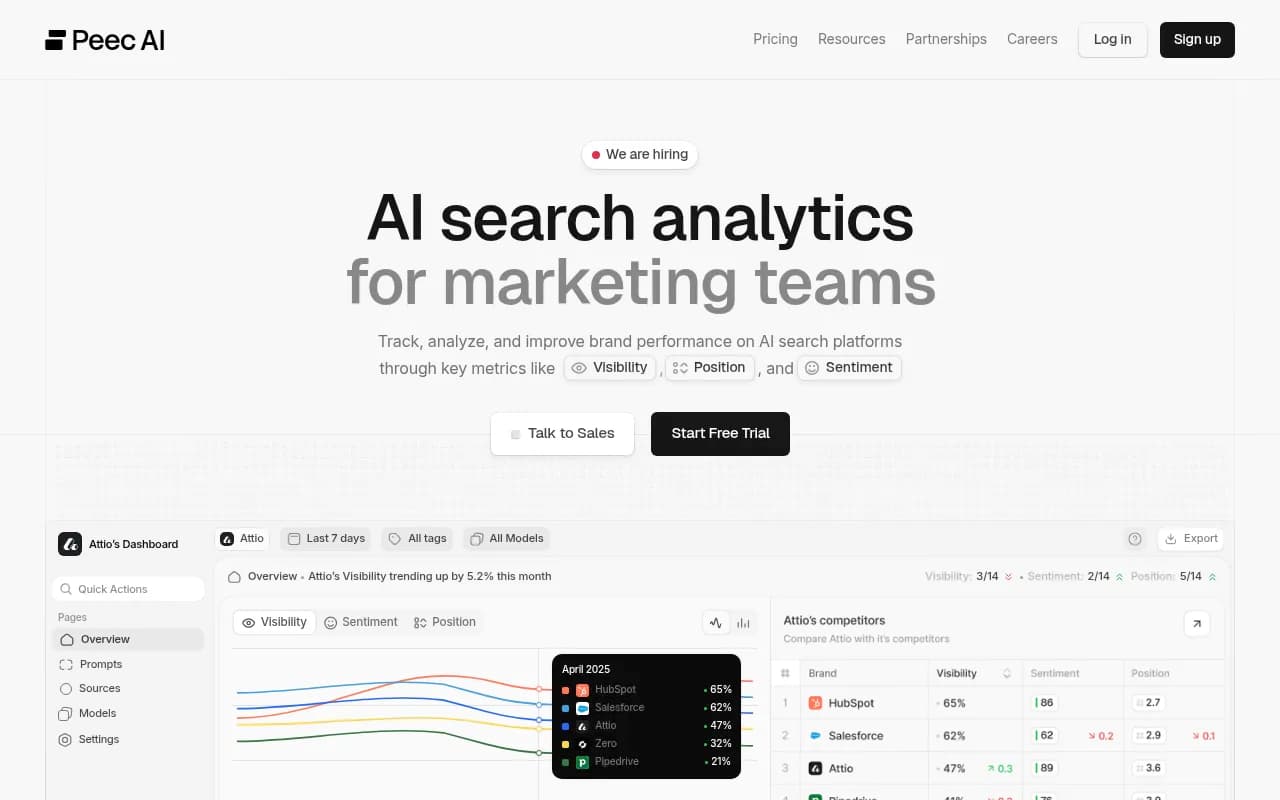
Peec AI is a straightforward citation tracker. It monitors your brand across the major AI models, shows you which prompts you appear in, and tracks changes over time. The pricing is accessible, which makes it popular with smaller marketing teams and solo practitioners.
The trade-off is depth. There's no crawler data, no content generation, and the prompt intelligence is limited. It's a good starting point if you're just getting into GEO tracking, but you'll likely outgrow it once you want to start optimizing rather than just observing.
LLM Pulse — strong for agencies
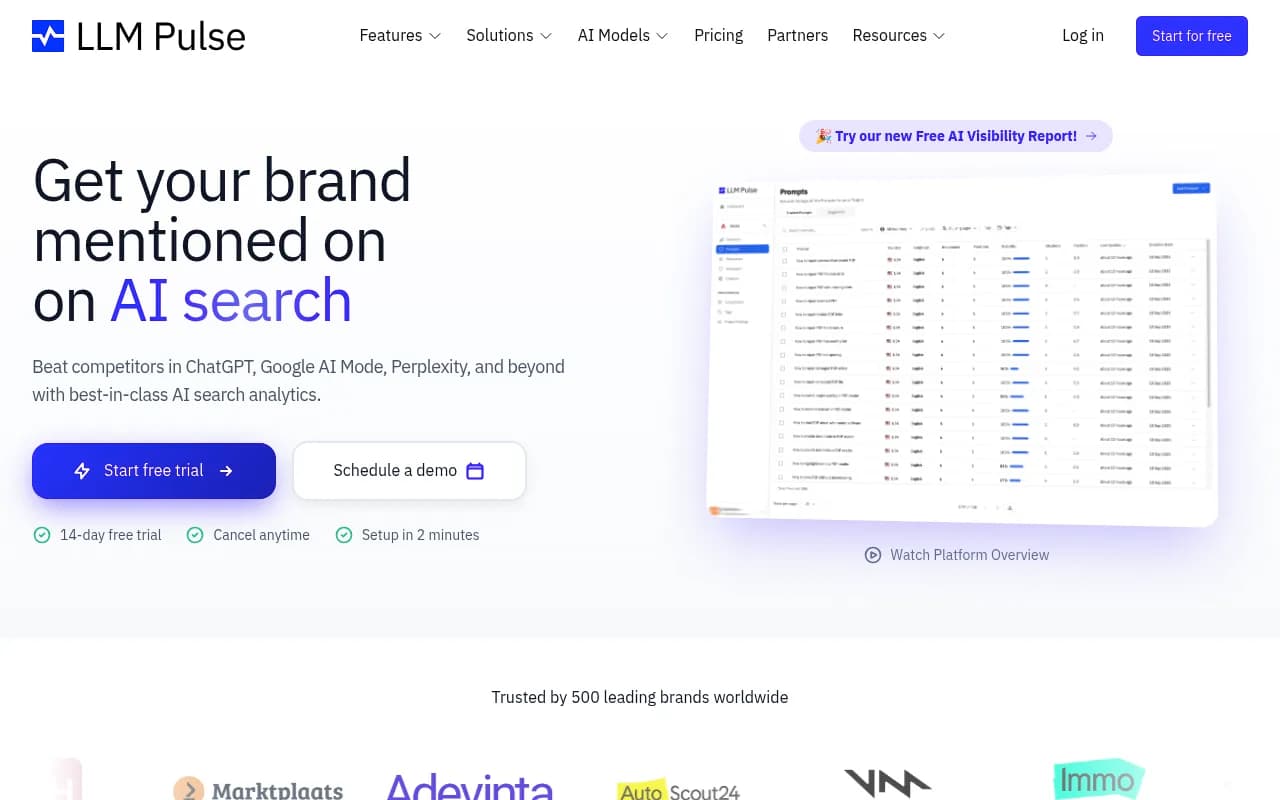
LLM Pulse covers citation attribution across multiple models and has built out agency-specific features including white-label reporting. The pricing starts at €49/month, which is competitive for what it offers.
It's a monitoring-first tool, but the citation attribution is detailed enough to be genuinely useful for client reporting. Agencies that need to show clients their AI visibility trends without needing to build content pipelines inside the tool will find it fits well.
AthenaHQ — monitoring with good competitive data
AthenaHQ is monitoring-focused but does competitive benchmarking well. You can see how your brand stacks up against competitors across different AI models and prompt categories. The heatmap-style visualizations make it easy to spot where you're losing ground.
Like most monitoring tools, it doesn't help you fix what it finds. But the competitive data is solid, and for teams that want to understand the landscape before building a content strategy, it's a useful research tool.

Scrunch AI — content-aware tracking
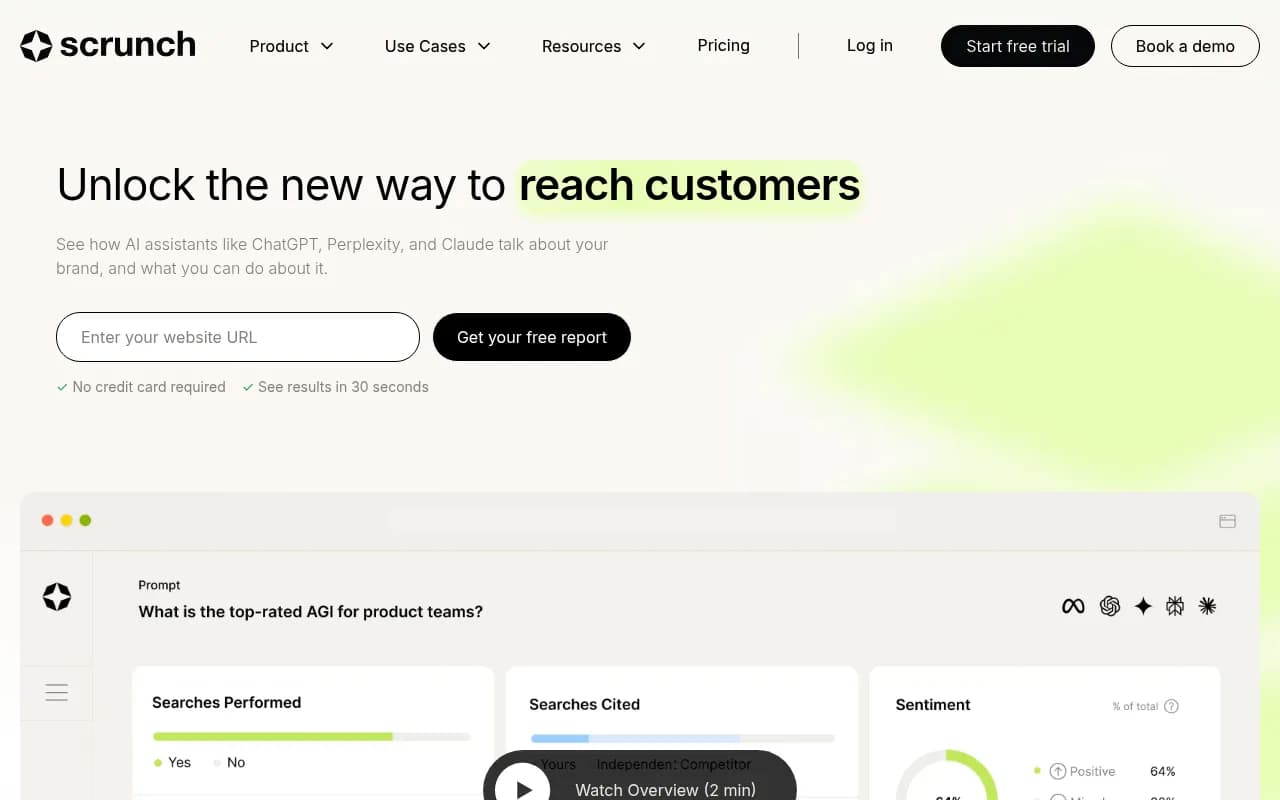
Scrunch AI sits somewhere between pure monitoring and optimization. It tracks citations and also analyzes the content of AI responses to understand why certain sources get cited. That content-level analysis gives you more actionable signal than a raw citation count.
It's not a full content generation platform, but the insights it surfaces about what makes cited content different from non-cited content are genuinely useful for briefing your content team.
SE Ranking — traditional SEO with AI visibility added
SE Ranking has been building out AI visibility features on top of its traditional SEO platform. If you're already using SE Ranking for rank tracking and site audits, the AI visibility layer is a natural addition rather than a separate tool to manage.
The depth of the AI-specific features doesn't match dedicated GEO platforms, but for teams that want one tool for both traditional SEO and AI visibility monitoring, it's a practical choice.
Semrush — broad coverage, limited AI depth
Semrush has added AI visibility tracking, but the implementation uses fixed prompts rather than dynamic prompt monitoring. That means you're tracking a predefined set of queries rather than the full range of prompts your audience actually uses.
For teams already deep in the Semrush ecosystem, the AI features are worth using. For teams whose primary goal is ChatGPT citation optimization, a dedicated GEO platform will give you more signal.
Ahrefs Brand Radar — useful but constrained
Ahrefs Brand Radar tracks brand visibility in AI search, but like Semrush it uses fixed prompts and lacks AI traffic attribution. It's a reasonable addition to an existing Ahrefs workflow but isn't built for teams whose primary focus is AI visibility optimization.
Head-to-head comparison
| Tool | Models tracked | Content generation | Crawler logs | Prompt volume data | Best for |
|---|---|---|---|---|---|
| Promptwatch | 10 | Yes (Content Agents) | Yes | Yes | Full optimization loop |
| Profound | 9+ | No | No | Limited | Enterprise monitoring |
| Otterly.AI | 3 | No | No | No | Small team monitoring |
| Peec AI | Multiple | No | No | No | Budget monitoring |
| LLM Pulse | 5 | No | No | No | Agency reporting |
| AthenaHQ | Multiple | No | No | No | Competitive benchmarking |
| Scrunch AI | Multiple | No | No | No | Content-aware tracking |
| SE Ranking | Multiple | No | No | No | SEO + AI combo |
| Semrush | Multiple | No | No | No | Existing Semrush users |
| Ahrefs Brand Radar | Multiple | No | No | No | Existing Ahrefs users |
What to look for when evaluating a GEO tool
Real prompt data vs. fixed prompts
Some platforms let you define custom prompts that match how your actual customers search. Others use a fixed library of pre-built prompts. The difference matters because your customers' prompts are specific to your category, your competitors, and your positioning. Fixed prompts give you a generic view of AI visibility; custom prompts give you the view that's actually relevant to your business.
Model coverage
ChatGPT gets the most attention, but Perplexity, Google AI Overviews, Google AI Mode, and Gemini collectively represent a significant share of AI-generated answers. A tool that only tracks one or two models gives you an incomplete picture. Look for platforms that cover at least 5-6 models, including Google's AI surfaces.
Crawler log access
This is the feature most teams don't know to ask for until they realize they need it. AI crawler logs tell you whether GPTBot, ClaudeBot, or PerplexityBot has actually visited your pages — and if not, why not. Without this data, you can't distinguish between "AI models have seen my content and chosen not to cite it" and "AI models have never crawled this page." Those are very different problems with very different solutions.
Content gap analysis
The most actionable output from any GEO tool is a list of specific prompts where competitors are visible and you're not, paired with an explanation of what content would close that gap. Not all tools offer this. The ones that do give you a direct line from data to action.
Traffic attribution
Citation rate is a leading indicator, but what you ultimately care about is whether AI visibility translates to traffic and revenue. Tools that connect citation data to actual site visits and conversions let you prioritize the prompts and content investments that matter most.
Common mistakes teams make with GEO tools
Tracking the wrong prompts. If you're monitoring generic industry prompts rather than the specific questions your buyers ask, your visibility data won't reflect your actual competitive position. Start by mapping the prompts your customers use at each stage of the buying journey.
Ignoring offsite citations. Your own pages are only part of the picture. Reddit threads, YouTube videos, and third-party review sites that mention your brand all influence how AI models perceive your authority. A GEO tool that only tracks your own domain is missing a significant part of the signal.
Treating monitoring as optimization. Knowing you're not being cited is the starting point, not the finish line. The teams seeing real citation rate improvements are the ones using that data to brief and publish content that directly addresses the gaps.
Not checking crawler access. If AI crawlers can't access your pages — due to robots.txt rules, JavaScript rendering issues, or slow load times — no amount of content optimization will help. Verify that the major AI crawlers (GPTBot, ClaudeBot, PerplexityBot) can actually reach your important pages.
A practical approach to improving your ChatGPT citation rate
Start by identifying the 20-30 prompts most relevant to your business. These should reflect how your buyers actually phrase questions, not just how you'd describe your product.
Run those prompts across ChatGPT, Perplexity, and Google AI Mode. Note which competitors appear and what sources they're citing. This gives you a baseline and a list of content gaps.
Audit your existing content against those prompts. For each gap, ask whether you have a page that directly answers the question. If not, that's a content brief.
Check your crawler logs. Confirm that GPTBot and PerplexityBot are crawling your key pages. If they're not, fix the technical issues first — content improvements won't help if the crawlers can't see them.
Publish content that directly answers the gap prompts. Structured formats (FAQ sections, direct definitions, numbered lists) tend to get cited more than dense prose. Keep the answer visible near the top of the page.
Track your citation rate over 4-8 weeks. AI models re-crawl frequently, and you should start seeing citation improvements within a few weeks of publishing well-structured content that addresses a real gap.
The bottom line
The GEO tool market in 2026 has a clear divide: platforms that show you data and platforms that help you act on it. Most tools sit in the first camp. They're useful for understanding your competitive position, but they don't move your citation rate on their own.
If you're serious about improving how often ChatGPT and other AI models cite your brand, you need a platform that closes the loop from gap identification to content creation to citation tracking. That's a short list, and Promptwatch is at the top of it. For teams with smaller budgets or simpler needs, Otterly.AI and Peec AI are reasonable starting points — just go in knowing you'll need a separate content workflow to act on what they surface.
The teams winning in AI search right now aren't the ones with the best dashboards. They're the ones publishing content that directly answers the prompts their buyers are using, in formats that AI models can read and cite. The right tool makes that process systematic rather than guesswork.